



Hello brothers and sisters,
This is the last one.
Four installments ago, Lawrence Campbell of Deeper Still and I opened Genesis 14 together. Today we close it.
If you are just arriving (or need a refresher), here is the road behind us.
In part one, four kings out of the east struck the Rephaim at Ashteroth-karnaim, sacked Sodom, and carried off Lot. Abram went after an empire with three hundred and eighteen men of his own household. And won.
In part two, over on Deeper Still, we asked who the Rephaim actually were, and I chased one word through the Greek Bible. The translators could not agree on it. Giants in one book. Titans in another. Earth-born. Healers. And in a later Greek translation, god-fighters. Sometimes they gave up and simply wrote the sound down.
In part three, we laid out every serious answer to who Melchizedek was. We found that the oldest Jewish answer, that he was Shem, only works in Hebrew arithmetic. We watched Psalm 110 crown a king at dawn in the Hebrew and beget a Son before the morning star in the Greek. And we watched Hebrews build an entire priesthood out of what Genesis refused to say.
In part four, back on Deeper Still, we followed the giants forward. Og and his iron bed. Goliath at four cubits in the oldest scroll and six in the Hebrew, and both numbers telling the truth about something. A verse that says someone else killed Goliath. And four giants falling at Gath “by the hand of David and by the hand of his servants,” though David killed none of them.
Now the two threads meet.
And I want to tell you up front where this ends, because it is not where I expected when we started. A series that opened on a battlefield ends at a graveside. In Isaiah 26. With a promise the giants never got.
Now let me hand you off to Lawrence so we can dig in.
If you’re reading this in email, be aware that the text is likely to cut off without warning. For a smoother reading experience and all the features Substack has to offer (including audio voiceovers of my posts), you can go HERE or download the app.
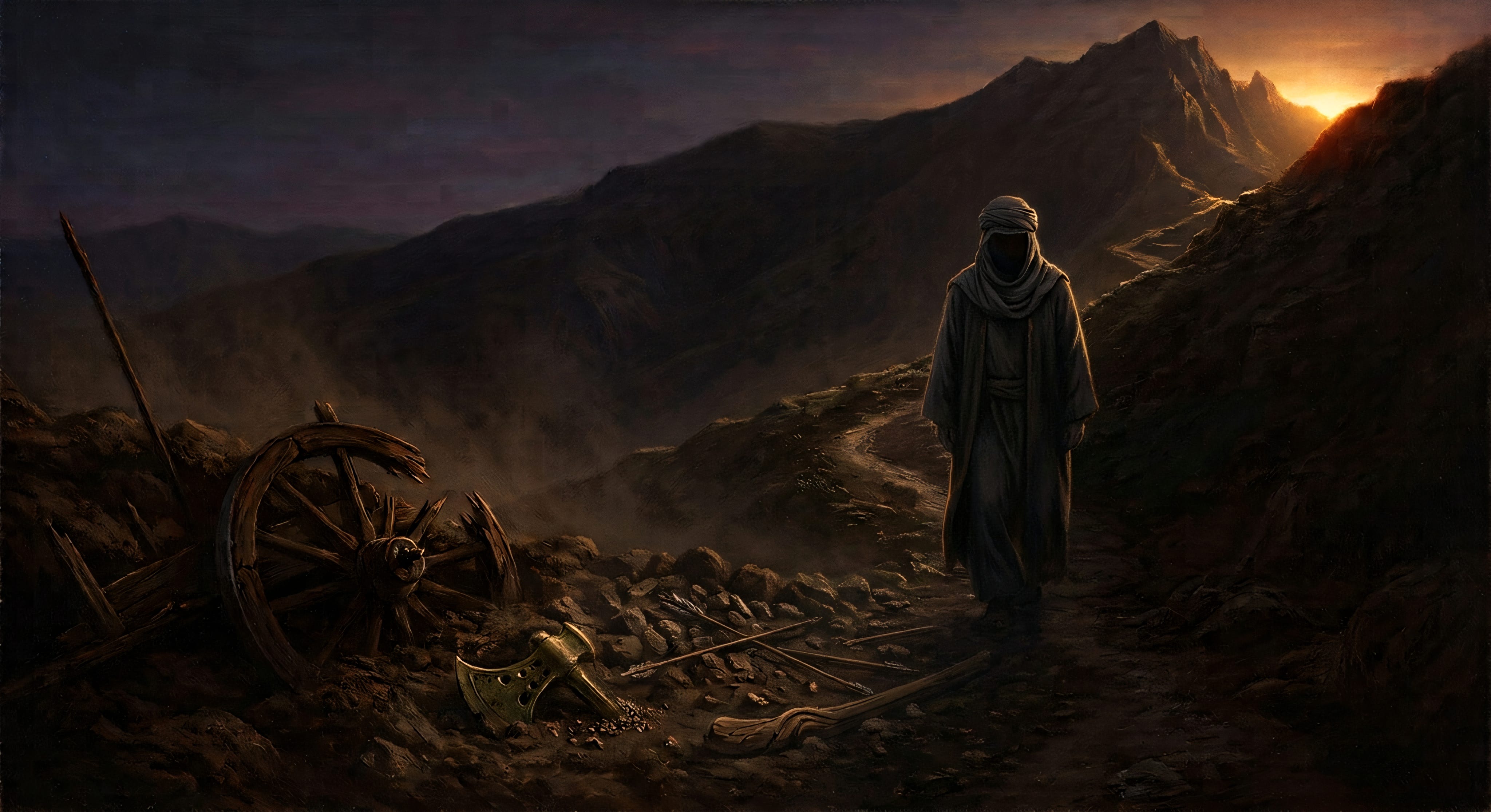
At the start of this series, Genesis 14 put two things on the same page, and almost nobody noticed they were arguing with each other.
Why would a chapter about a regional war end with a stranger handing out bread? Why would the book that tracks every bloodline go silent on the one man who outranks the patriarch? And why did the writer of Hebrews, with the whole Law and the whole priesthood of Israel at his disposal, reach back past all of it for a king nobody could trace?
We have enough on the table now to answer. Four pieces of evidence, two writers, one chapter. Time to lay the verdict out.
Two Ledgers
Think of it as two ledgers.
The first ledger runs on stature and descent. It records who is big and whose son they are, and it treats those as the same fact. Chedorlaomer’s coalition sits at the top of it in Genesis 14, an empire projecting force fifteen hundred miles from home. Beneath them sit the clans the coalition bothered to defeat first, the Rephaim, the Zuzim, the Emim, because those were the peoples whose size and pedigree made them worth the detour.
Follow that ledger through the rest of the Bible and the entries get more specific, not less. Israel’s own spies measure an entire land by it: “we seemed to ourselves like grasshoppers, and so we seemed to them” (Numbers 13:33). Og gets measured in cubits and his bed gets put on display. Goliath gets measured too, and whether you follow the Hebrew, the Greek, or the scroll from Qumran, the text keeps doing arithmetic on him. The last four at Gath get counted down to their fingers and toes. And every one of them comes with a pedigree: sons of Anak, born to the Rapha, traced back toward the Nephilim. These are the most thoroughly documented people in the Bible. Their claim to power is physical and genealogical, and they can point to both.
The second ledger has one entry. A king of Salem with no measurement, no father, no mother, no tribe. He carries no weapon anywhere in the chapter. He brings bread and wine, speaks a blessing, and receives a tenth. And the man who just defeated the first ledger’s best bows to him.
That is the contest Genesis 14 sets up. Power measured by stature and descent on one side. Authority that arrives with no pedigree, and blesses, on the other. The chapter doesn’t announce a winner. It lets Abram’s tithe do that quietly and then moves on, leaving the rest of the canon to answer.
How the Canon Answers
It takes about a thousand years for anyone to say it out loud, and when someone does, it’s a king writing a psalm.
David spent his whole life inside the first ledger. He fought men measured in cubits, and his own army once froze for forty days in front of one. Yet when he writes of a coming figure seated at the right hand of God, he reaches past every tribe and throne in Israel’s history and lands on Genesis 14: “The LORD has sworn and will not change his mind, ‘You are a priest forever after the order of Melchizedek’” (Psalm 110:4).
Look at the grammar of that verse. A priesthood established by an oath. Nobody is born into it. Nobody inherits it, seizes it, or grows into it. God swears it into existence.
Hebrews 7 makes the argument explicit, and it starts by conceding the first ledger’s objection. Jesus descended from Judah, a tribe about which Moses said nothing concerning priests. By the old rules, He has no claim at all. Then the writer turns the whole thing around. The priest-king isn’t disqualified by the old rules because He was never appointed under them. He became a priest “not on the basis of a legal requirement concerning bodily descent, but by the power of an indestructible life” (Hebrews 7:16).
Read that phrase against everything we’ve covered. Bodily descent is the first ledger’s entire currency. It is what the Levitical line ran on, and it is what the giant clans ran on. Hebrews says the new priest operates on a different currency altogether.
It also hands us the reason for Genesis 14’s silence. Melchizedek is “without father or mother or genealogy, and has neither beginning of days nor end of life, but resembling the Son of God he continues a priest forever” (Hebrews 7:3). Resembling. My read on that hasn’t moved since part three. The blank where the genealogy should be works like a portrait left unfinished on purpose, a figure sketched so that it points past itself to a priesthood no genealogy could contain. And the greater blesses the lesser. Abram pays the tithe with Levi still unborn inside him, which means the entire Levitical order, the best the first ledger ever produced on the priestly side, bowed in advance.
[KEVIN]
Both Ledgers
Lawrence is right about the currency. But there is one thing about those two ledgers I can’t stop looking at.
Christ is written in both.
The New Testament opens the way Genesis does. With a genealogy. Matthew traces Jesus through Judah and David, king by descent, every link accounted for. That is the first ledger, and He has a full entry in it. Then Hebrews makes Him priest with no descent at all, after an order that never ran through blood. That is the second.
So the thing the giants were built on, a royal line, He has. And for the office that actually saves you, He does not need it.
Now look closely at His entry in the first ledger. Because it is going to take us somewhere hard.
The Ban
This is the most difficult question in the whole series, and I am not going to walk around it.
When Israel entered Canaan, the commands in Deuteronomy 7 and 20 placed entire populations under the חֵרֶם, ḥerem, the ban. Devoted to destruction. Over the years I’ve heard many variations on the question of how a good God commands that.
Early in my walk with Jesus, it was some version of “it isn’t our place to assess God.”
I don’t think that holds anymore. Abraham assessed Him. In Genesis 18, with Sodom on the line, he stood before the Lord and asked, “Shall not the Judge of all the earth do what is just?” And God did not rebuke the question. He answered it.
So let’s ask it. I think there are two reasons on the table, and I think both are real.
The reason the text gives. Deuteronomy says it plainly, twice. The nations of Canaan would turn Israel’s children away to serve other gods (Deuteronomy 7:4). They would teach Israel the abhorrent things they did for their gods (Deuteronomy 20:18). And in case Israel was tempted to read the conquest as a reward, Deuteronomy 9:4–5 forbids it: not because of your righteousness, but because of the wickedness of these nations.
Wickedness the Lord waited on for a very long time.
One chapter after Genesis 14, God tells Abram that his descendants will not enter the land for four generations, because the iniquity of the Amorites is not yet complete (Genesis 15:16). Four hundred years of patience. And remember who rode with Abram against the four kings. Mamre, Eshcol, and Aner. Amorites. His allies (Genesis 14:13).
God was not impatient with the Amorites. He gave them centuries.
And the ban had a door in it.
Rahab was a Canaanite living inside Jericho, the very first city Israel put under the ban. She hid the spies. She confessed that their God is God in heaven above and on earth below (Joshua 2:11). And when Jericho fell, she and her household were spared (Joshua 6:25).
Now go back to that genealogy in Matthew 1. Verse 5. Salmon was the father of Boaz by Rahab.
A Canaanite woman from the first city under the ban is an ancestor of Jesus Christ. So is Ruth, a Moabite, in the same verse. That is Christ’s entry in the first ledger.
So whatever the ban was, it was not about Canaanite blood. The line God guarded through all of Israel’s history was never ethnically pure, and was never meant to be. When the idolatry ended, the door opened. Rahab walked through it straight into the Messiah’s family tree.
The reason underneath, for one group in particular. There is one population the conquest narratives single out by name. Again and again.
“Who can stand before the Anakim?” was a proverb in Israel (Deuteronomy 9:2). The spies came home describing themselves as grasshoppers next to them (Numbers 13:33). And when Joshua 11 summarizes the conquest, it stops to say that Joshua cut off the Anakim from the hill country and devoted them and their towns to destruction, until none were left in the land except in Gaza, Gath, and Ashdod (Joshua 11:21–22).
Gath. You know who comes from Gath.
Here is what I think, and I want to be clear that my reading, my interpretation, not what the text says.
If the giant clans were what this series has argued, the product of a renewed rebellion by the sons of God aimed squarely at the promise of Genesis 3:15, then their destruction carries a dimension the ordinary ban does not. Not ancestry. Rahab settles that. Something else. A lineage that should not have existed, standing in the land through which the Seed of the woman would come.
Deuteronomy gives idolatry as the reason, and I believe Deuteronomy. What I’m suggesting is that for the giant clans specifically, there may be a second reason the text only lets us glimpse, in the spies’ terror, in the proverb, in the way the Anakim keep being named when everyone else is summarized.
So I hold both. The stated reason explains the ban. The reason underneath may explain why the giants were its sharpest edge.
And Abraham’s question gets its answer. Shall not the Judge of all the earth do what is just? He waited four hundred years. He left a door open, and a Canaanite woman walked through it into the line of the Messiah.
Whatever else the ban was, it was not impatience. And it was not hatred of a people.
What Became of Them
The giant clans fall, one after another, until the last four go down at Gath. And then they vanish from the story.
But Genesis 6 leaves a question hanging that Scripture never answers in so many words. What happens to beings who are neither angel nor human when their bodies die?
There is a book that answers it, and I need to be honest with you about how I hold it.
The first section of 1 Enoch is called the Book of the Watchers, chapters 1 through 36. It was compiled in the centuries before Christ, and Aramaic copies of it turned up among the Dead Sea Scrolls. Early Christians read it and argued for it; Tertullian defended it by name. The Ethiopian Orthodox Church still counts it as Scripture.
And the New Testament quotes it. Jude 14–15 cites 1 Enoch 1:9 and says Enoch, “the seventh from Adam,” prophesied those words. Jude affirms the prophecy. That does not require every line of the book as we have it to have come from Enoch’s own hand, and I don’t claim it did.
I treat the portion I lean on today as authoritative.
Jude quotes it, and Jude 6 and 2 Peter 2:4 both assume the story it tells: angels who left their proper dwelling and are now held in chains.
The parts I am leaning on contradict nothing in Scripture, and nothing in known history.
It explains what the New Testament shows us about demons, which I’ll get to in a moment.
And it turns Genesis 6:1–4, four of the strangest verses in the Bible, from a puzzle into an account.
But I do not hold every line of the book, and I want you to see me make that distinction rather than hide it. In 1 Enoch 7:2, the Ethiopic text that R. H. Charles translated gives the giants a height of three thousand ells. Roughly forty-five hundred feet.
Science tells us that no living body could be that size, and the figure is wildly out of scale with every giant Scripture actually measures. Og’s bed: nine cubits. Goliath: four, or six.
And the number will not even hold still in the manuscripts. The Greek gives three thousand cubits. Other Ethiopic manuscripts give three hundred. The oldest copy we have, the Aramaic fragment from Qumran, is damaged at exactly that spot.
George Nickelsburg, whose commentary is the standard scholarly treatment of 1 Enoch, judges the height to be “probably a secondary gloss.” A later addition, in other words, not part of the text as first written. And the exaggeration seems to have run in the tradition itself. Nickelsburg points out that the Damascus Document, another text found among the Dead Sea Scrolls, describes the Watchers’ sons as tall as cedars, with bodies like mountains.
So I set the figure aside, and it costs the rest of the book nothing.
Now the part that matters.
In 1 Enoch 15, God explains to Enoch what the giants are. Born of spirit and flesh, of the Watchers and the daughters of men. And when their bodies die, what comes out of them are “evil spirits upon the earth.” Their home is not heaven, where the spirits of heaven dwell. Their home is the earth. They afflict and oppress and attack. They rise up against human beings, because that is where they came from. And then the detail that stops me every time I read it: they take no food, and yet they hunger and thirst (1 Enoch 15:8–11).
Spirits that hunger. With nothing to feed.
Now open the Gospels.
When an unclean spirit leaves a person, Jesus says, it wanders through waterless places looking for rest, and finds none. So it says, “I will return to my house” (Matthew 12:43–44).
My house.
It is talking about a human body.
And in Luke 8, the Legion begs Jesus not to send them into the abyss. Then they beg to be sent into a herd of pigs (Luke 8:31–32).
Read that slowly. Spirits that would rather inhabit swine than be without a body at all.
Meanwhile the angels who sinned are not roaming. Peter says they are in chains, held for judgment (2 Peter 2:4). Jude says the same (Jude 6). So who is wandering the waterless places, desperate for a house?
Enoch’s answer fits everything the Gospels show us. They belong to neither realm. Born of heaven and earth, at home in neither. Their bodies died, and no body is coming back to them. Ever.
Hold that. We are going to need it at the end.
Two Tiers of Gods
There is one more piece, and it keeps two things distinct that are easy to blur.
If you have followed my Divine Council series, you know I read Deuteronomy 32:8 as God dividing the nations among the members of His heavenly council. Brenton’s Greek puts it plainly: the Most High set the bounds of the nations “according to the number of the angels of God.” Those are the governors. Fallen angels, powerful, territorial.
But who received the sacrifices?
Nine verses later, the same song answers.
Brenton again:
They sacrificed to devils, and not to God; to gods whom they knew not.
The Hebrew word is שֵׁדִים, shedim. Demons.
Then Psalm 96:5, and here the two traditions do something I love. The Hebrew says all the gods of the peoples are אֱלִילִים, elilim. Worthless things. Nothings. The Greek of the same verse (Psalm 95:5 in its numbering) says something else entirely.
Brenton:
For all the gods of the heathen are devils: but the Lord made the heavens.
δαιμόνια, daimonia. Demons.
So which is it? Nothings, or demons?
The answer is both.
The idol is nothing. Wood and stone and metal. And behind it, receiving what is poured out before it, is something. The Hebrew tells you what the idol is. The Greek tells you who is at the altar. Paul holds both in a single breath in 1 Corinthians 10, when he says an idol is nothing and then warns that what the pagans sacrifice, they sacrifice to demons.
So there are two tiers. The elohim govern the nations. The demons take the offerings.
And remember Ugarit from part two. The Rapiuma, the Ugaritic cousins of the Rephaim, were feasted at El’s banquet in the poems and invoked by name in a royal funerary liturgy for the honored dead. That is the second tier at work. The dead being fed.
The Bible’s answer to all of it, as the Ugaritic specialist Theodore Lewis noticed, is to strip the Rephaim of every ounce of power the surrounding world gave them.
[LAWRENCE]
What the Giants Could Never Be
So what did the priest-king have that the giants could not? I count four things.
First, an appointment. The Nephilim story begins with taking. Genesis 6:2 says the sons of God “took as their wives any they chose.” That is the first ledger at its origin, something reaching down and seizing what it was never given. Everything the giant clans carried, their size, their bloodline, their claim, descended from a grab. The priesthood of Melchizedek and the priesthood of Christ after it are given. Sworn. One order starts in grasping and the other starts in an oath.
Second, a legitimate union of heaven and earth. The giants were a counterfeit of something God had planned all along, the two realms joined in one person. I said at the start of this series that I read the Nephilim as an assault on God’s plan for heaven and earth, and this is the other half of that sentence. When God joins the two, He does it by gift. “The Holy Spirit will come upon you, and the power of the Most High will overshadow you; therefore the child to be born will be called holy” (Luke 1:35). He is called the Son of God. A hybrid born of transgression and a Son born of promise are a similar idea traveling in two directions, and only one of them was ever going to hold.
Third, a life that doesn’t end. The first ledger has a problem it cannot solve, and the poetic books name it. The Rephaim who are measured in cubits in the narrative become, in Isaiah 14, shades who greet the newest arrival with a line that should end every argument about stature: “You too have become as weak as we! You have become like us!” (Isaiah 14:10). Size does not survive the grave. Og dies and the bed is what’s left. Goliath dies and the sword is what’s left. Hebrews points out that the Levitical priests had to be replaced one after another because death kept cutting their terms short, and then sets the contrast in a single line: “he holds his priesthood permanently, because he continues forever” (Hebrews 7:24). Every entry in the first ledger eventually reads the same way. Deceased.
Fourth, a victory without stature. Isaiah describes the Servant this way: “he had no form or majesty that we should look at him” (Isaiah 53:2). The first ledger would have had no interest in Him. Nothing to measure. Nothing to put on display. And that is the pattern the Bible has been running since 318 household men defeated a coalition. Abram wins with no standing army. David wins with a sling, and tells Goliath why before he throws it: “that all this assembly may know that the LORD saves not with sword and spear” (1 Samuel 17:47). The Bible refuses, every time, to let the contest be settled on the first ledger’s terms.
So when the priest-king finally wins the decisive battle, He wins it in the one way no giant could ever have conceived. Through death. “That through death he might destroy the one who has the power of death, that is, the devil” (Hebrews 2:14). Paul describes the same moment as a public humiliation of the powers behind the first ledger: “He disarmed the rulers and authorities and put them to open shame, by triumphing over them in him” (Colossians 2:15). The ones who measured everything by height got beaten by a man hanging at the height of a cross.
[KEVIN]
Isaiah 26: The Shades Will Not Rise
Lawrence took you to Isaiah 14. Sheol stirs. The dead kings of the nations rise from their thrones to meet the king of Babylon, and the welcome they give him is that he has become as weak as they are.
Twelve chapters later, Isaiah goes further.
Isaiah 24 through 27 is sometimes called the Isaiah Apocalypse or the “Little Apocalypse.” In chapter 26, the people of God are singing, and they say this:
“O Lord our God, other lords besides you have ruled over us, but we acknowledge your name alone. The dead do not live; shades do not rise.” (Isaiah 13-14, NRSV)
Other lords have ruled over us. They are dead. They will not live. And then the line: the רְפָאִים, rephaim, will not rise.
There is our word again.
Most commentators read those “other lords” as the tyrants who oppressed Israel, now dead and gone for good. That is a fair reading and I don’t dismiss it. But older commentators saw more. The nineteenth-century commentary of Jamieson, Fausset, and Brown reads those lords as earthly kings, and as idols too.
And this is where I land, and I want to label it clearly: this is my reading. My interpretation.
I think the Rephaim who will not rise are the giants’ spirits, the powers behind those other lords, the ones the nations fed. The text does not say when those lords ruled or who exactly they were, and it never names the giants. But nothing in it closes the door, and the word it chooses is the word this whole series has been chasing.
I am not offering that as proof of Enoch. If I read Enoch into Isaiah and then turn around and use Isaiah to prove Enoch, I have argued in a circle and you should catch me at it. What I am saying is that they fit. Enoch says the giants’ spirits have no future but judgment. Isaiah says the Rephaim will not rise.
Consistent. Not confirmation.
Now the Greek, because it heard this verse its own way.
Brenton:
“But the dead shall not see life, neither shall physicians by any means raise them up.”
ἰατροί, iatroi. Physicians. Healers. The same rendering we met back in part two, where the translators heard the Hebrew root for healing inside the word rephaim.
The healers cannot raise them.
Isaiah 26: Your Dead Shall Live
Three verses later the song turns into a birth scene. Like a woman in labor, Isaiah says, writhing and crying out. We were pregnant. We writhed. And we gave birth to wind. We accomplished no deliverance on the earth (26:17–18).
The people of God could not bring about their own salvation. All that labor, and nothing came out but air.
Then verse 19.
“Your dead shall live; their corpses shall rise. Those who dwell in the dust will awake and shout for joy! For your dew is a radiant dew, and the earth will give birth to those long dead.”
Your dead shall live. Their corpses shall rise. Dwellers in the dust, wake up and sing.
Every translation agrees on that much, Hebrew and Greek alike. God’s dead rise.
It is the last clause that splits the translators. It is only three words in Hebrew: the earth, the rephaim, and a form of נָפַל, naphal, “to fall,” that means cause to fall. And English Bibles have gone three different directions with it.
Most modern versions read it as birth. “The earth will give birth to the dead,” or, in the LEB, to “dead spirits.” The strongest argument for this reading is right next door. One verse earlier, in the middle of all that labor imagery, Isaiah uses the very same verb for being born. On this reading, the earth drops the dead into the world like a mother delivering a child, and the rephaim are the ones being raised.
The old RSV went another way: “on the land of the shades thou wilt let it fall.” God’s dew falls on the realm of the dead.
And the CEB reads it as judgment: “you will bring down the ghosts into the underworld.”
Now the Greek. Brenton has it as:
“The dead shall rise, and they that are in the tombs shall be raised, and they that are in the earth shall rejoice: for the dew from thee is healing to them: but the land of the ungodly shall perish.”
The Greek translator heard the last clause as judgment too. The land of the rephaim falls, and he renders the word one last way: the ungodly. Brenton writes “perish,” but the Greek verb is πεσεῖται. Will fall.
So where do I land?
With the CEB and the Greek. And here is why.
Five verses earlier, Isaiah says flatly that the rephaim will not rise. Psalm 88 asks whether the rephaim rise up to praise God, and expects the answer to be no. I do not think Isaiah, five verses after closing that door, turns around and opens it. Read as judgment, the chapter says one thing about the rephaim twice, and it ends on a hard contrast. Your dead will live. But the shades go down.
I want to be fair to the birth reading, because it is the majority view and the labor imagery in verse 18 gives it real force. If it is right, then the word for the powerless dead becomes the word for those the earth gives back, and that would be a beautiful thing. I just don’t think it is what Isaiah is saying here.
And this is where the two traditions earn their keep. The Hebrew line holds all three readings in three words. The Greek chose one and wrote it down, in the second century before Christ, which tells us that Jewish readers holding these same consonants heard this clause as the fall of the ungodly. The Hebrew preserved the question. The Greek preserved an answer.
Now look back at verse 14 in the Greek, because the translator built something across this chapter.
Verse 14: physicians, ἰατροί, will not raise them up. Verse 19: the dead shall rise, ἀναστήσονται, the same verb. Because the dew from God is ἴαμα, iama. Healing. A remedy.
The healers could not raise the dead. God’s dew is the healing that does.
The same root, five verses apart, and the same verb of rising. The Greek took its own hearing of rephaim as healers and made it the hinge of the chapter.
We have spent four posts watching this word move. Clan names. Giants. Titans. Earth-born. Healers. God-fighters. The ancestor of the four at Gath. The Gebalites of Lebanon wandering into Philistia as the land of Galiath.
Isaiah 26 is where it stops moving.
The rephaim will not rise. They are brought down. And in the same breath, the same verse, God’s own dead get up out of the dust singing.
One more thing, and I am going to be careful with it.
The Hebrew says God’s dew is a dew of אוֹרֹת, orot, lights. The same word, in 2 Kings 4:39, means herbs. It may be that the Greek translator heard “dew of herbs,” medicine, and that is how dew became a remedy. I can’t prove that, and I hold it loosely.
And dew appears somewhere else we have been. Psalm 110:3, in the Hebrew. The priest-king, wet with the dew of his youth.
I notice that, but I’m not building anything on it.
Allow me to confess something I have never said publicly: I am prone to making textual divergences carry more theological weight than they can bear. This is exactly the kind of place where I would do it.
So let me just place the two verses next to each other, and let you look, and you can decide for yourself.
Indestructible
Lawrence ended his four at the cross. The priest-king wins through death.
Death is not where Hebrews leaves Him.
Go back to the phrase Lawrence put at the center of this whole argument: the power of an indestructible life. It cannot mean a life that death never touched. He really died. It means a life that death could not keep. He rose.
The Rephaim will not rise. Isaiah says so. Their line ended in Bashan and at Gath, and their spirits, if Enoch is right, wander the waterless places with no body coming back to them.
The priest after the order of Melchizedek walked out of His grave, and Hebrews tells you what He has been doing ever since. He always lives to make intercession for those who come to God through Him (Hebrews 7:25).
One lineage ends in the dust and stays there.
One priest walks out of the dust and holds the door open behind Him.
[LAWRENCE]
The Bread Comes Back
One detail from Genesis 14 refuses to stay in Genesis 14.
Melchizedek brought out bread and wine to a man returning from a fight. Centuries later, a King sits down with the men who are about to scatter, takes bread, gives thanks, breaks it, and hands it over. Then He takes a cup. I’m not claiming Melchizedek was that King. I’ve told you where I land, and Hebrews’ own word is resembling. But the pattern is unmistakable. True authority arrives hosting. The first ledger takes, and the second gives.
The last entry in the Bible’s own record of this contest even settles the matter of titles. The inflated title of the ancient world was king of kings. Ezekiel 26:7 applies it to Nebuchadnezzar, the emperor of the day, and the rulers who claimed it measured it in armies and territory and bloodline. The book of Revelation gives that title a new address. On the robe of the rider, written on his thigh, are the words “King of kings and Lord of lords” (Revelation 19:16). The first ledger’s most swollen claim ends up as a name on the second ledger’s priest-king, and He didn’t take it by size.
Two orders, one verdict. The whole canon resolves the contest in one direction. And the One who wins is the One who was everything the giants could never be.
Under an Authority Not Your Own
Here is where it lands for you, friend, and I want to land it carefully.
You stand in a priesthood you did not build, under an authority you did not earn. Peter says it flatly: “a chosen race, a royal priesthood, a holy nation” (1 Peter 2:9). Royal and priestly, the two offices Genesis 14 placed in one man and the Law later separated. You’ve been folded into His office. It was never yours to begin with.
That matters, because over this series I’ve argued that the war is real and that believers are on the battlefield. I stand by every word. And the fastest way to lose that war is to forget whose office you are fighting from.
Jude 9 is the verse I keep returning to when this subject comes up. The archangel Michael, contending with the devil over the body of Moses, “did not presume to pronounce a blasphemous judgment, but said, ‘The Lord rebuke you.’” Read who that is. An archangel. Not a man with a platform, not a believer with a bold prayer. And even he, standing face to face with the adversary, does not reach for his own authority. He borrows the Lord’s. Jude’s very next verse describes people who do the opposite, who speak with total confidence about powers they do not understand.
That is the line between conviction and bravado. Conviction knows the war is real and knows it did not start with us. Bravado makes the unseen realm a stage for its own courage. If an archangel will not presume, you should not.
Borrowed authority is not weak authority, though. It is the only kind that works. Hebrews tells you to “with confidence draw near to the throne of grace, that we may receive mercy and find grace to help in time of need” (Hebrews 4:16). Confidence, in the borrowed sense. And the Commission we’ve talked about rides on the same foundation. Before Jesus says go, He says, “All authority in heaven and on earth has been given to me” (Matthew 28:18). Go because He has it. Not because you do.
There’s a quiet picture of this back in Hebrews 7. Levi, the future father of the whole priestly line, paid a tithe to Melchizedek while still in the body of Abraham. He hadn’t been born. He didn’t choose it. He wasn’t consulted. He was included in something his ancestor did, and the benefits and obligations came with him. That’s the structure of grace. You can be included in an office before you have done one thing to qualify for it.
The giants measured themselves by cubits, and plenty of us still do. By platform. By certainty. By how loudly we can say we aren’t afraid. The first ledger’s pull never fully leaves. But the King you serve had no form or majesty that anyone wanted to look at, and He is the one who won.
At the start of this series, I handed you Jacob at the Jabbok. “I will not let you go unless you bless me.” I asked you to wrestle with the text and with God until what you were holding was His understanding instead of your own. Remember how Jacob’s night ended. He did win. But he walked away limping, and he walked away blessed. The blessing came from the One he wrestled, not from anything he had earned.
Abram got his blessing the same way, on the road home from a victory, from a priest with no pedigree. Same shape. You don’t leave this fight with stature. You leave it blessed.
A priest-king with no genealogy. Giants with nothing but. And a verdict the whole Bible hands down in one direction.
Do you understand what you are reading?
Lawrence
[KEVIN]
Reflections: Their Corpses Shall Rise
Go back to those spirits in the waterless places. Think about what they want.
They hunger, and there is nothing to eat. They wander, looking for rest, and find none. They will beg to be sent into pigs rather than be without a body. That is what it is to be a spirit with no flesh and no promise.
And that, brothers and sisters, is the thing God promises you.
Not an escape from your body. Your body, back. “Their corpses shall rise.” Isaiah does not say their souls will drift upward. He says your dead shall live, and the ones who sleep in the dust will wake up singing.
The thing the demons crave most and can never have, God promises to the least of His people.
I find that staggering. Every spiritual power that has ever set itself against you would trade everything for what is already guaranteed to the weakest believer you know. The housebound widow. The child who believed at six and died at seven. The man who came to Christ on his deathbed with nothing to offer but the asking. Each of them will stand up in a body. The giants, for all their cubits, never will.
And notice who does the work.
Isaiah’s people labored and gave birth to wind. They could not produce their own deliverance, and neither can we. The dead do not rise because we pushed hard enough. They rise because God’s dew falls.
Think about how dew comes. In the dark. Silently. Nobody sees it arrive. And in the morning, everything it touched is wet with it.
I have stood at graves. You have too. We buried people we loved and walked away from the dirt with nothing in our hands. Isaiah tells the ones in that dirt to wake up. And he tells us how it will happen. Not by our labor. By God’s dew, settling in the dark on ground we walked away from, and found there in the morning.
This series began with an army striking down the Rephaim at Ashteroth-karnaim. It ends with God bringing the Rephaim down for the last time, and calling His own dead up out of the dust.
And in between, a priest walked down out of Salem carrying bread and wine.
Lawrence has shown you where that bread went. Paul adds one word about it that I don’t want you to miss. Every time you take the bread and the cup, you proclaim the Lord’s death until He comes (1 Corinthians 11:26).
Until. Nobody waits for a dead man to arrive. Every time the bread is broken, the church proclaims a death and expects the One who died to walk through the door.
A priest by the power of an indestructible life.
The shades will not rise.
But your dead will live.
Lawrence, thank you for bringing me this chapter. And thank you all for walking the whole road with us.
May the Lord be with you.
Kevin
Dig Deeper
rephaim, the Rephaim and the shades Genesis 14:5; 15:20 · Deuteronomy 2:11, 20; 3:11, 13 · Joshua 12:4; 13:12; 15:8; 17:15; 18:16 · 2 Samuel 5:18, 22; 23:13 · 1 Chronicles 11:15; 14:9; 20:4 · Job 26:5 · Psalm 88:10 · Proverbs 2:18; 9:18; 21:16 · Isaiah 14:9; 17:5; 26:14; 26:19
ha-rapha, “the Rapha,” the ancestor of the giants at Gath 2 Samuel 21:16, 18, 20, 22 · 1 Chronicles 20:6, 8
shedim, and daimonia, the demons who receive worship Deuteronomy 32:17 · Psalm 106:37 · Psalm 96:5 (Greek, 95:5) · 1 Corinthians 10:20–21 · Revelation 9:20
akatharton pneuma, unclean spirits seeking a body Matthew 12:43–45 · Mark 5:13 · Luke 11:24–26
tal, the dew Genesis 27:28 · Psalm 110:3 · Isaiah 26:19 · Hosea 14:5 · Micah 5:7
Questions for Reflection
If the deepest craving of the powers set against us is a body, and the resurrection of the body is God’s promise to His people, why do you think so much Christian hope is still pictured as escaping the body rather than receiving it back? What changes in how we live now if we take Isaiah 26:19 literally?
Christian funerals, burial customs, and the way we speak at gravesides all teach something about death, whether we intend them to or not. If Isaiah addresses the dead in the dust as people who will wake up, what would have to change about how your church buries its dead?
Ugarit fed its honored dead. Scripture stripped them of power. Christians have their own practices around the dead: memorials, anniversaries, prayers, saints. Where do you think the line falls between honoring the dead and the thing Scripture refuses to give them?
Rahab was under the ban and walked out of it into the Messiah’s family. Who in your community has been treated, formally or informally, as though the door is closed to them? What would a Rahab look like there?
Hebrews says Christ’s priesthood rests on an indestructible life rather than a pedigree. In what ways do churches still smuggle the first ledger back into spiritual authority: credentials, family names, succession, the right background?
Lawrence and I never settled how the giant clans existed after the flood. What kind of evidence would actually settle it, and does anything in your faith depend on the answer?
Lawrence draws the line between conviction and bravado at Jude 9: if an archangel would not rebuke the devil in his own name, neither should we. Where have you heard spiritual warfare talked about in a way that crossed that line? What would the same prayer sound like with the authority borrowed instead of claimed?
The LXX Scrolls is free to read and always will be. If this work has been worth something to you, there are a few ways to say so:
Buy the ebooks. Completed teaching series are available as polished books under the Two Witnesses, One Truth series. Buying ebooks through Curios will support this work most directly but they’re also available on Amazon if you’re looking for a Kindle, print, or audio edition, and elsewhere if you’re loyal to a particular ereader.
Become a supporter. A monthly or annual pledge through Substack helps me to bring the Septuagint to those who never knew they needed it.
Send a one-time tip. If this post has blessed you and you want to express that directly, you can Buy Me a Coffee.

Thank you for being part of this journey, your support makes this work possible
© 2026 LXX Scrolls. All rights reserved.