



Hello brothers and sisters,
Last week we opened a chapter that has bothered me for a while, and we opened it with company.
In part one, Lawrence Campbell of Deeper Still and I walked into Genesis 14 together and found a war. Four kings out of the east, five kings of the plain, a rebellion one year old, and a campaign that rolled through the Transjordan putting down clan after clan whose names most of us have read past a hundred times. Rephaim. Zuzim. Emim. Horites. Then Sodom fell, Lot was taken, and a man with three hundred and eighteen members of his own household went after an empire and won.
In part two, over on Deeper Still, Lawrence asked who those clans actually were, and I went after one word. Rephaim. The Greek translators could not agree on what to do with it. In one book they called them giants. In another, Titans. In Proverbs, the earth-born. In Psalm 88 and Isaiah 26, physicians. And sometimes they gave up and just wrote the sound down without explaining it. Same word. Same Bible. Six hundred years of people arguing about it and never settling.
If you have not read those, I strongly recommend you start there. This one will make a lot more sense after you’ve caught up.
Now we come to the four verses this whole series has been walking toward.
Because Genesis 14 does not end with the battle. It ends with a man coming down a road with bread and wine, blessing the one person in the chapter who had just proved he could not be beaten, and taking a tenth of everything before disappearing out of the book entirely.
No father. No mother. No tribe.
And then refusing to stay gone. He surfaces in Psalm 110. He surfaces again in Hebrews, where an entire doctrine of the priesthood of Christ gets built on top of him.
Today Lawrence takes the scene itself, and what Genesis pointedly declines to tell us about it. Then I want to lay out every serious answer anyone has given to the question of who this man was, including two you have probably never heard, and show you something about those answers that I have not seen anyone point out.
After that we go to the Greek of Psalm 110, which is where this series has been headed since I wrote the introduction, and finally into Hebrews 7.
It is a long one. Settle in.
Now let me hand you off to Lawrence so we can dig in.
If you’re reading this in email, be aware that the text is likely to cut off without warning. For a smoother reading experience and all the features Substack has to offer (including audio voiceovers of my posts), you can go HERE or download the app.
Reading Melchizedek’s entrance for what it doesn’t say
We spent the last piece establishing who the Rephaim were, why a four-king coalition thought them worth defeating before it ever reached Sodom, and why Genesis keeps circling back to the same cluster of names across the conquest narratives. That groundwork wasn’t a detour. It was the scale we needed before the second half of Genesis 14 can land with its actual weight.
Because here’s what the chapter has built so far. An empire-level coalition, methodical enough to rout the Rephaim, the Zuzim, the Emim, and the Horites in sequence, gets defeated by 318 household men and a covenant nobody in the chapter knows Abram is carrying. That’s the reversal. Power measured by conquest and stature loses to power that arrives with neither.
Genesis isn’t done making its point. Abram is riding back from the slaughter, Lot and the recovered plunder in tow, and the king of Sodom comes out to meet him in the King’s Valley. That’s the meeting you’d expect. A defeated ruler coming to collect what’s left of his city.
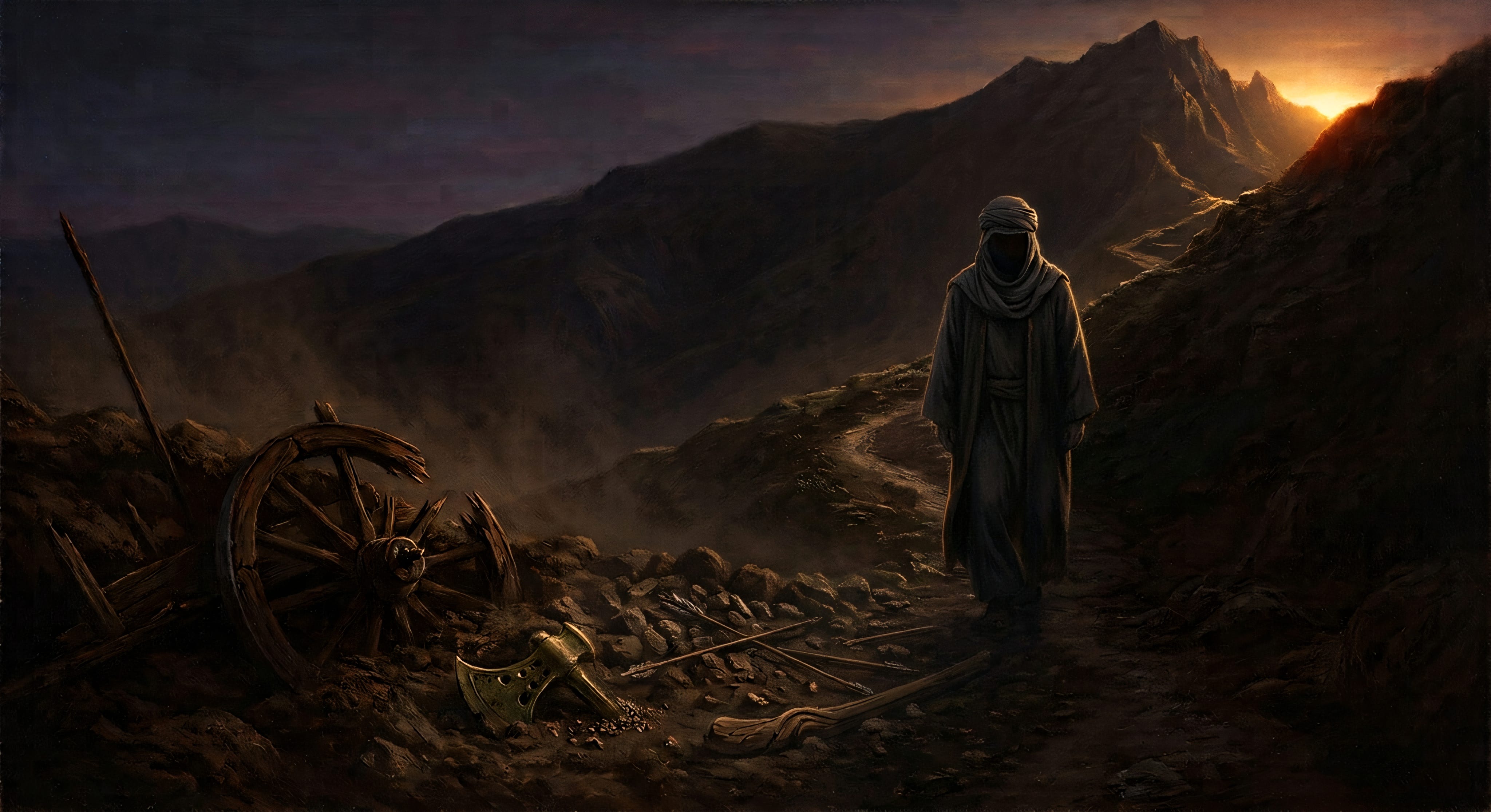
Then, in the middle of that scene, a second king arrives. This one doesn’t come from the east and he isn’t coming to negotiate. He doesn’t come with an army. He comes with bread and wine, and in four short verses he receives something the coalition of four kings never got close to: total, unqualified deference from the man who just proved he can’t be beaten by force.
That’s worth sitting with before we go any further. The war just taught us that Abram doesn’t lose, and he doesn’t lose here either, but this time he isn’t the one doing the defeating. He’s the one bowing. Whoever this king is, Genesis is telling us he outranks the reversal that came before him. Which means understanding him isn’t a side note to the war narrative. It’s the payoff the war narrative was building toward.
How could Abram have such a profound understanding of a power greater than his own, without the text giving us any explanation of where that understanding came from?
The name Jesus never enters the picture. Yet one of the earliest fathers of the faith knew to submit his worship to a priest of the true God.
With an act of submission like that, what exactly was the text trying to tell us?
What the Text Says
“And King Melchizedek of Salem brought out bread and wine; he was priest of God Most High. He blessed him and said, “Blessed be Abram by God Most High,
maker of heaven and earth, and blessed be God Most High, who has delivered your enemies into your hand!” And Abram gave him one-tenth of everything.” (Genesis 14:18-20 NRSV)
And who exactly was this man?
Was Melchizedek a Christophany, an appearance of Christ before His incarnation? Or was there an established lineage of priests who served the true God, ministering to certain people groups in a way Scripture simply never records?
The text gives us the action. It leaves us to figure out the knowledge behind it.
Four verses. That’s the entire appearance. A king of Salem, identified as priest of God Most High, El Elyon in the Hebrew, brings out bread and wine, pronounces a blessing that credits the victory to God rather than to Abram’s 318 men, and receives a tenth of everything Abram had recovered. Then he’s gone. He doesn’t reappear in Genesis. He doesn’t reappear anywhere in the Torah.
Notice what the blessing actually does, because it’s doing more theological work than its brevity suggests. Melchizedek doesn’t congratulate Abram on a military victory. He reframes the entire war we just spent two essays inside. The coalition wasn’t defeated by tactics or by the courage of a household militia. It was delivered into Abram’s hand by God Most High, Possessor of heaven and earth. Melchizedek says this to Abram’s face, immediately after Abram’s greatest triumph, and Abram’s response isn’t to correct him or claim credit. It’s to hand over a tenth of everything. Whatever authority this king carries, Abram recognizes it as real, and recognizes it as outranking his own.
The tithe matters here beyond the raw generosity of the gesture. Abram doesn’t tithe to the king of Sodom, who offers him a share of the goods a few verses later and gets refused outright. He tithes, unprompted, to a king he has apparently never met before this moment. That’s not a transaction. That’s Abram acknowledging a priesthood he didn’t create and doesn’t control.
Abram Knew the Difference
My perspective, as I follow the breadcrumbs, is this: I don’t believe Melchizedek was a Christophany.
Abram had already encountered God. He knew Him. He had experienced His presence and heard His voice. So when Abram encountered Melchizedek, I don’t believe he was mistaking a man for God Himself.
We actually see something striking in Genesis 18. When Abraham encounters three mysterious visitors by the oaks of Mamre, one of them is explicitly identified as the LORD. Abraham immediately runs to meet them, bows low to the ground, and invites them to stay. Then he offers them water: [SUPPLY: Genesis 18:4, NRSVUE]. He prepares a meal for them. Sarah is told to make cakes from choice flour, Abraham selects a tender calf, and they are served meat, curds, and milk.
Abraham is not hesitant to show extraordinary honor and hospitality when he recognizes the presence of the LORD.
That makes his encounter with Melchizedek even more interesting. With Melchizedek, Abram does not treat him as though he were God appearing before him. Instead, he honors him as a priest of God Most High.
That distinction matters.
We see another fascinating example in Judges 6. Gideon encounters the Angel of the LORD, and when he wants confirmation that this is truly a divine encounter, he prepares an offering. He brings meat from a young goat and unleavened cakes and places them on a rock. Then the Angel of the LORD touches the offering with the tip of His staff.
“Then the angel of the Lord reached out the tip of the staff that was in his hand and touched the meat and the unleavened cakes, and fire sprang up from the rock and consumed the meat and the unleavened cakes, and the angel of the Lord vanished from his sight.” (Judges 6:21 NRSV)
Again, Scripture gives us examples where God’s people encounter a divine figure and respond with offerings, worship, and acts of honor. So when Abram encounters Melchizedek, we need to pay attention to what the text actually shows us. Abram recognizes him as “priest of God Most High.” And then Abram gives him a tenth. This is the right hand washing the left, and the left hand washing the right. Both are part of the same body, serving the same purpose and pursuing the same mission, strengthening and securing one another along the way.
Which raises a much bigger question. Where did Abram learn all of this? How did he know Melchizedek was a priest? How did he know that a tenth was the appropriate offering?
The text doesn’t stop to explain it. And that is where another breadcrumb appears.
The King and the Priest
There is a pattern throughout the Old Testament that becomes especially clear once the Mosaic Law establishes Israel’s priesthood. The roles of king and priest were not meant to be casually combined. The king carried civil and military authority. The priests carried responsibility for the worship and sacrificial system. Under the Law, these offices were tied to different tribes. The royal line came through Judah, particularly the house of David, while the priesthood belonged to Levi through Aaron.
I want to be careful how I say this next part, because I’ve heard it said too strongly and I don’t want to overstate my case.
The Law never actually prints a prohibition. There’s no verse that says a king may not serve as a priest. What the Law does is assign the offices to different tribes and reserve certain specific acts to Aaron’s descendants. The separation is built into the structure rather than spelled out as a rule.
So how do we know it mattered?
Because Scripture shows us, in narrative rather than in statute, what happened when a king reached for something that wasn’t his.
King Saul is where I’d start, though I’ll admit up front that I’m reading something into this passage that the text doesn’t say outright. In 1 Samuel 13, Saul was told to wait seven days for Samuel at Gilgal. When Samuel appeared to be delayed and Saul’s army began scattering, Saul became impatient and offered the burnt offering himself. Samuel arrived immediately afterward and confronted him.
Here’s the part I want to be honest about. When Samuel explains what went wrong, he doesn’t say Saul usurped the priesthood. He says:
“Samuel said to Saul, “You have done foolishly; you have not kept the commandment of the Lord your God, which he commanded you.” (1 Samuel 13:13 NRSV)
The charge is disobedience to a specific instruction. And then the sentence:
“but now your kingdom will not continue” (1 Samuel 13:14 NRSV)
I still think the office matters here. Saul’s impatience took a particular shape, and it isn’t a coincidence that the thing he reached for was the altar. But the text itself puts the emphasis on the command he broke, not the role he took, and you should know that’s where I’m reading between the lines rather than reading the lines.
Uzziah is the clearer case, and here the text says the quiet part out loud.
In 2 Chronicles 26, Uzziah became powerful and successful, and his success led to pride. He entered the temple and attempted to burn incense on the altar. The priests confronted him:
“they withstood King Uzziah and said to him, “It is not for you, Uzziah, to make offering to the Lord, but for the priests the descendants of Aaron, who are consecrated to make offering. Go out of the sanctuary, for you have acted unfaithfully, and it will bring you no honor from the Lord God.” (2 Chronicles 26:18, NRSV).
Notice that the objection is stated in terms of office, explicitly, and tied to Aaron’s line. Uzziah became angry. And then leprosy broke out on his forehead. He was removed from the temple and lived the remainder of his life separated from the house of the LORD.
The message was unmistakable. Some things belonged to the sons of Aaron and to nobody else, and the crown did not change that.
I need add a minor aside here, because Lawrence has just made a distinction that is easy to get wrong in the other direction.
He is right that the line existed, and right that Uzziah is where Scripture draws it in ink. But I want to fill in what sits on the other side of that line, because the oft-repeated “the king was not the priest” is true in a narrow sense and misleading in a broad one, and the difference is where the argument actually lives.
Israelite kings were not shut out of worship. They were up to their elbows in it.
David brought the Ark into Jerusalem wearing a linen ephod, which is priestly clothing. He offered burnt offerings and offerings of well-being. When it was finished, he blessed the people in the name of the Lord of hosts. And 2 Samuel 8:18, in the Hebrew, says flatly that David’s sons were priests, a line so awkward that Chronicles later rewrites it and most English versions soften it.
Solomon is no quieter. A thousand burnt offerings at Gibeon. At the dedication of the temple he offers sacrifices in numbers the text declines to count, consecrates the middle of the court because the bronze altar cannot hold the volume, and blesses the whole assembly of Israel with his own mouth.
So if you were looking for a rule that says kings stay out of the sanctuary, it is not there, and pretending otherwise will not survive a reader who knows 2 Samuel 6.
What is there is narrower and sharper.
The reserved acts were specific. Entering the holy place. Burning incense on the incense altar. Handling the blood of the sin offering. Wearing the high priest’s vestments. Going in behind the veil, which even Aaron could only do once a year and not without blood. Those were tied by name to Aaron’s descendants, and the penalty attached to them in the Law is not a fine.
It is death.
Uzziah did not sacrifice. Kings sacrificed all the time. Uzziah walked into the temple and picked up a censer, and that is a different category of act entirely.
Which is why his story ends the way it does, and why David’s does not.
And it sharpens what Lawrence is about to do with Melchizedek. Because the point was never that kingship and worship could not touch. They touched constantly. The point is that after Sinai, the line ran through descent. You could not choose your way into the holy place. You had to be born into it, and if you were not, no amount of anointing oil made up the difference.
But Genesis 14 hands us a man who is king and priest at once, four hundred years before Sinai draws that line, and who holds both offices without anyone in the text raising an eyebrow.
Now, back to Lawrence.
David gives us another picture. David was a warrior, a king, and a man deeply involved in the worship of God. Yet he consistently recognized where the line fell. When he fled Jerusalem during Absalom’s rebellion, he told Zadok and the priests to take the Ark back into the city rather than treating it as something he personally controlled. He could be the most worshipful king Israel ever had and still know what wasn’t his to carry.
Solomon followed the same pattern. When he established his kingdom, the priesthood remained a distinct office. Zadok became high priest while Solomon remained king.
This separation is what makes something unusual, which happened long before any of these kings existed, worth noticing. Abram met Melchizedek. And Genesis 14 gives us a remarkable description:
“And King Melchizedek of Salem brought out bread and wine; he was priest of God Most High.” (Genesis 14:18 NRSV)
Read that slowly.
King. Priest. One man.
Abram had just returned from battle, the warrior who had defeated the kings and rescued Lot. Melchizedek was the king-priest who came out to meet him. He blessed Abram. Abram responded by giving him a tenth of everything.
And suddenly the picture becomes much larger. When Abram met Melchizedek, Israel didn’t exist yet. The twelve tribes didn’t exist. Moses hadn’t been born. The Levitical priesthood had not been established. The Tabernacle did not exist. The division between Judahite kingship and Levitical priesthood had not yet been established through the Mosaic covenant.
Yet Genesis already gives us a king who is also a priest of the Most High God.
And that is fascinating when we eventually arrive at Jesus.
The Breadcrumb Leads Forward
Centuries later, the Old Testament establishes a priesthood through Levi and a royal line through Judah. Then Jesus arrives from the tribe of Judah. He is the promised King. But He is also our High Priest.
So how can Jesus legitimately hold both offices?
This is exactly where Hebrews 7 takes us back to Melchizedek. The writer doesn’t point to Aaron to explain Jesus’ priesthood. He points to Melchizedek.
“The Lord has sworn and will not change his mind, “You are a priest forever according to the order of Melchizedek.” (Psalm 110:4, NRSVUE)
And Hebrews builds its argument from there. Melchizedek’s priesthood existed before Levi. Abram, the ancestor of Levi, gave Melchizedek a tenth. And Hebrews argues that the greater blesses the lesser.
The point isn’t simply that Melchizedek was an interesting character in Genesis. His appearance becomes part of the explanation for how Jesus can be both King and Priest. Jesus does not need to become a Levitical priest. His priesthood belongs to an older order.
The order of Melchizedek.
And now I think we can return to Abram. He was one of the foundational figures of the faith, a man who shared an extraordinary relationship with God. Yet when he encountered Melchizedek, he recognized something. He recognized the priest. He recognized the authority. And he knew what to give.
A tenth.
That’s the part that keeps pulling me deeper.
Maybe there was a priestly tradition that existed before the Mosaic priesthood, preserving the knowledge and worship of the true God through generations. Maybe Melchizedek was part of that lineage. I can’t prove every detail of that reconstruction from Genesis alone. But I don’t think we should rush past it either.
The text deliberately introduces Melchizedek as king of Salem and priest of God Most High. Then Abram honors him. Centuries later, the writer of Hebrews reaches backward to this same mysterious figure to explain the priesthood of Christ.
The mystery isn’t simply that Melchizedek appears. The mystery is that Abram already seems to know exactly who he is. And perhaps the question Hebrews wants us to ask is even bigger: what was God showing us through this mysterious priest-king, long before Jesus ever touched the scene?
What the Text Refuses to Say
Here’s what should stop you cold if you know how the rest of Genesis operates. This is a book obsessed with genealogy. It is built on a single recurring formula, “these are the generations of,” which appears about ten times and functions as the skeleton of the whole book. Every major figure who matters gets a lineage attached to them, father to son, generation to generation, often in tedious, repetitive detail that modern readers skim past but that the original audience would have read as essential information. Where you came from told you who you were, what claim you had to land, blessing, and priesthood.
Melchizedek gets none of it. No father. No mother. No tribe. No hometown beyond “Salem,” which itself is thin enough to have generated centuries of debate about where it actually was. He simply appears, king and priest at once, holding together two offices the Law would later assign to separate tribes. He blesses the covenant bearer, receives the tithe that acknowledges his authority, and exits a text that would ordinarily never let a figure this significant pass without telling us whose son he was.
I don’t think that’s an accident, and I don’t think it’s simply lost information, a genealogy that existed once and got dropped somewhere in transmission. A book this careful about lineage everywhere else doesn’t misplace one this significant by coincidence. The silence reads as deliberate. Genesis wants you to notice that this priesthood doesn’t come from anywhere the text is willing to tell you.
Which means the omission isn’t a gap waiting to be filled. It’s the argument. A priest-king shows up with no pedigree, in a book where pedigree is everything, and receives deference from the man carrying the covenant promise. Whatever Genesis wants us to understand about where legitimate priesthood and kingship ultimately come from, it’s telling us here, in the negative space, that it isn’t descent. Not fully. Not in the way the rest of the chapter, and the rest of the book, would lead you to expect.
Is there an unbroken, hidden royal priesthood being passed down from the beginning of time? Is there any merit to the continual arguments among church traditions over who holds the claim to being the “real church”?
I’m not here to settle that debate or argue over which institution can claim the title. But I do believe something bigger is happening. I believe God has preserved His divine plan throughout history, both in the physical realm and the unseen realm, and even when we cannot see the entire picture, the breadcrumbs are there. The question is whether we’re willing to follow them.
That silence is going to get picked up centuries later and turned into an argument nobody in Genesis could have anticipated, the very argument Hebrews just handed us. But my read here isn’t the only one worth hearing. Three other traditions have wrestled with who Melchizedek was, and each deserves the same fair hearing before this series moves on.
I dare you to ask.
Who was this man?
Now, Lawrence has left that second question open, and I want to answer it plainly, because it is the kind of question that fills comment sections.
My view is that all churches have a claim and also that none of them do.
Allow me to explain.
Most of them have a great deal right. I have learned from traditions I disagree with, and I expect I will keep doing it. But I have never encountered a denomination, my own included, that does not hold at least some doctrine it cannot get from Scripture. Every one of them has absorbed something along the way, from a council, a reformer, a culture, or a habit that nobody remembers starting.
So I do not believe any church now standing has perfectly preserved what Jesus and the apostles had in mind. Not one. Which means the honest posture is not to hunt for the institution that got it right, but to keep holding every institution, starting with our own, up against the text.
As I say so often, be Berean. Go back to the text. Test what your pastor, priest, or elder is telling you against the text itself.
Four Answers, and Which Bible You Are Holding
Lawrence has given you his reading, and I land close to him. But he ended by saying three other traditions deserve a fair hearing, and I want to give them one, because something happens when you set them side by side that I have never seen anyone point out:
Which answers are even available to you depends on which Bible you’re reading.
That might sound like a strange claim. So let me show you what I mean.
The first answer: he was Shem
The oldest solution on record is Jewish rather than Christian.
The Palestinian Targums, the Aramaic paraphrases read alongside the Hebrew in the synagogue, say plainly that Melchizedek was Shem, the son of Noah. Targum Neofiti has it. Targum Pseudo-Jonathan has it. The Fragment Targums have it. The Babylonian Talmud has it at Nedarim 32b. Genesis Rabbah has it. Pirkei de-Rabbi Eliezer has it. Rashi repeats it on Genesis 14:18. Targum Onkelos is the notable holdout.
Jerome knew about it. In his Hebrew Questions on Genesis he records the identification and seems entirely untroubled by it.
And it solves the puzzle elegantly. Why does Genesis give Melchizedek no genealogy? Because he already has one. He is Shem, whose line the book has just finished tracing in detail. The silence is not a mystery. It is an economy. Genesis does not repeat itself.
It also answers Lawrence’s question about where a priesthood of the Most High God came from centuries before Sinai. From the flood. Shem survived it, carried the knowledge of the true God through the generations after, and by the time Abram came west there was still one man in Canaan who knew who God was and how to serve Him. The rabbis even give Shem a house of study, shared with his great-grandson Eber, where the patriarchs learned.
Now watch what the Talmud does with the blessing, because it is the exact opposite of what Hebrews does with it.
At Nedarim 32b, Abraham objects. Melchizedek blessed Abram first and God second, and Abraham asks whether a servant’s blessing should come before his master’s. And on the strength of that inversion, the priesthood is taken from Melchizedek and given to Abraham’s line.
Set that next to Hebrews 7:7, where the very same blessing proves Melchizedek was the greater man.
One verse. Two readings. In one the blessing establishes his rank. In the other it costs him everything.
Those are not compatible and I will not pretend otherwise. But both are doing serious work on the same words, and neither is careless.
The part nobody mentions
The Shem identification rests on arithmetic. It only works if Shem was still alive when Abram came through.
In the Hebrew text, he was. Genesis 11 gives Shem a son two years after the flood at the age of a hundred, then five hundred more years of life. Add the begetting ages down the line from the flood to Abram’s birth and you get roughly two hundred and ninety years. Shem outlives Abraham by decades. The identification is not only possible, it is comfortable.
The Greek text runs different numbers.
The Septuagint’s Genesis 11 adds about a century to the age of nearly every patriarch at the birth of his son, and inserts an additional generation, Kainan, between Arphaxad and Shelah. The same stretch of the same genealogy comes out roughly eight hundred years longer. The Samaritan Pentateuch agrees with the Greek from Arphaxad forward, so the Hebrew side is not even unanimous with itself.
Run the arithmetic on the Greek numbers and Shem is centuries in the grave before Abram is born.
So the oldest Jewish answer to who Melchizedek was is an answer that can only be given in Hebrew. Read Genesis 11 in Greek and the identification is not merely unlikely. It is arithmetically impossible.
This is not one tradition being wrong. It is two traditions preserving numbers that send their readers down different roads. The Hebrew road produces Shem, a priesthood carried through the flood by a named survivor. The Greek road closes that door.
And the readers who went that way had to find another answer.
They did.
The second answer: he was a heavenly figure
In 1956, in the eleventh cave at Qumran, a fragmentary Hebrew scroll turned up that nobody expected. Scholars call it 11QMelchizedek, or 11Q13. Three columns, of which the first and third are nearly unreadable and the second is preserved well enough to work with. The copy dates to roughly the middle of the first century before Christ.
I want to spend real time here, because this text almost never gets explained properly to general readers, and what it actually argues is stranger than the summaries suggest.
What kind of document it is. Not a commentary in any sense we would recognize. It is a chain of quotations welded together and read as a single prophecy. Qumran exegesis works atomistically, taking a clause at a time and assigning each one a referent in the community’s own future. It takes some getting used to.
The argument. It begins with the jubilee. Leviticus 25 commands that every fiftieth year, land returns to its original family and debts are released. Deuteronomy 15 commands a release of debts every seventh year. The scroll quotes both, and then does something audacious. It reads them as a schedule for the end of history.
The release is not about farmland. It is about captives, and it comes from Isaiah 61, the passage about proclaiming liberty to those in bondage. The scroll quotes it and says the interpretation applies to the Last Days.
And the debts being released are sins. The text speaks of freeing them from the burden of all their iniquities.
The timetable. Jubilees are stacked. Nine pass, and in the first week of the tenth the proclamation is made. The Day of Atonement at the end of that tenth jubilee is the day of reckoning. Ten jubilees of forty-nine years gives four hundred and ninety, which is Daniel’s seventy weeks of years, and the scroll quotes Daniel 9 to make the link explicit.
Somebody has done arithmetic on the end of the world.
Melchizedek’s role. He proclaims the release. He returns the captives to what is rightfully theirs. And on that Day of Atonement, the text says he atones for the Sons of Light, the people who are allotted to Melchizedek.
He also fights. He delivers the captives from the hand of Belial and from the spirits of Belial’s lot, and allied with him are what the scroll calls the righteous elim, the divine beings.
Then the exegesis that makes everyone sit up. The scroll quotes Isaiah 52:7, about the messenger whose feet are beautiful on the mountains, who announces peace and salvation and says to Zion, your God reigns. Then it decodes the verse phrase by phrase.
The mountains are the prophets.
Zion is the congregation of the sons of righteousness.
And “your God,” the elohim of that verse, is Melchizedek, who will deliver them from the hand of Belial.
It reaches for Psalm 82 as well, the psalm where God takes His stand in the assembly and judges among the elohim, and puts Melchizedek in the judging position.
Be careful about what that does and does not establish. The word elohim in the Hebrew Bible is a category of being rather than a name, as I have argued at length elsewhere. Calling Melchizedek elohim here is not the same as calling him the Almighty. But it places him inside the divine council, functioning as a heavenly judge and deliverer, and that is a very long way from a Canaanite city ruler with a loaf of bread.
What scholars make of him. No consensus, and the fragments do not permit one. Van der Woude, who first published the text, identified Melchizedek with Michael, and that reading has been influential. Richard Bauckham treats him as a principal angel, probably Michael under another name. Others argue he is a title for God Himself. Still others read him as a distinct heavenly being with no other name.
There is a further complication worth knowing. The scroll also speaks of a messenger who is the “anointed of the spirit,” identified through Daniel 9. Whether that messenger is Melchizedek or a second figure beside him is not clear from what survives, and careful scholars say so.
Why this matters. Three things.
First, the date. This scroll was copied before Hebrews was written, by a Jewish community with no conceivable interest in Christian claims. And they were already reading Melchizedek as a heavenly deliverer who atones for sin, defeats the powers, and appears at the end of days. The Christian tradition did not invent the mystery. It walked into a conversation that had been running for a long time.
Second, the shape. Look at what this text expects. A priestly figure who proclaims release, forgives debts understood as sins, makes atonement on the Day of Atonement, and destroys the power holding people captive.
If that outline feels familiar, it should. Hebrews makes the same set of claims about the same order of priesthood, and arrives at an entirely different person.
Third, and I want to say this plainly: I do not follow Qumran. The scroll has Melchizedek performing atonement and standing in the council as an elohim, and I accept neither. The line between Creator and creature does not bend, and a text outside Scripture does not get to redraw it. The community that produced this scroll was wrong about who would do these things.
They were not wrong that someone would.
If you want to read it yourself. Most translations circulating online are unattributed or come from idiosyncratic private versions. Use the García Martínez and Tigchelaar study edition. Joseph Angel’s study of the scroll is the best recent treatment I know. And bear in mind throughout that the brackets in any translation are doing enormous work. This is a damaged text, and much of what you read is reconstruction.
The third answer: he was Christ
This is the reading that I suspect most of you arrived with, and Lawrence has already told you he does not hold it.
Neither do I.
Which means it has no defender in this post, and that is exactly why I want to make its case properly before saying why I think it fails.
The case is stronger than its critics usually allow.
Hebrews says this man has no father, no mother, no genealogy, no beginning of days and no end of life, and that he remains a priest continually. Read plainly, that describes someone who does not die.
Genesis gives him bread and wine, and the church has never been able to read that pairing innocently. He is king of righteousness and king of peace by the plain sense of his name and his city, and those are not titles that sit easily on a minor Bronze Age ruler.
He appears without warning, blesses the covenant bearer, receives a tithe, and leaves without a trace. Genesis records appearances of God in Abraham’s life elsewhere without always announcing them as such. And the strongest point of all: an eternal priesthood, in the logic of Hebrews, would seem to require an eternal priest.
Against all of that, one clause.
Hebrews 7:3 does not say Melchizedek was the Son of God. It says he was made to resemble Him. The Greek is ἀφωμοιωμένος, aphōmoiōmenos, a passive participle meaning made like, made to resemble.
You do not say a man resembles himself.
And a few verses on, at 7:15, the argument turns on another priest arising in the likeness of Melchizedek. That other priest is Christ. If Melchizedek already is Christ, the sentence collapses into Christ arising in the likeness of Christ, and the whole argument eats itself.
So I think this reading has to be set down. Not because it is unworthy. Because the book that made Melchizedek famous is careful, twice, to keep the two apart.
The fourth answer, and where I land
He was a man.
A real king of a real city, serving the real God, in a world where Abram had every reason to expect he would find nobody who did.
I hold this for the reason Lawrence gave when he read the silence as deliberate. Genesis does not misplace genealogies. It is built on them. In a structure like that, a missing lineage is not an accident of transmission. It is a decision.
And the decision is the argument. Hebrews does not claim Melchizedek had no parents. It says the record gives him none, and then builds a doctrine of priesthood on that absence. Had Genesis told us whose son he was, Hebrews 7 could not have been written.
On Lawrence’s larger point. He suggested there may have been a priesthood serving the true God before Moses, and that Melchizedek belonged to it. I think that is right, and I want to add something that makes it sharper than it looks.
You might assume such knowledge came down through Abram’s family. It did not. Joshua 24:2 says so flatly: Terah and his sons lived beyond the Euphrates and served other gods. Abram’s own household was pagan. Whatever Abram knew of God, he learned when God spoke to him in Genesis 12, not at his father’s table.
Which means Melchizedek’s priesthood was not a family inheritance Abram was rejoining. It was preserved independently, in a Canaanite city, by people Abram had no connection to whatsoever.
The hints are scattered but real. Genesis 4:26 says that in the time of Enosh people began to call on the name of the Lord. Noah builds an altar without being told to. Job knows God and is not an Israelite. Jethro is a priest of Midian and Moses takes counsel from him. Balaam hears from God and is a disaster of a man. Scripture keeps acknowledging, almost in passing, that the knowledge of God was never entirely confined to the covenant line.
And Genesis 14 itself gives the strongest evidence of all. When Abram refuses the king of Sodom’s offer, he swears by El Elyon, God Most High, Possessor of heaven and earth. That is Melchizedek’s title for God, which Abram had heard him use minutes earlier, and Abram takes it onto his own lips as a name for his own God.
He did not correct the Canaanite priest.
He agreed with him.
I cannot prove a pre-Mosaic priesthood from that, and I will not pretend the text states it. But Abram recognizing Melchizedek’s God as his own God is in the text, and it is the closest thing to proof we are going to get.
One last thing
Notice that the argument in Hebrews survives no matter which of these four you choose. Shem, or an elohim, or Christ, or a Canaanite king who knew the Lord: the case runs identically. This priesthood predates Levi, Abraham acknowledged it, and Christ’s priesthood belongs to that older order rather than to Aaron’s.
An argument that works under every reading of its central figure is telling you something.
The figure was never the point.
Before the Morning Star
Psalm 110 is the most quoted Old Testament chapter in the New Testament, and verse four is the hinge the whole Melchizedek argument turns on.
“The Lord has sworn and will not change his mind, ‘You are a priest forever according to the order of Melchizedek.’” (Psalm 110:4 NRSV)
In the Greek Bible this psalm is numbered 109, because the two traditions divide some earlier psalms differently and the numbering slips out of step through most of the Psalter. I will give you both numbers.
Brenton renders verse four this way:
“The Lord sware, and will not repent, Thou art a priest for ever, after the order of Melchisedec.” (Psalm 110:4 LXX/Brenton)
No divergence worth reporting. The traditions agree, and Hebrews quotes it in a form that matches both.
Verse three is another matter.
The two readings
“Your people will offer themselves willingly on the day you lead your forces on the holy mountains. From the womb of the morning, like dew, your youth will come to you.” (Psalm 110:3, NRSV)
“Your people shall be volunteers In the day of Your power; In the beauties of holiness, from the womb of the morning, You have the dew of Your youth.” (Psalm 110:3, NKJV)
And the Greek:
“With thee is dominion in the day of thy power, in the splendours of thy saints: I have begotten thee from the womb before the morning.” (Psalm 110:3 LXX/Brenton)
The Hebrew has a king’s people rallying to him at dawn, the vigor of youth on him like morning dew. A coronation.
The Greek has God telling this same figure that He begot him out of the womb before the morning existed.
That is not a difference of shading. One is a king crowned in time. The other is a son generated before time.
I have to be honest with you about this verse
I could stop there and let that contrast do its work. It would preach.
It would also not be the whole truth, and you deserve the whole truth.
The Hebrew of this verse is hard. Not subtle. Hard.
The NIV prints a footnote saying the meaning of the Hebrew is uncertain. Robert Alter, in his translation of the Psalms, says the language becomes cryptic at exactly this point and stays that way to the end of the poem. The NET Bible hangs six separate textual notes on one verse. This is not translators quibbling over nuance. Something in the transmission of this line has gone sideways, and the professionals say so in print.
There are three separate points of difficulty, and they stack.
The first is a single letter. The Masoretic Text reads behadrey qodesh, in holy array or holy garments. But a number of Hebrew manuscripts read beharrey qodesh, on the holy mountains. The difference is daleth against resh, two letters so nearly identical in Hebrew script that confusing them is the most common scribal slip there is. The RSV, the NRSV, and others follow the mountains reading.
So the Hebrew tradition is not unanimous with itself before we even reach the Greek.
The second is the dawn. The Hebrew mishchar is read as part of a construct phrase, the womb of the dawn. The Greek translator read the same letters as a preposition attached to dawn, giving before the dawn. And he rendered that dawn-word as ἑωσφόρος, heōsphoros, the dawn-bringer, the morning star.
The third is the word everything hangs on. The consonants are y-l-d-t-y-k. Vocalized as the Masoretes vocalized them, you get yaldutekha, your youth. Vocalized differently, the same letters give you “I have begotten you.”
Hebrew went without written vowels for centuries. The consonantal letters came first. And they allow both.
So what happened here
I am going to lay out the options rather than hand you a verdict, because I do not think the evidence supports one.
Option one: nothing went wrong. One consonantal text, deep enough to be heard two ways, and two communities each preserving a legitimate hearing of it. This is the tidiest answer and there is real force to it, since the letters genuinely do support both.
Option two: the Greek preserves an older reading the Hebrew lost. The translation handbook produced for the United Bible Societies reports that its committee’s majority favored a reconstruction close to the Greek, calling it the most probable interpretation on the criteria of textual analysis. That is a striking conclusion for a committee of that kind. There is also a report that some Hebrew manuscripts carry the begetting reading, though I have not examined the apparatus myself and would want to before leaning on it.
Option three: the Hebrew is damaged. Not reinterpreted. Damaged. A line knocked out of shape somewhere in transmission and never fully recovered, which would explain why the Greek, the Latin, and the modern committees all pull in a direction the Masoretic vowels will not go, and why every English version footnotes it.
Option four: it is just hard. Some poetry is compressed past the point of easy recovery, and ancient Hebrew verse is full of it. Not every difficulty is damage. Most modern translations have quietly taken this option, following the Masoretic Text and noting the trouble in the margin.
I lean toward the second and third, and I would rather say so than hedge. Looking at the Hebrew, I think something has probably gone wrong here that we cannot now undo. And I think the Greek likely preserves the original reading.
But I hold these possibilities loosely. Option four is entirely live. And I am not prepared to solve the tension for you.
Which raises the obvious question
I have spent this entire series telling you that neither tradition is the corrupt one.
Am I now taking it back?
No. And the distinction matters enough to state plainly.
Saying a verse suffered damage in transmission is not the same as saying a tradition is unreliable. Scribes were human beings copying by hand, sometimes by lamplight, in a script where two letters can differ by a tiny stroke. Of course errors entered. Both traditions have them. The Greek has them too, in places I have pointed out before and will point out again.
What I have claimed all along is something else. That God preserved both streams deliberately, and that where they genuinely diverge, the divergence usually carries something rather than destroying something. That was never a denial of scribal error. A providence that could not survive a copyist’s slip would not be worth much.
And notice what happens here even if the damage is real.
We are not left with a hole. We are left with two readings, both ancient, both intelligible, both preserved, and both saying something true about the one they describe.
Whatever went wrong in the copying, nothing essential was lost.
One warning about the English
Brenton gives you “before the morning,” not “before the morning star.” His own printed Greek has Ἑωσφόρου, capitalized, and he softened it in English the way a Victorian gentleman would.
I flag that because the exact word is about to matter enormously, and Brenton’s English hides it.
Where you have met this word before
ἑωσφόρος appears in one other place that people tend to remember.
Isaiah 14:12. The Hebrew there is הֵילֵל, helel, the shining one, and the Greek translators rendered it ἑωσφόρος. Jerome carried that into Latin as lucifer, the light-bearer, and an entire tradition grew out of the name.
So the Greek Bible uses one word for two figures.
One fell from the morning star.
The other was begotten before it.
I am not going to claim the Psalter translators were thinking of Isaiah. But the Greek Bible ended up holding both sentences, and a reader who knows both cannot hear one without the other.
And one more thing this difficulty produced
Remember the heavenly Melchizedek at Qumran, above.
James Kugel has pointed out that the ambiguity in this very verse is part of what generated those readings. A line that can be heard as a divine begetting, attached three verses later to a priest forever after the order of Melchizedek, is exactly the soil in which a heavenly Melchizedek grows.
Which means the textual difficulty we have been picking at is not a footnote to the identity question.
It is one of the things that created it.
What both traditions give you together
The Hebrew gives you a king crowned at daybreak, his people streaming to him, the dew of youth on him. Real, in time, in Jerusalem.
The Greek gives you a Son begotten before the morning. Before the light. Before the day that crowning happened in.
And the next verse, in both traditions, without a hair of difference, says this figure is a priest forever after the order of Melchizedek.
Whichever tradition you hold, the psalm hands the same man an eternal priesthood. The Hebrew tells you when he was crowned. The Greek tells you when he was begotten.
They part company for one verse, over his origin.
Then they rejoin completely on his office.
What Hebrews Actually Argues
Lawrence has given you the shape of it. Melchizedek’s priesthood predates Levi. Abraham, the ancestor of Levi, paid him a tenth. The greater blesses the lesser. And so Christ can hold both crown and priesthood without belonging to Aaron’s line.
That is the argument, and I am not going to run it again. I want three things underneath it that are easy to walk past.
A note on who is writing
Lawrence has been saying “the writer of Hebrews,” which is the standard way to put it, and I have been saying “Hebrews.” I should tell you why I avoid naming an author, because I do have a position and it is not the usual one.
I think Hebrews was composed by Paul and Luke together. Paul supplying the theological mind, Luke supplying the compositional hand. That accounts for what has always made the letter strange: the Greek is the most polished in the New Testament and does not sound like Paul, while the argument is built the way Paul builds arguments, and the closing greetings place its author inside Paul’s circle during his Roman imprisonment.
I have written an entire book making that case, so I will not compress it into a paragraph here. For today it is enough to know that when I say the composers, I mean two men, and that nothing in this section depends on you agreeing with me.
The names are doing work
Before Hebrews argues anything, it unpacks the words.
“This ‘Melchizedek, king of Salem, priest of the Most High God, met Abraham as he was returning from defeating the kings and blessed him,’ and to him Abraham apportioned ‘one-tenth of everything.’ His name, in the first place, means ‘king of righteousness’; next, he is also king of Salem, that is, ‘king of peace.’” (Hebrews 7:1-2, NRSV)
King of righteousness, from melek and tsedeq. Then king of Salem, which is shalom, peace. Righteousness first, then peace, in that order.
That is not decoration. It is the order Scripture keeps putting them in. Righteousness establishes something and peace follows from it. The composers are showing you that this man’s name and his address were preaching before he opened his mouth.
“Without father or mother” is a claim about a text
This is the line that generates every wild theory about Melchizedek, and I think it is almost universally misread.
“Without father, without mother, without genealogy, having neither beginning of days nor end of life but resembling the Son of God, he remains a priest forever.” (Hebrews 7:3, NRSV)
Read as biology, that sentence says Melchizedek had no parents, no birth, and no death. Which would make him something other than human, and off we go.
But that is not the kind of argument the composers make anywhere else in this letter, and it is not the kind of argument a first-century Jewish reader would have expected. They are reasoning from the record. Genesis, which supplies parentage for everyone who matters, supplies none for this man. It records no birth and no death. In a book built on genealogy, what the record omits is itself a statement.
So the claim is not that Melchizedek was deathless. The claim is that Scripture presents him without beginning or end, and therefore presents a priesthood that does not derive from descent and does not end in a successor.
Which is exactly Lawrence’s point about the silence. Hebrews is not filling the gap.
Hebrews is arguing from it.
And notice what that does to everything we just spent on the identity question. If the argument runs on the text’s silence rather than the man’s nature, then Melchizedek can have been Shem, or a heavenly figure, or a Canaanite king, and Hebrews still works. The composers were never telling us who he was. They were telling us what Genesis declined to say about him, and why that mattered.
The one word that settles the Christophany question
I said earlier that Hebrews keeps Melchizedek and Christ apart. This is where.
The clause is ἀφωμοιωμένος δὲ τῷ υἱῷ τοῦ θεοῦ, aphōmoiōmenos de tō huiō tou theou. Made to resemble the Son of God.
A perfect passive participle. Something was done to him. He was made like. And the thing you are made like is by definition not yourself.
Then at 7:15 another priest arises κατὰ τὴν ὁμοιότητα Μελχισέδεκ, according to the likeness of Melchizedek. Same root. Same logic, running the other direction.
Two figures, each said to resemble the other. If they were one figure, neither sentence means anything.
I do not think that is accidental precision. The composers were writing to people who knew Genesis intimately and who would have pressed exactly this question. They answered it in passing, with a participle.
And the psalm underneath it all
Everything in Hebrews 7 rests on one line from Psalm 110, quoted and requoted: a priest forever after the order of Melchizedek.
Which brings us back to where we were a few minutes ago. The traditions part company for one verse, over when this figure came into being. Then verse four arrives and they say the same thing without a seam.
Whatever the Hebrew and the Greek each preserved about his origin, they agree entirely about his office.
He is a priest forever.
Reflections: The Priesthood You Did Not Inherit
Here is what I keep coming back to.
Abram’s father served other gods. Joshua says so without flinching. Whatever Abram knew about the Most High when he walked into that valley, he did not learn it at home, and he did not learn it from a lineage, and he could not have produced a document proving his right to any of it.
Then a priest walks down out of Salem carrying bread and wine, and Abram, who has just defeated an empire, hands over a tenth of everything he owns to a man whose pedigree the text refuses to give him.
Two men. Neither one of them has a priestly genealogy that Scripture is willing to print.
And the entire Christian doctrine of the priesthood of Christ gets built on that encounter.
I think that is worth sitting with, because most of us carry around a quiet suspicion that we do not have the credentials. That the people who really belong to God inherited something we did not. A family that prayed. A church that got it right. A tradition that goes back far enough to count for something.
Genesis 14 is a chapter about exactly that anxiety, and it answers it in the negative space.
The priesthood that mattered in that valley did not come down a family line. Melchizedek’s did not come from anywhere the text will tell us. Abram’s did not exist. And Hebrews, reaching back a thousand years later, builds its whole case on the fact that neither man could have produced papers.
Which is the point.
Because the priest that chapter was pointing to did not qualify either. Not by the rules Sinai laid down. He came from the wrong tribe, held no Levitical descent, and had no standing whatsoever in the system that governed who could approach God. Hebrews says so plainly and then spends three chapters explaining why it does not matter.
He holds an older office. One that never ran through blood in the first place.
And what He does with it is bring people in who have no claim.
If you have ever wondered whether you are far enough inside, whether you came from the right place or believed the right things early enough or belong to the right church, that question died in a valley outside Jerusalem about four thousand years ago. Abram came from a house full of idols. Melchizedek came from nowhere the Bible will name. And when they met, what passed between them was bread, wine, a blessing, and a tenth.
No genealogy required.
None offered.
None, it turns out, ever needed.
-
Until next time,
Kevin
What’s Coming
Next time we’re going to take a look at the other major figure this study has been building toward, Og of Bashan. And while we’re at it we’re going to dive into the four giants who remained after Goliath. And we’re going to be talking about all this over on Deeper Still.
See you there next Wednesday.
The LXX Scrolls is free to read and always will be. If this work has been worth something to you, there are a few ways to say so:
Buy the ebooks. Completed teaching series are available as polished ebooks under the Two Witnesses, One Truth series. Buying through Curios will support this work most directly but they’re also available on Amazon (and elsewhere) if you’re loyal to a particular ereader.
Become a supporter. A monthly or annual pledge through Substack helps me to bring the Septuagint to those who never knew they needed it.
Send a one-time tip. If this post has blessed you and you want to express that directly, you can Buy Me a Coffee.

Thank you for being part of this journey, your support makes this work possible
© 2026 LXX Scrolls. All rights reserved.