


Hello brothers and sisters,
Today I want to do something a little different. My subscribers should all have a copy of my book, The Septuagint: An Introductory Analysis (if you haven’t gotten yours, check your email. The link was in your welcome email).
I hope you’ve read (or at least started reading) it. What you might not be aware of is that I published a compacted version of it called Discovering The Septuagint.
Well, I say compacted version, but that's not exactly right. You’ve already read most of what's in Discovering The Septuagint, in one form or another, in the larger book. That much is true. 90% of the content is basically The Septuagint: An Introductory Analysis in miniature. But it isn't only that. There are a handful of sections written just for this book, and I think you'll find them valuable.
The chapter below is one of those sections. It functions as chapter six of the book and covers a short sampling of New Testament verses, their Septuagint origins, and how the Hebrew reads.
Ready to dig in?
Great, let’s get to it.
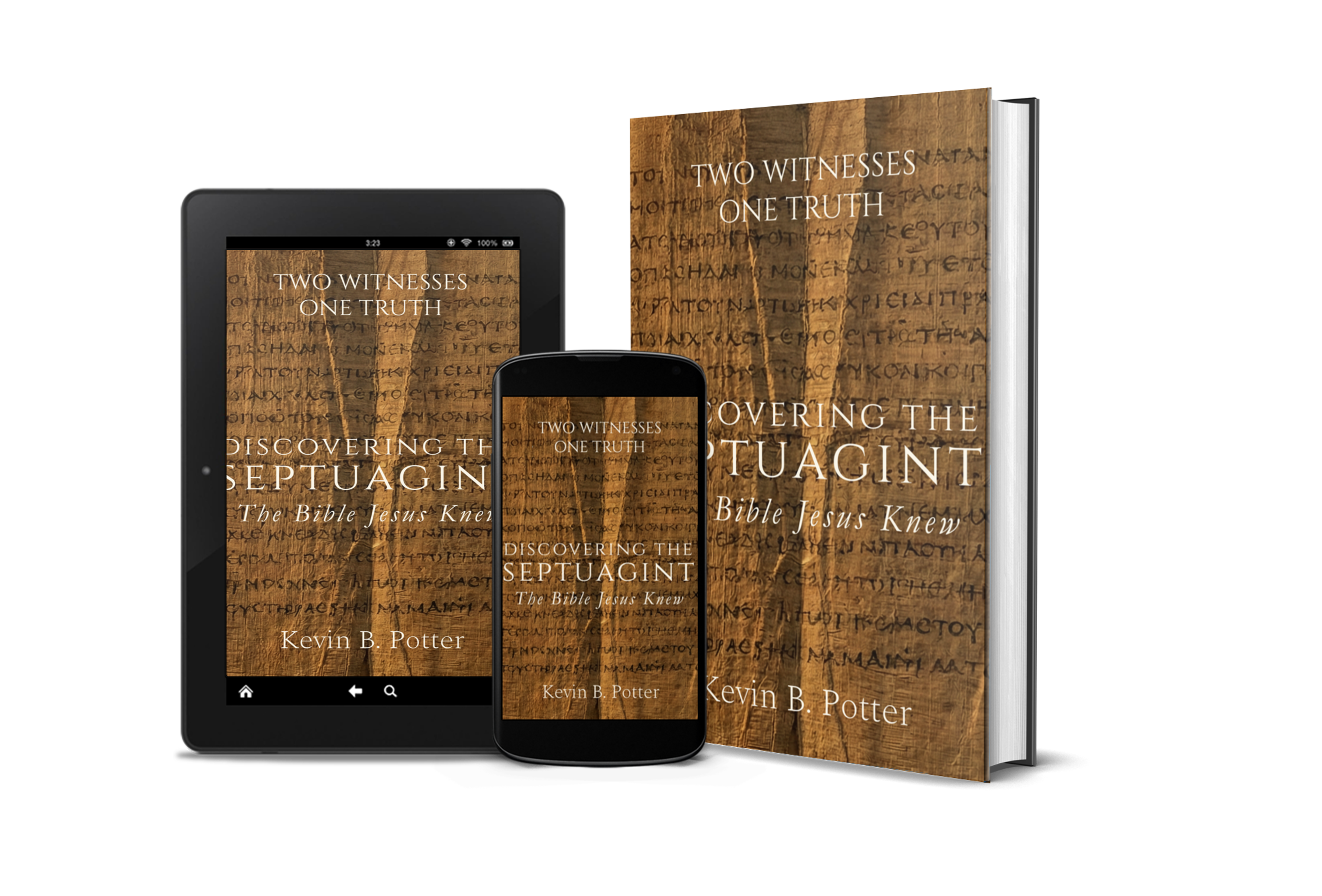
Before we jump into the chapter, let me share a little bit about why I’m showing you this.
First, I’m not asking you to buy the book. The digital version of this book is free, no strings attached, on virtually any ebook retailer.
Now, I am going to be asking you to do something for me, but we’ll save that for the end of this sample chapter. For now, just enjoy this sample of the content unique to this book
THE APOSTLES’ BIBLE — A GUIDED TOUR
At this point you’ve heard me say several times that the New Testament writers quoted the Septuagint as their Bible. I’ve told you the apostles preached from it, that Paul built arguments on it, that the author of Hebrews drew his doctrine from its specific wording.
But there’s a difference between hearing me say it and seeing it for yourself.
I want to slow down now and show you. Not in the abstract, but in the concrete. I’m going to show you actual New Testament passages laid out side by side with their Septuagint sources and the Masoretic Hebrew that often reads differently.
When you see the Greek wording of the apostles’ quotations next to the Greek text of the LXX, the match jumps off the page.
When you see how the Hebrew reads differently from both, you start to understand what was at stake in the textual choices the apostles were making.
What follows is a guided tour through six New Testament citations of the Old Testament.
Each one shows the apostle’s quotation, the Septuagint source they’re drawing from, and the Hebrew Masoretic equivalent. After each comparison I’ll offer a bit of explanation, but I’m largely leaving you to work out the implications on your own.
This isn’t a comprehensive list. There are hundreds of New Testament quotations of the Old Testament, and scholars agree that the majority of them follow the Septuagint. We’re just sampling six.
But these six are particularly clear, theologically significant, and useful for showing you what the pattern actually looks like.
Read these slowly. Let your eye move back and forth across the columns. Notice what matches and what doesn’t. You don’t need to know Greek or Hebrew to see what’s happening.
1. Matthew 1:23 — The Virgin Birth
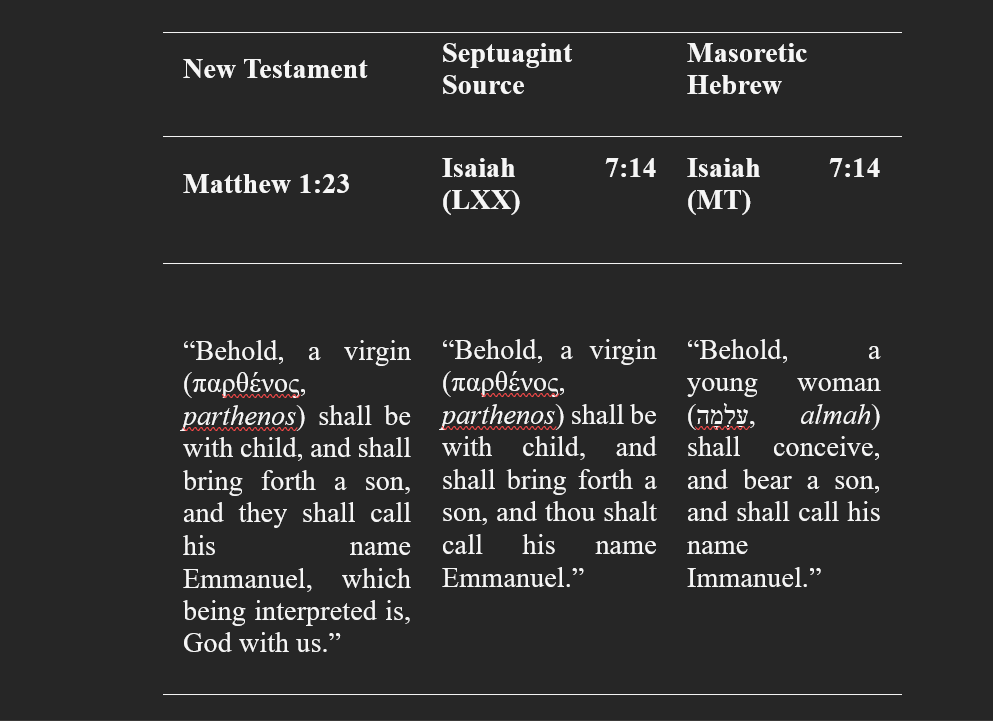
Matthew’s Greek matches the Septuagint’s Greek nearly word for word. Both use παρθένος, which most directly means “virgin.” The Hebrew word almah has a wider semantic range. It can mean a young woman of marriageable age, who would typically be a virgin in that culture, but the term doesn’t specify virginity the way παρθένος does.
Matthew didn’t choose παρθένος to make his case. The Jewish translators of the Septuagint chose it more than two centuries before Matthew was born. Matthew quotes their translation because that’s the Bible he and his readers knew. The Holy Spirit, working through Matthew, validated the LXX’s translation choice by applying it to the virgin birth of Christ.
2. Acts 7:14 — Seventy-Five in Egypt
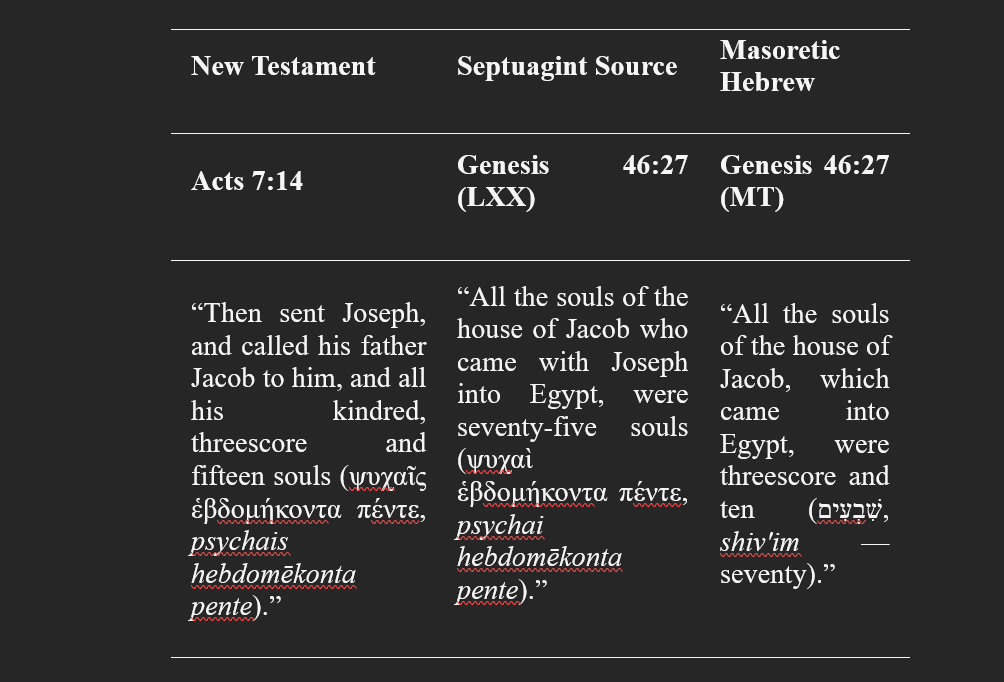
We explored this case study in detail earlier in the book. Stephen, speaking before the Sanhedrin in Acts 7, gives the number as seventy-five. The Masoretic Hebrew gives seventy. The Septuagint, which Stephen and Luke are both drawing from, gives seventy-five. And the Dead Sea Scrolls vindicated the Septuagint’s reading by preserving a Hebrew manuscript of Exodus that also gives seventy-five.
What’s worth seeing in the three-column comparison is how clean Stephen’s quotation is. He doesn’t paraphrase the Septuagint or summarize it. He gives the exact Greek term. The match is precise.
3. Hebrews 10:5 — A Body Prepared
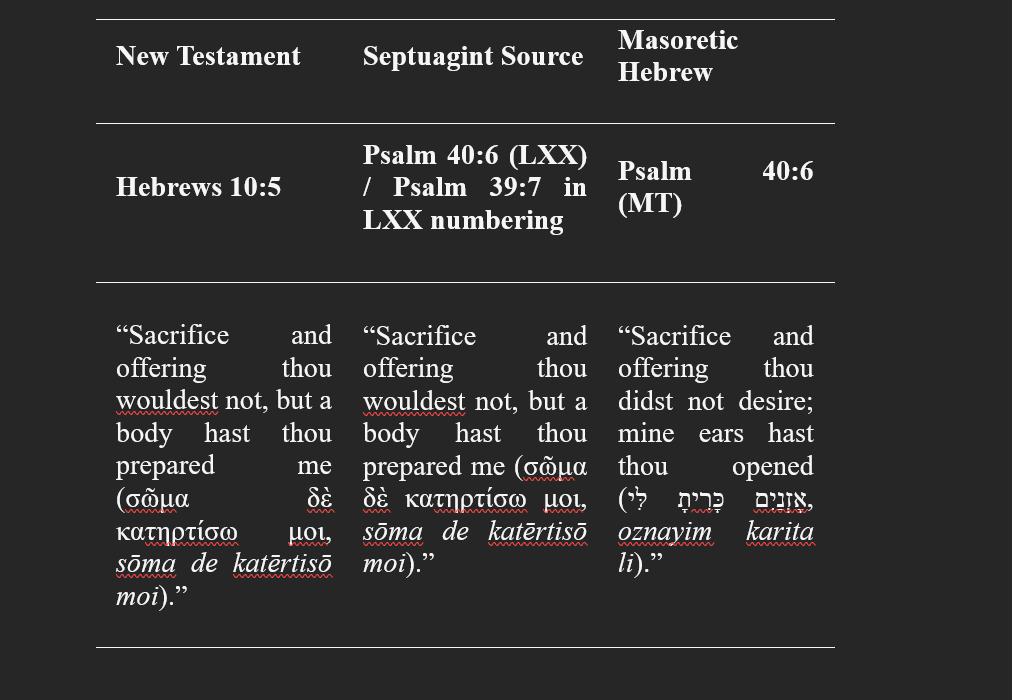
This is one of the most striking examples in the entire New Testament. The author of Hebrews quotes Psalm 40:6 to explain the incarnation and why the eternal Son took on a human body to offer Himself as a sacrifice. And the quotation depends entirely on the Septuagint’s reading.
The Hebrew says “ears you opened for me.” It’s a metaphor for obedience, opening the ear to hear and respond. It’s also a callback to Exodus 21:5–6, where it’s laid out that a slave can, for love of his master, his wife and his children, choose to stay with his master for life rather than go free. This is symbolized by having his ear pierced with an awl. So it’s also about obedience. About covenant faithfulness, which also speaks to the incarnation of the Son.
The Septuagint, in contrast, says “a body you prepared for me.” We don’t fully know how this translation arose. It may reflect a different Hebrew text, or it may reflect an interpretive rendering by the translators. But whatever its origin, the Hebrews author found in the Septuagint’s wording a perfect description of the incarnation.
A body prepared for sacrifice. A body offered once for all. The entire theology of Hebrews 10— Christ’s body as the once-for-all sacrifice that replaces the temple system —flows from this specific LXX reading. Take away the Septuagint, and you take away the wording on which Hebrews builds its doctrine of the incarnation.
4. Hebrews 1:6 — All the Angels of God Worship Him
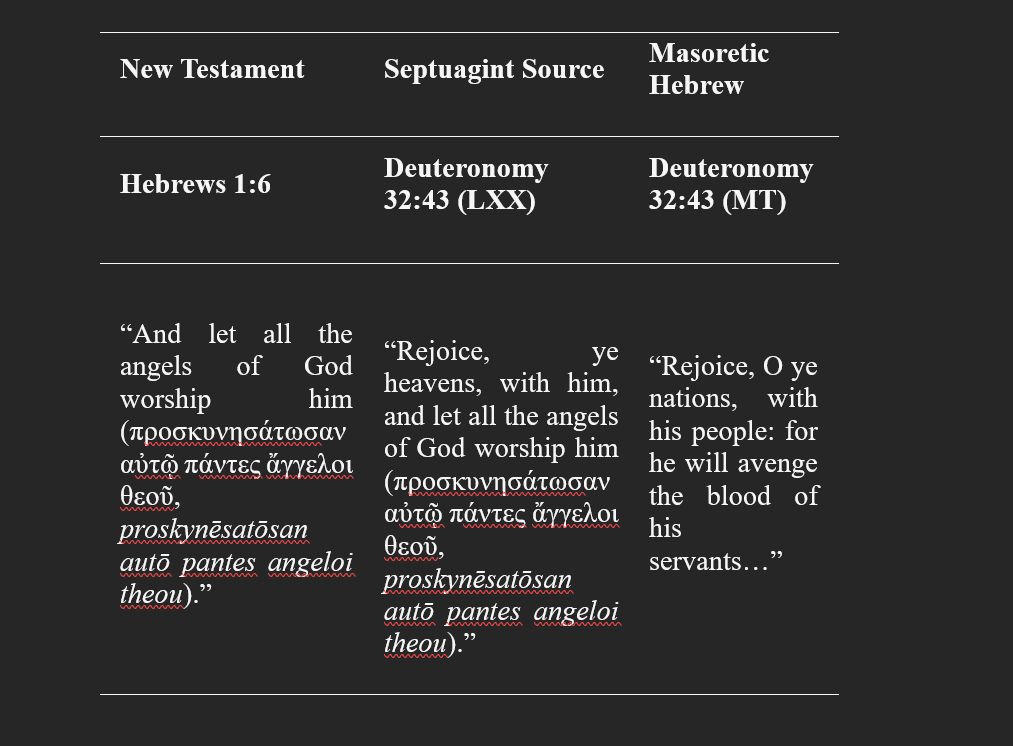
The Hebrews author is making the case that Jesus is superior to angels. To prove it, he quotes a passage commanding angels to worship the Son. And the passage he quotes is Deuteronomy 32:43 in the Septuagint.
But here’s the striking part: the Masoretic Hebrew text of Deuteronomy 32:43 doesn’t have the line about angels worshiping at all. The entire phrase “and let all the angels of God worship him” is absent from the Hebrew the Masoretes preserved. If you only had the Masoretic Text to work from, you couldn’t trace where Hebrews 1:6 is quoting from.
This is one of the strongest cases where the Dead Sea Scrolls help us understand what’s happening. A Hebrew manuscript known as 4QDeut-q (one of the Qumran fragments of Deuteronomy) preserves a longer form of Deuteronomy 32:43 that is closer to what the Septuagint translated. The Hebrew tradition behind the Septuagint genuinely existed. The Masoretic Text reflects a later, shorter form. The Septuagint preserves the earlier, fuller reading that the New Testament author needed.
Without the Septuagint, the entire argument of Hebrews 1— that angels are commanded to worship the Son —would lack its scriptural foundation.
5. Romans 9:33 — The Stone of Stumbling
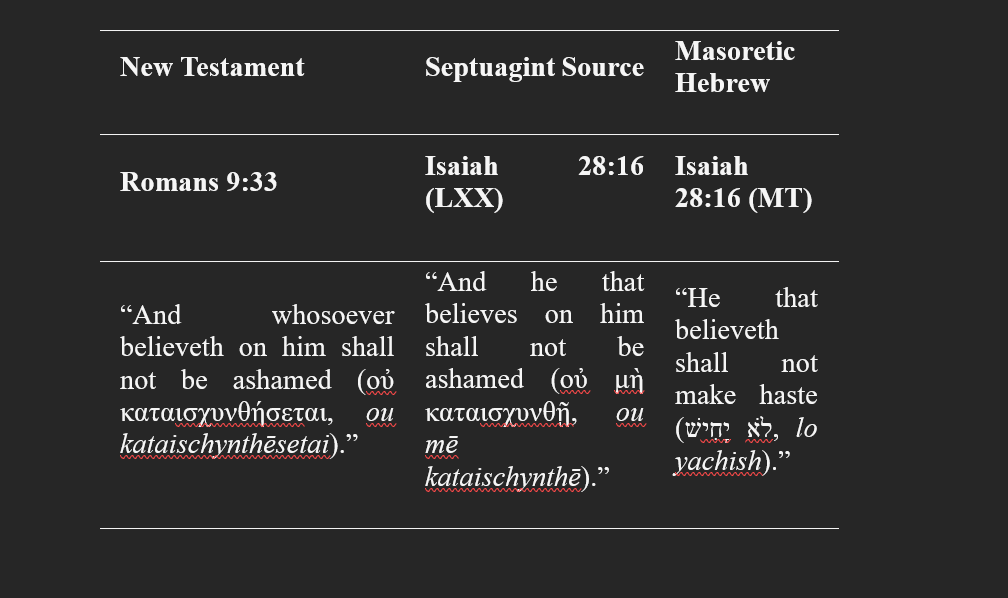
The Hebrew of Isaiah 28:16 says “shall not make haste.” It uses the verb chush, which in its primary sense means to hurry or hasten. The Septuagint translates this as “shall not be ashamed,” which is a different concept entirely.
The translation isn’t arbitrary. The Hebrew verb chush can carry an extended sense of being agitated or unsettled, the kind of panicked hurrying one does when afraid. The LXX translators picked up on that emotional undercurrent and rendered it with the language of shame and dishonor.
But the theological weight of the two readings is different. “Shall not make haste” suggests calm trust. “Shall not be ashamed” suggests vindication and honor before God. Paul builds his entire argument in Romans 9— that faith in Christ is what saves both Jew and Gentile —on the Septuagint’s reading. The promise that those who believe will not be put to shame becomes a cornerstone of Pauline theology.
Peter does the same thing in 1 Peter 2:6. The “stone of stumbling” passage from Isaiah 28 is one of the most important Old Testament passages for the apostolic understanding of Christ and both Paul and Peter quote it in its Septuagint form.
6. 1 Peter 2:22 — He Did No Sin
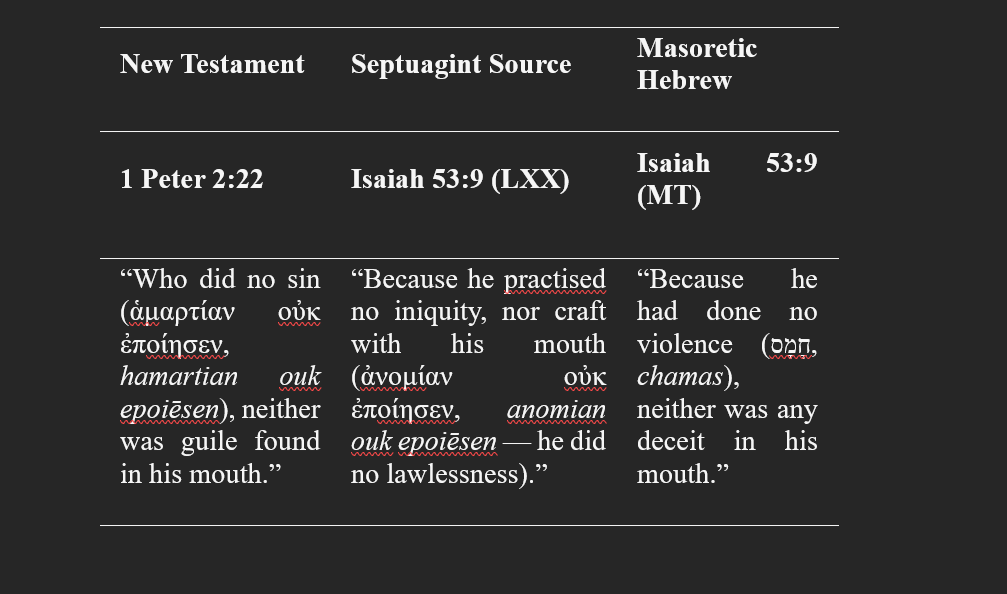
This one is worth slowing down for, because it’s a slightly more nuanced case than the others. The Hebrew word in Isaiah 53:9 is chamas. This is a strong word for violence, wrongdoing, or wickedness.
The Septuagint translates it with anomia, “lawlessness.” Peter, quoting from memory or paraphrasing, renders it with hamartia, “sin.”
So Peter doesn’t quote the Septuagint word-for-word here. He shifts the term slightly. But notice the direction of the shift.
The Hebrew’s specific “violence” becomes the Septuagint’s broader “lawlessness,” which becomes Peter’s more general “sin.” Each step moves from a narrower term to a wider one.
Peter follows the Septuagint’s direction of generalization rather than the Hebrew’s specific physical concept.
What this shows is that the apostles weren’t slavishly bound to either text. They knew their Bible, they followed the Septuagint’s broader theological framework, and they sometimes adjusted the wording to fit the specific point they were making.
But the framework they were working within was the framework the Septuagint had established. Peter’s “no sin” is much closer to the Septuagint’s “no lawlessness” than to the Hebrew’s “no violence.”
And the theological weight of Peter’s claim— that Christ committed no sin at all —depends on the broader Septuagint reading. The Hebrew’s “no violence” could simply mean Christ was non-violent. The Septuagint’s “no lawlessness” expanded that to mean Christ broke no commandment. Peter’s “no sin” carries that to its fullest expression: Christ had no fault of any kind.
What This Pattern Shows
Six examples. Six Old Testament references. Six places where the apostolic case for who Jesus is depends on the wording of the Septuagint.
And remember, this is just a small sample. Scholars who have counted estimate that 300 or more Old Testament quotations appear in the New Testament, and the majority of them follow the Septuagint’s wording. The pattern we’ve seen in these six examples plays out across the entire New Testament.
What does this mean for how you read your Bible?
It means that when Matthew quotes Isaiah on the virgin birth, when Paul quotes Isaiah on the cornerstone, when Peter quotes Isaiah on the suffering servant, when the author of Hebrews quotes the Psalms on the incarnation and Deuteronomy on angelic worship, they’re drawing from a Greek translation of the Hebrew Scriptures that was made by Jewish scholars more than two centuries before Christ.
They’re using the Bible that Jewish communities throughout the Greek-speaking world had been reading for generations.
That Bible is the Septuagint. And when you read it in Brenton’s English translation, you’re reading the Old Testament as the apostles read it.
That doesn’t make your English Bible wrong.
It doesn’t mean the Hebrew Masoretic Text is corrupted.
It means you have access to two ancient streams of witness to the Old Testament, and both of them have been faithfully preserved by communities of faith for thousands of years.
Your English translation gives you the Hebrew. Brenton gives you the Greek. Both belong on your shelf. Both feed your soul.
Both, together, give you something neither gives alone: the full chorus of Scripture in all the textures and tones the Holy Spirit has preserved through history.
If this chapter whet your appetite, there are two more pieces in the book you won't find anywhere else. There's a section called Five Verses That Read Differently, where I briefly walk through five times the Greek takes you somewhere the Hebrew doesn't. And there's a study of 1 Kings chapter 2. It’s the most in-depth piece in the book, and it comes the closest to the kind of dig we do here every week.
I don’t want you to feel obligated, but the material is there for free if you want to read it.
Now, remember that ask I mentioned? Well here it is.
You’ve seen week after week the value of the work I’m doing here. And what I want from the books I’m publishing, more than anything, is for the message of the Septuagint to reach as many people as possible.
And that’s where you come in.
You see, I publish my books independently. There’s no publisher backing my work. There’s no “donor” funding what I do. I work a full time day job to keep the lights on. As much as I would love for this ministry to grow big enough that I could afford to make it my full time commitment, that’s a long way off.
So, as you may or may not know, reviews are the lifeblood of any independent author. My best chance at my books being discovered and read by random browsers is by having lots of reviews on them.
If the Lord leads you to support the work I’m doing here, I would love it if you would go to your retailer of choice (or Goodreads) and leave an honest review on Discovering The Septuagint.
Now, I know what some of you are thinking. “Kevin, I haven’t read the book.”
But here’s the thing: you almost certainly have. Like I said above, most of Discovering is a miniature of the same material you’ve already worked through in Introductory Analysis. And the chapter I just shared with you is a fair sample of the new content.
Between the two, you’ve seen enough to speak to its value honestly. So you’d be vouching for work you already know.
And it doesn’t have to be long. A short sentence or two is all that’s truly necessary. An honest “here’s what I got out of it” helps a browsing stranger more than you’d guess.
Here’s the truth: every review left is one more way some curious stranger stumbles onto the Septuagint and discovers what you and I already have.
And that's the whole point, isn't it? Not the books. The Word. Reaching one more person who's never seen what the Septuagint has to offer.
I’m so glad you’re part of it.
God bless.
© 2026 LXX Scrolls. All rights reserved.
Has it crossed your mind that the Masoretic text, standardized several hundred years after Jesus, by the community that rejected him, could have been deliberately modified to counter or distort Christian arguments for Jesus Christ? Or is that a so-called conspiracy theory?