


Hello brothers and sisters.
Most Christians read their Bibles as if the spiritual realm contains exactly three categories: God, angels, and demons. It’s a tidy system. It fits neatly onto a whiteboard.
And it’s wrong.
Not completely wrong. There is one God. There are angels. There are demons (and yes, angels and demons are different). But the Hebrew Bible paints a far more complex picture of the spiritual world than most of us have been taught. There’s an entire framework of cosmic governance operating behind the scenes of Scripture, a framework that the biblical authors assumed their readers understood, and that we’ve largely forgotten.
At the center of that framework is a word. A word that appears over 2,500 times in the Old Testament. A word that most of us think we understand perfectly.
The word is אֱלֹהִים (elohim).
And I’m going to suggest that what you think it means is almost certainly incomplete.
Why This Series Exists
Before we go any further, I owe you some context, and I owe a debt of credit.
In 2015, the late Dr. Michael Heiser published The Unseen Realm: Recovering the Supernatural Worldview of the Bible, a book that brought the concept of the divine council into popular evangelical conversation for the first time. Heiser was a genuine scholar with a PhD in Hebrew Bible and Semitic languages from the University of Wisconsin-Madison, and he spent decades studying the intersection of ancient Near Eastern religion and biblical theology. His work opened a door that most Christians didn’t even know existed.
I’ve benefited enormously from Heiser’s research. I recommend his books. I think every serious student of Scripture should engage with his arguments. And I will be the first to say that on several key points, particularly his reading of Genesis 6, he is absolutely right.
But I don’t agree with him on everything.
This series is my attempt to walk through the divine council framework honestly, giving credit where it’s due, while charting an independent course where the textual and theological evidence demands it. Where I agree with Heiser, I’ll say so clearly. Where I disagree, I’ll explain why and show you the texts. As always, I invite you to study these things for yourself and let the Holy Spirit guide your understanding.
The Masoretic Text and the Septuagint will be our primary guides. And as we’ll see, they don’t always tell the same story about these divine beings in the same way. But when we read them together, we get a richer, more complete picture than either tradition offers alone.
Let’s dig in.
If you’re reading this in email, be aware that the text is likely to cut off without warning. For a smoother reading experience and all the features Substack has to offer (including audio voiceovers of my posts), you can go HERE or download the app.
The Divine Assembly in Scripture
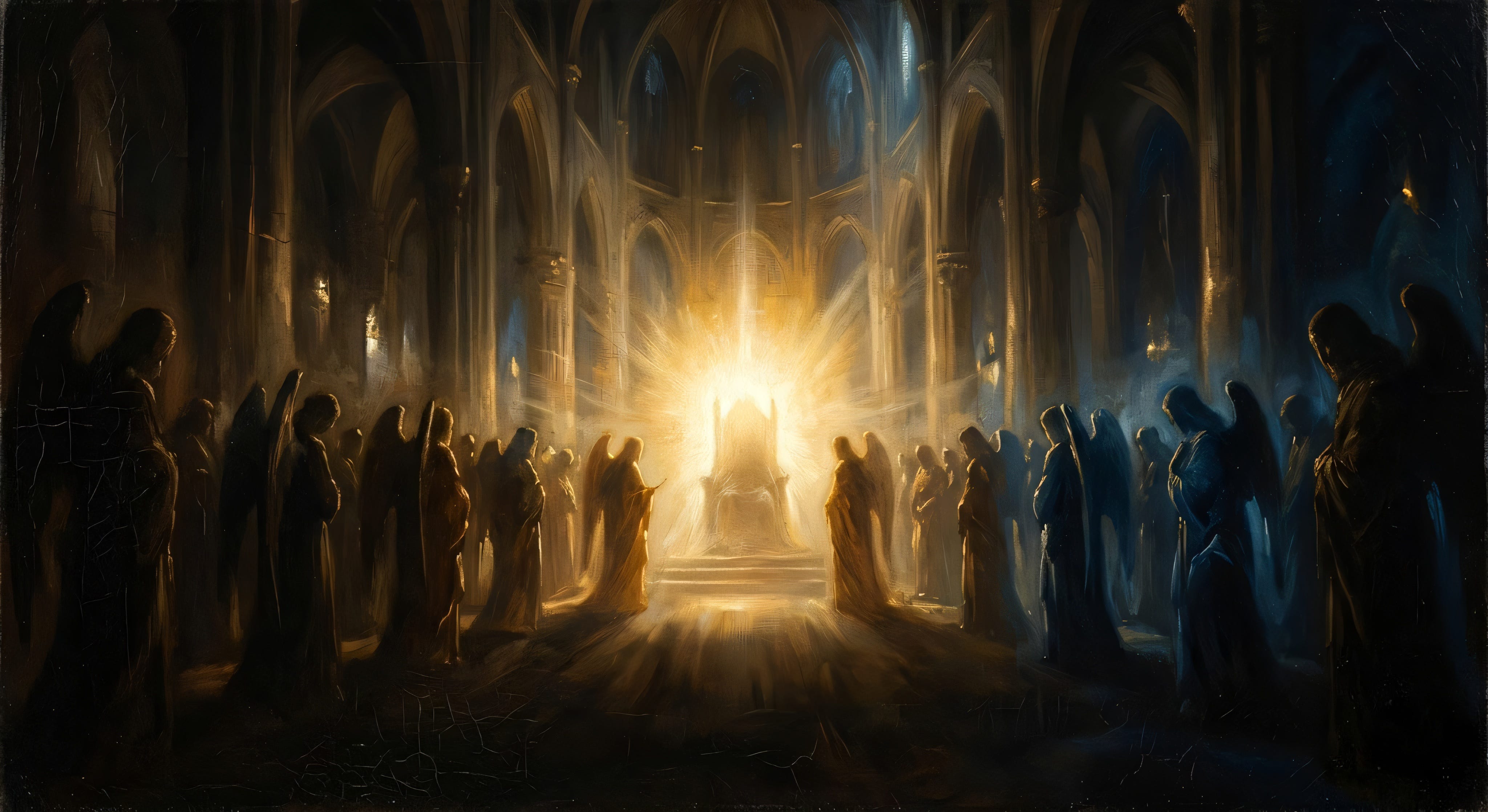
The concept of God presiding over an assembly of heavenly beings isn’t hidden in obscure corners of the Old Testament. It’s everywhere.
Psalm 82:1 — “God stands in the congregation of the mighty; He judges among the gods.” (NKJV)
1 Kings 22:19-22 — This passage is worth slowing down for, because it’s one of the most vivid depictions of the divine council in operation. The prophet Micaiah describes a vision: “I saw the Lord sitting on His throne, and all the host of heaven standing by, on His right hand and on His left” (NKJV).
What happens next is extraordinary. God poses a question to His council: “Who will persuade Ahab to go up, that he may fall at Ramoth Gilead?” And the text says the assembled beings offered different suggestions. One said this, another said that. Then a spirit came forward and proposed a specific plan: “I will go out and be a lying spirit in the mouth of all his prophets.” And God said, “You shall persuade him, and also prevail. Go out and do so.”
Read that carefully. God is not merely informing His council of what He has already decided. He is engaging them in a deliberative process. He asks for proposals. He evaluates a suggestion. He authorizes an action. This is a king holding court. And the members of that court are real, active agents with the capacity to propose and execute plans.
And, this part is crucial, although God Himself cannot lie, clearly these spirits can lie. Read that part again: “I will go out and be a lying spirit in the mouth of all his prophets.” Now, is there every possibility that this spirit is a fallen angel? Sure there is. But we don’t know that for certain. And the fact that angels can fall and become liars (Lucifer and the other fallen angels, the Watchers, etc.) shows us that like us, angels have free will and are not bound to act within God’s character.
Isaiah 6:1-8 — Isaiah sees the Lord seated on His throne, high and lifted up, surrounded by seraphim. After the prophet’s lips are cleansed with a coal from the altar, God says, “Whom shall I send, and who will go for Us?” That plural pronoun, “Us,” isn’t a royal we. It’s God speaking in the context of His heavenly assembly, addressing the council and asking for a volunteer. Isaiah responds, “Here am I! Send me.”
Now, for the Christian, there is a legitimate tension here in that the traditional interpretation is that this is God speaking within the Trinity. But I would argue that there is no need for that tension. Look at the grammar again. “Whom shall I send, and who will go for Us?” To me, this reads as God is speaking about the sending in the singular, showing this is only God the Father speaking. But in who will go for Us, that reads to me as showing that while God the Father is the only sending authority, he is not the only one who will benefit from the sending. Ergo, the heavenly assembly.
Job 1-2 — The “sons of God” (בְּנֵי הָאֱלֹהִים, bene ha-elohim) present themselves before the Lord, and among them comes the adversary, the Satan (הַשָּׂטָן, ha-satan). Notice that the Satan arrives as part of the assembly. He has access to the council. He gives a report (”From going to and fro on the earth, and from walking back and forth on it”). And God initiates a conversation with him about Job, drawing attention to His servant’s faithfulness. The Satan then proposes a course of action, and God sets boundaries on what he is permitted to do. Again, the structure is unmistakable: a king presiding over his court, hearing reports, authorizing actions within limits He sets.
Daniel 7:9-10 — Daniel sees the Ancient of Days take His seat, with “a thousand thousands” serving Him and “ten thousand times ten thousand” standing before Him. “The court was seated, and the books were opened.” This is judicial language. The heavenly court convenes in formal session to render judgment. The imagery is breathtaking in its scale, and it reinforces what every other passage tells us: God governs through a structured assembly of powerful spiritual beings.
These passages span centuries and multiple biblical genres: poetry (Psalm 82), prophetic vision (Isaiah 6, Daniel 7), historical narrative (1 Kings 22), and wisdom literature (Job). This isn’t one author’s peculiar theology. It’s a consistent framework that runs through the entire Hebrew Bible, from the earliest texts to the latest. The biblical authors assumed their audiences understood it.
The question is why most modern Christians don’t.
The short answer is that Western Christianity, particularly since the Reformation, has tended to flatten the spiritual realm into a simple binary: God versus the devil. Angels get mentioned occasionally, demons show up in the Gospels, and everything else gets filed under “mysterious” or ignored entirely. But the biblical writers saw a far more complex, layered cosmos than that, and recovering their perspective changes how you read dozens of passages you thought you already understood.
The Hebrew Bible uses several words to describe this assembly. The word עֵדָה (edah), meaning “assembly” or “congregation,” appears in Psalm 82:1. The word סוֹד (sod), meaning “council” or “intimate circle,” appears in passages like Jeremiah 23:18 and Amos 3:7. The picture is consistent: God doesn’t rule in isolation. He reigns from a throne, surrounded by powerful spiritual beings who participate in His governance of creation.
Now, none of this diminishes God’s sovereignty in the slightest. He is not Zeus, needing the agreement of lesser gods before He can act. He is the Almighty. He does whatever He pleases. But it has pleased Him to govern through a council, to delegate authority, to assign responsibilities. And understanding this framework changes how you read dozens of passages throughout Scripture.
So What Does Elohim Actually Mean?
Here’s where things get controversial, and here’s where I part ways with both the traditional evangelical reading and, to some extent, with Heiser himself.
Most Christians have been taught that elohim simply means “God” when it has a capital G, and “gods” (meaning false gods or idols) when it has a lowercase g. Simple. Clean. Done.
But it’s not that simple.
The word elohim is applied in the Hebrew Bible to a surprising range of beings:
The God of Israel (the overwhelming majority of uses)
The gods of the nations (Exodus 12:12, 1 Kings 11:33)
Members of the divine council (Psalm 82:1, 6)
The spirit of Samuel as he appears at Endor (1 Samuel 28:13)
Angelic beings (Psalm 8:5, which the LXX and the author of Hebrews both render as “angels”)
That last one deserves a moment. Psalm 8:5 in the MT reads: “You have made him a little lower than elohim.” Most English translations based on the Hebrew render this as “God” (NRSV, NASB) or “the heavenly beings” (ESV). But the Septuagint translators rendered elohim here as ἀγγέλους (angelous), “angels.” And when the author of Hebrews quotes this verse in Hebrews 2:7, he follows the Septuagint: “You made him a little lower than the angels.”
This tells us something crucial about how the LXX translators understood elohim. When the context pointed to God Himself, they translated it as θεός (theos), “God.” When the context pointed to the gods of the nations, they translated it as θεοί (theoi), “gods.” When the context pointed to divine beings in God’s service, they translated it as ἄγγελοι (angeloi), “angels.” And as we’re about to see, when the context was juridical, they translated it in terms of divine judicial authority. They weren’t confused. They understood that elohim was a flexible term whose meaning was determined by context, because it described a category, not a single entity.
This is not a complete list, but it establishes the point: elohim isn’t a word that exclusively refers to the one true God. It’s a category word. But what exactly does it categorize?
Heiser’s answer, which became enormously influential, is that elohim describes a being who inhabits the spiritual realm. In his framework, what makes a being an elohim is its “place of residence.” If you dwell in the spiritual world, you’re an elohim. God is an elohim. Angels are elohim. The dead (like Samuel at Endor) are elohim because they now reside in the spiritual realm.
I think Heiser was on to something important, but I believe his definition misses the mark. Let me show you why, and then I’ll offer what I think is a better reading.
The Exodus Problem
Consider Exodus 21:6. In the Masoretic Text, this verse reads:
“Then his master shall bring him to הָאֱלֹהִים (ha-elohim), and he shall bring him to the door or to the doorpost, and his master shall bore his ear with an awl, and he shall serve him forever.”
English translations are divided on how to render ha-elohim here. The KJV translates it as “the judges.” The NRSV renders it “God.” Some translations hedge with “the authorities.”
But look at what the Septuagint translators did with this verse. Working in the 3rd century B.C., with centuries of Hebrew linguistic tradition behind them, they rendered ha-elohim as:
πρὸς τὸ κριτήριον τοῦ θεοῦ (pros to kritērion tou theou): “to the judgment-seat of God”
This is fascinating, and I don’t think we’ve paid enough attention to it.
The LXX translators did not understand elohim here as “judges” (which would have been rendered with a standard Greek word for human judges). They did not understand it as “gods” plural (which they were perfectly willing to render as θεοί, theoi, when the context demanded it, as they did in Psalm 82). And they did not understand it as referring to the spiritual realm as a location.
What they understood was that elohim in this context refers to divine judicial authority. The servant is being brought before God’s own judgment-seat, the place where divine authority is exercised in legal matters.
The word κριτήριον (kritērion) is rare in the Septuagint, appearing only seven times in the entire Greek Old Testament. It refers specifically to a place or seat of judgment from which one in authority pronounces legal decisions. The LXX translators chose this word deliberately. They were telling us something about what elohim signifies in judicial contexts: not a person, not a place of residence, but an expression of divine power and authority exercised in judgment.
We see the same pattern in Exodus 22:8-9, and it’s worth walking through these verses because they reinforce the point powerfully.
In the MT, when a dispute arises between neighbors over property, the text says both parties shall come before ha-elohim (הָאֱלֹהִים). The KJV renders this as “the judges.” The NRSV renders it as “God.”
But look at what the Septuagint does. In verse 8 (LXX 22:7), the Greek reads ἐνώπιον τοῦ θεοῦ (enōpion tou theou), meaning “before God.” Not “before the judges.” Not “before the gods.” Before God. In verse 9 (LXX 22:8), the same phrase appears again, and the text adds that “the judgment of both shall come through God” (διὰ τοῦ θεοῦ, dia tou theou).
Notice what the translators did here. In Exodus 21:6, they rendered elohim as “the judgment-seat of God” (κριτήριον τοῦ θεοῦ), emphasizing the institutional authority. In Exodus 22:8-9, they rendered it as “before God” (ἐνώπιον τοῦ θεοῦ), emphasizing the divine presence behind the judgment. Different Greek phrases, but the same interpretive instinct: elohim in legal contexts refers to God’s judicial authority, not to human judges as independent agents.
And here’s the detail that really matters: the Targum Onkelos, an Aramaic paraphrase of the Torah produced by Jewish scholars, renders elohim in these same passages as dayyanei (”judges”). This is a later tradition, one that reflects rabbinic-era interpretation. The Septuagint translators, working centuries earlier, didn’t share it. They understood elohim in these judicial contexts as a reference to divine authority, not to human office-holders.
Why does this matter? Because it tells us that the “judges” interpretation, which many English Bibles treat as settled, is actually a later development in the interpretive tradition. The earliest major translation of the Hebrew Bible into another language, produced by Jewish scholars who were native Hebrew speakers, understood these passages differently.
This doesn’t mean the rabbinic reading is necessarily wrong. Judges in ancient Israel did derive their authority from God, and bringing a case “before God” could well mean bringing it before judges who represented God’s authority. But it does mean that the word elohim itself, in the minds of the earliest translators we have record of, pointed primarily to divine power and authority rather than to a human title.
And it undermines both the traditional “human judges” reading and Heiser’s “place of residence” definition simultaneously. The LXX translators didn’t render elohim as a reference to the spiritual realm. They rendered it as a reference to divine authority. The judgment-seat of God isn’t a location in the spirit world. It’s an expression of God’s sovereign judicial power operating through earthly structures.
The Elijah and Enoch Problem
Here’s another difficulty for the “place of residence” definition.
Both Elijah and Enoch were taken up into heaven. Both reside in the heavenly realm. Neither of them died (which makes them unique in all of Scripture, but that’s a topic for another day). If elohim is defined by where you reside, then both Elijah and Enoch should be called elohim. They live in the spiritual realm. They inhabit the heavenly domain.
But neither of them is ever called elohim in Scripture. Not once.
This is a significant problem for a definition that hinges on location. If being in the spiritual realm is what makes you an elohim, the absence of this label for two individuals who are clearly in the spiritual realm demands an explanation.
I think the explanation is straightforward: location doesn’t determine the category. Nature, power, and authority do.
Elijah and Enoch are humans. They were translated into heaven, but they remain human beings. They don’t possess inherent divine or spiritual power and authority in the way that the beings called elohim do. Their residence changed, but their essential nature did not.
I do feel it’s important to note here that in 3 Enoch (the Hebrew book of Enoch), he is in fact referred to as an elohim. However, there are a couple of factors to consider here. First is that in 3 Enoch he has been transformed into the archangel Metatron, so he has, in fact, undergone a dramatic change in his essential nature. Whether or not we accept this late book (5th or 6th century AD by most estimates) as authoritative, it still supports my view that elohim speaks to power and authority rather than place of residence.
The Witch of Endor: A Case Study
Now let’s look at one of the most fascinating uses of elohim in all of Scripture: 1 Samuel 28:13.
The scene is one of the most dramatic in the Old Testament. King Saul, desperate and abandoned by God, has sought out a medium at Endor to conjure up the spirit of the dead prophet Samuel. The medium performs her ritual, and something appears. Here’s what happens next:
“And the king said to her, ‘Do not be afraid. What do you see?’ And the woman said to Saul, ‘I see אֱלֹהִים (elohim) coming up out of the earth.’” (1 Samuel 28:13, NKJV: “a spirit”)
Notice the order carefully. The woman calls what she sees elohim before the figure is identified as Samuel. In the very next verse (v. 14), Saul asks what the figure looks like, and only then does the woman describe an old man wrapped in a robe, at which point Saul recognizes the figure as Samuel.
So the medium uses the word elohim as her initial, instinctive categorization of what she’s seeing. She doesn’t yet know it’s Samuel. She just sees something emerging from the spirit world and reaches for the word that fits: elohim.
Heiser uses this passage to argue that even the human dead are elohim because they now reside in the spiritual realm. But I think that reading presses the text too hard.
As the late Chuck Missler was fond of saying, “If you torture the data long enough, it will confess to anything.”
Consider who is speaking. This is a pagan medium, a practitioner of the occult arts. She’s operating from a Canaanite-influenced religious vocabulary, not from a precisely calibrated theological dictionary. The biblical narrator never validates her terminology. In fact, the narrator consistently calls the apparition “Samuel,” not “an elohim.” Five times in the passage, the text identifies the figure simply as Samuel, stating that Samuel spoke and Samuel said. The narrator is quite clear about who appeared. The medium’s use of elohim is her word, not the Bible’s endorsed category for the human dead.
Interestingly, the Septuagint translators handled this passage in a way that reflects their own discomfort with the theological implications. In the LXX, the medium is described as a ἐγγαστρίμυθος (engastrimythos), literally a “belly-speaker” or ventriloquist, possibly reflecting the Alexandrian Jewish view that such practitioners were frauds rather than genuine contacts with the spirit world. Yet the narrative itself still treats the apparition as genuinely Samuel. This tension in the text tells us something important: the biblical writers could acknowledge the reality of spiritual phenomena while simultaneously condemning the means by which they were accessed.
What this passage actually shows us is that a pagan practitioner categorized any spiritual apparition as elohim because she had no better word in her vocabulary for a being that manifested spiritual power and authority. She wasn’t making a theological statement about Samuel’s ontological category. She was using the only term available to her for “a powerful being from the spiritual realm.”
This is actually evidence for my definition, not Heiser’s. The medium’s instinct was to categorize the apparition by its apparent power and authority, not by its location. She saw something that radiated supernatural power and called it what her pagan framework told her to call it: elohim.
What the Septuagint Tells Us
Before I offer my own definition, I want to pause and acknowledge how significant the Septuagint evidence is for this question.
The LXX translators were Jewish scholars working in Alexandria, Egypt, somewhere around 270-250 B.C. for the Torah, with the rest completed over the following century or so. They were native speakers of both Hebrew and Greek. They were immersed in the scriptural tradition. They were intimately familiar with how elohim was used in every context of the Hebrew Bible.
And they made choices.
When they encountered elohim referring to the God of Israel, they rendered it θεός (theos), “God.” When they encountered it referring to the gods of pagan nations, they rendered it θεοί (theoi), “gods.” When they encountered it in Psalm 82, describing the divine council, they used θεῶν and θεούς (theōn and theous), “of gods” and “gods.” No ambiguity there. When they found it in Psalm 8:5 in a context suggesting heavenly beings, they used ἄγγελοι (angeloi), “angels.” And when they encountered it in the legal passages of Exodus 21-22, they rendered it in terms of divine judicial authority: “the judgment-seat of God,” “before God.”
They were not confused by the word. They understood it perfectly. And the way they translated it across these different contexts reveals something that a single English word like “God” or “gods” simply cannot capture: elohim is a term whose specific referent shifts based on context, but whose underlying meaning always involves power and authority in the divine or spiritual sphere.
This is why comparing the Masoretic Text and the Septuagint matters for this question. The Hebrew preserves the ambiguity of a single word used across multiple contexts. The Greek translation resolves that ambiguity by selecting different target words for different contexts. And in resolving it, the translators reveal what they understood the word to mean at its root.
That understanding points toward power and authority, not location.
What Elohim Really Means
So if elohim doesn’t simply mean “God” or “gods,” and if it’s not best defined by “place of residence,” what does it mean?
I believe elohim is a category term that denotes a being possessing divine or spiritual power and/or authority.
It’s a functional description, not a proper name. When applied to the God of Israel, it describes a being of infinite, uncreated, supreme power and authority. When applied to other members of the divine council, it describes beings of real but derivative, created power and authority. When applied to the gods of the nations, it acknowledges that they possess real spiritual power (even if that power is corrupt and illegitimate). And when a pagan medium uses it to describe a spiritual apparition, she’s categorizing what she sees based on its apparent power.
This reading accounts for every use of the word in Scripture without requiring us to stretch the definition to fit edge cases. It explains why the LXX translators rendered elohim in Exodus 21:6 as “the judgment-seat of God” (divine authority in action). It explains why Elijah and Enoch aren’t called elohim (they’re translated humans, not beings of inherent divine power). It explains why the medium at Endor called Samuel’s apparition elohim (she perceived spiritual power). And it maintains the absolute distinction between the Creator and all created beings, a distinction that the Bible never, ever blurs.
The God of Israel is elohim. But He is also infinitely more than every other being who bears that word. He is the Elohim above all elohim. The uncreated Source of all power. The one before whom every other powerful being in the cosmos is nothing. As Psalm 86:8 puts it: “Among the gods (elohim) there is none like You, O Lord.”
If you’ve found this insightful or helpful, please share it with a friend who loves Scripture as much as you do.
Why This Matters
At this point, you might be thinking: “This is interesting academic stuff, but what does it have to do with my faith?”
And the answer is, everything!
If elohim is a category term for beings of divine or spiritual power and authority, then we need to take seriously the Bible’s consistent testimony that such beings exist, that they were assigned real responsibilities in God’s cosmic government, and that many of them have acted corruptly.
The divine council isn’t a theological curiosity. It’s the framework that explains:
Why nations are so often characterized in Scripture as being under the influence of spiritual powers (Daniel 10:13, 20-21)
Why idolatry is treated as something far more dangerous than mere foolishness; it’s engagement with real, corrupt spiritual powers (Deuteronomy 32:17; 1 Corinthians 10:20)
Why Paul describes the Christian’s struggle not as a battle against flesh and blood but against “principalities, powers, rulers of the darkness of this age, spiritual hosts of wickedness in the heavenly places” (Ephesians 6:12, NKJV)
Why the cross is not merely a transaction for human sin but a cosmic event that “disarmed principalities and powers” and “made a public spectacle of them, triumphing over them” (Colossians 2:15, NKJV)
Understanding the divine council doesn’t change the Gospel. The Gospel is still about Jesus Christ crucified and risen for the forgiveness of sins. But it enriches your understanding of why the Gospel was necessary and how far-reaching its effects truly are.
It wasn’t just humanity that needed redemption. The entire cosmic order, corrupted by rebellious elohim who governed the nations unjustly, needed to be set right. And that’s exactly what Christ accomplished.
Coming Up Next
Over the next several posts in this series, we’re going to walk through the divine council framework step by step. Here’s what’s ahead:
In Part 2, we’ll look at Psalm 82 in depth, one of the most remarkable passages in all of Scripture, where God Himself stands to judge the corrupt members of His own council. We’ll see how the Septuagint handles this psalm, and we’ll tackle one of the most misunderstood moments in the Gospels: when Jesus quotes Psalm 82 to the Pharisees in John 10.
In Part 3, we’ll examine the most textually controversial verse in this entire discussion, Deuteronomy 32:8, where the Masoretic Text, the Septuagint, and the Dead Sea Scrolls all read differently. We’ll see how a both/and approach to these texts reveals God’s architecture for governing the nations, an architecture that runs from Babel to the Great Commission.
From there, we’ll explore Genesis 1:26 and the “Let us” question, the fall of the Watchers in Genesis 6, the spiritual powers behind ancient thrones in Isaiah 14 and Ezekiel 28, the distinction between fallen angels and demons (yes, they’re different), and ultimately, how Christ’s death and resurrection represents the cosmic victory over every corrupt power in the heavenly realm.
It’s going to be a journey. And I think it will change how you read your Bible.
I want to reiterate here that I owe a tremendous debt to Michael Heiser for opening this door. His work brought a conversation that had been confined to academic journals into the living rooms of everyday Christians, and the church is better for it.
There are plenty of places where I agree with him, and I’ll be transparent about that. And similarly, where I disagree I’ll explain why and show you the textual evidence.
And as always, I invite you to study these things for yourself. Don’t take my word for it. Don’t take Heiser’s word for it. Open your Bible, compare the texts, and let the Holy Spirit guide your understanding.
The unseen realm is more populated, more structured, and more relevant to your daily life than you’ve ever been told.
The LXX Scrolls is free to read and always will be. If this work has been worth something to you, there are a few ways to say so:
Buy the ebooks. Completed teaching series are available as polished ebooks under the Two Witnesses, One Truth series. Buying through Curios will support this work most directly but they’re also available on Amazon (and elsewhere) if you’re loyal to a particular ereader.
Become a supporter. A monthly or annual pledge through Substack helps me to bring the Septuagint to those who never knew they needed it.
Send a one-time tip. If this post has blessed you and you want to express that directly, you can Buy Me a Coffee.

Thank you for being part of this journey, your support makes this work possible.
© 2026 LXX Scrolls. All rights reserved.
Your ‘take’ is pretty good. Shows work in the original languages and the LXX. I would just add: the LXX is not considered normative, not normally used as key to understanding Hebrew or Koine. Sometimes I use it to try to understand why Jewish authors of the NT would choose a particular Koine word to translate their OT Hebrew thought. It can be helpful, but not normative. Further, Jews were pretty good at resisting Hellenization. These translators, though, were thoroughly hellenized. So, it would be understandable that they would take the one Hebrew word with its conflicting constellation of meanings and try to reduce and/or differentiate into multiple, more precise words. That IS the process of hellenization. So, kudos for the work. Keep going. Keep us posted. Maybe ‘spiritual authority’? Or a being given spiritual authority from the One Lord over all? Finally, remember, that every thing and being other than the One God-godhead is created, contingent, finite, while he alone is self-sustaining, forever, distinct.
I love this. Psalms 82 opened up the entire Bible to me (along with Genesis 6).
Thank you for writing this.