


Hello brothers and sisters.
We have journeyed together through eight centuries of biblical literature and two millennia of theological reflection. We began in ancient Mesopotamia, where childbirth was already a powerful metaphor for divine activity and cosmic transformation.
We traced the birth pang imagery through Hebrew prophecy; Isaiah’s use of חוּל for judgment and restoration, Jeremiah’s intensive application to both Gentile nations and Israel herself, Micah’s explicit connection of Zion’s labor to the Messiah’s birth.
We examined how the Septuagint translators chose ὠδίνω and related terms to render the Hebrew vocabulary, creating a standardized Greek framework inherited by the New Testament writers.
We watched Jesus deliberately invoke this prophetic tradition in the Olivet Discourse, reframing the end-times tribulation as “the beginning of birth pangs.”
We explored Paul’s three-fold expansion of the metaphor to all creation groaning in labor, to sudden judgment on the ungodly, to spiritual formation and pastoral ministry.
And we culminated in John’s cosmic vision in Revelation 12, where Israel, clothed with the sun, gives birth to the Messiah while a dragon waits to devour the child, and all of redemptive history is revealed as one continuous labor narrative.
If you missed any of the earlier posts, you can get caught up below:


Now, in this final installment, we’ll synthesize everything we’ve learned and ask the crucial questions: What does this metaphor teach us about God’s purposes in history? How should it shape our understanding of suffering? What does it mean to live faithfully and hopefully in “the labor pains” today?
And when the new creation is finally born and the Kingdom arrives in fullness, what will we have learned from the long labor of history?
Let’s dig in!
If you’re reading this in email, be aware that the text is likely to cut off without warning. For a smoother reading experience and all the features Substack has to offer (including audio voiceovers of my posts), you can go HERE or download the app.

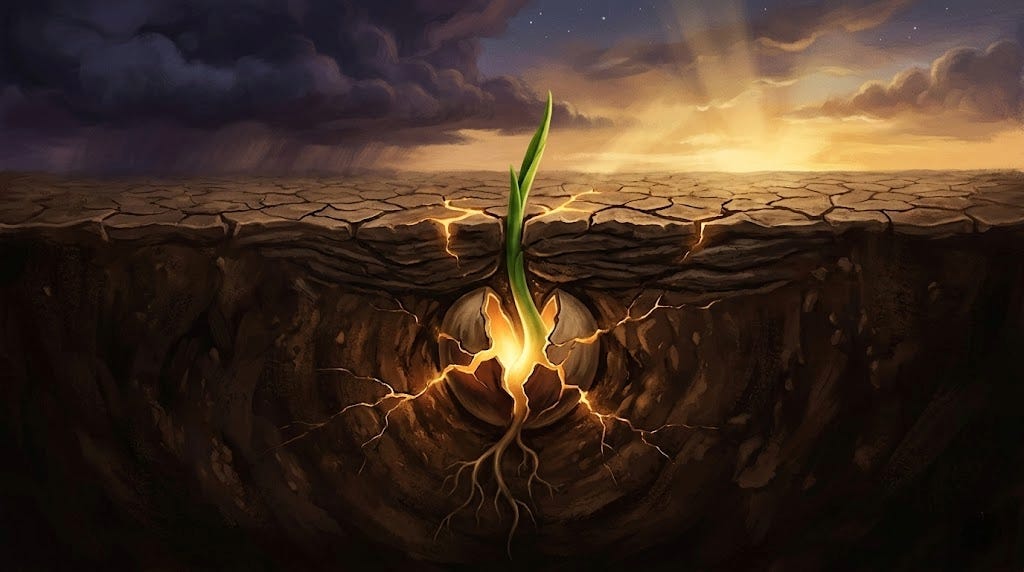
Part I: The Journey We’ve Taken — A Comprehensive Synthesis
Before we explore theological implications and pastoral applications, let’s consolidate what we’ve discovered across seven installments. The birth pang metaphor develops through Scripture in a remarkably coherent way.
Stage 1: Ancient Near Eastern Context (Part 1)
We began by establishing that the birth pang metaphor didn’t originate in Scripture. It was part of the cultural vocabulary of the ancient Near East. In Mesopotamian, Egyptian, and Canaanite literature, childbirth served as a metaphor for divine activity, cosmic transformation, and the transition from one state to another.
The key insight: In the ancient world, birth was simultaneously dangerous and hopeful. It was the moment of greatest vulnerability and greatest promise. A woman in labor was at the threshold between life and death, and the outcome— new life —was worth the agony.
When the Hebrew prophets adopted this imagery, they inherited this dual quality: suffering that is both real and productive, dangerous and hopeful, agonizing and purposeful.
Stage 2: Hebrew Vocabulary and Prophetic Usage (Parts 2-4)
Three Hebrew terms dominate the birth pang vocabulary:
חוּל (chul): to writhe, to be in anguish, to travail. The broadest term, describing the physical agony of labor and metaphorically applied to nations, armies, and the earth itself.
יָלַד (yalad): to give birth, to bear. The standard term for actual childbirth, used metaphorically when the prophet wants to emphasize the productive outcome of the labor.
חֶבֶל (chevel): labor pain, birth pang, cord. The noun describing the pangs themselves, later central to the rabbinic concept of חֶבְלֵי הַמָּשִׁיחַ (chevlei haMashiach), “the birth pangs of the Messiah.”
Isaiah deployed the metaphor strategically across four key passages:
Isaiah 13:8 — Babylon writhes in birth pangs at God’s judgment (birth pangs as curse)
Isaiah 21:3 — Isaiah himself experiences birth-pang agony at his own visions (birth pangs as prophetic empathy)
Isaiah 26:17-18 — Israel is like a woman in labor who gives birth to spirit (birth pangs as spiritual labor)
Isaiah 66:7-9 — Zion gives birth before her labor begins (birth pangs as eschatological reversal)
Isaiah’s arc moves from judgment to spiritual creation to miraculous hope. By Isaiah 66, the metaphor has been transformed: birth without labor, a nation born in a day, God Himself asking, “Shall I bring to the point of birth and not cause to bring forth?”
Jeremiah saturated his prophecy with birth imagery, applying it to Gentile nations and Israel alike. His most significant contribution is Jeremiah 30:6-7, the “time of Jacob’s distress,” where even men are described as having their hands on their stomachs “like a woman in labor.” Jeremiah universalized the metaphor: everyone writhes. No one is exempt.
Micah provided the crucial messianic link. In Micah 4:9-10 and 5:2-3, Zion’s labor explicitly produces the Messiah. The Ruler from Bethlehem comes forth after “she who is in labor has given birth.” Micah connects the dots: the birth pangs of Israel are not just judgment or distress, they are the labor that produces the Redeemer.
Stage 3: LXX Translation Creates a Greek Framework (Part 5)
The Septuagint translators, working at least two centuries before Christ, made critical linguistic decisions:
חוּל (chul) → ὠδίνω (ōdinō, “to be in labor”)
יָלַד (yalad) → τίκτω (tiktō, “to give birth”)
חֶבֶל (chevel) → ὠδִν (ōdin, “birth pang, labor pain”)
This standardization created a unified Greek vocabulary for birth pang imagery that the New Testament writers inherited. When Jesus says ἀρχὴ ὠδίνων (”beginning of birth pangs”) in Matthew 24:8, he’s using the exact terminology the LXX established for the prophetic tradition.
The LXX didn’t just translate; it created a theological vocabulary.
Stage 4: Jesus Adopts the Prophetic Tradition (Part 6)
In the Olivet Discourse (Matthew 24:4-8; Mark 13:5-8), Jesus describes the signs preceding the end:
πάντα δὲ ταῦτα ἀρχὴ ὠδίνων “All these things are the beginning of birth pangs”
Jesus deliberately invokes the prophetic tradition. In doing so, He is placing Himself squarely within the framework of the prophets, not coining a new metaphor. He’s Following the traditions of Isaiah, Jeremiah, and Micah and positioning Himself within the Jewish apocalyptic concept of chevlei haMashiach, the birth pangs of the Messiah.
Five truths emerge from Jesus’ usage:
Inevitability: The birth will happen. The Kingdom will come.
Inescapability: There is no way around the labor, only through it.
Progressive intensification: These are the beginning (ἀρχὴ) of birth pangs. They will get worse.
Purposeful suffering: The pain is producing something: the Kingdom.
Joy after anguish: John 16:21 makes this explicit: the woman forgets the anguish for joy that a child has been born.
Stage 5: Paul’s Three Expansions (Part 7)
Paul takes Jesus’ teaching and develops it in three distinct directions:
Romans 8:22-23 — Cosmic Scope:
οἴδαμεν γὰρ ὅτι πᾶσα ἡ κτίσις συστενάζει καὶ συνωδίνει ἄχρι τοῦ νῦν
“We know that the whole creation has been groaning together and suffering birth pangs together until now”
Paul universalizes the metaphor beyond anything in the prophets. Not just Israel and not just humanity. He’s showing that all creation groans in birth pangs. The triple groaning structure (creation groans, believers groan, the Spirit groans) emphasizes universal participation in the labor. With the goal being glorified sons of God revealed and, after the millennial reign that separates the glorification of the Redeemed and the ultimate new creation, all the Universe being liberated from the bondage to decay.
1 Thessalonians 5:3 — Eschatological Judgment:
ὄλεθρος ὥσπερ ἡ ὠδὶν τῇ ἐν γαστρὶ ἐχούσῃ
“destruction like the birth pang upon a pregnant woman”
Paul emphasizes two characteristics of birth pangs: suddenness (labor can begin without warning) and inevitability (once begun, there is no escape). He applies this to judgment on unbelievers who declare “peace and security,” explicitly exposing the Roman imperial propaganda as false. The same eschatological event produces deliverance for believers and destruction for unbelievers.
Galatians 4:19 — Spiritual Ministry:
τέκνα μου, οὓς πάλιν ὠδίνω μέχρις οὗ μορφωθῇ Χριστὸς ἐν ὑμῖν
“My children, for whom I am again in labor until Christ is formed in you”
Paul personalizes the metaphor, describing his pastoral anguish as birth pangs. He is in labor again (πάλιν) for the Galatians. Once previously for their conversion, and now for their restoration from legalism. The goal being that Christ is formed (μορφωθῇ Χριστὸς) in them.
Stage 6: John’s Cosmic Vision (Part 7)
Revelation 12:1-2:
γυνὴ περιβεβλημένη τὸν ἥλιον... καὶ κράζει ὠδίνουσα καὶ βασανιζομένη τεκεῖν
“A woman clothed with the sun... and she cries out, being in labor and being tormented to give birth”
John takes all the prophetic birth pang imagery and expands it to cosmic, apocalyptic heights.
The Scene:
Woman = Israel, clothed with the sun, moon under her feet, crowned with twelve stars (recalling Genesis 37:9 and the twelve tribes)
Male child = The Messiah, Jesus Christ, who will rule with a rod of iron (Psalm 2:9), with a secondary symbolic identification as the body of Christ, the church
Dragon = Satan, the ancient serpent (Revelation 12:9)
Woman’s labor = Israel’s suffering and expectation throughout redemptive history
Key elements:
The woman (Israel) gives birth to the Messiah
The child is caught up to God’s throne: in the literal sense, Christ’s ascension; symbolically, the ascension of the body of Christ (the Rapture)
The woman flees to the wilderness for 1,260 days: the Great Tribulation, where Israel is protected and nourished by God
The dragon persecutes “the rest of her offspring”: Messianic Jews, Jewish believers who hold to the testimony of Jesus
The dragon is ultimately defeated
Key development: John reveals that all of history is a birth narrative. From the Fall to the new creation, Israel has been in labor. The Messiah has been born. Satan has tried and failed to devour the child. And the full birth— the complete realization of the Kingdom, the new heavens and new earth —is yet future.
The Unified Biblical Trajectory
When we synthesize Parts 1-7, a clear developmental arc emerges:
Ancient Near East → Birth = transformation, productive suffering, cosmic ordering ↓
Isaiah → Applies to judgment, prophetic empathy, Israel’s struggle, Zion’s miracle ↓
Jeremiah → Universalizes: everyone in labor, all nations writhe ↓
Micah → Links to Messiah: Zion’s labor produces the Ruler from Bethlehem ↓
LXX → Standardizes Greek vocabulary (ὠδίνω, τίκτω, ὠδίν) ↓
Jesus → Adopts tradition: end-times tribulation = beginning of birth pangs ↓
Paul → Expands three ways: cosmic (all creation), judicial (Day of the Lord), ministerial (spiritual formation) ↓
John → Cosmifies: all history is labor; Israel gives birth to Messiah and His people ↓
Result → Birth pang metaphor encompasses entire biblical eschatology from Fall to new creation
Part II: Theological Implications — What the Metaphor Teaches Us
Now that we’ve traced the metaphor’s development, what does it mean? What theological truths emerge from seeing suffering-as-labor across Scripture?
1. Suffering Is Productive, Not Meaningless
The Metaphor’s Core Message:
The most fundamental truth communicated by birth pang imagery is this: Suffering is producing something.
Labor pain is not:
Arbitrary
Punitive for its own sake
An end in itself
Meaningless
It is productive. Every contraction moves the baby closer to birth. The pain has a telos, a purpose, a goal.
Biblical Examples:
Isaiah’s Babylon (13:8) — The labor produces judgment and the fall of tyranny
Micah’s Zion (4:9-10; 5:2-3) — The labor produces the Messiah and restoration
Jesus’ teaching (Matthew 24:8) — The labor produces the Kingdom of God
Paul’s creation (Romans 8:22) — The labor produces glorified sons and liberated cosmos
John’s woman (Revelation 12:2) — The labor produces the Messiah and His people
Theological Significance:
This radically reframes how we understand suffering in the present age.
Pain without purpose → despair
Pain with purpose → hope
The Christian life is not about avoiding suffering. It’s about suffering productively. We endure tribulation in hope (Romans 8:20, 24-25) because we know the labor is producing the glory that will be revealed in us (Romans 8:18).
Pastoral Application:
When a believer asks, “Why is this happening to me?” or “Why does God allow suffering?” the birth pang metaphor provides a biblical answer:
You’re not suffering randomly. You’re in labor. God is using this pain to birth something glorious. Whether it’s in you (Christlikeness, Galatians 4:19), through you (ministry, evangelism, witness), or for you (future glory, Romans 8:18-23). The pain is temporary. The birth is coming.
2. The Outcome Is Certain — Birth Will Happen
The Metaphor’s Inevitability:
A woman in labor will give birth. Once contractions begin, the process is irreversible. The baby will be born.
This is one of the most powerful aspects of the metaphor: inevitability.
Biblical Emphasis:
Jeremiah 30:7 — “Alas! That day is so great there is none like it; it is a time of distress for Jacob; yet he shall be saved out of it“
Matthew 24:6 — Jesus says tribulation is coming, “but the end is not yet“ (implying: but it will come)
1 Thessalonians 5:3 — Destruction “will come upon them... and they will not escape“
Romans 8:21 — Creation will be set free from bondage
Revelation 12:5 — The male child is caught up to God (already accomplished in Christ’s ascension, with the secondary reality yet to come)
Theological Significance:
The birth pang metaphor guarantees eschatological certainty.
The Kingdom will come. Christ will return. The dead will be raised. The new creation will be born. Justice will be established. Satan will be defeated. Death will be abolished.
Just as a woman in labor will inevitably give birth, so the promises of God will inevitably be fulfilled.
Pastoral Application:
When the world seems chaotic, when evil appears to triumph, when believers are persecuted and the church suffers, remember: The baby is coming.
History is in labor. Every contraction (war, famine, earthquake, persecution) brings us closer to the birth. The pain is real, but the outcome is certain.
This is why Paul can say with confidence: “I consider that the sufferings of this present time are not worth comparing with the glory that is to be revealed to us” (Romans 8:18). He’s certain about the outcome.
3. We Live “Between the Contractions” — Already/Not Yet
The Metaphor’s Timeline:
The birth pang metaphor perfectly captures what theologians call inaugurated eschatology or the “already/not yet” tension of the Christian life.
Already:
The Messiah has been born (Revelation 12:5 — “She gave birth to a male child... caught up to God”)
The Kingdom has been inaugurated (Luke 17:21 — “The kingdom of God is in your midst”)
The Spirit has been poured out (Acts 2 — “This is what was spoken by the prophet Joel”)
Believers are already children of God (1 John 3:2 — “now we are children of God”)
We already have the “firstfruits of the Spirit” (Romans 8:23)
Not Yet:
The Kingdom has not come in fullness (Matthew 6:10 — “Your kingdom come”)
We do not yet have resurrection bodies (Romans 8:23 — “we wait eagerly for... the redemption of our bodies”)
Creation is not yet liberated (Romans 8:21 — creation “will be set free”)
Not everything is yet subjected to Christ (Hebrews 2:8 — “we do not yet see everything in subjection to him”)
We have not yet been fully glorified (1 John 3:2 — “what we will be has not yet appeared”)
The Birth Pang Metaphor Explains This:
We live in the middle of the labor.
The contractions have begun (Jesus: “This is the beginning of birth pangs”). But the baby has not yet been fully born (Paul: “creation groans... until now”). The Messiah’s literal birth, death, resurrection, and ascension have been accomplished, but the full consummation— the resurrection of the dead, the millennial reign, and ultimately the new heavens and new earth —remains future. And the most intense phase of the labor, the Great Tribulation when Israel will be sustained in the wilderness (Revelation 12:6, 14), is still ahead.
Theological Significance:
The birth pang metaphor helps us understand why Christian experience is characterized by tension:
We have peace with God (Romans 5:1), yet we suffer tribulation (John 16:33)
We are seated with Christ in heavenly places (Ephesians 2:6), yet we groan for redemption (Romans 8:23)
We have eternal life now (John 5:24), yet we await the resurrection (1 Corinthians 15:51-52)
The Kingdom is here (Luke 17:21), yet we pray for its coming (Matthew 6:10)
This is not contradiction. It’s labor.
The baby has been conceived (the Kingdom inaugurated). The contractions have begun (tribulation). But the full birth (consummation) is still ahead.
Pastoral Application:
Christians should neither:
Over-realize eschatology (expecting complete healing, prosperity, and victory now)
Under-realize eschatology (thinking the Kingdom is entirely future with no present blessings)
Instead, we live in the “already/not yet”:
We experience real blessings now (healing, provision, answered prayer, Spirit’s presence)
But we also experience real suffering (sickness, persecution, death, groaning)
Both are part of the labor process
The contractions don’t negate the blessings, and the blessings don’t eliminate the contractions
We’re between the “already” (Messiah born, Kingdom inaugurated) and the “not yet” (full birth, Kingdom consummated). We live in the labor pains of the present age, sustained and nourished by God even as we groan for what is coming.
4. Contractions Get Stronger — Progressive Intensification
The Metaphor’s Nature:
Real labor contractions progressively intensify:
They start farther apart, then get closer together
They start milder, then become stronger
They start shorter, then last longer
Jesus’ phrase “the beginning of birth pangs” (ἀρχὴ ὠδίνων) implies this progression.
If Matthew 24:4-8 describes “the beginning,” what comes after?
Biblical Testimony:
Jesus goes on to describe increasing tribulation:
Matthew 24:9-14 — Persecution, martyrdom, apostasy, gospel to all nations
Matthew 24:15-22 — The great tribulation, “such as has not been from the beginning of the world”
Matthew 24:29-31 — Cosmic signs, Son of Man coming, elect gathered
The progression: Beginning of birth pangs → Increasing tribulation → Great tribulation → Second Coming
Theological Significance:
If we’re living “between the contractions,” and contractions intensify, we should expect:
Increasing frequency of wars, famines, earthquakes (not constant stability)
Escalating persecution of Christians globally
Growing apostasy and false teaching
Acceleration of gospel proclamation to unreached peoples
Intensification of spiritual warfare
The labor pains get worse before they get better.
But the wild part is this is cause for hope rather than despair. Every time a contraction gets stronger, every time it lasts longer, every time a new one comes with less downtime than the last, means we’re closer to the birth.
Pastoral Application:
When believers observe:
Increasing hostility toward Christianity
Escalating natural disasters
Rising persecution of the church worldwide
Growing apostasy and heresy
Increasing profusion of false teaching and false prophets
They should not respond with fear or discouragement. They should recognize: The contractions are intensifying. The birth is near.
Jesus said, “When these things begin to take place, straighten up and raise your heads, because your redemption is drawing near” (Luke 21:28).
5. Multiple Outcomes — Judgment and Deliverance
The Metaphor’s Dual Nature:
One of the most sobering aspects of the birth pang metaphor is that the same event produces different outcomes for different people:
For believers: Deliverance, salvation, entry into the Kingdom
For unbelievers: Judgment, destruction, exclusion from the Kingdom
Biblical Evidence:
1 Thessalonians 5:2-3 vs. 5:9:
Verse 3: “While people are saying, ‘Peace and security,’ then sudden destruction will come upon them... and they will not escape“
Verse 9: “For God has not destined us for wrath, but to obtain salvation through our Lord Jesus Christ”
Revelation 12:
Dragon tries to devour the child → Child is rescued (v. 5)
Dragon persecutes the woman → Woman is protected (vv. 6, 13-16)
Dragon wars against her offspring → They overcome by the blood of the Lamb (vv. 11, 17)
Romans 8:
Creation groans → Will be liberated (v. 21)
Believers groan → Will be glorified (v. 23)
Those who reject God → Face wrath (Romans 2:5, 8)
Theological Significance:
The birth of the Kingdom is simultaneously:
Salvation for those in Christ
Judgment for those who don’t accept Christ
There is no neutral position. Everyone experiences the birth pangs, but:
For believers, they are labor pains leading to glory
For unbelievers, they are judgments leading to destruction
Pastoral Application:
This underscores the urgency of evangelism.
The contractions are intensifying. The birth is coming. When the Kingdom arrives in fullness, it will be too late. There is no escape after labor culminates in birth.
Paul’s language is stark: “they will not escape“ (1 Thessalonians 5:3).
The church’s mission in the present age is to proclaim the gospel so that as many as possible will be ready when the birth happens. Our Great Commission is to prepare all peoples to experience it as deliverance rather than destruction.
6. Joy Follows Anguish — Retrospective Reframing
The Metaphor’s Climax:
Jesus makes this explicit in John 16:20-22:
“Truly, truly, I say to you, you will weep and lament, but the world will rejoice. You will be sorrowful, but your sorrow will turn into joy. When a woman is giving birth, she has sorrow because her hour has come, but when she has delivered the baby, she no longer remembers the anguish, for joy that a human being has been born into the world. So also you have sorrow now, but I will see you again, and your hearts will rejoice, and no one will take your joy from you.”
The key insight here is the woman no longer remembers the anguish.
Not because the pain wasn’t real. But because the joy of the baby eclipses the memory of the pain.
Theological Significance:
Paul echoes this in Romans 8:18:
“For I consider that the sufferings of this present time are not worth comparing with the glory that is to be revealed to us.”
The glory will be so overwhelming, so magnificent, so all-consuming that:
The centuries of groaning will seem momentary
The tribulation will appear light
The labor will be forgotten in the joy of the birth
This is not minimizing present suffering. Paul acknowledges creation’s groaning, believers’ groaning, the Spirit’s groaning. The pain is real.
But the future glory will so far surpass the present suffering that, in retrospect, it will seem like nothing.
Biblical Examples:
Genesis 21:6 — Sarah laughs with joy at Isaac’s birth (after decades of barrenness and pain)
Psalm 30:5 — “Weeping may tarry for the night, but joy comes with the morning”
Isaiah 65:17 — “For behold, I create new heavens and a new earth, and the former things shall not be remembered or come into mind“
Revelation 21:4 — “He will wipe away every tear from their eyes, and death shall be no more, neither shall there be mourning, nor crying, nor pain anymore, for the former things have passed away“
Pastoral Application:
This truth sustains believers in suffering:
Yes, the pain is real. Yes, the labor is long. Yes, the contractions are intense. But when you see the baby— when you see the new creation, when you receive your resurrection body, when you stand in the New Jerusalem, when you see Christ face to face —you will look back on two thousand years of church history, on your own lifetime of trials, on every tear and every groan, and you will say: “It was worth it. The baby is so beautiful. I don’t even remember the pain anymore.”
Part III: Living Faithfully in the Labor — Pastoral Application
Having traced the metaphor’s development and explored its theological implications, we now turn to practical application. What does it mean to live faithfully and hopefully in the labor pains of the present age?
1. Reframe Suffering: It’s Labor, Not Punishment
The Shift:
Many Christians default to viewing their suffering as punishment from God. They ask, “What did I do wrong?” or “Why is God angry with me?”
The birth pang metaphor reframes this entirely. Suffering is not (primarily) punitive. It is productive. It’s not about what you did wrong; it’s about what God is birthing through you.
Ministry Opportunity:
Pastors, teachers, and counselors can help believers reframe their trials:
When you face trials, don’t start with “What did I do wrong?” Start with “What is God birthing?” Maybe it’s patience. Maybe it’s character (Romans 5:3-5). Maybe it’s a deeper dependence on Christ. Maybe it’s a testimony that will reach someone you haven’t yet met. The pain is real, but it’s labor. And labor always produces something.
2. Maintain Hope: The Outcome Is Certain
The Anchor:
In a world of uncertainty, the birth pang metaphor provides an anchor of hope:
The birth will happen. The process, once begun, is irreversible. God finishes what He starts.
Biblical Grounding:
Philippians 1:6 — “He who began a good work in you will bring it to completion at the day of Jesus Christ”
Romans 8:30 — “And those whom he predestined he also called, and those whom he called he also justified, and those whom he justified he also glorified” (note the past tense, this is already accomplished in God’s purpose)
Isaiah 66:9 — ““Shall I bring to the point of birth and not cause to bring forth?” says the Lord”
Ministry Opportunity:
When believers face despair, when the labor seems too long, the pain too intense, the outcome too uncertain, remind them:
The baby is coming. God does not bring to the point of birth and then close the womb. He finishes what He starts. The labor is long, but the outcome is certain. Hold on.
3. Embrace Progressive Sanctification: Christ Being Formed
Galatians 4:19 Applied:
Paul’s language of spiritual labor has direct application for discipleship:
The Christian life is not a one-time decision. It’s a labor. Christ is being formed in you: Shaped, molded, brought to birth. And that process is painful. Growth is costly. Sanctification involves suffering. But the goal is glorious: Christ formed in you.
Ministry Opportunity:
For pastors and spiritual mentors:
You are in labor for the people you serve. Paul was. The anguish you feel for believers who backslide, who fall into sin, who are seduced by false teaching, that’s labor. You are in birth pangs until Christ is formed in them. Don’t give up. The labor is worth it.
4. Watch for the Signs: Contractions Are Intensifying
Matthew 24:32-33 — The Fig Tree Parable:
“From the fig tree learn its lesson: as soon as its branch becomes tender and puts out its leaves, you know that summer is near. So also, when you see all these things, you know that he is near, at the very gates.”
Application:
Believers should be discerning observers of the times:
Global evangelism accelerating (Matthew 24:14)
Persecution intensifying (Matthew 24:9)
Apostasy increasing (Matthew 24:10-12)
Natural disasters multiplying (Matthew 24:7)
These are not reasons for fear. They are contractions. Stronger contractions mean the birth is closer.
A Word of Caution:
Discerning the times is not the same as date-setting. Jesus explicitly warned against this (Matthew 24:36: “But about that day and hour no one knows”). We can recognize the signs of labor without predicting the exact moment of birth. A woman in active labor knows the birth is near; she doesn’t know the exact minute the baby will arrive.
5. Proclaim the Gospel Urgently: No Escape After Birth
1 Thessalonians 5:3 Applied:
The urgency of evangelism flows directly from the birth pang metaphor:
The contractions are intensifying. The birth is coming. When the Kingdom arrives in fullness, it will be too late. Now is the day of salvation (2 Corinthians 6:2). Now is the time to repent and believe. The same event— the birth of the Kingdom —will be salvation for those in Christ and destruction for those apart from Christ. There is no neutral ground. Flee to Christ while there is still time. The labor is progressing. The birth is coming.
6. Endure with Joy: Remember the Baby
John 16:21 Application:
Jesus explicitly connects birth pangs to the promise that sorrow will turn to joy:
“When a woman is giving birth, she has sorrow because her hour has come, but when she has delivered the baby, she no longer remembers the anguish, for joy that a human being has been born into the world.”
Practical Application:
Believers can endure present suffering by keeping the future joy in view.
Biblical Examples:
Hebrews 12:2 — “looking to Jesus, the founder and perfecter of our faith, who for the joy that was set before him endured the cross, despising the shame, and is seated at the right hand of the throne of God”
2 Corinthians 4:17-18 — “For this light momentary affliction is preparing for us an eternal weight of glory beyond all comparison, as we look not to the things that are seen but to the things that are unseen“
Philippians 3:20-21 — “But our citizenship is in heaven, and from it we await a Savior, the Lord Jesus Christ, who will transform our lowly body to be like his glorious body”
Ministry Opportunity:
Churches should regularly preach on future hope:
Yes, the labor is hard. Yes, the contractions are painful. Yes, you’re weary. But remember the birth. Remember what’s coming: resurrection bodies, the new creation, the New Jerusalem, dwelling with God forever, no more tears, no more death, no more pain. When you see all that— when you see Christ face to face, when you receive your inheritance, when you enter the fullness of the Kingdom —you’ll look back on this life and say, “I don’t even remember the anguish anymore.” The joy will be so great that it will eclipse the memory of the pain. Hold on. The baby is coming. And when you see Him, it will all be worth it.
Part IV: What Will We Learn From the Long Labor? — Final Reflections
As we conclude this eight-part series, we return to the question posed at the beginning of Part 8:
When the new creation is finally born and the Kingdom arrives in fullness, what will we have learned from the long labor of history?
1. We Will Have Learned About God’s Faithfulness
The Lesson:
God promised a Seed who would crush the serpent’s head (Genesis 3:15). Thousands of years later— after patriarchs, judges, kings, prophets, exile, and return —the Seed came (Galatians 3:16).
God promised a new covenant (Jeremiah 31:31-34). Centuries later, Jesus inaugurated it at the Last Supper (Luke 22:20).
God promised that the dead would be raised (Daniel 12:2). Jesus rose from the dead and became the firstfruits of the resurrection (1 Corinthians 15:20).
God promised that creation would be liberated (Romans 8:21). We await this fulfillment in hope (Romans 8:24-25).
The Birth Pang Lesson:
Every contraction has been productive. Every promise has been or will be kept. What God begins, He completes. The long labor of history is a testimony to God’s unwavering, unshakable faithfulness.
2. We Will Have Learned That Suffering Produces Glory
The Lesson:
“For I consider that the sufferings of this present time are not worth comparing with the glory that is to be revealed to us” (Romans 8:18).
When we stand in the New Jerusalem, we will know experientially what Paul stated by faith: the suffering was worth it. The labor was necessary. The pain was productive. Every tear, every groan, every persecution, every loss… it all contributed to the glory that was being birthed.
The Birth Pang Lesson:
Just as a mother looks at her child and knows that the hours of agony were necessary and worthwhile, we will look at the new creation and know that the millennia of groaning were part of the process. The glory could not have been born without the labor.
3. We Will Have Learned the Value of Hope
The Lesson:
“Now hope that is seen is not hope. For who hopes for what he sees? But if we hope for what we do not see, we wait for it with patience” (Romans 8:24-25).
Throughout the long labor, hope sustained the people of God. Abraham hoped for a city whose builder and maker is God (Hebrews 11:10). Moses endured as seeing Him who is invisible (Hebrews 11:27). The prophets hoped for the Messiah. The apostles hoped for the Kingdom. The church has hoped for the return of Christ for two thousand years.
And hope did not disappoint (Romans 5:5).
The Birth Pang Lesson:
Hope is not wishful thinking. It is confident expectation based on God’s character and promises. The woman in labor hopes for the baby not because she’s naïve about the pain, but because she knows the process will produce what it promises. Christian hope is the same: we hope for the Kingdom not because we’re naïve about suffering, but because we know the God who promised it.
4. We Will Have Learned That Love Endures All Things
The Lesson:
“Love bears all things, believes all things, hopes all things, endures all things” (1 Corinthians 13:7).
Christ’s love endured the cross, which is the ultimate birth pang. Our love has endured persecution, loss, and suffering. The mutual love between God and His people has sustained the labor throughout history.
The Birth Pang Lesson:
The labor of history is, at its deepest level, a labor of love. God’s love for His creation drives the redemptive process. Christ’s love for the church endured the cross. The church’s love for Christ sustains us through persecution. Love is the driving force behind the labor, and love will be the character of the new creation.
5. We Will Have Learned That the Metaphor Was True
The Lesson:
When we stand in the New Jerusalem and look back over the entire sweep of history, from Eden to the new creation we will see that all of it really was labor. Every war, every famine, every earthquake, every persecution, every natural disaster, every instance of decay and death… all of it has been part of the cosmic labor of bringing forth the new creation.
The prophets were right. Jesus was right. Paul was right. John was right.
All of history was birth pangs. Every contraction was productive. And the baby was worth the wait.
If you’ve found this helpful or insightful, please share it with a friend who loves Scripture as much as you do.
Conclusion: Between the Contractions
We have journeyed together from ancient Mesopotamia to the New Jerusalem, tracing a single, profound image across centuries of Scripture.
We’ve seen how the birth pang metaphor began as a common cultural image in the ancient Near East, was adopted and transformed by the Hebrew prophets, standardized in Greek by the Septuagint translators, deliberately invoked by Jesus in the Olivet Discourse, theologically expanded by Paul in three directions, and brought to its cosmic climax by John in Revelation 12.
Through it all, the core message has remained consistent:
We are in labor. History is in travail. The people of God, the creation, the cosmos itself are all groaning, suffering, crying out in birth pangs. But this suffering is not the end. It is the means to the end. Something glorious is being born.
Right now, in this moment, you are living between the contractions.
The Messiah has been born, was executed, is risen, and has ascended. The Kingdom has been inaugurated. The Spirit has been poured out. The firstfruits have been given.
But the full birth is yet future. The resurrection of the dead. The return of Christ. The millennial reign. The new heavens and new earth. The New Jerusalem descending from heaven.
The contractions are real. The pain is intense. The labor is long.
But the birth is coming.
Every contraction brings us closer. Every birth pang is productive. Every groan is purposeful.
And when Christ returns— when the trumpet sounds, when the dead are raised, when the new heavens and new earth descend, when God makes His dwelling with man and wipes away every tear —we will look back on the long labor and say:
“It was worth it.”
The pain will be forgotten. The joy will be overwhelming. The Kingdom will have been born.
And we will worship the Lamb who endured His own labor to birth the new creation.
Final Word: For Those Still in Labor
If you’re reading this and you’re in pain— be it physical, emotional, or spiritual —I need you to hear this:
You’re in labor.
Your suffering is not meaningless. God is birthing something glorious:
Christlikeness in you
Redemption through you
Glory for you
The contractions are real. The pain is intense. The labor is long.
But the birth is coming.
Hold on. The end is near. Your redemption is drawing close.
“For I consider that the sufferings of this present time are not worth comparing with the glory that is to be revealed to us” (Romans 8:18).
Maranatha—Come, Lord Jesus.
Bring the birth.
The LXX Scrolls is free to read and always will be. If this work has been worth something to you, there are a few ways to say so:
Buy the ebooks. Completed teaching series are available as polished ebooks under the Two Witnesses, One Truth series. Buying through Curios will support this work most directly but they’re also available on Amazon (and elsewhere) if you’re loyal to a particular ereader.
Become a supporter. A monthly or annual pledge through Substack helps me to bring the Septuagint to those who never knew they needed it.
Send a one-time tip. If this post has blessed you and you want to express that directly, you can Buy Me a Coffee.

Thank you for being part of this journey, your support makes this work possible.
© 2026 LXX Scrolls. All rights reserved.