


Hello brothers and sisters,
We’re tracing the “woman in travail” metaphor from its ancient origins through the Hebrew prophets and into the New Testament. By the end, you’ll understand why the early church saw all of history as a long labor, groaning for the final revelation of God’s kingdom.
By comparing the Masoretic Text and Septuagint, we’re not just studying translation differences; we’re watching how different communities of faith understood God’s word and passed it on. The LXX sometimes softens the Hebrew, sometimes sharpens it, and sometimes interprets it in ways that shaped early Christian theology.
Understanding both traditions deepens our reading of Scripture and enriches our grasp of how God’s people have wrestled with these texts across millennia.
Hello brothers and sisters.
In Parts 1 and 2, we established the ancient Near Eastern context of the birth pang metaphor and examined Isaiah’s strategic deployment of the imagery across four key passages.
Isaiah showed us how the metaphor could describe judgment on Gentile nations (Babylon), personal prophetic anguish, Israel’s own suffering, and finally the miraculous birth of the new Jerusalem.
If you missed either post, you can check them out below:
Now we turn to Jeremiah, who saturates his prophecy with birth imagery to an extent unmatched by any other prophet. If Isaiah introduced the metaphor, Jeremiah made it his signature.
If you’re reading this in email, be aware that the text is likely to cut off without warning. For a smoother reading experience and all the features Substack has to offer (including audio voiceovers of my posts), you can go HERE or download the app.

Why Jeremiah Loved (and Lived) This Metaphor
No prophet in Scripture uses birth pang imagery more extensively than Jeremiah. By my count, at least eight major passages in Jeremiah employ this metaphor. Which does not include the numerous additional references to crying out, writhing, and anguish that echo the language of labor without explicitly mentioning it.
Why did Jeremiah lean so heavily on this particular image?
The answer, I believe, lies in the nature of his prophetic calling and the historical moment in which he ministered. Jeremiah prophesied during the final decades of Judah’s existence as an independent kingdom (roughly 627-586 BC). He witnessed the Babylonian invasions, the destruction of Jerusalem, the burning of the Temple, and the exile of his people. His entire ministry was one long labor pain: a prolonged, escalating agony as the old order died and something new (though Jeremiah couldn’t yet see what) was being born.
More personally, Jeremiah himself embodied the anguish he described. He was the weeping prophet, the man who lamented his own birth (Jer 20:14-18), who was forbidden to marry or have children (Jer 16:1-4), who was beaten, imprisoned, and thrown into a cistern. When Jeremiah reaches for the metaphor of a woman in travail, he’s not speaking abstractly. He knows what it feels like to cry out in pain you cannot control, to writhe under suffering you cannot escape, to be gripped by something bigger than yourself that must run its course.
Birth pangs were not just Jeremiah’s favorite metaphor. They were his lived experience.
The Key Passages: A Survey
Let’s examine Jeremiah’s major uses of birth pang imagery chronologically as they appear in the Hebrew text (remembering, of course, that the Septuagint orders some of these passages differently—more on that below).
1. Jeremiah 4:31 — The Daughter of Zion’s First Cry
MT: כִּי קוֹל כְּחוֹלָה שָׁמַעְתִּי צָרָה כְּמַבְכִּירָה קוֹל בַּת־צִיּוֹן תִּתְיַפֵּחַ תְּפָרֵשׂ כַּפֶּיהָ אוֹי־נָא לִי כִּי־עָיְפָה נַפְשִׁי לְהֹרְגִים
Literal: “For I have heard a voice as of a woman in travail (cholah), anguish as of one bringing forth her first child (mabkirah), the voice of the daughter of Zion gasping for breath, stretching out her hands: ‘Woe is me! For my soul faints before murderers.’”
This is Jeremiah’s first deployment of the metaphor, and it’s striking because it’s Jerusalem herself who is in labor. Not Babylon. Not the enemy nations. The people of God are writhing in birth pangs.
Notice the Hebrew vocabulary:
חוֹלָה (cholah) — from the root חוּל (chul), “to writhe, twist, whirl”
מַבְכִּירָה (mabkirah) — “one bringing forth her first child”
The term mabkirah is particularly vivid. Any woman who has given birth knows that first labors are typically the longest, most difficult, and most terrifying. You don’t yet know what to expect. You don’t yet have the confidence that comes from having successfully delivered a baby before. Jeremiah is saying that Jerusalem’s anguish is like a first-time mother’s labor: raw, overwhelming, and filled with fear.
LXX Rendering:
The Septuagint translates cholah with ὠδίνω (ōdinō), “to suffer birth pangs,” the same Greek verb that will become standard in the New Testament for this metaphor. Interestingly, the LXX renders mabkirah more literally as πρωτοτόκου (prōtotokou), “firstborn” or “first birth,” preserving the sense that this is a first labor.
2. Jeremiah 6:24 — Terror Seizes the Warriors
MT: שָׁמַעְנוּ אֶת־שָׁמְעוֹ רָפוּ יָדֵינוּ צָרָה הֶחֱזִקַתְנוּ חִיל כַּיּוֹלֵדָה
Literal: “We have heard the report of it; our hands fall helpless; anguish has seized us, pain as of a woman in labor (ka-yoledah).”
Here the metaphor shifts perspective. In 4:31, we heard Jerusalem’s own voice crying out. Now, in 6:24, we hear the enemy’s reaction to impending judgment. Even the invaders— the strong men, the warriors —will experience terror so profound it feels like childbirth.
Note the progression:
“Our hands fall helpless” — Loss of strength, inability to fight
“Anguish has seized us” — The Hebrew word צָרָה (tzarah) means distress, tribulation; you are caught in the grip of something inescapable
“Pain as of a woman in labor” — The ultimate image of inescapable, escalating suffering
Theological Significance:
Jeremiah is universalizing the metaphor. Birth pangs don’t just describe what happens to God’s people under judgment. They describe what happens to anyone caught in the machinery of divine justice. Babylon will judge Jerusalem, but then Babylon itself will writhe in labor (as we’ll see in Jer 50:43).
LXX Rendering:
The LXX again uses ὡς τικτούσης (hōs tiktousēs), “as one giving birth,” using the verb τίκτω (tiktō) which emphasizes the actual act of delivery rather than just the pangs. This is slightly different from the Hebrew yoledah (a woman in the process of laboring) but captures the same essential imagery.
3. Jeremiah 13:21 — When Your Lovers Turn Against You
MT: מַה־תֹּאמְרִי כִּי־יִפְקֹד עָלַיִךְ וְאַתְּ לִמַּדְתְּ אֹתָם עָלַיִךְ אַלֻּפִים לְרֹאשׁ הֲלוֹא חֲבָלִים יֹאחֵזוּךְ כְּמוֹ אֵשֶׁת לֵדָה
Literal: “What will you say when he sets over you as head those whom you yourself taught to be friends to you? Will not pangs (chavalim) seize you like a woman in labor (eshet ledah)?”
This passage introduces a new Hebrew term for birth pangs: חֲבָלִים (chavalim), from the root חֶבֶל (chevel), which we discussed in Part 1. Remember, chevel literally means “cord” or “rope”: the binding, constricting, pulling sensation of contractions. The image is of being tied up, unable to escape.
The context here is Jerusalem’s political alliances. Judah had made treaties with foreign powers— Egypt, Babylon, others —hoping these “friends” would protect her. But Jeremiah warns that these very allies will become her oppressors. And when that happens, Jerusalem will be seized by chavalim: she’ll feel like a woman whose body is being bound and twisted by contractions she cannot control.
The Irony:
You trained your lovers. You taught them how to manipulate you. You invited them into positions of authority. And now they will seize you (Hebrew יֹאחֵזוּךְ, yo’achezukh: to take hold of, to grasp) with the same inevitability that birth pangs seize a laboring woman.
LXX Rendering:
The Septuagint renders chavalim as ὠδῖνες (ōdines), the standard Greek term for birth pangs (related to the verb ōdinō). This is the same word used in the New Testament when Jesus says, “All these are the beginning of birth pangs” (ἀρχὴ ὠδίνων, Matthew 24:8). The LXX translators consistently preferred ōdin- words to translate both chul and chevel, standardizing the Greek vocabulary in a way that made the metaphor more consistent across the Old Testament.
4. Jeremiah 22:23 — You Who Nest in the Cedars
MT: יֹשַׁבְתְּ בַּלְּבָנוֹן מְקֻנַּנְתְּ בָּאֲרָזִים מַה־נֵּחַנְתְּ בְּבֹא־לָךְ חֲבָלִים חִיל כַּיֹּלֵדָה
Literal: “O inhabitant of Lebanon, nested among the cedars, how you will groan when pangs (chavalim) come upon you, pain (chil) as of a woman in labor (ka-yoledah)!”
This passage layers the birth imagery with another metaphor: Lebanon’s cedars. The royal house of Judah had built its palace with expensive cedar imported from Lebanon (see 1 Kings 7:2; Jer 22:14-15). The kings lived in luxury, “nested” like birds in the high cedar beams, believing themselves secure and untouchable.
But Jeremiah says: wait until the chavalim come. Wait until you feel the cords tightening around you, the contractions gripping you, the chil— the writhing, twisting agony —of a woman in labor.
Double Vocabulary:
Notice that Jeremiah uses both chavalim (the binding, cord-like sensation) and chil (the writhing, twisting motion) in the same verse. He’s piling up the birth imagery, emphasizing both the inescapable binding and the violent physical response.
The Future Tense Matters:
“How you will groan” (מַה־נֵּחַנְתְּ, mah-nechant); this is a prophetic certainty. The pangs are coming. You can’t see them yet. You’re comfortable now, nested in your cedar palace. But labor is inevitable, and when it arrives, you’ll realize how unprepared you were.
LXX Rendering:
Again, the Septuagint translates chavalim as ὠδῖνες (ōdines) and uses ὡς τικτούσης (hōs tiktousēs), “as one giving birth.” The LXX is remarkably consistent in its translation choices across Jeremiah’s birth pang passages, which suggests the translators recognized this as a coherent prophetic motif and wanted to preserve its continuity.
5. Jeremiah 30:6 — Can a Man Give Birth?
Now we come to perhaps the most shocking use of birth imagery in all of Scripture:
MT: שַׁאֲלוּ־נָא וּרְאוּ אִם־יֹלֵד זָכָר מַדּוּעַ רָאִיתִי כָל־גֶּבֶר יָדָיו עַל־חֲלָצָיו כַּיּוֹלֵדָה וְנֶהֶפְכוּ כָל־פָּנִים לְיֵרָקוֹן
Literal: “Ask now, and see, if a male (zakhar) gives birth (yoled). Why then do I see every man (gever) with his hands on his loins (chalatzav) like a woman in labor (ka-yoledah), and all faces turned to paleness (yeraqon)?”
This is extraordinary. Jeremiah asks a rhetorical question with an obvious answer: No, males do not give birth. It’s biologically impossible. It’s absurd. It’s preposterous.
And yet, Jeremiah sees a vision of the Day of the Lord, and in that vision, every man has his hands pressed against his loins in the posture of a laboring woman. Every face has turned the color of yeraqon (a word that means greenish-yellow, like sickly grass, like the face of someone about to vomit or faint).
Why This Image?
Because Jeremiah wants us to understand that the coming judgment will reduce even the strongest, most masculine, most powerful men to the state of a woman in the most vulnerable, uncontrollable, undignified moment of her life. No one will be able to maintain composure. No one will be able to act strong. Everyone— male and female, soldier and civilian, king and peasant —will be caught in the same inescapable grip.
The Hebrew Grammar:
The participle יֹלֵד (yoled) is masculine singular, which is exactly Jeremiah’s point. Normally, birth language in Hebrew uses feminine forms (yoledet, yoledah). But here, Jeremiah forces the masculine form into the sentence to highlight the absurdity: “if a male gives birth.” The grammar itself is doing theological work.
Hebrew lexicons note that the use of yalad with a male subject is “preposterous” (Brown-Driver-Briggs). The only other example is Numbers 11:12, where Moses sarcastically asks God, “Did I conceive all this people? Did I give birth to them, that you should say to me, ‘Carry them in your bosom... as a nurse carries a nursing child’?” Moses is complaining that God is treating him like a mother who bore Israel, when in fact God is the one who brought them into being.
Jeremiah is tapping into that same sense of the impossible made real by divine action. On the Day of the Lord, the impossible will happen: men will experience what only women experience. The strong will be made weak. The secure will be made vulnerable.
LXX Rendering:
The Septuagint translates this passage with εἰ τίκτει ἄρσην (ei tiktei arsēn), “if a male gives birth,” using the verb τίκτω (tiktō) and the adjective ἄρσην (arsēn), “male.” The Greek is just as jarring as the Hebrew: a male... giving birth? Impossible. But the LXX doesn’t shy away from the strangeness of the image. It preserves the shock value.
Interestingly, the LXX then translates “every man” (kol-gever) with πᾶς ἀνήρ (pas anēr), which also means “every man” or “every male human.” The emphasis on masculinity is preserved in the Greek translation, ensuring that Greek readers would feel the same cognitive dissonance as Hebrew readers: men don’t give birth... yet here they are, in labor.
Theological Payoff:
This passage is crucial for understanding how Jeremiah has developed the birth pang metaphor beyond Isaiah. Isaiah used the image mostly for foreign nations experiencing judgment. Jeremiah has turned it inward on Judah, on Jerusalem, on every man. And by making men the subjects of birth imagery, Jeremiah is saying: no one is exempt. Everyone will be caught in the labor pains of the Day of the Lord.
6. Jeremiah 49:24 — Damascus Weakened
MT: רָפְתָה דַּמֶּשֶׂק הִפְנְתָה לָנוּס וְרֶעְדָה הֶחֱזִיקָתָה צָרָה וַחֲבָלִים אֲחָזַתָּה כַּיּוֹלֵדָה
Literal: “Damascus has become feeble, she turned to flee, and panic seized her; anguish (tzarah) and pangs (chavalim) have taken hold of her, as of a woman in labor (ka-yoledah).”
Here Jeremiah applies the birth metaphor to Damascus, the capital of Syria. The judgment imagery moves geographically outward from Jerusalem (Jer 4:31, 6:24) to regional powers. Damascus— a wealthy, ancient city, a center of trade and military power —will be reduced to the state of a woman in travail.
Note the sequence of verbs:
רָפְתָה (raphetah) — “has become feeble, weak, slack”
הִפְנְתָה לָנוּס (hiphenah lanus) — “she turned to flee”
רֶעְדָה הֶחֱזִיקָתָה (re’dah hecheziqatah) — “panic seized her”
צָרָה וַחֲבָלִים אֲחָזַתָּה (tzarah va-chavalim achazattah) — “anguish and pangs took hold of her”
This is a narrative of progressive collapse. First: weakness. Then: the instinct to flee. Then: panic overtakes. Finally: the full force of labor pangs seizes her.
LXX Rendering:
The Septuagint is shorter here and less detailed, reading simply: ἀπέστρεψεν καὶ ἔφυγεν· τρόμος ἔλαβεν αὐτήν: “she turned away and fled; trembling seized her.” The LXX omits the explicit birth imagery (“as of a woman in labor”), though it preserves the language of seizing and trembling. This is one of the many places where the LXX of Jeremiah is abbreviated compared to the MT.
Why the difference? The Septuagint of Jeremiah is famously about one-eighth shorter than the Masoretic Text and arranges material differently (particularly the oracles against the nations in chapters 46-51 MT, which appear in a different order and location in the LXX). Scholars debate whether:
The LXX represents an earlier, shorter Hebrew text
The MT represents an expanded version
Multiple editions of Jeremiah circulated in antiquity
Dead Sea Scrolls fragments of Jeremiah show evidence of both the shorter (LXX-type) and longer (MT-type) versions existing in Hebrew, so it’s almost certain that multiple editions did circulate. For our purposes, however, what matters is that the birth pang imagery appears consistently across both traditions, even when specific verses differ.
7. Jeremiah 50:43 — Babylon’s Turn
MT: שָׁמַע מֶלֶךְ־בָּבֶל אֶת־שִׁמְעָם וְרָפוּ יָדָיו צָרָה הֶחֱזִיקַתְהוּ חִיל וָחִלָה כַּיּוֹלֵדָה
Literal: “The king of Babylon heard the report about them, and his hands fell helpless. Anguish (tzarah) seized him, pain (chil) and agony (chilah) as of a woman in labor (ka-yoledah).”
And now: full circle. The nation that brought labor pangs to Jerusalem (Jer 6:24) now experiences them itself. Babylon, the hammer of the earth, the golden city, will writhe like a woman in childbirth when her own judgment arrives.
Compare this passage to Jeremiah 6:24, which we looked at earlier:
Jer 6:24 (Judah under threat from Babylon):
“We have heard the report... our hands fall helpless; anguish has seized us, pain as of a woman in labor.”
Jer 50:43 (Babylon under threat from the Medes/Persians):
“The king of Babylon heard the report... his hands fell helpless. Anguish seized him, pain and agony as of a woman in labor.”
The vocabulary is nearly identical. Jeremiah is making a deliberate parallel. What goes around comes around. The oppressor becomes the oppressed. The one who inflicted labor pangs now experiences them. This is the logic of divine justice: Babylon will drink from the same cup of wrath she forced Jerusalem to drink (see Jer 25:15-29, 51:7).
The Double Chil Words:
Notice that Jer 50:43 uses both חִיל (chil) and חִלָה (chilah); two forms from the same root חוּל, meaning “to writhe.” Jeremiah is emphasizing the intensity. This isn’t just pain. This is writhing, twisting, violent agony. Babylon will not face judgment stoically. She will thrash in agony.
LXX Rendering:
In the Septuagint, Jeremiah’s oracles against the nations (chapters 46-51 MT) appear in a different order and location. What is Jeremiah 50:43 in the MT becomes Jeremiah 27:43 in the LXX (the oracles appear earlier, after chapter 25 in the LXX ordering). However, the content is preserved: ἤκουσεν βασιλεὺς Βαβυλῶνος τὴν ἀκοὴν αὐτῶν, καὶ παρελύθησαν αἱ χεῖρες αὐτοῦ· ὠδῖνες κατέσχον αὐτόν: “The king of Babylon heard the report concerning them, and his hands became weak; birth pangs seized him.”
The Greek word ὠδῖνες (ōdines), “birth pangs,” appears again; the same term the LXX uses consistently throughout Jeremiah to translate the Hebrew birth imagery. And just as in the Hebrew, the Septuagint makes clear that Babylon’s judgment mirrors what she inflicted on others.
8. Jeremiah 48:41 — Moab’s Warriors
MT: נִלְכְּדָה הַקְּרִיּוֹת וְהַמְּצָדוֹת נִתְפָּשָׂה וְהָיָה לֵב גִּבּוֹרֵי מוֹאָב בַּיּוֹם הַהוּא כְּלֵב אִשָּׁה מְצֵרָה
Literal: “The cities shall be taken, and the strongholds seized. The heart of the warriors of Moab shall be in that day like the heart of a woman in travail (merzerah).”
This passage doesn’t use the standard yoled- or chul- vocabulary. Instead, it uses מְצֵרָה (metzerah), from the root צרר (tzarar), “to bind, restrict, be in distress.” This is the same word we saw in Jeremiah 48:41 rendered as צָרָה (tzarah), “anguish, tribulation.”
A מְצֵרָה (metzerah) is a woman experiencing the binding, restricting sensation of labor: the tightness, the pressure, the sense of being physically compressed. Moab’s mighty warriors— the גִּבּוֹרִים (gibborim), “mighty men, heroes” —will have hearts like a woman in this state.
Ironic Contrast:
The gibbor is the quintessential strong man in Hebrew thought: the warrior, the hero, the one who fights and conquers. But on the day of judgment, even the gibborim of Moab will feel like a woman in labor. Strength will become weakness. Courage will become panic. Military prowess will dissolve into the helplessness of childbirth.
LXX Rendering:
The Septuagint places this material in Jeremiah 31:41 (because of the different chapter ordering) and reads: ἡ καρδία τῶν ἰσχυρῶν τῆς Μωαβίτιδος ἐν τῇ ἡμέρᾳ ἐκείνῃ ὡς καρδία γυναικὸς ὠδινούσης: “the heart of the strong men of Moab in that day shall be like the heart of a woman suffering birth pangs.”
The LXX uses the verb ὠδινούσης (ōdinousēs), “suffering birth pangs,” from ὠδίνω (ōdinō). Once again, the Septuagint standardizes the vocabulary, using ōdin- words to translate various Hebrew birth terms.
Jeremiah’s Theological Vision: The Universality of Judgment
Stepping back and surveying all of Jeremiah’s birth pang passages together, a pattern emerges:
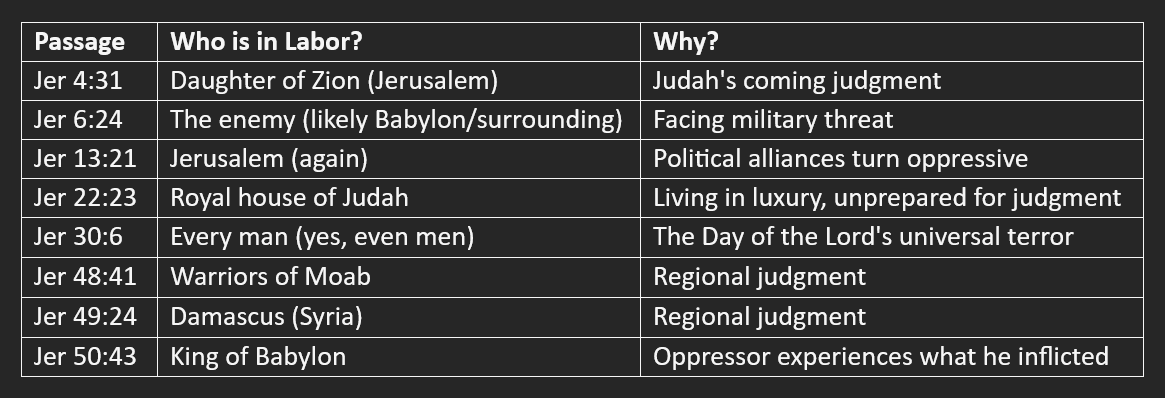
Do you see it? Everyone experiences labor pangs in Jeremiah’s vision. God’s people. God’s enemies. Regional powers. The great empire. Men. Women. Warriors. Kings. Cities. Nations.
The birth pang metaphor, in Jeremiah’s hands, becomes universal.
This is profoundly important for understanding the New Testament’s use of the metaphor. When Jesus says “all these are the beginning of birth pangs” (Matt 24:8), he’s standing in Jeremiah’s tradition. The birth pangs of the Messianic Age won’t be limited to one nation or one city. They’ll be global. Everyone— Jew and Gentile, believer and unbeliever —will feel the labor pains of the old age passing away and the new age being born.
MT vs. LXX: Translation Patterns
Before we conclude, let’s synthesize what we’ve observed about how the Septuagint translated Jeremiah’s birth imagery:
Hebrew Terms:
חוּל (chul) — to writhe, twist, be in labor
יָלַד (yalad) — to bear, give birth
חֶבֶל (chevel) — cord, rope; used for birth pangs
צָרָה (tzarah) — distress, anguish
Greek Equivalents in LXX:
ὠδίνω (ōdinō) — to suffer birth pangs (verb)
ὠδίν (ōdin) — birth pang (noun)
τίκτω (tiktō) — to give birth
ὡς τικτούσης (hōs tiktousēs) — “as one giving birth”
Observation:
The LXX translators used the ὠδίν (ōdin) word family as their standard translation for both chul and chevel, creating more consistency in Greek than exists in Hebrew. This standardization had lasting effects: when the New Testament writers (who used the LXX as their Old Testament) reached for language to describe the birth pangs of the last days, they naturally used ὠδίν-words, the same vocabulary the LXX used throughout the prophets.
In other words: the Septuagint translation choices in Jeremiah directly shaped New Testament eschatological vocabulary.
What’s Being Born?
We’ve talked extensively about the pangs, but we haven’t yet addressed the crucial question: What’s being born?
Jeremiah sees judgment. He sees destruction. He sees the death of the old order: the kingdom of Judah, the Temple, the Davidic monarchy, the land inheritance, everything that defined Israel’s identity.
But birth pangs always precede birth (well, usually at least). Something is coming. Jeremiah hints at it:
Jeremiah 30:3 — “Behold, days are coming, declares the LORD, when I will restore the fortunes of my people, Israel and Judah, says the LORD, and I will bring them back to the land that I gave to their fathers, and they shall take possession of it.”
Jeremiah 31:31-34 — “Behold, the days are coming, declares the LORD, when I will make a new covenant with the house of Israel and the house of Judah... I will put my law within them, and I will write it on their hearts... And no longer shall each one teach his neighbor and each his brother, saying, ‘Know the LORD,’ for they shall all know me, from the least of them to the greatest.”
The labor pains are real. The destruction is coming. But Jeremiah knows— even if he can’t fully articulate it yet —that after the pain comes new birth. A new covenant. A restored people. A rewritten heart.
This is why the metaphor is so powerful. It doesn’t just describe suffering. It describes suffering with purpose. It describes pain that leads to life.
If you’ve found this helpful or insightful, please share it with a friend who loves Scripture as much as you do.
Coming Up Next
In Part 4, we’ll turn to Micah, whose use of the birth pang metaphor connects directly to Messianic prophecy. We’ll see how Micah 4:9-10 and 5:2-3 use birth imagery to describe both Israel’s suffering and the arrival of the ruler from Bethlehem; a passage that Matthew will quote in his Gospel.
Until then, sit with Jeremiah’s vision. Sit with the image of every man with his hands on his loins. Sit with the reality that judgment, when it comes, spares no one. Sit with the profound truth that even in the most universal, inescapable suffering, something is being born.
Labor is not the end. It’s the prelude to a new beginning.
The LXX Scrolls is free to read and always will be. If this work has been worth something to you, there are a few ways to say so:
Buy the ebooks. Completed teaching series are available as polished ebooks under the Two Witnesses, One Truth series. Buying through Curios will support this work most directly but they’re also available on Amazon (and elsewhere) if you’re loyal to a particular ereader.
Become a supporter. A monthly or annual pledge through Substack helps me to bring the Septuagint to those who never knew they needed it.
Send a one-time tip. If this post has blessed you and you want to express that directly, you can Buy Me a Coffee.

Thank you for being part of this journey, your support makes this work possible.
© 2025 LXX Scrolls. All rights reserved.