

Hello brothers and sisters.
In Parts 1-3, we explored three major textual differences between the Septuagint and Masoretic Text in Isaiah 52-53: the explicit resurrection prophecy (”he will see light”), the medical vs. penal atonement debate (”cleanse” vs. “crush”), and the priestly-prophetic identity of the Servant (”sprinkle” vs. “startle”).
If you missed any of the previous posts, you can catch up below:
Now comes the big question: If there are differences between these ancient texts, what does that mean for biblical inspiration, authority, and inerrancy? Is this a problem? Or is it actually part of the plan?
If you’ve made it through Parts 1-3 of this series, you’ve discovered something that might initially feel unsettling:
The Bible you read isn’t based on a single, uniform Hebrew text. It’s based on multiple ancient textual traditions that sometimes disagree.
In Isaiah 53 alone, we’ve seen:
The Dead Sea Scrolls and LXX preserve “he will see light“ (resurrection) while the MT omits it
The LXX says God desired to “cleanse“ the Servant while the MT says God was pleased to “crush“ him
A single Hebrew word (נָזָה) can mean either “sprinkle“ (priestly) or “startle“ (prophetic)—and maybe both
For some readers, this raises anxious questions:
Which version is “right”?
If they disagree, doesn’t that undermine inerrancy?
How can we trust the Bible if we don’t even know what the original said?
Did God preserve His Word, or did He let it get corrupted?
These are honest questions. They deserve honest answers.
And the answer might surprise you:
What if multiple text forms aren’t a problem at all? What if they’re exactly what God intended?
If you’re reading this in email, be aware that the text is likely to cut off without warning. For a smoother reading experience and all the features Substack has to offer (including audio voiceovers of my posts), you can go HERE or download the app.
The Myth of the Single “Original” Text
Here’s something most Christians don’t realize: The idea that there was ever a single, unified, “original text” of the Old Testament is a modern assumption. And I hope you won’t be reaching for your pitchforks when I tell you… it’s probably wrong.
Let me explain.
We tend to think of biblical inspiration like this:
God inspired the original author (Isaiah) to write specific words
Those words were copied perfectly by faithful scribes
We have those copies (or copies of copies), and by careful textual criticism we can reconstruct the original
The “original text” is what’s inerrant, and any variants are corruptions
This model works reasonably well for the New Testament, where we have thousands of manuscripts dating from the 2nd-4th centuries, and textual criticism can confidently reconstruct the original with fair accuracy.
But the Old Testament doesn’t work that way.
Here’s what the evidence actually shows:
The Old Testament Text Was Pluriform from the Beginning
Well, perhaps not the beginning. How could we know that? The earliest extant copies of any Old Testament books are from roughly 1,500-2,000 years after the Pentateuch (first five books, those attributed to Moses) was first written.
Pluriform means “existing in multiple forms simultaneously,” which is exactly what we find in the pre-Christian period.
The Dead Sea Scrolls (250 B.C. - A.D. 70) revealed something stunning: There wasn’t just one version of the Hebrew Bible circulating in Second Temple Judaism. There were several. That we know of.
Example: The Book of Jeremiah
The Masoretic Text of Jeremiah is 1/8th longer than the Septuagint version. That’s about 2,700 words longer.
The order of chapters is also different: chapters 46-51 appear in a completely different sequence in the LXX.
For centuries, scholars assumed the LXX translators just took liberties with the text, shortening it and rearranging it.
Then came the Dead Sea Scrolls.
In Cave 4 at Qumran, scholars found three Hebrew manuscripts of Jeremiah:
Two (4QJera and 4QJerc) follow the longer MT tradition
One (4QJerb) follows the shorter LXX tradition
Do you see what this means? Both the long version and the short version existed in Hebrew, side by side, in the same Jewish community, at the same time.
Neither had marginal notes saying “this one is corrupt” or “this one is correct.” They were both treated as authoritative Scripture.
What This Means
The evidence from Qumran suggests that textual pluriformity was normal in Second Temple Judaism.
Different communities preserved different editions of the same books. Sometimes these were parallel literary editions (like Jeremiah). Sometimes they reflected different stages of composition or editing. Sometimes they were just regional text types.
But— and this is crucial —they were all considered inspired Scripture.
The Jewish scribes at Qumran didn’t think they had to choose between manuscripts. They copied and preserved multiple traditions, trusting that all of them faithfully transmitted God’s Word.
Isaiah 53: A Case Study in Textual Pluriformity
Now let’s apply this to our passage.
In Isaiah 53, we don’t have the dramatic differences we see in Jeremiah (no missing chapters or major rearrangements). But we do have theologically significant variants:
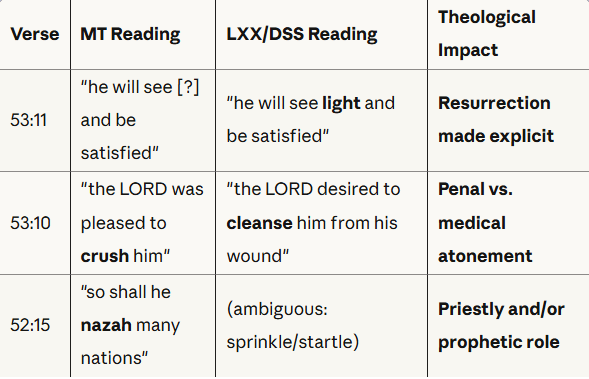
Now here’s the key question: Which reading is “original”?
For Isaiah 53:11 (”see light”), the answer seems clear: The DSS and LXX are original; the MT lost it through scribal error. Three ancient Hebrew manuscripts plus the Greek translation all agree against the medieval MT.
For Isaiah 53:10 (”crush” vs. “cleanse”), the answer is murkier. Both could be ancient. Both could be inspired. They might reflect different Hebrew Vorlagen (parent texts) that coexisted, or they might represent theological interpretation by the LXX translators working under divine inspiration.
For Isaiah 52:15 (”sprinkle” vs. “startle”), both meanings might be intentionally present through wordplay.
The point? These aren’t necessarily “corruptions” of a single original. They might be complementary witnesses to a textual tradition that was pluriform from the start.
But Doesn’t Inerrancy Require a Single Original?
This is where we need to think carefully about what we mean by “inerrancy.”
The Traditional Formulation
The Chicago Statement on Biblical Inerrancy (1978) says:
“We affirm that inspiration, strictly speaking, applies only to the autographic text of Scripture, which in the providence of God can be ascertained from available manuscripts with great accuracy.”
This assumes:
There was a single “autographic text” (original)
We can reconstruct it from manuscripts
That reconstructed original is what’s inerrant
This works fine for the New Testament. We have early, abundant manuscripts, and textual criticism can confidently recover the original wording.
But it doesn’t work as well for the Old Testament, where:
The manuscripts we have are much later (medieval)
The ancient witnesses (LXX, DSS, Samaritan Pentateuch) often disagree
Some books (like Jeremiah) seem to have had multiple inspired editions
A Better Formulation?
What if we said this instead:
God inspired the biblical authors to write His Word. In His providence, He preserved that Word through multiple textual traditions. Where these traditions differ, both may faithfully transmit the inspired message, offering complementary perspectives on the same divine truth.
This doesn’t abandon inerrancy. It redefines it to match the actual evidence.
Inerrancy applies to what God inspired. Not to a single reconstructed manuscript, but to the textual tradition(s) God providentially preserved.
If God inspired both a longer and shorter Jeremiah, both are inerrant.
If God inspired Isaiah 53:10 to say “cleanse” in one tradition and “crush” in another, both are inerrant. Clearly both are true descriptions of what God did through Christ.
The Apostolic Precedent: Paul Didn’t Worry About This
Here’s what should really settle the issue: The Apostles used the Septuagint, and they never worried about its differences from the Hebrew.
Romans 15:12 - Paul quotes Isaiah 11:10 from the LXX, which differs significantly from the MT in that verse.
Romans 11:26-27 - Paul quotes Isaiah 59:20 from the LXX: “The Deliverer will come from Zion.” The MT says “to Zion.” Paul follows the LXX.
Matthew 8:17 - Matthew quotes Isaiah 53:4 from the LXX: “He took our illnesses and bore our diseases.” The MT says “He bore our griefs and carried our sorrows.” Matthew uses the LXX’s medical language.
Acts 7:14 - Stephen says 75 people went down to Egypt with Jacob, following the LXX. The MT says 70. Luke records Stephen’s LXX-based speech without correction.
Did Paul, Matthew, and Luke know about these differences? Probably. Paul was a trained pharisaic rabbi. He would have known Hebrew. Matthew was writing to a Jewish audience.
Did they care? Apparently not. They quoted the LXX freely, even when it differed from the Hebrew, because they believed the LXX was also inspired Scripture.
If it was good enough for the Apostles, it should be good enough for us.
Two Complementary Portraits of the Messiah
Now let’s bring this back to Isaiah 53 and see how the textual differences actually enrich our understanding of Christ.
The Resurrection Prophecy (53:11)
MT alone: “He will see [?] and be satisfied”
Implies resurrection but doesn’t state it explicitly
Leaves room for mystery and interpretation
LXX + DSS: “He will see light and be satisfied”
Explicitly predicts resurrection
Uses Hebrew idiom for life-after-death
Makes the prophecy unmistakable
What we gain from both:
The MT preserves the mystery; resurrection is implied but not obvious (fitting for prophecy)
The LXX/DSS preserve the clarity—resurrection is stated outright
Together, they show that Isaiah intended both mystery and clarity: hidden to those who don’t have eyes to see, but plain to those who do
The Atonement Theology (53:10)
MT: “Yet it was the LORD’s will to crush him”
Emphasizes God’s justice and the weight of sin
Highlights the Servant’s suffering as penal/substitutionary
Christ bears the punishment we deserve
LXX: “And the LORD desired to cleanse him from his wound”
Emphasizes God’s restorative purpose
Highlights the Servant’s healing ministry
Christ descends into our condition to heal us from within
What we gain from both:
The MT preserves the penal dimension: sin must be dealt with, wrath must be borne
The LXX preserves the medical dimension: the goal is healing, not punishment for its own sake
Together, they give us a full-orbed atonement theology: Christ was crushed so that God could cleanse Him and us; the crushing was the means, the cleansing was the goal
The Dual Identity (52:15)
“Sprinkle” reading:
The Servant as Priest
Atoning, cleansing, mediating
Blood sacrifice for the nations
“Startle” reading:
The Servant as Prophet/King
Revealing, astonishing, proclaiming
Gospel announcement to the nations
What we gain from both:
Jesus isn’t just a Priest OR a Prophet—He’s both
He doesn’t just cleanse OR reveal—He does both
The wordplay (nazah) intentionally captures His dual role
Practical Implications: How Should We Read Our Bibles?
So where does all this leave us practically?
1. Trust Your English Bible
Your English translation is reliable. Whether you use the ESV, NIV, NASB, NRSV, or CSB, the translators have done the hard work of textual criticism for you. They’ve consulted the MT, LXX, DSS, and other witnesses, and they’ve made informed decisions about what to include.
When you see a footnote saying “Dead Sea Scrolls read...” or “LXX adds...”, don’t panic. That’s transparency, not a problem. The translators are showing you the textual landscape.
2. Read the Footnotes
The footnotes are gold. They’re not just “optional trivia.” They’re windows into the ancient textual tradition.
When the ESV says “Dead Sea Scroll he shall see light,” that’s not undermining the text, it’s enriching it. Now you know that ancient Hebrew manuscripts explicitly predicted resurrection, even if the medieval MT lost that word.
3. Compare Translations
Different translations sometimes reflect different textual traditions:
ESV/NASB/NKJV tend to follow the MT closely
NRSV tends to be more eclectic, adopting LXX/DSS readings when they seem original
Orthodox Study Bible translates directly from the LXX
Read multiple translations. See where they differ. Ask why. You’ll discover textual richness you never knew existed.
4. Don’t Pit MT Against LXX
They’re not enemies. They’re complementary witnesses.
The MT is the official Jewish text, preserved with incredible care by the Masoretes.
The LXX is the Bible of the early Church, used by Jesus (probably), certainly by the Apostles, and by the Church Fathers.
Both have authority. Both are inspired. Both are gifts.
Sometimes the MT preserves the original reading.
Sometimes the LXX does.
Sometimes they’re both right in different ways.
5. Embrace the Mystery
Not every textual question has a clear answer. And that’s okay.
Did Isaiah write “crush” or “cleanse” in 53:10? We may never know with 100% certainty which word was in the autograph.
But we do know this:
Both readings are ancient
Both were considered inspired by faithful Jews and Christians
Both teach true theology about Christ’s work
God has preserved both for us
Maybe instead of asking “Which one is right?” we should ask “What does God want us to learn from having both?”
The Providence of Textual Pluriformity
Here’s my theory: God intended for the biblical text to exist in multiple forms.
Not because He couldn’t preserve a single text (He could have).
Not because scribes were careless (the Hebrew scribes, at least, were remarkably careful).
But because textual pluriformity serves a theological purpose.
Purpose #1: It Prevents Idolatry of the Letter
If there were only one manuscript, one textual tradition, one perfect copy, we’d be tempted to worship the artifact rather than the God it reveals.
The multiplicity of texts forces us to seek the meaning behind the words, not just the words themselves.
The Pharisees had the text. They studied it meticulously. But they missed the Messiah standing in front of them because they worshiped the letter instead of knowing the Spirit.
Textual pluriformity keeps us humble. We can’t just say “My version is right and yours is wrong.” We have to listen, compare, discern.
Purpose #2: It Gives Us Stereoscopic Vision
You have two eyes. Why? Because depth perception requires two slightly different perspectives.
If God had given us only one textual tradition, we’d have only one perspective on Isaiah 53.
Instead, He gave us at least two (MT and LXX), and in some cases three or four (when DSS and Samaritan Pentateuch weigh in).
The result? We see the text in 3D.
MT shows us the crushing (penal dimension)
LXX shows us the cleansing (restorative dimension)
Together, we see the fullness of what Christ accomplished
That’s not a bug. That’s designed redundancy for richer revelation.
Purpose #3: It Models the Unity-in-Diversity of the Church
The Church has one Lord, one faith, one baptism—but it exists in many forms.
Eastern Orthodox, Roman Catholic, Protestant, Coptic, Ethiopian, Syrian… all confess Christ, all read Scripture, all have slightly different canons and textual traditions.
The Orthodox use the LXX.
The Catholics use the Vulgate (based on Hebrew, but with Deuterocanonical books from LXX).
The Protestants largely use the MT (but recognize the LXX’s historical importance).
Is this a problem? Only if we think uniformity equals unity.
But unity doesn’t require uniformity. The Church is one body with many members. The Scripture is one Word with many textual witnesses.
God used textual pluriformity to teach us how to be the Church: united in essentials, diverse in expression, humble in disagreements, rich in complementarity.
What About Inerrancy? A Positive Proposal
Let me offer a doctrine of inspiration and inerrancy that accounts for textual pluriformity:
Thesis: God inspired the original authors of Scripture to write His Word. In His providence, He preserved that Word through multiple textual traditions, all of which faithfully transmit His revelation. Where these traditions differ in wording, both may be considered inspired where both teach true theology consistent with the unified testimony of Scripture. Textual criticism helps us discern the earliest recoverable readings, but variant readings preserved in ancient witnesses may also carry theological authority when they reflect authentic interpretive traditions guided by the Spirit.
What This Means Practically:
1. Inspiration applies to the original text(s)—but “original” may include multiple inspired editions (like Jeremiah).
2. Inerrancy applies to what God intended to reveal—not necessarily to every scribal detail, but to the theological truth conveyed.
3. Textual variants don’t threaten inerrancy when they represent:
Scribal errors that don’t affect meaning.
Different but equally valid translations/interpretations.
Complementary traditions that enrich our understanding.
4. We trust God’s providence in textual transmission—He got us what we need to know Him and His Messiah.
5. Textual criticism is a tool for worship, not a threat to faith—it helps us listen more carefully to what God has said.
How the Early Church Handled This
You know what’s remarkable? The early Church Fathers weren’t bothered by textual differences.
They knew the LXX differed from the Hebrew.
They knew there were textual variants.
They knew manuscripts disagreed sometimes.
And they kept right on preaching Christ.
Origen (c. 185-254) even created the Hexapla—a massive six-column work placing the Hebrew text alongside multiple Greek translations (LXX, Aquila, Symmachus, Theodotion) to compare them.
Did Origen freak out when he found differences? No. He studied them. He learned from them. He used them to enrich his understanding of Scripture.
Jerome (c. 347-420), when translating the Latin Vulgate, consulted both the Hebrew and the LXX. When they differed, he made judgment calls. Sometimes he followed the Hebrew. Sometimes he followed the LXX.
Did Jerome think this undermined biblical authority? No. He believed God’s Word was stable and sure. And he believed it precisely because it was witnessed by multiple ancient traditions that agreed on the essentials.
The Fathers had a high view of Scripture and a sane view of textual transmission. They knew copies weren’t perfect. They knew translations involved interpretation. And they trusted God’s providence anyway.
Maybe we should too.
A Final Word: The Messiah Is Bigger Than the Variants
Here’s the ultimate answer to the “inerrancy question”:
Jesus doesn’t need a perfect manuscript tradition to be perfectly revealed.
Think about it: The New Testament writers quote the Old Testament roughly 300 times. Sometimes they quote the LXX. Sometimes they quote the MT. Sometimes instead of quoting they give their own inspired paraphrase.
Did this bother the Apostles? Not at all.
Why? Because they weren’t defending a textual tradition. They were proclaiming a Person.
Isaiah 53 points to Jesus whether you read it in Hebrew (MT), Greek (LXX), or English (any version). The textual differences we’ve explored in this series— resurrection, atonement, priestly/prophetic identity —all point to the same Messiah:
He suffered and died (all texts agree)
He rose from the dead (explicit in LXX/DSS, implied in MT)
He atoned for sin (penal emphasis in MT, medical emphasis in LXX)
He cleanses and reveals (priestly in “sprinkle,” prophetic in “startle”)
Two textual traditions. One Messiah.
That’s not a problem. That’s stereo sound.
Textual Differences Are a Gift
If you came into this series worried that LXX/MT differences undermine biblical authority, I hope you’re leaving with a different perspective:
Textual differences aren’t a threat to faith. They’re an invitation to see more.
The Dead Sea Scrolls didn’t weaken our confidence in Isaiah 53. Instead, they strengthened it by giving us older, better manuscripts that explicitly predict resurrection.
The LXX didn’t corrupt Isaiah 53, it preserved a theological emphasis (cleansing, healing) that the medieval MT lost or de-emphasized.
The ambiguity of “sprinkle/startle” isn’t a translation problem, it’s a poetic masterstroke that captures the Servant’s dual role.
God gave us multiple textual traditions for the same reason He gave us four Gospels instead of one: Because truth is multi-faceted, and seeing it from multiple angles makes it richer, deeper, and fuller.
So the next time you see a footnote in your Bible saying “Some manuscripts read...” Don’t skip it. Read it. Treasure it.
You’re holding not just a book, but a library of ancient witnesses, all testifying to the same glorious truth:
The Messiah suffered, died, rose again, cleanses us, and will startle the nations with His glory.
And that message comes through loud and clear in every manuscript, in every translation, in every textual tradition.
Because the Word of God is living and active. And no amount of textual variance can obscure the One to whom all Scripture points.
If you found this helpful, enlightening, or even challenging, share it with a friend who loves Scripture as much as you do.
Postscript: A Prayer for Students of Scripture
Lord,
You inspired Your prophets to write of the Messiah.
You preserved their words through faithful scribes across millennia.
You gave us the Dead Sea Scrolls, the Septuagint, and the Masoretic Text.
Not to confuse us, but to enrich us.
Teach us to read with humility,
To compare texts with care,
To discern truth with wisdom,
And to see Jesus in every word.
When manuscripts differ, show us Your providence.
When translations vary, show us Your purpose.
When questions arise, show us Your Son.
Help us put Him in the center and see our confusion vanish.
For You are the God who speaks.
And Your Word is sure,
Your promises are certain,
Your Messiah is revealed,
In every tongue, in every text, in every tradition.
In the name of Jesus, the Living Word,
Amen.
For Further Reading
If this series has sparked your interest in textual criticism and the Septuagint, here are some resources for deeper study:
Introductory:
Karen Jobes & Moisés Silva, Invitation to the Septuagint (accessible intro to LXX)
Emanuel Tov, Textual Criticism of the Hebrew Bible (the standard work, but technical)
Timothy McLay, The Use of the Septuagint in New Testament Research (how Apostles used LXX)
Advanced:
Martin Hengel, The Septuagint as Christian Scripture (historical theology)
Eugene Ulrich, The Dead Sea Scrolls and the Origins of the Bible (text-critical)
Jennifer Dines, The Septuagint (Orthodox perspective)
For Isaiah 53 specifically:
Daniel Bailey, “The Suffering Servant: Isaiah 53 in the Septuagint” (in Hengel’s volume)
Alec Motyer, The Prophecy of Isaiah (evangelical commentary, MT-based)
Peter Flint, The Great Isaiah Scroll and the Masoretic Text (DSS expert)
Online:
NETS (New English Translation of the Septuagint): nets.bible.org
Orthodox Study Bible (LXX-based): Available in print
Blue Letter Bible: Compare MT, LXX, DSS side-by-side
Thank You for Reading
This concludes our four-part series on Isaiah 53’s textual differences. I hope you’ve discovered that the Bible is even more wonderful than you thought. Not less trustworthy because of textual variants, but more glorious because of the rich, multi-dimensional witness God has preserved.
The Suffering Servant suffered, died, rose, cleansed us, and will startle the nations.
That message is inerrant.
That truth is unchanging.
That Messiah is Jesus.
And you can trust that, no matter which manuscript tradition you’re reading.
Coming Up Next
What’s Next: From the Suffering Servant to Leviathan
We’ve spent four posts exploring how the Septuagint and Masoretic Text offer complementary perspectives on Isaiah’s Suffering Servant. We’ve seen resurrection made explicit, atonement theology enriched, and the Messiah’s identity revealed in stereo rather than mono.
But textual criticism isn’t just for the “safe” passages.
What happens when we apply the same careful, comparative approach to one of Scripture’s strangest passages? What happens when we ask: What did the ancient translators think Job 41 was describing?
You know the passage. God, speaking from the whirlwind, challenges Job:
“Can you draw out Leviathan with a fishhook?” (Job 41:1)
What follows is thirty-four verses of detailed description: impenetrable scales, fire-breathing nostrils, smoke pouring from its mouth, eyes that glow like dawn, a creature that makes the ocean boil and leaves a luminous wake. A creature so terrifying that “when it raises itself up, the mighty are afraid” (Job 41:25).
For centuries, we’ve been told this is poetic hyperbole about a crocodile. Or maybe a whale. Or perhaps just symbolic language for chaos.
But the Septuagint translators— those same Jewish scholars working 250-150 B.C. who gave us “he will see light” in Isaiah 53:11 —had a different take.
They called it a δράκων (drakōn).
A dragon.
Not metaphorically. Not poetically. They used the same Greek word that Homer used for the serpent that attacked Laocoon, that Hesiod used for the dragon that guarded the Golden Fleece, that Greek mythology used for the monster Python slain by Apollo.
The ancient translators thought God was describing a dragon.
And they weren’t alone. When we look at Job 41 in its broader biblical context, when we connect it to Genesis 1:21’s “great sea creatures” (תַּנִּינִם, tanninim, the same word used for dragons in Isaiah 27:1), when we examine the Dead Sea Scrolls’ Book of Giants (which describes Nephilim battling Leviathan), when we compare Job’s description to dragon accounts from Mesopotamia to China to medieval Europe… a fascinating possibility emerges:
What if they called it a dragon because that’s what it was?
In our next series, we’re going to do something that might make some readers uncomfortable: We’re going to take Job 41 literally. Not as allegory. Not as poetic exaggeration. Not as ancient misunderstanding of crocodile behavior.
The LXX Scrolls is free to read and always will be. If this work has been worth something to you, there are a few ways to say so:
Buy the ebooks. Completed teaching series are available as polished ebooks under the Two Witnesses, One Truth series. Buying through Curios will support this work most directly but they’re also available on Amazon (and elsewhere) if you’re loyal to a particular ereader.
Become a supporter. A monthly or annual pledge through Substack helps me to bring the Septuagint to those who never knew they needed it.
Send a one-time tip. If this post has blessed you and you want to express that directly, you can Buy Me a Coffee.

Thank you for being part of this journey, your support makes this work possible.
© 2025 LXX Scrolls. All rights reserved.