


Hello brothers and sisters.
We’ve spent seven parts diagnosing the disease. Now we prescribe the cure.
Across this series, we’ve examined the full spectrum of idolatry:
Physical idols and false gods
Sacred objects transformed into substitutes for God
Human beings elevated to divine status
Pursuits and possessions that consume our hearts
The throne-seeking self
Religion itself becoming the idol
If you missed any of the previous posts, you can catch up below:
The catalog is exhaustive because idolatry is comprehensive; it’s the fundamental human condition. But diagnosis without treatment offers no hope. So we turn now to the only cure that can break the stranglehold of idolatry: the Gospel of Jesus Christ.
If you’re reading this in email, be aware that the text is likely to cut off without warning. For a smoother reading experience and all the features Substack has to offer (including audio voiceovers of my posts), you can go HERE or download the app.
The Problem: The Great Exchange
Paul’s indictment in Romans 1 reveals the core mechanism of idolatry:
Romans 1:21-25: διότι γνόντες τὸν θεὸν οὐχ ὡς θεὸν ἐδόξασαν ἢ ηὐχαρίστησαν, ἀλλ’ ἐματαιώθησαν ἐν τοῖς διαλογισμοῖς αὐτῶν καὶ ἐσκοτίσθη ἡ ἀσύνετος αὐτῶν καρδία... καὶ ἤλλαξαν τὴν δόξαν τοῦ ἀφθάρτου θεοῦ ἐν ὁμοιώματι εἰκόνος φθαρτοῦ ἀνθρώπου... οἵτινες μετήλλαξαν τὴν ἀλήθειαν τοῦ θεοῦ ἐν τῷ ψεύδει καὶ ἐσεβάσθησαν καὶ ἐλάτρευσαν τῇ κτίσει παρὰ τὸν κτίσαντα
“For although they knew God, they did not honor him as God or give thanks to him, but they became futile in their thinking, and their foolish hearts were darkened... and they exchanged the glory of the immortal God for images resembling mortal man... They exchanged the truth about God for a lie and worshiped and served the creature rather than the Creator, who is blessed forever! Amen.”
Notice the repetition: ἤλλαξαν (ēllaxan, v. 23) and μετήλλαξαν (metēllaxan, v. 25); both forms of ἀλλάσσω (allassō), “to exchange.” Paul isn’t describing an addition but a substitution. Humanity didn’t add idols alongside God; we replaced God with idols.
The Double Exchange
Paul identifies two devastating exchanges:
They exchanged the glory of the immortal God (τὴν δόξαν τοῦ ἀφθάρτου θεοῦ) for images (ἐν ὁμοιώματι εἰκόνος)
The Greek ἀφθάρτου (aphthartou) means “imperishable, incorruptible, immortal.” They traded the eternal, glorious, transcendent God for φθαρτοῦ (phthartou)—”perishable, corruptible, mortal” images. They exchanged infinite worth for worthless copies.
They exchanged the truth about God (τὴν ἀλήθειαν τοῦ θεοῦ) for the lie (ἐν τῷ ψεύδει)
Note the definite article: τῷ ψεύδει—”the lie,” not “a lie.” Paul may be referencing the original lie in Genesis 3: “You will be like God” (Genesis 3:5). The primal lie that birthed all idolatry was the promise that we could replace God with ourselves or with created things and find satisfaction.
The Result
Paul uses stark language for the outcome:
ἐματαιώθησαν (emataiōthēsan): “they became futile”—their thinking became empty, purposeless, vain
ἐσκοτίσθη (eskotisthē): “was darkened”—their understanding became obscured
ἐσεβάσθησαν καὶ ἐλάτρευσαν (esebasthēsan kai elatreusan): “they worshiped and served”—religious language reserved for God alone, now directed toward creation
This is the idolatrous condition: worshiping the created instead of the Creator, and finding ourselves empty, dark, and enslaved.
The Solution: The Greater Exchange
But the Gospel announces a reversal. If Romans 1 describes the terrible exchange that enslaves humanity, the Gospel proclaims the glorious exchange that sets us free.
Christ Makes the Exchange
2 Corinthians 5:21:
τὸν μὴ γνόντα ἁμαρτίαν ὑπὲρ ἡμῶν ἁμαρτίαν ἐποίησεν, ἵνα ἡμεῖς γενώμεθα δικαιοσύνη θεοῦ ἐν αὐτῷ.
“For our sake he made him to be sin who knew no sin, so that in him we might become the righteousness of God.”
Here’s the divine exchange:
Christ, who knew no sin (τὸν μὴ γνόντα ἁμαρτίαν), became sin (ἁμαρτίαν ἐποίησεν) for us
We, who had no righteousness, become the righteousness of God (γενώμεθα δικαιοσύνη θεοῦ) in Him
This isn’t merely forgiveness; it’s substitutionary transformation. Christ takes our idolatrous rebellion, and we receive His perfect righteousness.
The Idol-Breaking Power of the Cross
Colossians 2:13-15:
καὶ ὑμᾶς νεκροὺς ὄντας ἐν τοῖς παραπτώμασιν... συνεζωοποίησεν ὑμᾶς σὺν αὐτῷ, χαρισάμενος ἡμῖν πάντα τὰ παραπτώματα, ἐξαλείψας τὸ καθ’ ἡμῶν χειρόγραφον τοῖς δόγμασιν... ἀπεκδυσάμενος τὰς ἀρχὰς καὶ τὰς ἐξουσίας ἐδειγμάτισεν ἐν παρρησίᾳ, θριαμβεύσας αὐτοὺς ἐν αὐτῷ.
“And you, who were dead in your trespasses... God made alive together with him, having forgiven us all our trespasses, by canceling the record of debt that stood against us with its legal demands... He disarmed the rulers and authorities and put them to open shame, by triumphing over them in him.”
Three stunning Gospel realities destroy idolatry’s power:
1. Resurrection: We Are Made Alive (συνεζωοποίησεν)
The verb συζωοποιέω (syzōopoieō) is rare and powerful: ”to make alive together with.” The σύν (syn) prefix emphasizes union: we are made alive with Christ, not merely like Christ. His resurrection life becomes our life.
Why does this matter for idolatry? Because idols promise life but deliver death. We turn to them seeking satisfaction, purpose, and identity; but they’re “dumb idols” (1 Corinthians 12:2), lifeless and powerless. Christ gives actual life, not the mirage of life that idols dangle before us, but genuine, eternal, abundant life (John 10:10).
2. Forgiveness: The Debt Is Canceled (χαρισάμενος πάντα τὰ παραπτώματα)
The word χαρισάμενος (charisamenos, “having forgiven”) comes from χάρις (charis)—”grace, gift.” God’s forgiveness isn’t grudging tolerance; it’s gracious, generous, complete gift.
Paul describes what was canceled: τὸ χειρόγραφον (to cheirographon): literally a “handwritten document,” a certificate of debt. Picture it: every act of idolatry, every exchange of God’s glory for created things, every moment of serving self instead of the Savior; all recorded, all owed, all unpayable.
Then Paul says God ἐξαλείψας (exaleipsas): ”wiped out, blotted out, erased.” The verb suggests taking a wet sponge to ink on parchment until no trace remains. The debt that guaranteed our condemnation? Gone. Obliterated. Removed.
And how? Paul says God nailed it to the cross. The debt-certificate that condemned us was nailed to the cross where Jesus died. The punishment we owed for our idolatry was paid there. The wrath we deserved for exchanging God’s glory fell on Christ. The cross satisfied the justice that idolatry violated.
3. Victory: The Powers Are Disarmed (ἀπεκδυσάμενος)
The most dramatic statement: God ἀπεκδυσάμενος τὰς ἀρχὰς καὶ τὰς ἐξουσίας: ”disarmed the rulers and authorities” or literally “stripped off the rulers and authorities.”
The verb ἀπεκδύομαι (apekdyomai) means to strip off completely, like removing a garment. The only other place it appears in Colossians is 3:9, where believers are told to “strip off the old self.” Paul uses the same word: Christ stripped the demonic powers the way we strip off filthy clothes.
What did He strip from them? Their weapons. And what were their weapons?
Hebrews 2:14-15 explains:
“that through death he might destroy the one who has the power of death, that is, the devil, and deliver all those who through fear of death were subject to lifelong slavery.”
Satan’s weapon was the fear of death, and behind that fear was the sting of sin and condemnation. But when Christ died, bearing our sin and rising victorious, He removed the sting. Death lost its terror because judgment was satisfied. Sin lost its power because forgiveness was secured.
And Paul says Christ ἐδειγμάτισεν ἐν παρρησίᾳ (edeigmatisen en parrēsia): ”made a public spectacle” or “publicly displayed them.” The imagery is of a Roman triumph, where a victorious general would parade defeated enemies through the streets in chains.
The cross looked like defeat, with Jesus mocked, beaten, and executed as a criminal. But Paul says it was actually θριαμβεύσας (thriambeusas): ”triumphing,” celebrating victory. On the cross, Christ defeated every power that held us in bondage to idolatry. He broke the fear that drives us to false securities. He destroyed the guilt that makes us hide behind religious performance. He shattered the slavery that keeps us serving created things.
How the Gospel Defeats Specific Idols
Let’s trace how this Gospel victory addresses each form of idolatry we’ve examined:
1. Physical Idols and False Gods
The cross declares: There is only one true God, and He has acted decisively in history.
Idols are silent, impotent, and imaginary (Psalm 115:4-8). The God of the Gospel speaks (Hebrews 1:1-2), acts (Colossians 1:20), and reveals Himself in Christ (John 14:9). You don’t need substitute deities when the true God has made Himself known and accessible through His Son.
Application: When tempted to put trust in anything that promises divine power or protection apart from Christ— whether astrology, superstition, or modern forms of spiritual searching —remember that Christ alone is “the image of the invisible God” (Colossians 1:15). Every other “god” is a poor counterfeit.
2. Sacred Objects Turned Into Idols
The cross declares: The symbols point to the reality; Christ is the fulfillment.
Remember Nehushtan, the bronze serpent (from Part 1)? God commanded its creation for healing, but Israel turned it into an idol. Christ referenced it as a type of His crucifixion (John 3:14-15): the serpent on the pole pictured Christ becoming sin for us. Once Christ came, the symbol was fulfilled.
All sacred objects— whether the brazen serpent, the ark, or the temple —pointed forward to Christ. When the reality arrives, clinging to the shadows becomes idolatrous.
Application: Christian symbols, practices, and traditions are valuable as means of grace that point us to Christ. But when we vest them with inherent power apart from Christ, or when they become ends rather than means, we’ve made them idols. The Gospel frees us to use sacred things rightly, as windows to Christ, not walls between us and Christ.
3. People as Idols
The cross declares: Only one man is worthy of absolute trust and devotion; the God-man, Jesus Christ.
We explored the danger of trusting humans (in Part 4). Even good leaders, even godly pastors. Every human disappoints because every human is fallen. Even the best people make terrible saviors.
But Christ is the Second Adam (Romans 5:12-21), the perfect human who obeyed where we failed. He’s the ultimate Prophet (Deuteronomy 18:15; Acts 3:22), Priest (Hebrews 4:14-16), and King (Revelation 19:16). Every human authority points to Him and derives authority from Him. When we make a person ultimate, we burden them with a weight only Christ can carry.
Application: Honor human authority and learn from godly leaders (Hebrews 13:7), but remember Psalm 118:8: “It is better to take refuge in the LORD than to trust in man.” The Gospel gives us the perfect human— fully God and fully man —who will never fail, never disappoint, and never die again.
4. Pursuits and Possessions
The cross declares: Christ is the treasure that satisfies every longing.
Paul counted his impressive résumé as σκύβαλα (skybala)— ”rubbish, garbage, dung” —compared to “the surpassing worth of knowing Christ Jesus my Lord” (Philippians 3:8). Why? Because in Christ are “hidden all the treasures of wisdom and knowledge” (Colossians 2:3).
The idols of wealth, success, comfort, and security all promise satisfaction but deliver emptiness. Jesus alone can say, “I am the bread of life; whoever comes to me shall not hunger, and whoever believes in me shall never thirst” (John 6:35).
Application: The Gospel doesn’t demonize possessions or pursuits, it merely dethrones them. Money, career, comfort, family are all good gifts. But when we believe these things can give us what only Christ can give— ultimate security, worth, purpose, satisfaction —we’re functional atheists. The cross reminds us that God loved us enough to give His Son (Romans 8:32), so we can trust Him to provide everything we need.
5. The Idol of Self
The cross declares: You must die to live.
This is the most direct assault. Jesus said, “If anyone would come after me, let him deny himself and take up his cross and follow me” (Mark 8:34). The cross is an instrument of death. And that’s the point.
Paul writes, “I have been crucified with Christ. It is no longer I who live, but Christ who lives in me” (Galatians 2:20). The ego that demands to be God, the pride that refuses to bow, the self-righteousness that clings to performance; all these die at the cross.
But here’s the Gospel paradox: in dying, we live. “For whoever would save his life will lose it, but whoever loses his life for my sake will find it” (Matthew 16:25). When self-as-god dies, we discover our true identity as beloved children of God. We exchange the crushing burden of self-determination for the liberating rest of gospel-identity.
Application: Self-denial isn’t self-hatred. It’s the recognition that the self-enthroned is the self-enslaved. The Gospel offers the death that leads to life; the crucifixion of the tyrannical ego and the resurrection of our true humanity in Christ. We don’t become less ourselves; we become our truest selves by living in union with Christ.
6. Religious Idolatry
The cross declares: God despises performance-based religion and demands heart transformation.
This is perhaps the Gospel’s most counter-intuitive assault on idolatry. Religion— even biblical religion —becomes an idol when we use it to earn God’s favor rather than to express love for the God who has already shown us favor in Christ.
The Pharisees had impeccable religious credentials. But Jesus said, “Unless your righteousness exceeds that of the scribes and Pharisees, you will never enter the kingdom of heaven” (Matthew 5:20). How can anyone exceed Pharisee-level righteousness?
Only by receiving Christ’s righteousness as a gift. The Gospel announces that “God made him to be sin who knew no sin, so that in him we might become the righteousness of God” (2 Corinthians 5:21). We don’t achieve righteousness through religious performance; we receive it through faith in Christ’s performance.
Application: Religious idolatry thrives on the lie that God’s love must be earned. The Gospel shatters this lie by announcing that God’s love was demonstrated while we were still sinners (Romans 5:8). We practice spiritual disciplines not to earn God’s favor but because we already have it in Christ. Prayer, worship, Bible reading, and service all flow from grace, not toward it.
How the Gospel Works: Five Movements
Understanding what the Gospel is and how it breaks idolatry’s power are different questions. Let’s trace the Gospel’s operation in the life of the believer:
Movement 1: The Spirit Convicts and Exposes
John 16:8:
“And when he comes, he will convict the world concerning sin and righteousness and judgment”
The Holy Spirit opens our eyes to see our idols. Left to ourselves, we’re blind to our functional gods. But the Spirit, working through the Word (Hebrews 4:12), exposes “the thoughts and intentions of the heart.”
This conviction isn’t condemnation, it’s a diagnosis. The Spirit shows us what we’ve been trusting instead of God so we can repent and turn to Christ.
Movement 2: The Gospel Grants Repentance
2 Timothy 2:25:
“God may perhaps grant them repentance leading to a knowledge of the truth”
Repentance is a gift, not merely a decision. The verb μετάνοια (metanoia) means “change of mind,” but it’s deeper than intellectual assent. It’s a Spirit-wrought reorientation of the entire person from idols to God.
True repentance mourns sin (2 Corinthians 7:10), but it also includes hope. Because we’re not turning from something into emptiness; we’re turning to Someone infinitely better.
Movement 3: Faith Transfers Allegiance
Acts 20:21:
“testifying both to Jews and to Greeks of repentance toward God and of faith in our Lord Jesus Christ”
Faith is the instrument by which we receive what Christ accomplished. But biblical faith isn’t mere intellectual agreement; it’s trust-driven allegiance.
The Greek πίστις (pistis) implies both belief and faithfulness. We believe Christ is trustworthy, and therefore we entrust ourselves to Him. Faith is the means by which we stop serving idols and start serving the living God (1 Thessalonians 1:9).
Movement 4: Union with Christ Transforms Identity
Galatians 2:20:
“I have been crucified with Christ. It is no longer I who live, but Christ who lives in me. And the life I now live in the flesh I live by faith in the Son of God, who loved me and gave himself for me.”
The Gospel doesn’t just forgive us and leave us unchanged. It unites us to Christ so that His death becomes our death, His resurrection our resurrection, and His life our life.
Paul uses the perfect tense: “I have been crucified” (συνεσταύρωμαι, synestaurōmai): it’s a past event with ongoing effects. At conversion, we were united to Christ’s death and resurrection. Now we live in the power of that union.
This union shatters idolatry because our identity is no longer found in what we achieve, possess, or become, it’s found in Christ. We are “in Christ” (ἐν Χριστῷ, en Christō); Paul’s favorite description of the Christian, used over 80 times in his letters.
Movement 5: Sanctification Progressively Detaches Us from Idols
Romans 12:1-2:
“I appeal to you therefore, brothers, by the mercies of God, to present your bodies as a living sacrifice, holy and acceptable to God, which is your spiritual worship. Do not be conformed to this world, but be transformed by the renewal of your mind, that by testing you may discern what is the will of God, what is good and acceptable and perfect.”
The Gospel doesn’t just change our standing (justification); it changes our being (sanctification). As we are transformed (μεταμορφοῦσθε, metamorphousthe)— continuously reshaped —our minds are renewed and our affections redirected from idols to God.
Sanctification is war. We “put to death” (Colossians 3:5) the remaining vestiges of idolatry. But it’s a war we fight from victory, not for victory. Christ has already defeated our idols; we’re progressively experiencing that defeat in our daily lives.
The Ultimate Hope: Complete Freedom from Idolatry
But even in sanctification, we struggle with idolatry. Is there hope for complete victory?
Yes, in glorification.
1 John 3:2-3:
Ἀγαπητοί, νῦν τέκνα θεοῦ ἐσμεν, καὶ οὔπω ἐφανερώθη τί ἐσόμεθα. οἴδαμεν ὅτι ἐὰν φανερωθῇ, ὅμοιοι αὐτῷ ἐσόμεθα, ὅτι ὀψόμεθα αὐτὸν καθώς ἐστιν. καὶ πᾶς ὁ ἔχων τὴν ἐλπίδα ταύτην ἐπ’ αὐτῷ ἁγνίζει ἑαυτὸν καθὼς ἐκεῖνος ἁγνός ἐστιν.
“Beloved, we are God’s children now, and what we will be has not yet appeared; but we know that when he appears we shall be like him, for we shall see him as he is. And everyone who thus hopes in him purifies himself as he is pure.”
The Promise: We Will Be Like Him
ὅμοιοι αὐτῷ ἐσόμεθα (homoioi autō esometha): ”we will be like him.” The word ὅμοιος (homoios) means “similar, like, resembling.” We won’t become God, but we will be conformed fully to Christ’s image.
This is the completion of what began at conversion. Romans 8:29 says God predestined us “to be conformed to the image of his Son.” That conformity begins now but reaches completion when we see Him face to face.
The Reason: We Will See Him As He Is
ὅτι ὀψόμεθα αὐτὸν καθώς ἐστιν (hoti opsometha auton kathōs estin): ”because we will see him as he is.”
The vision of God is the end of idolatry. We will see Him, not through a mirror dimly, but “face to face” (1 Corinthians 13:12). When we behold the infinitely beautiful, glorious, satisfying God with unveiled sight, every idol will lose its power.
Idols thrive on God’s absence or hiddenness. When we can’t see Him clearly, we grasp for substitutes. But when we see Him “as he is” (καθώς ἐστιν, kathōs estin), in His full glory, beauty, and love, we won’t even glance at the pathetic counterfeits.
The Present Application: Hope Purifies
John doesn’t leave this truth in the distant future. He says, “everyone who thus hopes in him purifies himself“ (ἁγνίζει ἑαυτὸν, hagnizei heauton).
The present tense verb indicates ongoing action: we keep purifying ourselves. Why? Because we have hope (ἐλπίδα, elpida); confident expectation of future glory.
This hope isn’t escapism; it’s motivation. Because we know we will be fully free from idolatry when we see Christ, we pursue purity now. We fight sin, mortify idols, and pursue holiness; not to earn glory, but because glory is certain.
The New Creation: Worship Without Idolatry
The culmination of the Gospel is the New Creation, where idolatry is impossible.
Revelation 21:3-4:
καὶ ἤκουσα φωνῆς μεγάλης ἐκ τοῦ θρόνου λεγούσης· Ἰδοὺ ἡ σκηνὴ τοῦ θεοῦ μετὰ τῶν ἀνθρώπων, καὶ σκηνώσει μετ’ αὐτῶν, καὶ αὐτοὶ λαοὶ αὐτοῦ ἔσονται, καὶ αὐτὸς ὁ θεὸς μετ’ αὐτῶν ἔσται,
“Behold, the dwelling place of God is with man. He will dwell with them, and they will be his people, and God himself will be with them”
The Greek σκηνή (skēnē) means “tabernacle, dwelling.” The imagery recalls Exodus 40, where God’s glory filled the tabernacle. But now God will dwell with His people directly rather than in a tent or temple.
Why is this the end of idolatry? Because idolatry exists where there’s distance between God and His image-bearers. We make substitutes because the original seems absent. But in the New Creation, God’s presence is immediate, unmediated, and perpetual.
Revelation 22:3-4 adds:
καὶ οἱ δοῦλοι αὐτοῦ λατρεύσουσιν αὐτῷ καὶ ὄψονται τὸ πρόσωπον αὐτοῦ
“his servants will worship him. They will see his face”
λατρεύω (latreuō)— ”to serve, to worship” —the same word used in Romans 1:25 for humanity’s idolatrous service of creation. But now it’s redirected to its proper object: God Himself.
And we will see his face (ὄψονται τὸ πρόσωπον αὐτοῦ, opsontai to prosōpon autou). No more “knowing in part” (1 Corinthians 13:12). No more veiled vision. Perfect sight, perfect worship, perfect satisfaction. Forever.
This is the Gospel’s ultimate promise: not merely freedom from idolatry, but freedom for perfect worship of the only One worthy of worship.
Practical Application: Living in Gospel Freedom
How do we apply this Gospel to our ongoing battle with idolatry?
1. Remember Your Union with Christ
Every morning, recall: “I have been crucified with Christ. It is no longer I who live, but Christ who lives in me” (Galatians 2:20). Your old idolatrous identity died. Your new identity is “in Christ.”
When tempted to find your worth in career success, remember: you’re already accepted in Christ (Ephesians 1:6). When tempted to serve money, remember: Christ is your treasure (Philippians 3:8). When tempted to idolize relationships, remember: you’re loved with an everlasting love (Jeremiah 31:3).
2. Preach the Gospel to Yourself Daily
Martin Luther said we must “return daily” to our baptism; to the reality of our justification in Christ. Don’t assume the Gospel. Rehearse it. Remind yourself:
Christ died for my sins (1 Corinthians 15:3)
God raised Him from the dead (1 Corinthians 15:4)
I am forgiven, justified, and adopted (Romans 8:1, 15)
Nothing can separate me from God’s love (Romans 8:38-39)
The Gospel isn’t just the entry point to Christianity, it’s the power that sustains the Christian life.
3. Mortify Idols Through the Spirit
Colossians 3:5:
“Put to death therefore what is earthly in you: sexual immorality, impurity, passion, evil desire, and covetousness, which is idolatry.”
The command to “put to death” (νεκρώσατε, nekrōsate) is aorist imperative; decisive action. But how?
Romans 8:13 explains: “by the Spirit you put to death the deeds of the body.” We don’t kill idols through willpower; we do it through Spirit-empowered faith. We look to Christ by faith, and the Spirit applies Christ’s death and resurrection to our remaining sin.
Practically:
Identify: Ask the Spirit to expose your functional gods. What do you fear losing? What are you angry about not having? What consumes your thought life?
Repent: Confess the idol and turn from it to Christ
Replace: You can’t just stop worshiping an idol; you must replace it with worship of God. Fill the vacuum with Scripture, prayer, worship, and fellowship
4. Feed Your Affections for Christ
We don’t overcome bad affections with no affections. We overcome them with better affections.
Psalm 34:8: “Oh, taste and see that the LORD is good!”
Practical means:
Scripture: Read not just for information but to see Christ. Ask, “How does this text reveal God’s character? How does it point to the Gospel?”
Prayer: Don’t make prayer a duty; make it communion. Talk to God as your Father, not your boss
Worship: Sing, whether in corporate worship or alone. Singing truth lodges it in the heart
The Lord’s Supper: Participate in the eucharist, remembering Christ’s death until He comes (1 Corinthians 11:26)
5. Fix Your Eyes on the Appearing
Hebrews 12:1-2:
“Let us run with endurance the race that is set before us, looking to Jesus, the founder and perfecter of our faith”
The Greek ἀφορῶντες (aphorōntes) means “fixing the eyes upon, looking away from all else to one object.” Idolatry is myopic, as it fixates on created things. But faith is far-sighted; it keeps your eyes set upon Christ.
Practically, this means:
When tempted to find security in money, look to Christ the provider (Matthew 6:25-34)
When tempted to find identity in success, look to Christ who defines you (1 Peter 2:9)
When tempted to find satisfaction in pleasure, look to Christ who satisfies eternally (Psalm 16:11)
6. Live in Community
We don’t fight idolatry alone. Hebrews 3:13 tells us, “Exhort one another every day...that none of you may be hardened by the deceitfulness of sin.”
Idolatry is deceitful, blinding us to our own slavery. We need brothers and sisters who will lovingly expose our idols and point us to Christ.
Practically:
Join a small group where you can be honest about your struggles
Give others permission to ask hard questions: “What are you trusting in right now besides Christ?”
Pray for and with one another specifically about idolatry
A Final Plea: Flee to Christ
1 Corinthians 10:14:
Διόπερ, ἀγαπητοί μου, φεύγετε ἀπὸ τῆς εἰδωλολατρίας.
“Therefore, my beloved, flee from idolatry.”
The command is present imperative: keep fleeing. This isn’t a one-time act; it’s a lifelong posture. We’re always running from idols to Christ.
But here’s the Gospel: we don’t run in terror. We run in joy. Because we’re not fleeing into emptiness—we’re fleeing into the arms of the One who is infinitely more satisfying than any idol.
The Surpassing Worth of Christ
We began this series asking, “What is idolatry?” We’ve learned it’s anything that functions as a God-replacement in our lives; physical objects, sacred things, people, possessions, self, or even religion itself.
But the real question isn’t “What is idolatry?” It’s “Who is God, and what has He done to free us from idolatry?”
And the answer is the Gospel:
God is the Creator, infinitely glorious and worthy of all worship (Revelation 4:11)
We exchanged His glory for created things and became enslaved to idols (Romans 1:25)
But God sent His Son to die in our place, bearing the wrath our idolatry deserved (1 Peter 3:18)
Christ rose victorious, defeating every power that held us captive (Colossians 2:15)
He offers us forgiveness, new life, and union with Himself by grace through faith (Ephesians 2:8-9)
And He promises that one day we will see Him face to face and worship Him perfectly forever (1 John 3:2; Revelation 22:4)
This is the glorious exchange: Christ took our sin and idolatry; we receive His righteousness and life. He drank the cup of wrath; we drink from the fountain of living water. He was forsaken; we are adopted. He died; we live.
And in that exchange, every idol loses its power.
So we end where Scripture ends—with worship:
“To him who sits on the throne and to the Lamb be blessing and honor and glory and might forever and ever!” (Revelation 5:13)
Thank you for journeying through this series. May God use these truths to expose your idols, deepen your faith, and magnify your joy in Christ. He alone is worthy.
Soli Deo Gloria: To God Alone Be Glory
Series Recap: The Complete Journey
Part 1: The Foundation (Nehushtan and the nature of idolatry)
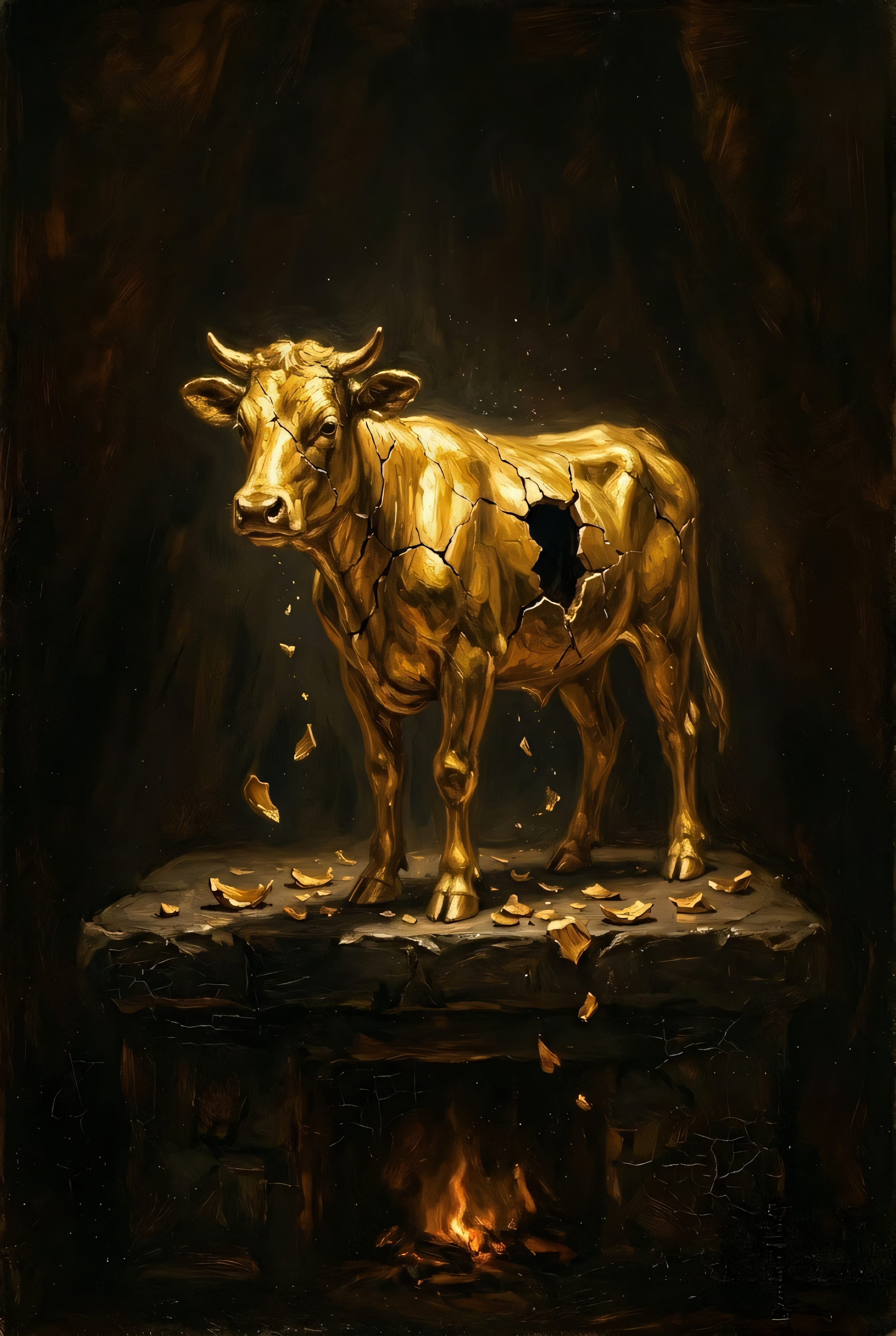
Part 2: Physical Idols and False Gods (Golden calf, Baal, Dagon)
Part 3: Sacred Objects Become Idols (The Ark, the Temple)
Part 4: The Idolatry of Human Beings (Kings, leaders, hero worship)
Part 5: The Invisible Idols (Pursuits and possessions)
Part 6: The Ultimate Idol—Self (Pride and autonomy)
Part 7: Religious Idolatry (When religion replaces God)
Part 8: Breaking Free (The Gospel solution)
If you’ve found this helpful or insightful, please share it with a friend who loves Scripture as much as you do.
Coming Up Next
A New Series Begins
We’ve spent eight weeks exploring idolatry: how created things become god-substitutes, and how the Gospel alone can break their power. But now we turn to a different kind of imagery, one that appears throughout Scripture with surprising frequency and builds to a crescendo in Jesus’ own teaching about the end times.
The Woman in Travail: How Birth Became the Bible’s Most Powerful End-Times Metaphor
When Jesus sat on the Mount of Olives and described the signs of the end, He chose a specific image: “All these are but the beginning of birth pangs” (Matthew 24:8). Not earthquakes. Not wars. Not famines. Birth pangs.
Why? What made this particular metaphor so powerful for describing the last days?
It turns out Jesus was reaching back into centuries of prophetic tradition. From Isaiah’s warnings against Babylon to Jeremiah’s anguished cries over Jerusalem, from Micah’s messianic promises to Paul’s cosmic vision in Romans 8, Scripture repeatedly uses the image of a woman in labor to describe God’s judgment, Israel’s suffering, and ultimately the birth of the new creation.
In our next paid series, we’ll trace this metaphor’s development across both testaments, examining:
Ancient Roots and Hebrew Foundations
Isaiah’s Strategic Deployment
Jeremiah’s Intensive Saturation
Micah’s explicit messianic connection
Jesus’ adoption and transformation of the prophetic metaphor
Paul and John’s theological development in Romans 8, 1 Thessalonians 5, and Revelation 12
The complete arc from judgment to eschatological hope
Why This Series Matters
Understanding the birth pang metaphor isn’t just academic interest. It’s about grasping what Jesus meant when He said we’re living in the “beginning of birth pangs.” It’s about recognizing that:
Suffering has purpose: Labor pain is productive pain that brings forth new life
There’s a pattern to history: Birth pangs increase in frequency and intensity as delivery approaches
The end is certain: Once labor begins, birth is inevitable. The new creation will be born
Hope sustains through pain: Every contraction brings us closer to joy
When Paul says in Romans 8:22, “the whole creation has been groaning together in the pains of childbirth until now,” he’s not describing random suffering. He’s describing a universe in labor. And the new creation is crowning.
This series will show you how to read your Bible’s most vivid end-times imagery through the lens of both Hebrew prophecy and Greek fulfillment. We’ll compare the Masoretic Text and Septuagint at every turn, examining how the Greek translators rendered these Hebrew terms and how that shaped the New Testament writers’ understanding.
The LXX Scrolls is free to read and always will be. If this work has been worth something to you, there are a few ways to say so:
Buy the ebooks. Completed teaching series are available as polished ebooks under the Two Witnesses, One Truth series. Buying through Curios will support this work most directly but they’re also available on Amazon (and elsewhere) if you’re loyal to a particular ereader.
Become a supporter. A monthly or annual pledge through Substack helps me to bring the Septuagint to those who never knew they needed it.
Send a one-time tip. If this post has blessed you and you want to express that directly, you can Buy Me a Coffee.

Thank you for being part of this journey, your support makes this work possible.
© 2025 LXX Scrolls. All rights reserved.