


Hello brothers and sisters.
In Parts 1-5 we examined physical idols, sacred objects, human beings, and the pursuits that become our functional gods. But beneath every form of idolatry lies one primal sin: the worship of self. This is the idol that birthed all others, the original rebellion that echoes through every subsequent act of disobedience. It’s the whisper in the garden, the voice in our hearts, the throne we refuse to vacate: “I will be my own god.”
If you missed any of the first 5 posts, you can catch up below:
There’s a reason every other idol ultimately points back to ourselves. When we worship money, we’re worshiping our own security. When we idolize people, we’re worshiping either the thing in them we covet, our need for connection, or their approval. When we covet, we’re worshiping our own desires. Every functional god is really just the self wearing a different mask.
This is why the idolatry of self is the most dangerous, as well as the most difficult to detect.
We can see a golden calf. We can identify when someone trusts in wealth. But pride hides behind every good intention, every theological conviction, every religious activity. It’s the idol that convinced Eve she could improve on God’s provision. It’s the idol that made Satan believe he could ascend to God’s throne. It’s the idol that whispers to each of us, “You know better than God what you need and how to get it.”
Pride isn’t just a sin among sins. It’s the engine that drives all sin, the foundation upon which every false god is built. And until we dethrone the self, every attempt to smash other idols will fail.
If you’re reading this in email, be aware that the text is likely to cut off without warning. For a smoother reading experience and all the features Substack has to offer (including audio voiceovers of my posts), you can go HERE or download the app.

THE GARDEN — WHERE SELF-WORSHIP BEGAN
The Serpent’s Promise (Genesis 3:1-7)
The Fall didn’t begin with an apple. It began with a question designed to make God seem unreasonable:
Genesis 3:1:
וַיֹּאמֶר אֶל־הָאִשָּׁה אַף כִּי־אָמַר אֱלֹהִים לֹא תֹאכְלוּ מִכֹּל עֵץ הַגָּן
“Did God actually say, ‘You shall not eat of any tree in the garden’?”
Notice the subtlety. The serpent doesn’t start with, “Disobey God!” He starts by making God’s single prohibition sound like comprehensive restriction. He reframes generosity as stinginess. God had said: “You may freely eat of every tree of the garden, but of the tree of the knowledge of good and evil you shall not eat” (Genesis 2:16-17). The serpent inverts this: didn’t God say you can’t eat from any tree?
Eve corrects him, though only partially. Then comes the devastating promise:
Hebrew (Genesis 3:5):
כִּי יֹדֵעַ אֱלֹהִים כִּי בְּיוֹם אֲכָלְכֶם מִמֶּנּוּ וְנִפְקְחוּ עֵינֵיכֶם וִהְיִיתֶם כֵּאלֹהִים יֹדְעֵי טוֹב וָרָע
“For God knows that when you eat of it your eyes will be opened, and you will be like God, knowing good and evil.”
LXX (Genesis 3:5):
ᾔδει γὰρ ὁ θεὸς ὅτι ἐν ᾗ ἂν ἡμέρᾳ φάγητε ἀπ’ αὐτοῦ, διανοιχθήσονται ὑμῶν οἱ ὀφθαλμοί, καὶ ἔσεσθε ὡς θεοὶ γινώσκοντες καλὸν καὶ πονηρόν
“For God knew that on whatever day you should eat of it, your eyes would be opened, and you would be as gods, knowing good and evil.”
The Core Temptation: Autonomy
The Hebrew phrase וִהְיִיתֶם כֵּאלֹהִים (vihyitem ke-elohim) can be translated “you will be like God” (taking אֱלֹהִים as singular with majestic plural) or “you will be like gods/divine beings” (plural). The LXX opts for plural: ἔσεσθε ὡς θεοί (esesthe hōs theoi), “you will be as gods.”
Either way, the promise is the same: autonomy. Independence from God. The ability to determine for yourself what is good and what is evil, without reference to God’s standard.
Notice what the serpent doesn’t promise:
He doesn’t promise happiness
He doesn’t promise fulfillment
He doesn’t promise wisdom
He promises self-determination. The right to be your own moral authority. To answer to no one. To define truth for yourself.
This is the essence of self-worship: claiming the authority that belongs to God alone.
The Progression of Pride
Watch the sequence in Genesis 3:6:
Hebrew:
וַתֵּרֶא הָאִשָּׁה כִּי טוֹב הָעֵץ לְמַאֲכָל וְכִי תַאֲוָה־הוּא לָעֵינַיִם וְנֶחְמָד הָעֵץ לְהַשְׂכִּיל וַתִּקַּח מִפִּרְיוֹ וַתֹּאכַל
“So when the woman saw that the tree was good for food, and that it was a delight to the eyes, and that the tree was to be desired to make one wise, she took of its fruit and ate.”
She saw (וַתֵּרֶא, vatere) — She evaluated independently
Good for food (טוֹב לְמַאֲכָל, tov le-ma’akhal) — She judged what was good
A delight to the eyes (תַאֲוָה לָעֵינַיִם, ta’avah la-einayim) — She desired it
Desirable for wisdom (נֶחְמָד לְהַשְׂכִּיל, nechmad le-haskil) — She wanted to be wise on her own terms
She took (וַתִּקַּח, vatikach) — She acted on her self-determined judgment
This is the pattern of self-worship:
I evaluate
I judge
I desire
I decide
I act
At no point does the creature consult the Creator. At no point does she ask, “What does God think about this?” She has become her own god, her own standard, her own authority.
The Immediate Consequence: Shame
Genesis 3:7:
וַתִּפָּקַחְנָה עֵינֵי שְׁנֵיהֶם וַיֵּדְעוּ כִּי עֵירֻמִּם הֵם
“Then the eyes of both were opened, and they knew that they were naked.”
The serpent promised that their eyes would be opened. He was right. But what they saw wasn’t divine wisdom, it was shame. They gained knowledge of good and evil not by elevation but by degradation. They learned good by abandoning it. They knew evil by committing it.
And the first thing self-worship produces is not glory but shame. Not confidence but hiding. Not life but death.
The Pattern for All Idolatry
Genesis 3 isn’t just about eating fruit. It’s the template for every subsequent act of idolatry:
Question God’s goodness — “Did God really say...?”
Reject God’s authority — “I will decide what’s good.”
Claim God’s prerogative — “I will be like God.”
Suffer the consequences — Shame, fear, death, separation
Every idol is an attempt to usurp God’s throne. And the throne we most want to claim is our own.
THE FIVE “I WILLS” OF SATAN (Isaiah 14:12-15)
The King of Babylon or the Fall of Satan?
Isaiah 14 is addressed to the king of Babylon, mocking his arrogant ambition and prophesying his fall. But for centuries, theologians have seen in this passage a deeper reference, as it seems to point to the original fall of Satan himself.
Hebrew (Isaiah 14:12):
אֵיךְ נָפַלְתָּ מִשָּׁמַיִם הֵילֵל בֶּן־שָׁחַר נִגְדַּעְתָּ לָאָרֶץ חוֹלֵשׁ עַל־גּוֹיִם
“How you are fallen from heaven, O Day Star, son of Dawn! How you are cut down to the ground, you who laid the nations low!”
LXX (Isaiah 14:12):
πῶς ἐξέπεσεν ἐκ τοῦ οὐρανοῦ ὁ ἑωσφόρος ὁ πρωὶ ἀνατέλλων
“How has the morning star, which rose in the morning, fallen from heaven!”
The Hebrew word הֵילֵל (heilel) appears only here in the Old Testament. It comes from the root הָלַל (halal), which can mean “to shine” or “to boast/be arrogant.” The LXX translates it as ἑωσφόρος (heōsphoros), “light-bearer” or “dawn-bringer,” which Jerome later translated into Latin as lucifer.
But the passage isn’t about the name. It’s about the attitude.
The Five “I Will” Declarations
Isaiah 14:13-14:
וְאַתָּה אָמַרְתָּ בִלְבָבְךָ
הַשָּׁמַיִם אֶעֱלֶה
מִמַּעַל לְכוֹכְבֵי־אֵל אָרִים כִּסְאִי
וְאֵשֵׁב בְּהַר־מוֹעֵד בְּיַרְכְּתֵי צָפוֹן
אֶעֱלֶה עַל־בָּמֳתֵי עָב
אֶדַּמֶּה לְעֶלְיוֹן
“You said in your heart,
‘I will ascend to heaven;
above the stars of God I will set my throne on high;
I will sit on the mount of assembly in the far reaches of the north;
I will ascend above the heights of the clouds;
I will make myself like the Most High.’”
Five times, the assertion of self: אֶעֱלֶה (e’eleh, “I will ascend”), אָרִים (arim, “I will exalt”), אֵשֵׁב (eshev, “I will sit”), אֶעֱלֶה (e’eleh, “I will ascend”), אֶדַּמֶּה (edammeh, “I will make myself like”).
Let’s break down each declaration:
1. “I Will Ascend to Heaven”
הַשָּׁמַיִם אֶעֱלֶה (ha-shamayim e’eleh)
This is the declaration of upward mobility, of not being content with one’s assigned place. It’s the refusal to accept limitations. Heaven is God’s dwelling place, His throne room. To say “I will ascend to heaven” is to say, “I’m not satisfied with the position God gave me. I’m going to take what belongs to Him.”
Modern equivalent: “I refuse to accept any limitations on my potential. I will not submit to anyone’s authority.”
2. “Above the Stars of God I Will Set My Throne”
מִמַּעַל לְכוֹכְבֵי־אֵל אָרִים כִּסְאִי (mimma’al le-kokhvei-El arim kis’i)
The “stars of God” likely refers to angels (Job 38:7, “when the morning stars sang together”). To set one’s throne above them is to claim superiority over all created beings, to demand that others worship and serve you.
Modern equivalent: “I deserve to be first. Others should serve my interests. I should be exalted above everyone else.”
3. “I Will Sit on the Mount of Assembly”
וְאֵשֵׁב בְּהַר־מוֹעֵד בְּיַרְכְּתֵי צָפוֹן (ve-eshev be-har-mo’ed be-yarketei tsafon)
The “mount of assembly” is the place where the divine council meets, where God holds court with the heavenly host. To sit there is to claim the right to participate in divine deliberations, to have a say in how the universe is run.
Modern equivalent: “I have a right to be part of every decision. My voice matters as much as God’s. I won’t be excluded from anything.”
4. “I Will Ascend Above the Heights of the Clouds”
אֶעֱלֶה עַל־בָּמֳתֵי עָב (e’eleh al-bamotei av)
Clouds are associated with God’s glory and presence (Exodus 19:9, 1 Kings 8:10-11). To ascend above them is to position yourself above even the manifestations of God’s glory.
Modern equivalent: “I will surpass even what God has done. I can do better than Him. I don’t need His glory, I’ll make my own.”
5. “I Will Make Myself Like the Most High”
אֶדַּמֶּה לְעֶלְיוֹן (edammeh le-elyon)
This is the culmination, the ultimate goal of self-worship: to be like God. Not in the sense of reflecting His image through obedience and love, but in the sense of being God. Independent. Self-sufficient. Autonomous. Answerable to no one.
Modern equivalent: “I will be my own god. I will determine my own truth, my own morality, my own destiny. No one— not even God —will tell me what to do.”
The Response: Humiliation
Isaiah 14:15:
אַךְ אֶל־שְׁאוֹל תּוּרָד אֶל־יַרְכְּתֵי־בוֹר
“But you are brought down to Sheol, to the far reaches of the pit.”
The Hebrew word for “brought down” is תּוּרָד (turad), passive voice. You will be brought down—not by your own choice, but by God’s judgment. Five declarations of “I will ascend”; one declaration of “you will descend.”
Pride promises elevation. God delivers humiliation.
Pride promises autonomy. God decrees subjugation.
Pride promises to be like the Most High. God consigns to the lowest depths.
The Connection to Self-Worship
Satan’s sin wasn’t murder, adultery, or theft. His sin was pride; the refusal to accept his place as a created being, the insistence that he could be like God. And this is the sin that he packaged and sold to Eve in the garden: “You will be like God.”
This is the ultimate idolatry: self-deification. Not bowing before a statue, but refusing to bow at all. Rather than trusting in created things, this is trusting in a self-professed creator—yourself.
THE SPECTRUM OF SELF-IDOLATRY
Pride and Reputation
John 5:44:
πῶς δύνασθε ὑμεῖς πιστεῦσαι, δόξαν παρὰ ἀλλήλων λαμβάνοντες, καὶ τὴν δόξαν τὴν παρὰ τοῦ μόνου θεοῦ οὐ ζητεῖτε;
“How can you believe, when you receive glory from one another and do not seek the glory that comes from the only God?”
Jesus identifies a profound obstacle to faith: the addiction to human approval. The Greek word δόξα (doxa) means “glory, honor, praise, reputation.” To receive glory from one another means to organize your life around what people think of you.
Jesus’ point: you can’t simultaneously seek God’s approval and people’s approval. The two are incompatible. Why? Because seeking human glory is a form of idolatry. It makes people’s opinions your god.
The Modern Manifestations:
1. Social Media and the Curated Self
We live in an age of performative existence. For most people (several flavors of neurodivergence being obvious exceptions), every post, every photo, every status update is carefully curated to elicit approval in the form of likes, comments, shares, and followers. We craft personas designed to impress.
This isn’t about using social media. It’s about why and how we use it. Are we sharing to bless others, or to receive δόξα (doxa; praise)? Do we need the validation? Does our mood rise and fall with our engagement metrics?
When your self-worth depends on others’ approval, you’ve made an idol of reputation.
2. Platform-Building in Ministry
Even Christian work can become an idol of self. We build platforms, grow audiences, measure success by numbers. We speak of “influence” and “reach” as if they were spiritual metrics.
But Jesus asks: whose glory are you seeking? Are you building His kingdom or your brand? Would you be content in obscurity if that’s where God called you?
Diagnostic question: If God stripped away all your influence, platform, and recognition— if no one knew your name —would you still serve Him joyfully?
3. Fear of Others’ Opinions
Proverbs 29:25 warns: “The fear of man lays a snare, but whoever trusts in the LORD is safe.”
When you’re controlled by what others think:
You compromise truth to avoid offense
You hide your faith to fit in
You make decisions based on approval rather than obedience
You’re paralyzed by criticism
This is self-worship because you’ve made yourself the center of the universe. Every decision revolves around, “What will people think of me?”
Self-Righteousness: Making Self the Standard
Luke 18:9-14 - The Pharisee and the Tax Collector
Jesus tells a parable specifically aimed at “some who trusted in themselves that they were righteous, and treated others with contempt” (v. 9).
Luke 18:11-12:
ὁ Φαρισαῖος σταθεὶς πρὸς ἑαυτὸν ταῦτα προσηύχετο· ὁ θεός, εὐχαριστῶ σοι ὅτι οὐκ εἰμὶ ὥσπερ οἱ λοιποὶ τῶν ἀνθρώπων, ἅρπαγες, ἄδικοι, μοιχοί, ἢ καὶ ὡς οὗτος ὁ τελώνης· νηστεύω δὶς τοῦ σαββάτου, ἀποδεκατῶ πάντα ὅσα κτῶμαι.
“The Pharisee, standing by himself, prayed thus: ‘God, I thank you that I am not like other men, extortioners, unjust, adulterers, or even like this tax collector. I fast twice a week; I give tithes of all that I get.’”
Count the first-person pronouns: “I thank you that I am not... I fast... I give...” The entire prayer is about himself. He mentions God only to congratulate himself before Him.
Notice the comparison: “not like other men.” Self-righteousness always requires someone to feel superior to. The Pharisee’s identity depends on being better than others.
By contrast, the tax collector’s prayer is simple:
Luke 18:13:
ὁ θεός, ἱλάσθητί μοι τῷ ἁμαρτωλῷ
“God, be merciful to me, a sinner!”
No comparison. No self-congratulation. Just honest confession and desperate need.
Jesus’ verdict: “This man went down to his house justified, rather than the other” (v. 14).
Romans 10:3 - Establishing One’s Own Righteousness
Greek:
ἀγνοοῦντες γὰρ τὴν τοῦ θεοῦ δικαιοσύνην καὶ τὴν ἰδίαν ζητοῦντες στῆσαι, τῇ δικαιοσύνῃ τοῦ θεοῦ οὐχ ὑπετάγησαν
“For, being ignorant of the righteousness of God, and seeking to establish their own, they did not submit to God’s righteousness.”
The phrase τὴν ἰδίαν ζητοῦντες στῆσαι (tēn idian zētountes stēsai) means “seeking to establish their own.” The word ἰδίαν (idian) means “one’s own, private, personal.” It’s the root of our English word “idiot,” which originally meant “a private person,” someone concerned only with their own affairs.
To seek to establish your own righteousness is to make yourself your own savior. It’s saying:
I don’t need God’s righteousness; I’ll create my own
I don’t need Christ’s sacrifice; my works are sufficient
I don’t need grace; I’ve earned it
This is self-worship in religious form. It’s using religion to worship the self.
Autonomy and Control
James 4:13-17 - The Sin of Presumption
Greek (James 4:13-15):
Ἄγε νῦν οἱ λέγοντες· σήμερον ἢ αὔριον πορευσόμεθα εἰς τήνδε τὴν πόλιν καὶ ποιήσομεν ἐκεῖ ἐνιαυτὸν καὶ ἐμπορευσόμεθα καὶ κερδήσομεν· οἵτινες οὐκ ἐπίστασθε τῆς αὔριον ποία ἡ ζωὴ ὑμῶν... ἀντὶ τοῦ λέγειν ὑμᾶς· ἐὰν ὁ κύριος θελήσῃ, καὶ ζήσομεν καὶ ποιήσομεν τοῦτο ἢ ἐκεῖνο.
“Come now, you who say, ‘Today or tomorrow we will go into such and such a town and spend a year there and trade and make a profit’—yet you do not know what tomorrow will bring... Instead you ought to say, ‘If the Lord wills, we will live and do this or that.’”
The sin isn’t planning. God commends wise planning (Proverbs 21:5). The sin is planning without reference to God’s will. It’s living as if you’re in control, as if your plans determine the future, as if God is irrelevant to your decision-making.
Notice the arrogance in the statement James critiques:
“We will go” (πορευσόμεθα, poreusometha)
“We will spend a year” (ποιήσομεν, poiēsomen)
“We will trade” (ἐμπορευσόμεθα, emporeusometha)
“We will make a profit” (κερδήσομεν, kerdēsomen)
All future tense, all certainty, all self-determined. God is absent from the entire plan.
James’ correction: ἐὰν ὁ κύριος θελήσῃ (ean ho kyrios thelēsē), “if the Lord wills.” Four words that dethrone self and acknowledge God’s sovereignty.
The Modern Temptation: Self-Made Success
We celebrate “self-made” people, those who “pulled themselves up by their bootstraps,” who succeeded through grit and determination. But the very concept is idolatrous. No one is self-made. Every breath is a gift. Every talent is given. Every opportunity is providence.
To claim self-made status is to:
Deny dependence on God
Take credit for grace
Make an idol of your own effort
Diagnostic questions:
Do you plan your life without praying about it?
Do you make major decisions without seeking God’s will?
Do you credit yourself for your success while blaming God for your failures?
Do you resent limitations, or do you see them as God-ordained?
Self-Reliance vs. God-Dependence
2 Chronicles 16:7-12 - King Asa’s Mistake
King Asa had been a good king. Early in his reign, when threatened by a massive Ethiopian army, he cried out to God and won a miraculous victory (2 Chronicles 14:9-15). But later, when threatened by the northern kingdom of Israel, Asa made a different choice:
2 Chronicles 16:2-3:
וַיּוֹצֵא אָסָא כֶּסֶף וְזָהָב מֵאֹצְרוֹת בֵּית־יְהוָה וּבֵית הַמֶּלֶךְ וַיִּשְׁלַח אֶל־בֶּן־הֲדַד מֶלֶךְ־אֲרָם
“Then Asa took silver and gold from the treasures of the house of the LORD and the king’s house and sent them to Ben-hadad king of Syria.”
Instead of trusting God, Asa hired Syria to attack Israel from the north, creating a two-front war. It worked militarily. But spiritually, it was a disaster.
The prophet Hanani came with a rebuke:
2 Chronicles 16:7:
בְּהִשָּׁעֶנְךָ עַל־מֶלֶךְ אֲרָם וְלֹא נִשְׁעַנְתָּ עַל־יְהוָה אֱלֹהֶיךָ עַל־כֵּן נִמְלַט חֵיל מֶלֶךְ־אֲרָם מִיָּדֶךָ
“Because you relied on the king of Syria, and did not rely on the LORD your God, the army of the king of Syria has escaped you.”
The verb שָׁעַן (sha’an) means “to lean on, rely on, support oneself.” Asa leaned on Syria instead of leaning on God.
Then comes a devastating reminder:
2 Chronicles 16:9:
כִּי יְהוָה עֵינָיו מְשֹׁטְטוֹת בְּכָל־הָאָרֶץ לְהִתְחַזֵּק עִם־לְבָבָם שָׁלֵם אֵלָיו
“For the eyes of the LORD run to and fro throughout the whole earth, to give strong support to those whose heart is blameless toward him.”
God was ready to help. He was looking for someone to trust Him. But Asa chose self-reliance.
The consequence? Disease and death.
2 Chronicles 16:12:
וַיֶּחֱלָא אָסָא...אַף־בְּחָלְיוֹ לֹא־דָרַשׁ אֶת־יְהוָה כִּי בָּרֹפְאִים
“In the thirty-ninth year of his reign Asa was diseased in his feet, and his disease became severe. Yet even in his disease he did not seek the LORD, but sought help from physicians.”
The issue wasn’t seeking medical help, it was seeking it instead of God. Medicine is a gift from God to be used. But when medicine becomes your functional savior, when you trust the treatment more than the Healer, you’ve made an idol of self-sufficiency.
The Principle:
Legitimate means become idols when they replace ultimate trust. You can:
Use medicine while trusting God
Save money while trusting God
Work hard while trusting God
Plan wisely while trusting God
But you cannot:
Trust medicine instead of God
Trust money instead of God
Trust yourself instead of God
Trust your plans instead of God
The question isn’t whether you use these means. The question is where your ultimate confidence lies.
THE GOSPEL RESPONSE — CHRIST’S SELF-EMPTYING
Philippians 2:3-11 - The Anti-Idol
If Satan’s five “I wills” represent the essence of self-worship, Christ’s descent in Philippians 2 represents its opposite.
Philippians 2:3-4:
μηδὲν κατ’ ἐριθείαν μηδὲ κατὰ κενοδοξίαν, ἀλλὰ τῇ ταπεινοφροσύνῃ ἀλλήλους ἡγούμενοι ὑπερέχοντας ἑαυτῶν, μὴ τὰ ἑαυτῶν ἕκαστος σκοποῦντες, ἀλλὰ καὶ τὰ ἑτέρων ἕκαστοι.
“Do nothing from selfish ambition or conceit, but in humility count others more significant than yourselves. Let each of you look not only to his own interests, but also to the interests of others.”
Then Paul presents Christ as the example:
Philippians 2:5-8:
Τοῦτο φρονεῖτε ἐν ὑμῖν ὃ καὶ ἐν Χριστῷ Ἰησοῦ, ὃς ἐν μορφῇ θεοῦ ὑπάρχων οὐχ ἁρπαγμὸν ἡγήσατο τὸ εἶναι ἴσα θεῷ, ἀλλὰ ἑαυτὸν ἐκένωσεν μορφὴν δούλου λαβών... ἐταπείνωσεν ἑαυτὸν γενόμενος ὑπήκοος μέχρι θανάτου, θανάτου δὲ σταυροῦ.
“Have this mind among yourselves, which is yours in Christ Jesus, who, though he was in the form of God, did not count equality with God a thing to be grasped, but emptied himself, by taking the form of a servant... And being found in human form, he humbled himself by becoming obedient to the point of death, even death on a cross.”
The Contrasts
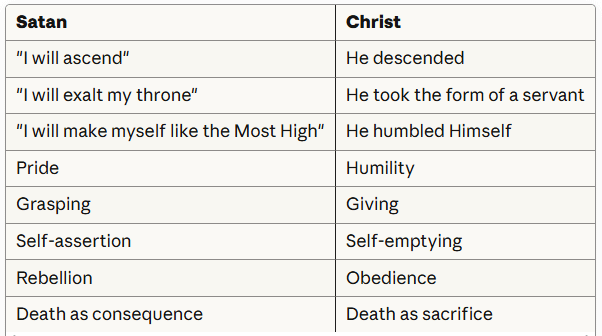
Christ had every right to assert Himself. He was “in the form of God” (ἐν μορφῇ θεοῦ, en morphē theou): He possessed the very nature and attributes of deity.
But He “did not count equality with God a thing to be grasped” (οὐχ ἁρπαγμὸν ἡγήσατο, ouch harpagmon hēgēsato). The word ἁρπαγμός (harpagmos) means “something to cling to, to grasp, to hold onto tightly.” Christ didn’t cling to His divine prerogatives. He didn’t insist on His rights.
Instead, ἑαυτὸν ἐκένωσεν (heauton ekenōsen): ”He emptied Himself.” Not of His deity, but of His divine privileges. He voluntarily set aside the independent exercise of divine attributes. He became dependent, vulnerable, obedient.
The Result: Exaltation by God
Philippians 2:9-11:
διὸ καὶ ὁ θεὸς αὐτὸν ὑπερύψωσεν καὶ ἐχαρίσατο αὐτῷ τὸ ὄνομα τὸ ὑπὲρ πᾶν ὄνομα, ἵνα ἐν τῷ ὀνόματι Ἰησοῦ πᾶν γόνυ κάμψῃ...καὶ πᾶσα γλῶσσα ἐξομολογήσηται ὅτι κύριος Ἰησοῦς Χριστὸς εἰς δόξαν θεοῦ πατρός.
“Therefore God has highly exalted him and bestowed on him the name that is above every name, so that at the name of Jesus every knee should bow... and every tongue confess that Jesus Christ is Lord, to the glory of God the Father.”
The word ὑπερύψωσεν (hyperypsōsen) means “super-exalted, exalted to the highest degree.” Because Christ humbled Himself, God exalted Him.
Here’s the principle: self-exaltation leads to humiliation; self-humbling leads to exaltation.
Satan said “I will ascend” → God cast him down
Christ descended → God highly exalted Him
This is the pattern Jesus taught:
Luke 14:11:
“For everyone who exalts himself will be humbled, and he who humbles himself will be exalted.”
Galatians 2:20 - The Death of Self as God
Greek:
Χριστῷ συνεσταύρωμαι· ζῶ δὲ οὐκέτι ἐγώ, ζῇ δὲ ἐν ἐμοὶ Χριστός· ὃ δὲ νῦν ζῶ ἐν σαρκί, ἐν πίστει ζῶ τῇ τοῦ υἱοῦ τοῦ θεοῦ
“I have been crucified with Christ. It is no longer I who live, but Christ who lives in me. And the life I now live in the flesh I live by faith in the Son of God.”
Paul declares the death of self-as-god: οὐκέτι ἐγώ (ouketi egō), “no longer I.” The self that insisted on autonomy, that demanded to be its own lord, that claimed the right to self-determination… that self has been crucified.
And in its place: ζῇ δὲ ἐν ἐμοὶ Χριστός (zē de en emoi Christos), “Christ lives in me.”
This is the only solution to the idolatry of self: death and resurrection. Self must die so that Christ can live. Autonomy must be crucified so that God’s lordship can be enthroned.
KILLING THE IDOL OF SELF
Diagnostic Questions
1. Whose approval do you crave?
If losing human approval would devastate you more than losing God’s approval, you’ve made an idol of reputation.
2. Can you admit you’re wrong?
Pride can’t apologize. Pride can’t say, “I was wrong.” If you find yourself always justifying, always defending, always explaining why you were actually right, then you’re worshiping the self.
3. Do you chafe at limitations?
Do you resent God-given boundaries? Do you see rules as restricting your freedom rather than protecting your joy? Do you resist authority structures?
Self-worship demands autonomy. Godliness embraces limits as loving protection.
4. Are you willing to decrease that Christ might increase?
John the Baptist said, “He must increase, but I must decrease” (John 3:30). Can you say that? Can you joyfully become less visible, less important, less recognized if it means Christ becomes more visible?
5. What’s your response to criticism?
Do you become defensive? Angry? Do you ruminate on it for days? Or can you humbly evaluate whether it’s true, repent if necessary, and move on?
Pride can’t handle criticism. Humility welcomes it as a means of growth.
6. Do you need to be right?
Do you always have to win arguments? Do you need the last word? Do you secretly gloat when you’re vindicated?
The need to always be right is the ego demanding worship.
The Path to Humility
1. See God Rightly
The cure for pride is a vision of God’s glory. Isaiah saw the Lord “high and lifted up” (Isaiah 6:1) and immediately said, “Woe is me! For I am lost” (v. 5).
When you see God as He is, you see yourself as you are; small, dependent, and sinful. And paradoxically, this vision doesn’t crush you. It frees you. Because you’re no longer trying to be God.
2. Remember Your Origin
You are dust (Genesis 2:7). Every breath is borrowed. Every heartbeat is gifted. You own nothing. You earned nothing. You deserve nothing.
This isn’t self-loathing, it’s reality. And recognizing reality is the beginning of humility.
3. Embrace Your Creatureliness
You are not God. You’re not supposed to be God. You have limitations, which is a good thing. You need help, and that’s by design. You’re dependent, and that’s glorious.
Stop fighting against your finitude. It’s not a flaw. It’s how you were made.
4. Practice the “If the Lord Wills” Mindset
Make it a habit— literally, verbally, daily —to acknowledge God’s sovereignty. “If the Lord wills, I’ll...” “God willing, we’ll...” “Lord, if You want me to, I’ll...”
This isn’t superstition. It’s cultivating a heart posture of dependence.
5. Confess Quickly
When you sin, don’t defend. Don’t justify. Don’t minimize. Just confess: “I was wrong. I’m sorry. Please forgive me.”
Quick confession is death to pride. Prolonged justification is food for the ego.
6. Rejoice in Others’ Success
Can you celebrate when someone else gets the promotion, the recognition, the platform you wanted? Or do you feel threatened?
The death of self-worship is the ability to genuinely rejoice when others are exalted and you’re not.
The Promise: True Glory
Here’s the paradox: the way up is down.
When you stop grasping for glory, God gives it. When you stop demanding recognition, God grants it. When you stop insisting on your rights, God defends you.
Jesus promised: “Whoever exalts himself will be humbled, and whoever humbles himself will be exalted” (Matthew 23:12).
You were made for glory. Real glory. Not the cheap counterfeit of self-promotion, but the radiant glory of being conformed to Christ’s image. But you’ll never get there by exalting yourself. You’ll get there by dying to yourself.
The idol of self must die. Daily. Repeatedly. Ruthlessly.
And in its place, Christ will reign.
THE ROOT OF ALL IDOLATRY
We’ve journeyed through six parts of this series, examining physical idols, sacred objects, human beings, possessions, pursuits… and now, we’ve discovered that all idolatry traces back to one source: the worship of self.
When we covet, we’re worshiping our own desires
When we trust in humans, we’re worshiping our need for security
When we elevate possessions, we’re worshiping our own comfort
When we make an idol of family, work, or comfort, we’re worshiping our own will
At the center of every idol is the same throne. And on that throne sits the same pretender: self.
This is why smashing external idols never works permanently. You can remove every golden calf from your life, but if self still sits on the throne, you’ll just create new idols. The problem isn’t ultimately money or people or pursuits, the problem is the heart that insists, “I will be my own god.”
The serpent’s promise in Genesis 3:5 echoes through every human heart: “You will be like God.” And we’ve been trying to make that promise true ever since. We’ve been climbing our own towers of Babel, ascending our own thrones, declaring our own five “I wills,” all in service of the ultimate idol.
But there’s good news. The gospel doesn’t just forgive the fruit of self-worship (our individual sins). It strikes at the root. It doesn’t just remove idols. It dethrones self.
Paul declares: “I have been crucified with Christ. It is no longer I who live, but Christ who lives in me” (Galatians 2:20).
This is the only solution. Not self-improvement. Not behavior modification. Not even idol-smashing. But death. The death of self as god. The crucifixion of autonomy. The end of the ego’s reign.
And in that death, resurrection: “Christ who lives in me.”
When self dies, Christ reigns. When pride is crucified, humility is born. When autonomy surrenders, peace floods in.
This is the gospel’s solution to idolatry: Christ instead of self.
Not Christ and self. Not a balanced partnership. Not shared authority. But Christ alone on the throne that self vacates.
If you’ve found this helpful or insightful, please share it with a friend who loves Scripture as much as you do.
Just as I have with previous entries in this series, I want to emphasize that my intention here is not to shame anyone. I have no desire to influence feelings of guilt. But I do want to point out that if anything I’ve said here makes you feel called out, attacked, angry, or convicted, then it is working as intended. Because my intention here is to bring to light the things we (and I don’t exclude myself here) might be ignoring, tamping down, or perhaps are even totally unaware of. I want to help us all to recognize the things and people in our lives that we might be turning into idols and putting in the place of the Lord.
God Bless you.
Coming Up Next
In Part 7, we’ll examine what might be the most deceptive form of idolatry: religious idolatry. What happens when we use religion itself as an idol? When correct doctrine, faithful practices, and theological systems become functional gods? When we worship the gift rather than the Giver, even when the gift is Scripture, church, or spiritual disciplines themselves?
The LXX Scrolls is free to read and always will be. If this work has been worth something to you, there are a few ways to say so:
Buy the ebooks. Completed teaching series are available as polished ebooks under the Two Witnesses, One Truth series. Buying through Curios will support this work most directly but they’re also available on Amazon (and elsewhere) if you’re loyal to a particular ereader.
Become a supporter. A monthly or annual pledge through Substack helps me to bring the Septuagint to those who never knew they needed it.
Send a one-time tip. If this post has blessed you and you want to express that directly, you can Buy Me a Coffee.

Thank you for being part of this journey, your support makes this work possible.
© 2025 LXX Scrolls. All rights reserved.