


Hello brothers and sisters.
In Part 1, we explored how even God-ordained objects can become idols when they displace our devotion to God Himself. We saw how Hezekiah destroyed the bronze serpent— something Moses made at God’s command —because it had become Nehushtan, a mere piece of brass that people worshiped instead of the God who worked through it.
If you missed part 1, you can read it here:
But before we can recognize the subtle forms of idolatry that ensnare believers today, we must first understand the obvious ones. We must see how Scripture systematically dismantles the claims of physical idols and false gods; those visible, tangible objects that ancient peoples worshiped as deities.
This isn’t just ancient history. The pattern of physical idolatry reveals something fundamental about the human heart: We crave gods we can see, control, and manipulate. We want deities that make demands we can meet, that fit into our categories, that don’t require radical trust in an invisible, sovereign Lord.
The Bible’s relentless assault on idol worship isn’t about wood and stone. It’s about exposing the lie at the heart of all false religion: that we can manufacture our own salvation, that we can approach the divine on our terms, that we can replace the Creator with the creature.
Let’s examine three paradigmatic examples of physical idolatry, paying close attention to how both the Masoretic Text and the Septuagint handle these accounts.
If you’re reading this in email, be aware that the text is likely to cut off without warning. For a smoother reading experience and all the features Substack has to offer (including audio voiceovers of my posts), you can go HERE or download the app.
1: The Golden Calf
When Impatience Births Idolatry
The Setting (Exodus 32:1-6)
The scene is Mount Sinai. Moses has been on the mountain for forty days and nights, receiving the Law directly from God. The people wait below, and their patience grows thin. They’ve just witnessed the most dramatic displays of divine power in human history: the plagues of Egypt, the parting of the Red Sea, the pillar of cloud and fire, the thunder and lightning on Sinai. They’ve heard God’s voice declaring the Ten Commandments, including the explicit prohibition: “You shall have no other gods before me.”
And yet...
“When the people saw that Moses delayed to come down from the mountain, the people gathered themselves together to Aaron and said to him, ‘Up, make us gods who shall go before us. As for this Moses, the man who brought us up out of the land of Egypt, we do not know what has become of him.’” (Exodus 32:1)
The Hebrew text uses an interesting word for “delayed”: בֹּשֵׁשׁ (boshesh), which comes from a root meaning “to be ashamed” or “to be confounded.” The people felt confused by Moses’ absence, perhaps even embarrassed that they’d been left waiting so long. The Septuagint renders this with ἐχρόνισεν (echron isen), “he took a long time,” capturing the sense of excessive delay from the people’s perspective.
Notice their request: “make us אֱלֹהִים (elohim).” This word is grammatically plural and can mean either “gods” or “God” depending on context. Here, most English translations render it as “gods” (plural), and the Hebrew verb construction supports this: “who shall go before us” uses a plural verb form. The Septuagint confirms this reading with θεούς (theous), the plural “gods.”
This is crucial. The people weren’t necessarily rejecting their God outright to worship a completely foreign deity. They were demanding visible representation of divine presence, something tangible that would “go before us” as Moses had been doing. They wanted a mediator they could see and control.
Aaron’s Capitulation
Aaron’s response is both swift and tragic:
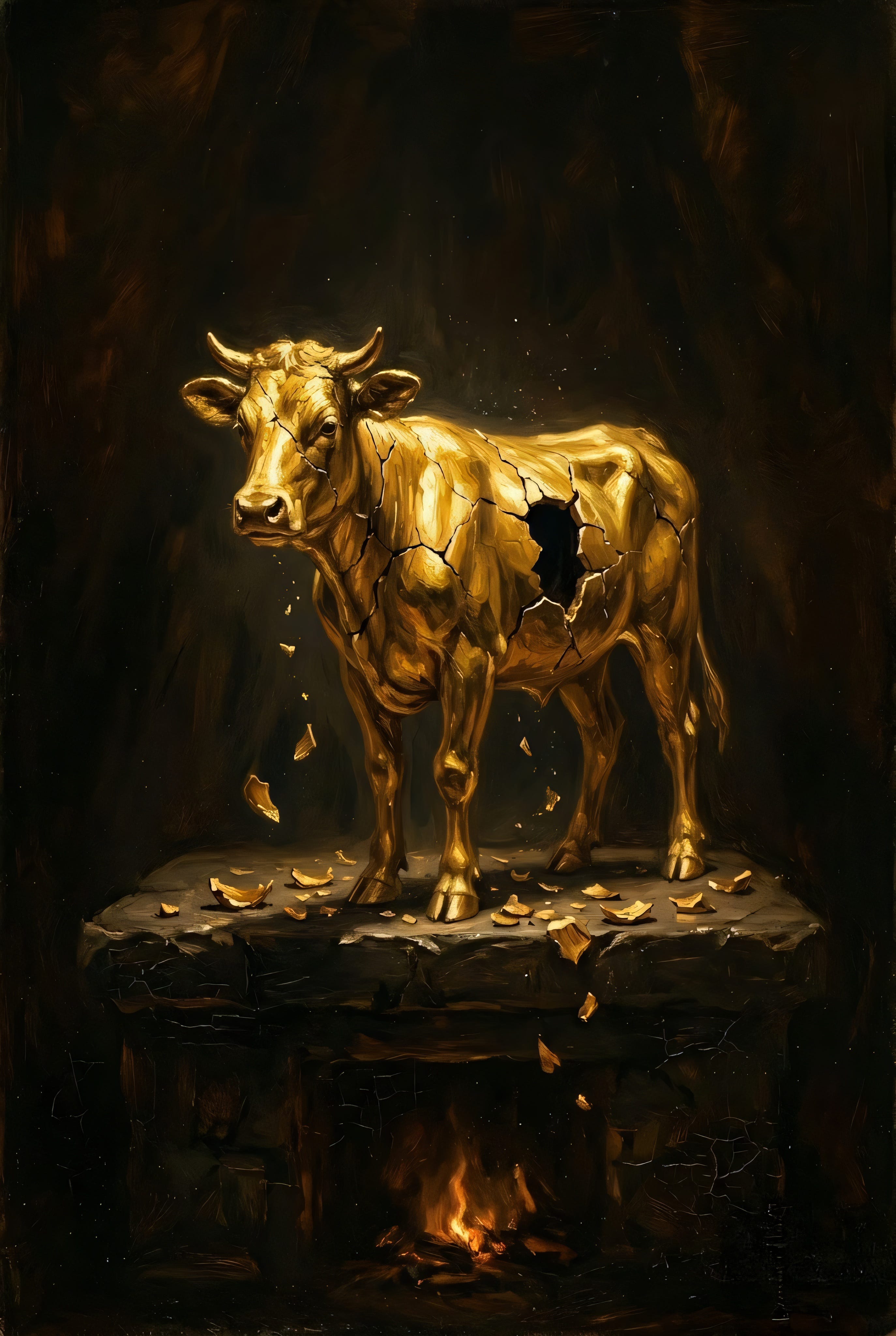
“So Aaron said to them, ‘Take off the rings of gold that are in the ears of your wives, your sons, and your daughters, and bring them to me.’ So all the people took off the rings of gold that were in their ears and brought them to Aaron. And he received the gold from their hand and fashioned it with a graving tool and made a golden calf.” (Exodus 32:2-4a)
The Hebrew says Aaron “fashioned it” (וַיָּצַר, vayyatsar) with a “graving tool.” This is the same verb used in Genesis 2:7 where God “formed” man from the dust. It suggests careful, artistic work, not a hasty casting. The Septuagint uses ἔπλασεν (eplasen), “he molded/shaped it,” also implying careful craftsmanship.
Aaron spent time on this. He didn’t make a snap decision in a moment of weakness. He collected the gold, melted it down, and shaped it carefully.
Many English readers miss the subtext here. The unspoken detail is that depending on its size (which Scripture doesn’t tell us), the process of carefully crafting a calf from the gold of the people’s earrings would be a time-consuming, labor-intensive process. Assuming Aaron was a highly skilled goldworker and already had everything he would need for the work on hand, and considering the level of artistry involved, it would take at least several days but more likely several weeks if not longer to complete.
Consider that using modern technology and processes, it would take a skilled goldworker a week or more to create such a calf.
So what goes unspoken is that Moses probably wasn’t gone for very long before the people came to Aaron asking him to make this idol, and then Aaron proceeded to take a great deal of time to make it. Just further emphasizing that this was not an impulse decision. Aaron clearly put a lot of thought into what he was doing and why.
In any event, he created a calf. A young bull, which in the ancient Near East symbolized strength, fertility, and divine power. The bull was sacred to multiple cultures: the Egyptians worshiped Apis, the Canaanites associated the bull with Baal and El.
Why a calf specifically? Perhaps because the imagery was familiar and comfortable. Perhaps because it represented power and vitality. Perhaps because a visible, contained representation of deity felt safer than the terrifying, invisible God who spoke from fire and smoke on the mountain.
The Shocking Declaration
What happens next reveals the depths of Israel’s confusion:
“And they said, ‘These are your gods, O Israel, who brought you up out of the land of Egypt!’ When Aaron saw this, he built an altar before it. And Aaron made proclamation and said, ‘Tomorrow shall be a feast to the LORD.’” (Exodus 32:4b-5)
Here’s where it gets complicated. The people declare, “These are your אֱלֹהֶיךָ (elohecha), O Israel.” The word is literally “your gods,” but Aaron’s response suggests something else. He builds an altar and proclaims a feast to יְהוָה (YHWH), the LORD, the covenant name of God.
So what’s happening? Were they worshiping a false god, or were they trying to worship the true God through a false medium?
The answer is: Both. And that’s precisely the danger.
The golden calf incident teaches us that idolatry isn’t always about rejecting God for a completely different deity. Often, it’s about attempting to worship the true God in ways contrary to His nature, through mediators of our own choosing, on terms we find comfortable.
The Septuagint handles the proclamation with ἑορτὴ τοῦ κυρίου (heortē tou kyriou), “a feast to the Lord,” using kyrios (Lord) to translate the divine name. The Greek translators understood that Aaron was claiming to honor Adonai, but through an idol, which made the whole exercise blasphemous.
The Terrible Climax
“And they rose up early the next morning and offered burnt offerings and brought peace offerings. And the people sat down to eat and drink and rose up to play.” (Exodus 32:6)
The Hebrew word for “play”— לְצַחֵק (letsacheq) —is related to Isaac’s name and can refer to laughter, sport, or carousing. But it also has sexual connotations (see Genesis 26:8, where the same word describes Isaac “caressing” his wife). The Septuagint translates it as παίζειν (paizein), which can mean “to play” but also “to sport” or “to make merry” in ways that include sexual license.
Paul confirms this interpretation in 1 Corinthians 10:7-8, where he quotes this passage and immediately connects it to sexual immorality: “Nor let us act immorally, as some of them did, and twenty-three thousand fell in one day.”
This is the pattern of pagan worship: rituals that descend into revelry, sacrifices followed by sensuality, religious activity that permits rather than prohibits indulgence of the flesh. When we make our own gods, we inevitably make gods who approve of what we want to do.
The Principle
The golden calf incident establishes a crucial principle: Even when we claim to be worshiping the true God, if we do so through means against his nature or in ways that contradict His revealed character, we’re committing idolatry.
Aaron didn’t say, “Let’s abandon the LORD for Baal.” He said, “Let’s have a feast to Adonai through this golden calf!” But God’s response made clear that this was not worship. It was rebellion. It was idolatry. It was breaking the covenant they had just agreed to keep.
The text uses plural forms for “gods” because even though Aaron proclaimed a feast to the LORD, the people’s hearts were divided. They wanted the security of the God who had delivered them from Egypt, but they also wanted Him domesticated, visible, and controllable. They wanted a god who would go before them without requiring them to wait, to trust, to obey an invisible voice.
Modern Application
We may not craft golden calves, but we engage in the same essential error whenever we:
Attempt to worship God through unnatural means — Creating our own spiritual practices that appeal to us rather than submitting to biblical patterns of worship.
Domesticate God to fit our preferences — Emphasizing only the divine attributes we find comfortable (love and grace) while downplaying those we find troubling (holiness and justice).
Demand visible, tangible mediators — Looking to religious rituals, church buildings, or spiritual experiences to provide the sense of divine presence that should come through faith in God’s promises.
Blend truth with cultural idolatry — Syncretizing Christianity with secular ideologies, just as Israel tried to blend worship of Adonai with Egyptian bull-worship.
The golden calf teaches us that good intentions don’t sanctify bad worship. Aaron thought he was helping. The people thought they were honoring the God who delivered them. But they were, in fact, exchanging the glory of God for an image of a calf (Psalm 106:19-20).
2: Baal Worship
The Danger of Divided Loyalty
The Context
If the golden calf was Israel’s first major idolatry, Baal worship was their most persistent one. Throughout the period of the Judges and the Monarchy, Israel repeatedly “played the harlot” with the Baals (Judges 2:17). Why was this particular form of idolatry so attractive and so difficult to eradicate?
Baal (Hebrew בַּעַל, ba’al) means “lord” or “master” and was the primary deity of the Canaanites. He was worshiped as a storm god, the bringer of rain and fertility. In an agricultural society dependent on seasonal rains, Baal offered something immediately practical: control (or so they thought) over the weather and thus over their livelihood and survival.
When the Israelites entered Canaan, they encountered a culture saturated with Baal worship. Canaanite religion taught that performing the right rituals— often including temple prostitution and other forms of sexual immorality —would ensure that Baal would “fertilize” the earth and bring rain. This wasn’t abstract theology. This was, from their perspective, practical survival religion.
The temptation was obvious: Why not hedge your bets? Worship God at the central sanctuary, but also honor the local Baals at the high places. After all, the Canaanites seemed prosperous. Their crops grew. Their herds multiplied. Maybe there was something to their methods?
This is the allure of syncretism: Take the best from both, offend neither, cover all your bases. But God’s response to syncretism is unambiguous and fierce.
The Showdown (1 Kings 18:20-40)
The definitive confrontation between God and Baal occurs on Mount Carmel during the reign of Ahab, Israel’s worst king. Ahab had married Jezebel, a Phoenician princess who brought with her an aggressive program of Baal worship. She imported 450 prophets of Baal and 400 prophets of Asherah (Baal’s consort) and sponsored them at the royal court. Meanwhile, she systematically persecuted the prophets of Adonai, forcing many into hiding (1 Kings 18:4).
Into this crisis came Elijah— whose very name meant “My God is YHWH” —with a challenge designed to force Israel to choose.
Elijah’s Indictment (1 Kings 18:21)
“And Elijah came near to all the people and said, ‘How long will you go limping between two different opinions? If the LORD is God, follow him; but if Baal, then follow him.’ And the people did not answer him a word.”
The Hebrew phrase translated “go limping” is פֹּסְחִים (posechim), from the root פָּסַח (pasach), which means “to limp,” “to hop,” “to skip,” or “to leap.” It’s the same word used later in verse 26 to describe the prophets of Baal who “limped” or “leaped” around their altar during their ritual dance.
The Septuagint renders this vividly: ἕως πότε ὑμεῖς χωλανεῖτε ἐπ’ ἀμφοτέραις ταῖς ἰγνύαις (heōs pote hymeis chōlaneite ep’ amphoterais tais ignyais)—”How long will you halt/limp upon both knees?” The image is of someone hobbling back and forth, unable to put full weight on either leg, never fully committing to either path.
Elijah wasn’t just criticizing their polytheism. He was condemning their attempt at religious pluralism. The people wanted to follow Adonai and Baal. They wanted to maintain covenant relationship with God and practice Canaanite fertility rites. They wanted to be faithful to the LORD and ensure good crops through Baal worship.
But Elijah made it clear: This is not an option. There is no both/and. Only either/or.
“How long will you limp between two opinions?” The Hebrew literally says two סְעִפִּים (se’ippim): two “branches,” “forks,” or “divided thoughts.” You cannot walk down two paths simultaneously. You cannot serve two masters. You cannot devote yourself to Yahweh while maintaining practical hedges through Baal worship.
The people’s silence here is damning. They had no answer because they wanted what Elijah said was impossible: loyalty to both. They wanted the moral framework and covenant promises of their God combined with the practical benefits they believed Baal provided.
The Contest
The test Elijah proposed was simple and devastating: Two altars. Two bulls. Whichever deity sent fire to consume the sacrifice, that deity was God.
The prophets of Baal went first. From morning until evening, they cried out, cut themselves with swords and lances until blood flowed, performed their ritual dance around the altar. Elijah mocked them relentlessly:
“And at noon Elijah mocked them, saying, ‘Cry aloud, for he is a god. Either he is musing, or he is relieving himself, or he is on a journey, or perhaps he is asleep and must be awakened.’” (1 Kings 18:27)
The Hebrew is even more caustic than most English translations suggest. The phrase “relieving himself” is a euphemism for “using the toilet.” Elijah was saying: “Maybe your god is indisposed. Maybe he’s taking care of personal business. Shout louder, he might not have heard you!”
This mockery serves a theological purpose: False gods cannot respond because they do not exist. They are lies given form. They are human projections. They are empty vanities. And all the sincerity, all the self-mutilation, all the desperate ritual cannot conjure reality from fantasy.
“But there was no voice. No one answered; no one paid attention.” (1 Kings 18:29)
The Hebrew is stark: וְאֵין קוֹל וְאֵין עֹנֶה וְאֵין קָשֶׁב (ve’ein qol ve’ein oneh ve’ein qashev). “And there was no voice, and there was no answer, and there was no attention.” Three times the word אֵין (ein), “there was no...,” hammers home the absolute emptiness of Baal worship. The Septuagint similarly emphasizes: καὶ οὐκ ἦν φωνὴ καὶ οὐκ ἦν ἀκρόασις (kai ouk ēn phōnē kai ouk ēn akroasis). “And there was no voice and there was no hearing.”
When Elijah’s turn came, he repaired the altar of the LORD that had been torn down, arranged the wood and the sacrifice, then— to remove all possibility of trickery —ordered that twelve jars of water be poured over everything. Three times. Until the sacrifice, the wood, and the altar were drenched, and water filled the trench around the altar.
In sports terms, we have a name for this. It’s called a handicap. In modern parlance, what he’s saying here is, “I can beat you with my ankles tied together and one hand tied behind my back.” And maybe blindfolded on top of it.
So then Elijah prayed. Not for hours. Not with self-mutilation. Not with frenzy. Just a simple, direct prayer asking God to vindicate His name:
“Answer me, O LORD, answer me, that this people may know that you, O LORD, are God, and that you have turned their hearts back.” (1 Kings 18:37)
The response was immediate and overwhelming:
“Then the fire of the LORD fell and consumed the burnt offering and the wood and the stones and the dust, and licked up the water that was in the trench. And when all the people saw it, they fell on their faces and said, ‘The LORD, he is God; the LORD, he is God.’” (1 Kings 18:38-39)
The Hebrew declaration is יְהוָה הוּא הָאֱלֹהִים (YHWH hu ha’Elohim): “Adonai, He is God!” Not one god among many. Not even the best god. The God. The only God. The God beside whom all others are nothing.
The Principle
Baal worship teaches us about the impossibility of divided loyalty. You cannot serve God with 90% of your heart while reserving 10% for something else. You cannot be fully committed to Christ while maintaining backup plans, hedge bets, or practical compromises with the idolatries of your culture.
Jesus echoed Elijah’s challenge: “No one can serve two masters; for either he will hate the one and love the other, or else he will be loyal to the one and despise the other. You cannot serve God and mammon.” (Matthew 6:24)
The limping metaphor is perfect. Try to walk with equal weight on two paths simultaneously, and you won’t walk properly on either. You’ll hobble. You’ll stumble. You’ll make no progress.
God demands what Baal could never deliver: exclusive devotion. Whole-hearted commitment. Undivided loyalty. Not because He’s insecure, but because He alone is real, He alone is powerful, He alone is worthy, and He alone can save.
Modern Application
We may not bow to Baal, but we engage in the same limping whenever we:
Seek to combine Christian faith with cultural idolatries — Trying to serve both God and mammon, both Christ and career, both Scripture and secular ideology
Hedge our spiritual bets — Trusting God for eternal salvation while trusting money for security, relationships for significance, or pleasure for satisfaction
Pursue practical syncretism — Maintaining Christian identity while adopting pagan practices, whether ancient (horoscopes, fortune-telling) or modern (looking to technology, activism, or politics to provide what only God can give)
Worship at multiple altars — Giving lip service to God on Sunday while serving other masters (ambition, approval, comfort, control) the rest of the week
The fire that fell on Mount Carmel proved what Israel should have already known: There is only one God, and He is jealous for His people’s full devotion.
3: The Humiliation of Dagon
Idols Cannot Save
The Setup (1 Samuel 4-5)
If the golden calf shows the origin of idolatry and Baal worship shows its persistence, the Dagon incident reveals its ultimate futility.
The context is Israel’s defeat by the Philistines. In a disastrous battle, Israel lost 30,000 men— including Eli’s two sons, the corrupt priests Hophni and Phinehas —and worse, the Philistines captured the Ark of the Covenant, the golden chest containing the tablets of the Law and symbolizing God’s presence with His people.
From a human perspective, this was catastrophic. The symbol of God’s presence had been captured. The holy Ark was now a trophy in enemy hands. Israel’s God had been defeated. Or so it seemed.
But God was about to teach the Philistines (and remind Israel) an important lesson about who really controlled events.
Dagon Meets Adonai (1 Samuel 5:1-5)
“When the Philistines captured the ark of God, they brought it from Ebenezer to Ashdod. Then the Philistines took the ark of God and brought it into the house of Dagon and set it beside Dagon.” (1 Samuel 5:1-2)
Dagon was the chief deity of the Philistines, possibly represented as half-man, half-fish (the Hebrew word דָּג, dag, means “fish”). In the ancient Near East, when you defeated an enemy, you brought their god’s idol into your god’s temple as a trophy, demonstrating your deity’s superiority.
The Philistines placed the Ark— which they treated as Israel’s god-image —next to Dagon. In their minds, this positioned the Hebrew God as a defeated, subordinate deity paying homage to the victor, Dagon.
But the next morning:
“And when the people of Ashdod rose early the next day, behold, Dagon had fallen face down on the ground before the ark of the LORD. So they took Dagon and set him in his place again.” (1 Samuel 5:3)
The Hebrew phrase נֹפֵל לְפָנָיו אַרְצָה (nofel lephanav artsah) means “fallen on his face to the ground,” the position of worship and submission. The Septuagint uses πεπτωκὼς ἐπὶ πρόσωπον αὐτοῦ (peptōkōs epi prosōpon autou), conveying the same image of prostration.
The Philistines must have been disturbed, but they rationalized it. Perhaps the statue was poorly balanced. Perhaps there had been tremors in the night. Perhaps it was just an unfortunate accident. So they picked up their god and put him back in place.
But the next morning:
“But when they rose early on the next morning, behold, Dagon had fallen face downward on the ground before the ark of the LORD, and the head of Dagon and both his hands were lying cut off on the threshold. Only the trunk of Dagon was left to him.” (1 Samuel 5:4)
Now there could be no rationalizing. Dagon wasn’t just bowing before the LORD. He was dismembered. His head— the seat of wisdom and authority —was severed. His hands— the instruments of power and action —were cut off and lying on the threshold. All that remained was his torso, his “stump.”
In the ancient Near East, decapitation symbolized utter defeat and humiliation. Taking an enemy’s head and hands was the ultimate trophy of conquest (see 1 Samuel 17:51, where David does this to Goliath; 1 Samuel 31:9, where the Philistines do it to Saul). By allowing this to happen to the statue of Dagon— in Dagon’s own temple —God was making an unmistakable statement:
Your god is not just defeated. He is powerless. He has no wisdom, no strength, no ability to help you. He is nothing.
The text tells us that this incident became part of Philistine religious practice: “Therefore neither the priests of Dagon nor any who come into Dagon’s house tread on the threshold of Dagon in Ashdod to this day” (1 Samuel 5:5). They made the threshold sacred because Dagon’s head and hands had lain there. Even in their superstition, they were memorializing their god’s humiliation.
The Plague (1 Samuel 5:6-12)
But God wasn’t finished. He struck the people of Ashdod with tumors (possibly bubonic plague, suggested by the references to mice in chapter 6). The text emphasizes repeatedly: “The hand of the LORD was heavy upon” them (1 Samuel 5:6, 7, 9, 11).
The Philistines tried moving the Ark from city to city— Ashdod to Gath to Ekron —but everywhere it went, God brought devastating judgment. Finally, in desperation, they sent it back to Israel along with a guilt offering: golden images of the tumors and mice that had afflicted them (1 Samuel 6:4-5).
The irony is rich. The Philistines had treated the Ark as a trophy, proof that their god had defeated Israel’s God. But the presence of the Ark among them became a terror. Their god couldn’t protect them. Their god couldn’t even protect himself. The supposedly defeated God of Israel was demonstrating His absolute sovereignty over gods, people, and nations.
The Principle
The Dagon incident teaches us that idols cannot save. They have no power. They offer no protection. They cannot respond to prayers because they are not real.
This is the consistent testimony of Scripture. Isaiah 44:9-20 contains a blistering satire of idol-making: A man cuts down a tree, uses half of it to cook his food, and carves the other half into a god. He bows before the wood and says, “Deliver me, for you are my god!” (Isaiah 44:17). The absurdity is meant to be obvious.
Psalm 115:4-8 similarly mocks idols:
“Their idols are silver and gold, the work of human hands. They have mouths, but do not speak; eyes, but do not see. They have ears, but do not hear; noses, but do not smell. They have hands, but do not feel; feet, but do not walk; and they do not make a sound in their throat. Those who make them become like them; so do all who trust in them.”
That last line is crucial: Those who make them become like them. When you worship a deaf god, you become spiritually deaf. When you worship a blind god, you lose spiritual sight. When you worship a powerless god, you become powerless. You become like what you worship.
But the inverse is also true: When you worship the living God, you become conformed to His image (Romans 8:29; 2 Corinthians 3:18). You grow in wisdom, love, holiness, and power as you are transformed by His Spirit.
Modern Application
We may not bow to Dagon, but we trust in equally powerless idols whenever we:
Look to created things for salvation — Trusting in money for security, relationships for identity, success for significance, pleasure for satisfaction
Expect finite things to bear infinite weight — Asking our jobs, our spouses, our children, our achievements to give us what only God can provide
Serve dead gods — Devoting ourselves to causes, ideologies, or pursuits that have no ultimate power to save, heal, or transform
Forget that God is sovereign — Acting as if our circumstances, our governments, our economies, or our enemies have more power than the God who humiliated Dagon in his own temple
The Philistines learned what every idolater eventually learns: The gods you make cannot help you. They are less than nothing. And the living God will not share His glory with them.
The Pattern of Physical Idolatry
These three examples— the golden calf, Baal worship, and Dagon’s humiliation —reveal a consistent pattern in Scripture’s treatment of physical idolatry:
1. Idols are human creations, not divine realities
Whether fashioned with a graving tool like the golden calf, represented in Canaanite mythology like Baal, or worshiped by surrounding nations like Dagon, these “gods” were not discovered but invented. They were projections of human desires, fears, and imaginations. They were not revelations of transcendent reality.
**Note** This does not mean that none of these ancient “gods” were based on demonic or fallen angelic forces. It is absolutely feasible that some, if not all, of mythology’s most prominent “deities” were.
2. Idols promise what they cannot deliver
The golden calf was supposed to “go before” Israel, but it could not move. Baal was supposed to bring rain, but he couldn’t even bring fire. Dagon was supposed to defeat Adonai, but he ended up prostrate and dismembered before the Ark.
Idols always over-promise and under-deliver. They seduce with promises of security, prosperity, pleasure, or power, but they are impotent to fulfill their claims.
3. Idolatry often disguises itself as worship of the true God
The Israelites didn’t make the golden calf to replace God but to represent Him. Aaron proclaimed a feast “to the LORD.” The people at Mount Carmel didn’t think they were abandoning Adonai; they thought they were hedging their bets.
This is the most dangerous form of idolatry: when we maintain orthodox labels while engaging in heterodox practices. When we claim to worship God but do so through false mediators, on our own terms, according to our preferences.
4. God responds to idolatry with judgment
Moses ground the golden calf to powder and made Israel drink it.
Think about that one. It’s a miraculous event all on its own. How exactly does one go about grinding gold into powder? Pure gold, which I have to assume the earrings were, is so malleable, it tends to flatten and fold rather than grind. My only conclusion has to be that he accomplished it with God’s help.Elijah slaughtered the prophets of Baal.
God struck the Philistines with plague and dismembered their god’s statue.
God’s severity toward idolatry isn’t arbitrary. It’s the fierce love of a husband who will not tolerate his wife’s adultery, the zealous protection of a father who will not allow his children to be poisoned.
5. Idols are exposed as powerless, but the exposure requires divine action
The prophets of Baal could have danced around their altar forever; Baal still wouldn’t answer. Dagon could have been propped up repeatedly; but he would still keep falling. Only when the true God acts do idols reveal themselves for what they truly are: nothing.
This is why Paul says in 1 Corinthians 8:4, “We know that ‘an idol has no real existence,’ and that ‘there is no God but one.’” Idols aren’t alternative powers competing with God. They’re lies. They’re empty. They don’t exist in the way their worshipers imagine.
The Textual Testimony:
MT and LXX on Idolatry
Throughout these narratives, both the Masoretic Text and the Septuagint convey the same fundamental message, though with occasional differences in emphasis or detail.
Vocabulary
The Hebrew Bible employs multiple terms for idols, each dripping with contempt:
אֱלִילִים (elilim) → LXX: εἴδωλα (eidōla) — “worthless things,” “nothings”
גִּלּוּלִים (gillulim) → LXX: εἴδωλα (eidōla) or βδελύγματα (bdelygmata) — “dung pellets,” “abominations”
פְּסִילִים (pesilim) → LXX: γλυπτά (glypta) — “carved images”
עֲצַבִּים (atsabim) → LXX: εἴδωλα (eidōla) — “labored things,” idols made by hands
Both traditions consistently emphasize the manufactured nature of idols and their utter inability to help their worshipers.
Theological Consistency
Whether reading the Hebrew or the Greek, the message is unmistakable:
Physical idols are powerless
False gods do not exist as true deities
Syncretism is not an option
Divided loyalty is no loyalty
God will not share His glory
Idols will be exposed and destroyed
Those who trust in idols will be put to shame
Why This Matters Today
Modern Western readers often skim past these passages thinking, “Well, I don’t worship statues, so this doesn’t apply to me.” But that misses the point entirely.
The form idolatry takes is less important than the function it serves.
Physical idols in the ancient world functioned as:
Visible mediators of invisible realities
Objects of trust and devotion
Sources of security and blessing
Representations of ultimate values
Competitors with God for allegiance
We may not carve wooden statues, but we absolutely create functional equivalents. Our idols are often mental rather than metal, but they serve the same purposes and provoke the same divine jealousy.
When we look to money for the security only God can provide, money becomes our functional god—even if we never literally worship it.
When we look to relationships for the identity only God can give, those relationships become idols—even if we claim to love God more.
When we look to success, pleasure, comfort, or control to provide what our souls ultimately crave, we’ve simply modernized ancient idolatry without changing its essential character.
The golden calf, Baal, and Dagon have contemporary expressions. They wear business suits. They hold political offices. They appear as apps on our phones. They promise fulfillment through consumption, validation through achievements, significance through platforms.
But they are as powerless as Dagon face-down before the Ark. They are as empty as Baal unable to answer. They are as dead as the golden calf ground to powder.
And God’s demand remains unchanged: You shall have no other gods before Me.
If you found this helpful or enlightening, or even challenging, share it with a friend who loves Scripture as much as you do.
The Question That Won’t Go Away
Elijah’s challenge on Mount Carmel still echoes across the centuries: “How long will you go limping between two different opinions?”
How long will you try to serve God and mammon?
How long will you attempt to worship Christ while maintaining other ultimate loyalties?
How long will you claim devotion to the living God while functionally trusting in dead idols?
The test on Mount Carmel exposed the truth: Baal cannot answer. Idols cannot save. False gods have no power.
But it also revealed something else: The true God answers. He responds. He acts. He delivers.
When Elijah prayed, fire fell. When the Ark entered Dagon’s temple, the idol collapsed. When Moses interceded for Israel after the golden calf, God relented from destroying them entirely.
The living God is not like the dead gods. He hears prayer. He keeps promises. He judges idolatry. He saves His people. He will not be mocked, manipulated, or managed. But He can be trusted, worshiped, and obeyed.
The question is not whether idols exist in your life. The question is: Will you recognize them, renounce them, and turn to the One who alone is God?
In our next post, we’ll examine an even more subtle and dangerous form of idolatry: when sacred things— things God Himself has ordained —become objects of worship themselves. We’ll explore the Ark of the Covenant used as a lucky charm, the Temple trusted as a talisman, and other ways that means of grace become competitors with God’s glory.
Until then, may Elijah’s challenge ring in your ears: If the LORD is God, follow Him. If He’s not, then honestly follow whatever else you’re trusting in. But stop limping between two opinions. Stop trying to serve two masters. Stop treating God like one option among many.
He is God alone. He demands all. He deserves all. He is worth all.
“I am the LORD; that is my name; my glory I give to no other, nor my praise to carved idols.” — Isaiah 42:8
For Further Study
Key Passages Examined:
Exodus 32:1-35 (The golden calf)
1 Kings 18:20-40 (Elijah and the prophets of Baal)
1 Samuel 5:1-12 (The humiliation of Dagon)
Related Passages:
Judges 2:11-23 (The pattern of Israel’s idolatry)
Isaiah 44:9-20 (The satire against idol-making)
Psalm 115:1-18 (Idols versus the living God)
Jeremiah 10:1-16 (Contrasting Yahweh with idols)
1 Corinthians 10:14-22 (Paul on idolatry and demons)
Hebrew Terms for Idols:
אֱלִילִים (elilim) — nothings, worthless things
גִּלּוּלִים (gillulim) — dung pellets (contemptuous)
פֶּסֶל / פְּסִילִים (pesel / pesilim) — carved image(s)
עֲצַבִּים (atsabim) — labored things, idols made by human hands
תְּרָפִים (teraphim) — household idols
בַּעַל (ba’al) — lord, master (name of the Canaanite storm god)
Questions for Personal Reflection:
In what areas of my life am I “limping between two opinions,” trying to serve both God and something else?
What modern equivalents of Baal am I tempted to trust for practical blessing while giving God theoretical allegiance?
Like the Israelites with the golden calf, do I ever attempt to worship God on my own terms rather than His?
What powerless “Dagons” am I trusting in that God needs to expose and dismantle?
Am I willing to face the truth that my functional gods (what I actually trust) may not match my professed God (what I claim to trust)?
Coming Up Next
Part 3 - When Sacred Things Become Idols
In our next post, we’ll examine the most subtle form of idolatry: taking God-ordained objects—the Ark, the Temple, even Scripture itself—and turning them into competitors with God. We’ll explore why even the best gifts can become god-substitutes and how to recognize when we’ve crossed that line.
The LXX Scrolls is free to read and always will be. If this work has been worth something to you, there are a few ways to say so:
Buy the ebooks. Completed teaching series are available as polished ebooks under the Two Witnesses, One Truth series. Buying through Curios will support this work most directly but they’re also available on Amazon (and elsewhere) if you’re loyal to a particular ereader.
Become a supporter. A monthly or annual pledge through Substack helps me to bring the Septuagint to those who never knew they needed it.
Send a one-time tip. If this post has blessed you and you want to express that directly, you can Buy Me a Coffee.

Thank you for being part of this journey, your support makes this work possible.
© 2025 LXX Scrolls. All rights reserved.