


Hello brothers and sisters,
We come now to the most famous story in the entire book. Daniel in the lions’ den. It’s the one every child learns in Sunday School, the one painted on nursery walls and printed on coloring pages. And like most stories we think we know by heart, it turns out to be deeper, stranger, and more theologically rich than the flannel-board version ever let on.
Last time, we watched Babylon fall in a single night. Belshazzar was weighed and found wanting, and Darius the Mede received the kingdom. Now the empire has changed hands. The Babylonians are gone; the Medes and Persians rule. And Daniel, who must be in his eighties by now, finds himself serving yet another king under yet another administration.
If you missed any of the earlier posts, you can get caught up HERE
You’d think an old man who had survived Nebuchadnezzar, outlived Belshazzar, and watched empires rise and fall might be allowed to retire quietly. But the most dangerous moment of Daniel’s life is still ahead of him. And it comes not because he did anything wrong, but precisely because he did everything right.
A Note Before We Begin: Where the Chapter Starts
There’s a versification wrinkle worth mentioning up front. In the Masoretic Text and most English Bibles, the last verse of chapter 5 (”Darius the Mede received the kingdom”) is numbered 5:31, and chapter 6 begins with Darius organizing his administration. In the Greek traditions and the Aramaic, that verse is often counted as 6:1, which shifts the numbering by one throughout the chapter. So when I cite the Masoretic verse numbers, just be aware the Greek numbering may run one ahead. I’ll keep the references clear as we go.
Now, let’s dig into the story.
If you’re reading this in email, be aware that the text is likely to cut off without warning. For a smoother reading experience and all the features Substack has to offer (including audio voiceovers of my posts), you can go HERE or download the app.
Excellence as a Target
Daniel 6:1-3 (NRSVUE):
“It pleased Darius to set over the kingdom one hundred twenty satraps, stationed throughout the whole kingdom, and over them three presidents, including Daniel; to these the satraps gave account, so that the king might suffer no loss. Soon Daniel distinguished himself above all the other presidents and satraps because an excellent spirit was in him, and the king planned to appoint him over the whole kingdom.”
Daniel 6:1-3 (Theodotion/Brenton):
“And it pleased Darius to set over the kingdom a hundred and twenty satraps, to be in all his kingdom; and over them three governors, of whom Daniel was one; for the satraps to give account to them, that the king should not be troubled. And Daniel was over them, for there was an excellent spirit in him; and the king set him over the whole kingdom.”
The Old Greek tells the same setup with some differences in the administrative detail:
Daniel 6:1-3 (OG/N.E.T.S.):
“And he appointed the one hundred twenty-seven satraps to be over his whole kingdom, and over them men of authority, and Daniel was one of the three men who had authority over all those in the kingdom. And Daniel was clothed in purple, and he was glorious and honored before Darius the king, since he was glorious and knowledgeable and intelligent and holy, and a divine spirit was in him, and he prospered in the affairs of the kingdom which he did. Then the king intended to set Daniel over his whole kingdom, and the two men whom he appointed with him and the one hundred twenty-seven satraps.”
A couple of differences worth noting. The Masoretic and Theodotion count 120 satraps; the OG counts 127. (Interestingly, 127 is the same number of provinces named in the book of Esther, which is set in this same Medo-Persian world, a small detail that may reflect a shared administrative memory.) The OG also expands on Daniel’s qualities, piling up adjectives in its characteristic way: glorious, knowledgeable, intelligent, holy, with a divine spirit in him. Where the Masoretic says simply “an excellent spirit was in him,” the OG wants you to feel the full weight of Daniel’s distinction.
One small vocabulary note in that piling-up: where Theodotion (like the Hebrew) says simply that "there was an excellent spirit in him" (Brenton, 6:3), the Old Greek says "a holy spirit was in him" (N.E.T.S., 6:3). It is a slight shift, but a characteristic one. The Old Greek reaches for the language of holiness where Theodotion is content with excellence, another small instance of the Old Greek's more theologically colored hand throughout these chapters.
But all three traditions agree on the essential point, and it’s the engine of the whole story: Daniel was excellent. So excellent that the king planned to promote him over the entire kingdom. An octogenarian foreigner, a holdover from the defeated Babylonian regime, was about to be made the most powerful administrator in the Persian Empire, purely on merit.
And that excellence made him a target.
This is worth pausing on, because it cuts against a comfortable assumption many believers carry: the idea that if we just live faithfully and do good work, things will go well for us.
Sometimes they do, that’s true. But Daniel 6 reminds us that faithfulness and excellence can attract hostility precisely because they expose everyone around them.
Daniel’s colleagues didn’t resent him because he was corrupt. They resented him because he wasn’t, and his integrity was a standing rebuke to theirs.
The Conspiracy: No Dirt to Find
Daniel 6:4-5 (NRSVUE):
“So the presidents and the satraps tried to find grounds for complaint against Daniel in connection with the kingdom. But they could find no grounds for complaint or any corruption, because he was faithful, and no negligence or corruption could be found in him. The men said, ‘We shall not find any ground for complaint against this Daniel unless we find it in connection with the law of his God.’”
This is one of the highest compliments Scripture ever pays to anyone, and it’s paid by Daniel’s enemies. They launched a full investigation into his public conduct, looking for fraud, negligence, bribery, anything they could use against him. And they found nothing. The man was clean. After decades in the highest levels of two different governments, handling the affairs of empires, there was not a single mark on his record.
Let that sit for a moment. Could your enemies investigate your entire career and find nothing? Daniel’s could not. His integrity was total.
So the conspirators reach a chilling conclusion: the only way to destroy this man is to use his faith against him. The very thing that makes him incorruptible, his devotion to his God, becomes the lever they will use to pry him loose. “We shall not find any ground for complaint against this Daniel unless we find it in connection with the law of his God.”
There’s a dark theological insight buried here. When the world cannot corrupt a believer, it will often try to criminalize the believer’s obedience instead. If they can’t make you sin, they’ll make your righteousness illegal. We’ve seen this pattern before in this very book, in chapter 3, when the same strategy was used against Daniel’s three friends. The accusers couldn’t fault their work, so they engineered a situation where faithfulness to God became a capital crime. Now, decades later, the same trap is being set for Daniel.
Two Men, Not a Mob
Here is a small divergence that is easy to pass over but rewards a second look. How many conspirators were there?
The Masoretic Text and Theodotion keep the accusers as a plural group, the governors and satraps acting together. Brenton reads: “Then the governors and satraps sought to find occasion against Daniel.” A faceless official bloc, the machinery of the court turning against one man.
The Old Greek is more specific. It names two.
Daniel 6:4 (OG/N.E.T.S.):
“then the two young men, speaking to each other, agreed to a plan and resolve among themselves, since they found neither sin nor ignorance against Daniel for which they could accuse him to the king.”
And the Old Greek is consistent about it to the very end. When justice falls, it is these same two:
Daniel 6:24 (OG/N.E.T.S.):
“Then these two men who testified falsely against Daniel, they and their wives and their children were cast to the lions.”
This is the kind of concrete detail the Old Greek loves, and it changes the texture of the story slightly. In the Masoretic and Theodotion, Daniel is opposed by an institution, a whole tier of jealous officialdom. In the Old Greek, he is opposed by two named schemers, “young men,” ambitious and specific, who cooked up the plot between themselves.
Neither picture is wrong. The Masoretic shows you the scale of the hostility; the Old Greek shows you its human face. Conspiracies are institutional and personal at once. Somebody in every mob is the one who first said, “Come, let us establish an interdict.”
The Trap: A Law That Cannot Be Changed
Daniel 6:6-9 (NRSVUE):
“So the presidents and satraps conspired and came to the king and said to him, ‘O King Darius, live forever! All the presidents of the kingdom, the prefects and the satraps, the counselors and the governors, are agreed that the king should establish an ordinance and enforce an interdict, that whoever prays to anyone, divine or human, for thirty days, except to you, O king, shall be thrown into a den of lions. Now, O king, establish the interdict and sign the document, so that it cannot be changed, according to the law of the Medes and the Persians, which cannot be revoked.’ Therefore King Darius signed the document and interdict.”
Notice the flattery and the lie working together. The conspirators tell Darius that “all the presidents... are agreed.” That’s a lie. Daniel was one of the three presidents, and he certainly didn’t agree. They’ve already excluded him from the “all,” because the entire scheme is designed to destroy him. They manipulate the king’s vanity (who wouldn’t enjoy thirty days of being the sole object of his kingdom’s petitions?) to trap the king’s most valuable servant.
And the trap is sprung on the famous immutability of Medo-Persian law. Once the king signs, the decree “cannot be changed” and “cannot be revoked.” This is a documented feature of Persian legal custom, and we see it again in the book of Esther, where even the king cannot undo a decree he regrets. The conspirators have built a cage with no door. Once Darius signs, not even Darius can save Daniel.
There’s an irony here that the original readers would have savored. The king of the most powerful empire on earth makes a law that he himself cannot break. He is bound by his own word. And in the chapters to come, we’ll see the contrast drawn sharply: the laws of human kings trap even the kings who make them, but the living God is bound by nothing except His own faithful character, and His power to deliver is absolute.
Daniel’s Response: Windows Open Toward Jerusalem
Now comes the heart of the story, and it’s one of the most quietly heroic moments in all of Scripture.
Daniel 6:10 (NRSVUE):
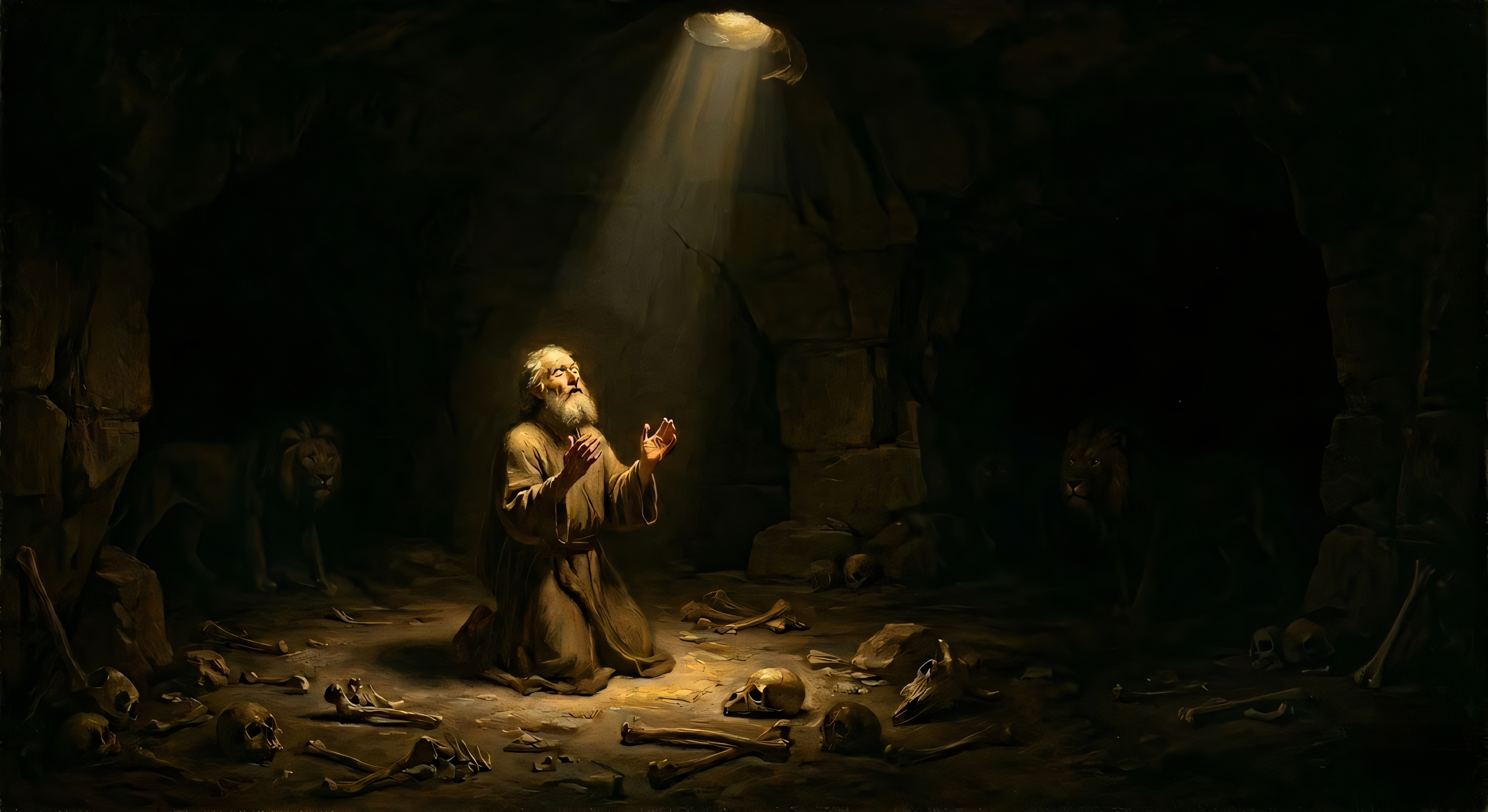
“Although Daniel knew that the document had been signed, he went to his house, which had windows in its upper room open toward Jerusalem, and he got down on his knees three times a day to pray to his God and praise him, just as he had done previously.”
Read that last phrase again: “just as he had done previously.” Daniel didn’t increase his prayers in defiance. He didn’t decrease them in fear. He simply kept doing exactly what he had always done. The decree changed nothing about his devotion. He had prayed three times a day toward Jerusalem his whole life, and he would keep praying three times a day toward Jerusalem now, law or no law, lions or no lions.
This is faithfulness in its purest form. Not dramatic, not showy, just the steady continuation of a lifelong habit in the face of a death sentence. Daniel didn’t make a scene. He didn’t march into the palace to protest. He went home, climbed to his upper room, opened his windows toward the holy city as he always had, knelt down, and prayed.
The detail about the windows “open toward Jerusalem” is rich with meaning. Daniel was praying toward a city that lay in ruins, a Temple that had been destroyed decades earlier. The vessels of that Temple had been used as party cups by Belshazzar in the last chapter. Jerusalem was rubble. And yet Daniel turned his face toward it three times a day, because Jerusalem was where God had placed His name, and the promises attached to that place had not expired just because the stones had fallen.
This practice goes back to Solomon’s prayer at the dedication of the Temple, in 1 Kings 8, where Solomon asked that when God’s people were carried away to the land of their enemies, and they “pray toward their land which You gave to their fathers, the city which You have chosen, and the temple which I have built for Your name,” God would hear from heaven. Daniel was doing exactly what Solomon had prayed his descendants would do. Across the centuries, in exile, in danger, the old man was keeping faith with a promise made before he was born.
And he opened the windows. He didn’t hide. There’s no defiance in it, but there’s no concealment either. Daniel simply refused to let fear change the shape of his devotion. If praying toward Jerusalem was right yesterday, it was right today, and the consequences belonged to God.
The Oath They Made Him Swear
There is a detail in the Old Greek that sharpens the trap, and it appears nowhere in the Masoretic Text or in Theodotion.
In all our traditions, the conspirators get their interdict passed: no one may petition any god or man for thirty days except the king, on pain of the lions’ pit. But the Old Greek adds a further scene. After Darius confirms that the interdict stands, the conspirators are not satisfied with a law. They come back and make the king swear.
Daniel 6:12a (OG/N.E.T.S.):
“And they said to him, ‘We adjure you; swear by the decrees of the Medes and Persians that you not change the matter nor that you respect the person nor that you reduce anything of the things said and you punish the person who did not abide by this interdict.’ And he said, ‘Thus I will do as you say, and this has been established for me.’”
Read that carefully, because it is chillingly precise. They do not merely want a decree on the books. They anticipate exactly what Darius will try to do once he realizes who has been caught. They make him swear he will “not change the matter” (no repeal), that he will “not respect the person” (no favoritism toward Daniel), and that he will “not reduce anything” (no lightening of the sentence). They box him in on every side, and they make him seal it with an oath by the very decrees of the Medes and Persians that cannot be revoked.
This is what makes the Old Greek’s trap so airtight. In the Masoretic account, Darius is caught by an irrevocable law. In the Old Greek, he is caught by an irrevocable law and by his own irrevocable word. He has sworn. And a king who has sworn by the decrees of the Medes and Persians has no honorable way out, which is precisely why the text will show him agonizing until sunset, straining to find a loophole that his own oath has already closed.
The conspirators understood something about power that is worth pausing on. They knew the king liked Daniel. They knew that when the moment came, Darius’s affection would fight against the law. So they did not leave the outcome to the king’s conscience. They bound his conscience in advance. This is how the enemies of the faithful have always worked: not by winning the argument in the moment, but by arranging things beforehand so that the moment has only one possible outcome.
And yet, for all their cleverness, they left one thing entirely out of their calculations. They locked down the king. They could not lock down the King of kings. Every exit from the pit was sealed by human decree and royal oath, and it made no difference at all, because the God who governs the host of heaven was under no man’s interdict and bound by no man’s oath.
The Spring of the Trap
Daniel 6:11-15 (NRSVUE):
“The conspirators came and found Daniel praying and seeking mercy before his God. Then they approached the king and said concerning the interdict, ‘O king! Did you not sign an interdict, that anyone who prays to anyone, divine or human, within thirty days except to you, O king, shall be thrown into a den of lions?’ The king answered, ‘The thing stands fast, according to the law of the Medes and Persians, which cannot be revoked.’ Then they responded to the king, ‘Daniel, one of the exiles from Judah, pays no attention to you, O king, or to the interdict you have signed, but he is saying his prayers three times a day.’
“When the king heard the charge, he was very much distressed. He was determined to save Daniel, and until the sun went down he made every effort to rescue him. Then the conspirators came to the king and said to him, ‘Know, O king, that it is a law of the Medes and Persians that no interdict or ordinance that the king establishes can be changed.’”
The cruelty of the trap now becomes fully visible. The conspirators note that Daniel is “one of the exiles from Judah,” reminding the king that this is a foreigner, a member of a conquered people. And they catch Daniel in the act, not of any crime, but of prayer.
And there’s an Old Greek touch worth noticing here, though I hold it loosely. When the conspirators report Daniel to the king, we get this little nugget.
Daniel 6:13 (OG/N.E.T.S.):
And they said, “Lo, we have found Daniel, your Friend, praying and entreating the face of his God thrice a day.
Your Friend.
In the Hellenistic courts the translator would certainly have known, “Friend of the King” was a formal rank, a member of the royal inner circle. If the translator intended that overtone, the malice sharpens: they are reminding Darius that the man they have trapped is his own trusted intimate, twisting the knife while pretending to inform him. It is likely more a translator’s flourish than a certain feature of the underlying text, but it fits the Old Greek’s consistently more vivid hand.
But what moves me most in this passage is Darius’s reaction. The king is “very much distressed.” He spends the entire day trying to find a legal loophole, “every effort to rescue him,” laboring until sunset to save the man he had hoped to promote. This is no bloodthirsty tyrant. Darius genuinely values Daniel and is horrified to discover he’s been manipulated into condemning his best servant.
But the king is trapped by his own decree. The same immutable law that the conspirators weaponized now binds the king himself. Darius wants to save Daniel and cannot, because he made a law that even he cannot break. The most powerful man in the world is powerless to undo his own word.
The contrast with the living God could not be sharper, and I think it’s the theological spine of the whole chapter. The human king is sovereign in name but trapped by his own decree, unable to deliver the one he loves. The God of heaven, by contrast, is genuinely sovereign, bound by nothing but His own character, and fully able to deliver. Darius will spend the night unable to sleep, powerless. God will spend the night shutting the mouths of lions.
Into the Den
Daniel 6:16-18 (NRSVUE):
“Then the king gave the command, and Daniel was brought and thrown into the den of lions. The king said to Daniel, ‘May your God, whom you faithfully serve, deliver you!’ A stone was brought and laid on the mouth of the den, and the king sealed it with his own signet and with the signet of his lords, so that nothing might be changed concerning Daniel. Then the king went to his palace and spent the night fasting; no food was brought to him, and sleep fled from him.”
Even as he condemns him, Darius blesses Daniel: “May your God, whom you faithfully serve, deliver you!” The pagan king becomes, in spite of himself, a witness to the power of Daniel’s God. He has watched this old man’s faithfulness for long enough to half-believe that deliverance might actually come.
Notice the sealing of the stone “with his own signet and with the signet of his lords.” This detail ensures that no one can tamper with the den during the night, neither the king sneaking in to rescue Daniel, nor the conspirators sneaking in to make sure he’s dead. Whatever happens in that den will be God’s doing alone, witnessed and sealed by the authority of the empire itself. When Daniel emerges alive, no one will be able to claim it was a trick.
And then we get one of the most humanly poignant verses in the book. The king goes home and cannot eat, cannot be entertained, cannot sleep. “Sleep fled from him.” The man who signed the death warrant spends the night in torment, while the man under the death sentence, as we’re about to see, spends the night in peace among the lions. The guilty king cannot rest; the innocent prisoner can. There’s a sermon in that contrast all by itself.
The Morning: A King’s Desperate Hope
Daniel 6:19-23 (NRSVUE):
“Then, at break of day, the king got up and hurried to the den of lions. When he came near the den where Daniel was, he cried out anxiously to Daniel, ‘O Daniel, servant of the living God, has your God whom you faithfully serve been able to deliver you from the lions?’ Daniel then said to the king, ‘O king, live forever! My God sent his angel and shut the lions’ mouths so that they would not hurt me, because I was found blameless before him, and also before you, O king, I have done no wrong.’ Then the king was exceedingly glad and commanded that Daniel be taken up out of the den. So Daniel was taken up out of the den, and no kind of harm was found on him, because he had trusted in his God.”
The king runs to the den at first light, and his cry is desperate and full of fragile hope: “O Daniel, servant of the living God.” Notice that phrase. Darius calls the God of Israel “the living God,” in direct contrast to the dead, handmade idols we’ve seen throughout the book. This is part of the monotheistic trajectory we’ve been tracking. Even a Persian king, watching Daniel’s faithfulness, reaches for the language of the living God over the lifeless gods of the nations.
And Daniel answers from inside the den, alive. But here is where our three voices split in a way most readers have never seen, and it is worth slowing down for.
Theodotion (Brenton) gives us the words we all grew up with:
“My God has sent his angel, and stopped the lions’ mouths, and they have not hurt me: for uprightness was found in me before him; and moreover before thee, O king, I have committed no trespass.”
But the Old Greek reads differently:
Daniel 6:22 (OG/N.E.T.S.):
“O king, I am still alive, and the Lord has saved me from the lions, because righteousness was found in me in his presence, and also in your presence, O king, neither ignorance nor sin was found in me. But you listened to people who deceive kings, and you cast me into the lions’ pit for destruction.”
Notice two things. First, the Old Greek names no angel. Where Theodotion says “My God has sent his angel,” the Old Greek says simply, “the Lord has saved me from the lions.”
Second, the Old Greek adds a rebuke that the Masoretic and Theodotion do not have. Daniel does not merely report his deliverance; he tells the king to his face that he was deceived, that he “listened to people who deceive kings,” and that he cast an innocent man into a pit “for destruction.” The Old Greek’s Daniel is bolder, more prophetic, more willing to name the king’s failure even in the moment of rescue.
Now, this is exactly the kind of place where our both/and reading does its best work. It would be easy to treat these as rivals, as though we have to decide whether an angel shut the lions’ mouths or whether the Lord did it directly. But that is a false choice, and both texts tell us so.
Look again at Theodotion. Even there, the angel never acts on its own authority. Daniel says, “My God has sent his angel.” The angel is an agent, dispatched, commanded, doing the bidding of the One who sent him. The deliverance belongs to God; the angel is the hand God extends. And look at the Old Greek. When it says “the Lord has saved me,” it is not denying the mechanism. It is fixing our eyes past the instrument and onto the One who wielded it.
So the two traditions are giving us the same rescue from two vantage points. Theodotion shows us the how: an angel sent down into the pit, a member of the heavenly court standing between an old man and the jaws of starving lions. The Old Greek shows us the who: the Lord Himself, reaching into the darkness to save His servant.
You need both.
Without the angel, you can forget that God governs and delivers through the host of heaven, the pattern that runs through this entire book. Without the direct statement that the Lord saved him, you can make the mistake of thinking the angel is the point, when the angel is only ever the errand-runner of the Most High.
And this matters for how we think about the divine council. Nowhere in either text does Daniel command the angel, summon the angel, or take any credit for the deliverance himself. He does not bind the lions in his own name. He does not rebuke the pit. He kept his windows open, he bent his knees, and God did the rest, sending His messenger or reaching in Himself, however you frame it. The creature never acts apart from the Creator’s command. That is the whole shape of biblical deliverance, and it is the shape here.
We have watched this pattern the whole way through. In chapter 3, a fourth figure “like a son of the gods” (or “a divine angel,” in the Old Greek) walked in the furnace with the three young men. In chapter 4, the watchers pronounced the sentence and the angels carried it out and then restored the king. In chapter 5, the fingers of a hand from the heavenly court wrote the verdict on Belshazzar’s wall. And now, in chapter 6, whether we name the angel with Theodotion or name the Lord with the Old Greek, the same truth lands: the God of Daniel governs and delivers, and He is never without His court, and His court is never idle.
This is the same angelic deliverance the writer to the Hebrews may have in mind when he lists the heroes of faith who “shut the mouths of lions” (Hebrews 11:33). Daniel did not shut those mouths. God did, whether by the angel He sent or by His own forethought. Daniel’s part was simply to be “found blameless before him,” to keep his windows open and his knees bent and his trust fixed on the God who saves.
Justice Falls on the Accusers
Daniel 6:24 (NRSVUE):
“The king gave a command, and those who had accused Daniel were brought and thrown into the den of lions, they, their children, and their wives. Before they reached the bottom of the den, the lions overpowered them and broke all their bones in pieces.”
This is a hard verse for modern readers, and I won’t soften it. The conspirators are thrown to the lions, along with their families, and they are torn apart before they even hit the floor of the den. The same fate they engineered for Daniel falls on them instead.
A couple of things to say about this. First, it demonstrates beyond any doubt that the lions were real, hungry, and fully capable of killing. Daniel’s survival was not because the lions were tame or sated. The moment the angel’s protection was absent, the lions did exactly what starving lions do. The miracle of Daniel’s deliverance is underscored by the speed of the conspirators’ deaths.
Second, the inclusion of the families reflects the ancient Near Eastern practice of corporate justice, where a traitor’s whole household shared his fate. This was the standard of the Medo-Persian legal world, not a command of God, and we should read it as a description of how that empire administered justice, not a prescription for how justice ought to be done. The Mosaic law, by contrast, explicitly forbade executing children for the sins of their fathers (Deuteronomy 24:16). The text is showing us the brutal reality of pagan imperial justice, the very system that had nearly killed Daniel, now turned against those who abused it.
There’s a principle of poetic justice here that runs all through Scripture: the pit you dig for the righteous becomes your own grave. “Whoever digs a pit will fall into it” (Proverbs 26:27). Haman hanged on the gallows he built for Mordecai. The conspirators died in the den they prepared for Daniel. The schemes of the wicked have a way of recoiling on the schemers.
One slight divergence in the OG at the end of this verse deserves a mention:
and Daniel was appointed over the whole kingdom of Darius.
Although you could certainly argue that the Masoretic Text implies this end result for Daniel with the close in verse 28, here it is made explicit that Daniel is given authority over the entire kingdom.
The King’s Decree: The Living God
The chapter closes, as the Nebuchadnezzar stories did, with a pagan king issuing a decree in praise of the God of Israel.
Daniel 6:25-27 (NRSVUE):
“Then King Darius wrote to all peoples and nations of every language throughout the whole world: ‘May you have abundant prosperity! I make a decree, that in all my royal dominion people should tremble and fear before the God of Daniel:
For he is the living God, enduring forever. His kingdom shall never be destroyed, and his dominion has no end. He delivers and rescues, he works signs and wonders in heaven and on earth; for he has saved Daniel from the power of the lions.’”
The Old Greek’s version of the king’s confession is worth setting alongside it, because it sharpens the monotheistic point even further:
Daniel 6:26-27 (OG/N.E.T.S.):
“Let all people who are in my kingdom do obeisance and worship Daniel’s God, for he is an enduring and living God for generations of generations unto eternity. And I, Darius, will do obeisance and be subject to him all my days, for the handmade idols are not able to save, as the God of Daniel redeemed Daniel.”
Look at that last line in the Old Greek: “the handmade idols are not able to save, as the God of Daniel redeemed Daniel.” This is the explicit contrast the whole book has been driving toward. The handmade idols, the gods of gold and silver and wood and stone that Belshazzar toasted, that Nebuchadnezzar’s golden image represented, that the nations bow to, cannot save. They are powerless. Only the living God delivers. Darius, like Nebuchadnezzar before him, is brought to confess not merely that the God of Israel is strong, but that the idols are nothing by comparison. They cannot do the one thing a god is supposed to do: save.
This is the same trajectory we’ve been following chapter by chapter. The Old Greek in particular keeps sharpening it: from “idol temple” in chapter 1, to God who reveals mysteries “alone” in chapter 2, to “our one Lord” in chapter 3, to “God is one” in chapter 4, to “the living God” here in chapter 6. The pagan world, king by king, is being driven to the same confession: there is one God, He is living, and the idols are powerless.
That is the Old Greek’s decree, and its climax, “the handmade idols are not able to save,” is the sharpest statement of the monotheistic trajectory we have been tracking all through the book. But listen to how Theodotion has Darius speak, because it goes in a different and equally revealing direction.
Daniel 6:26-27 (Theodotion/Brenton):
“This decree has been set forth by me in every dominion of my kingdom, that men tremble and fear before the God of Daniel: for he is the living and eternal God, and his kingdom shall not be destroyed, and his dominion is for ever. He helps and delivers, and works signs and wonders in the heaven and on the earth, who has rescued Daniel from the power of the lions.”
Do those words sound familiar? They should. This is almost exactly the language Nebuchadnezzar used at the end of his own humbling in chapter 4, when he blessed “him that lives for ever,” whose “dominion is an everlasting dominion, and his kingdom lasts to all generations,” who “does according to his will in the army of heaven, and among the inhabitants of the earth.”
Theodotion’s Darius, a Median king who never met Nebuchadnezzar, arrives at the same confession the Babylonian king reached a generation earlier: the God of Israel has an indestructible kingdom, an everlasting dominion, and He works signs and wonders in heaven and on earth.
So look at what the two Greek decrees do side by side. The Old Greek drives toward the powerlessness of the idols: the handmade gods cannot save, only the living God delivers. Theodotion drives toward the permanence of God’s kingdom: His dominion never ends, and He works wonders in both realms. One tradition tears down the false gods; the other lifts up the true King’s unending reign. Set them together and you have the whole shape of the confession every pagan king in this book is dragged toward, from Nebuchadnezzar to Darius: the idols are nothing, and the God of Daniel reigns forever.
That is not two decrees competing. That is one truth confessed from two sides, exactly the pattern this whole series has been showing you, and exactly why we read the traditions together rather than choosing between them.
Daniel 6:28 (NRSVUE):
“So this Daniel prospered during the reign of Darius and the reign of Cyrus the Persian.”
As I mentioned in our chapter 5 discussion, this verse is one of the keys some scholars use to identify Darius the Mede with Cyrus, since the Aramaic can be read “the reign of Darius, that is, the reign of Cyrus the Persian.”
However you resolve that question, the point of the verse is clear: Daniel didn’t just survive the lions’ den. He flourished. He outlasted his accusers, outlasted the regime change, and continued to serve faithfully into the reign of Cyrus, the very king whose decree would soon send the exiles home to rebuild Jerusalem.
If you’ve found this work insightful or enlightening, share it with a friend who needs to see the power of reading this incredible story in multiple traditions.
Reflections: The God Who Sends His Angel
Daniel 6 is a story about faithfulness that doesn’t bend, and a God who delivers those who trust Him. But I want to be careful here, because this story is often preached in a way that promises too much.
The lesson of the lions’ den is not that God always rescues the faithful from danger in this life. We know that’s not true. Daniel’s three friends declared in chapter 3 that God was able to deliver them, “but if not,” they would still not bow. Sometimes the furnace is real and the deliverance comes through the fire rather than from it. The same writer to the Hebrews who praised those who “shut the mouths of lions” went on, in the very same passage, to praise those who were “tortured,” “killed with the sword,” who “wandered about... destitute, persecuted, tormented” (Hebrews 11:35-37). Same faith. Different outcomes. Some were delivered from death; some were delivered through death.
So the lesson of Daniel 6 is not “be faithful and God will always keep you safe.” The lesson is deeper and more durable than that: be faithful regardless of the outcome, because the God you serve is the living God, and He is able to deliver, in this life or the next, by shutting the lions’ mouths or by carrying you home through them.
What Daniel controlled was his faithfulness. He kept his windows open. He bent his knees. He prayed toward the ruined city where God had placed His name, trusting promises older than himself. The outcome, whether the lions ate or whether an angel shut their mouths, was God’s business, not his. And that is exactly the posture of faith. We are responsible for the open window and the bent knee. God is responsible for the lions.
There’s also a word here for anyone who feels that their integrity has made them a target. Daniel did everything right and it nearly got him killed. If you have found that your faithfulness, your honesty, your refusal to compromise has made you enemies rather than friends, you are in good company. The world did not hate Daniel because he was bad. It hated him because he was good, and his goodness exposed the rot around him.
Jesus told us plainly that this is the pattern: “If the world hates you, know that it hated me before it hated you” (John 15:18). The open window is still the right place to kneel, even when it makes you a target.
Especially when it makes you a target.
And finally, hold onto the phrase that ties this whole book together: “My God sent his angel.” You are not alone in your den. The same God who governs the kingdoms of men through the host of heaven, who sent a fourth figure into the furnace and an angel into the lions’ pit, has not left His people without help.
The living God still sends His angels. He still shuts the mouths that would devour His children. And even when He allows the lions to do their worst, He has prepared a deliverance that no den, no decree, and no death can finally prevent.
Keep your windows open. Bend your knees. Trust the living God. He has not changed.
Coming Up Next
Next time, we cross a major threshold in the book. With chapter 7, we leave the court stories behind and enter the visions. The night Daniel saw four great beasts rise from a churning sea, a little horn speaking great things, and the Ancient of Days seated on a throne of fire while the books of judgment were opened. It is one of the most important prophetic chapters in all of Scripture, and the three traditions have much to show us. You won’t want to miss it.
The LXX Scrolls is free to read and always will be. If this work has been worth something to you, there are a few ways to say so:
Buy the ebooks. Completed teaching series are available as polished ebooks under the Two Witnesses, One Truth series. Buying through Curios will support this work most directly but they’re also available on Amazon (and elsewhere) if you’re loyal to a particular ereader.
Become a supporter. A monthly or annual pledge through Substack helps me to bring the Septuagint to those who never knew they needed it.
Send a one-time tip. If this post has blessed you and you want to express that directly, you can Buy Me a Coffee.

Thank you for being part of this journey, your support makes this work possible.
© 2026 LXX Scrolls. All rights reserved.