


Hello brothers and sisters,
In our last post, we walked through Nebuchadnezzar’s dream of the great tree and Daniel’s interpretation, comparing how the Old Greek, Theodotion, and the Masoretic Text each tell the story with their own distinctive voice. We saw the OG’s cosmic tree with the sun and moon dwelling in its branches, the watcher versus angel divergence, and the OG’s Daniel explicitly accusing the king of ravaging the Temple.
If you missed any of the earlier posts, you can get caught up HERE
Now we reach the fulfillment. The dream comes true. And this is where the Old Greek version of Daniel 4 becomes something that no other ancient text quite resembles: a first-person account of madness, written by the man who lived through it.
Let’s dig in.
If you’re reading this in email, be aware that the text is likely to cut off without warning. For a smoother reading experience and all the features Substack has to offer (including audio voiceovers of my posts), you can go HERE or download the app.
The Boast
All three traditions agree on the setup. Twelve months pass. Nebuchadnezzar has done nothing to heed Daniel’s warning. And then, walking on the roof of his palace (or “on the walls of the city,” as the OG puts it), the king boasts. First, the Masoretic and Theodotion versions, which agree closely here:
Daniel 4:29-30 (NRSVUE):
“At the end of twelve months he was walking on the roof of the royal palace of Babylon, and the king said, ‘Is this not magnificent Babylon, which I have built as a royal capital by my mighty power and for my glorious majesty?’”
Daniel 4:29-30 (Theodotion/Brenton):
“After a twelvemonth, as he walked in his palace in Babylon, the king answered and said, Is not this great Babylon, which I have built for a royal residence, by the might of my power, for the honour of my glory?”
Now the Old Greek:
Daniel 4:26-27 (OG/N.E.T.S.):
“And after twelve months the king was walking on the walls of the city in all his glory and going through its towers, and answering he said, ‘This is the great Babylon, which I have built by the might of my power, and it will be called my royal house.’”
The boast is essentially the same across all three traditions. Every pronoun points to the king. I built it. My power. My glory. This is the sin of chapter 4 distilled into a single sentence.
And here’s what makes it tragic: Nebuchadnezzar isn’t entirely wrong about the facts. He did build Babylon. Archaeologists have recovered bricks stamped with his name by the thousands, and his building projects (the Ishtar Gate, the processional way, the massive walls) were among the wonders of the ancient world. The Babylon he’s looking at really was his achievement.
But that’s precisely the deception of pride. It takes a true thing (I accomplished this) and removes God from it (by my power, for my glory). The Most High gave Nebuchadnezzar his kingdom. Daniel told him so directly back in chapter 2: “you are the head of gold.” Nebuchadnezzar even confessed it himself at the end of chapter 2, falling on his face and declaring that Daniel’s God is “God of gods and Lord of kings.” But knowing the truth and living by it are two very different things. A year of prosperity erased a moment of revelation.
This is the same warning Moses gave Israel in Deuteronomy 8:17-18: “Do not say to yourself, ‘My power and the might of my own hand have gotten me this wealth.’ But remember the Lord your God, for it is he who gives you power to get wealth.” Nebuchadnezzar said the exact thing Moses warned against. And judgment was already on its way.
The Voice from Heaven
What happens next is where the traditions diverge sharply. In the Masoretic and Theodotion, the heavenly voice is brief and devastating:
Daniel 4:31-32 (NRSVUE):
“While the words were still in the king’s mouth, a voice fell from heaven: ‘O King Nebuchadnezzar, to you it is declared: The kingdom has departed from you! You shall be driven away from human society, and your dwelling shall be with the animals of the field. You shall be made to eat grass like oxen, and seven times shall pass over you, until you have learned that the Most High has sovereignty over the kingdom of mortals and gives it to whom he will.’”
Daniel 4:31-32 (Theodotion/Brenton):
“While the word was yet in the king’s mouth, there came a voice from heaven, saying, To thee, king Nabuchodonosor, they say, The kingdom has departed from thee. And they shall drive thee from men, and thy dwelling shall be with the wild beasts of the field, and they shall feed thee with grass as an ox: and seven times shall pass over thee, until thou know that the Most High is Lord of the kingdom of men, and he will give it to whomsoever he shall please.”
Both are concise. The kingdom is taken, the king becomes a beast, and seven times (seven years, in Hebrew idiom) will pass until he learns the lesson. Notice that the timing is precise to the point of being almost theatrical: the judgment falls “while the word was yet in the king’s mouth.” He doesn’t even finish congratulating himself. The boast and the sentence collide in the same breath.
Now listen to the Old Greek’s heavenly voice. It’s nearly three times longer:
Daniel 4:28-30 (OG/N.E.T.S.):
“And at the completion of his word, he heard a voice from heaven: ‘O King Nabouchodonosor, to you it is said: The kingdom of Babylon has been taken away from you and is being given to another, a contemned person in your house. Lo, I establish him over your kingdom, and he will receive your authority and your glory and your luxury so that you may recognize that the God of heaven has authority in the kingdom of humans and he will give it to whomever he desires. Now, by sunrise, another king will rejoice in your house and will take your glory and your power and your authority. And the angels will pursue you for seven years, and you will never be seen, nor will you ever speak with any person. They will feed you grass like an ox, and your pasture will be from the tender grass of the earth. Lo, instead of your glory they will tie you, and another will have your luxurious house and the kingdom. Now, by morning everything will be completed concerning you. O King Nabouchodonosor of Babylon, and none of all these things will fail.’”
The differences are striking. The OG’s heavenly voice doesn’t just announce judgment. It describes a transfer of power to a specific replacement, “a contemned person in your house.” It says “the angels will pursue you for seven years,” picking up that plural agency we saw with the watchers in the dream itself.
I want to pause on that detail, because it connects to something we’ve been tracing throughout the book. In the Masoretic and Theodotion, the dream’s decree came from “a watcher, a holy one.” Now the OG says “the angels will pursue you.” Both traditions are pointing at the same reality: the heavenly host, the divine council, are active agents in the administration of God’s judgment on earth. God doesn’t just decree from a distance. He deploys. The watchers who pronounced the sentence in the dream are the angels who execute it in waking life.
This is the same picture we get in 1 Kings 22, where the Lord asks the heavenly council, “Who will entice Ahab?” and a spirit volunteers. It’s the same picture in Job 1 and 2, where the sons of God present themselves before the Lord. It’s the picture Paul assumes in Ephesians 6 when he tells us our struggle is against rulers and authorities in the heavenly places. The God of Daniel governs through a council of spiritual beings, and chapter 4 shows that council carrying out a sentence against the most powerful man on earth.
The OG also specifies that the judgment will be complete “by sunrise” or “by morning,” and it closes with a chilling guarantee: “none of all these things will fail.” Where the Masoretic and Theodotion deliver a sentence, the OG delivers a detailed prophecy of exactly what will happen, when it will happen, and who will benefit from it. The OG’s version reads less like a judicial pronouncement and more like a declaration of war from heaven.
The Madness — Inside vs. Outside
Now we arrive at one of the most extraordinary divergences in the entire chapter, if not the whole book.
In the Masoretic Text and Theodotion, the madness is described from the outside, in the third person:
Daniel 4:33 (NRSVUE):
“Immediately the sentence was fulfilled against Nebuchadnezzar. He was driven away from human society, he ate grass like oxen, his body was bathed with the dew of heaven, until his hair grew as long as eagles’ feathers and his nails became like birds’ claws.”
Daniel 4:33 (Theodotion/Brenton):
“In the same hour the word was fulfilled upon Nabuchodonosor: and he was driven forth from men, and he ate grass as an ox, and his body was bathed with the dew of heaven, until his hairs were grown like lions’ hairs, and his nails as birds’ claws.”
One small difference between these two: the Masoretic says his hair grew like eagles’ feathers; Theodotion says like lions’ hair. A minor variant, but a good reminder that even the two traditions that usually march in lockstep can part ways on a detail.
The Masoretic and Theodotion tell us what happened to Nebuchadnezzar. We observe from a distance. It’s clinical, almost restrained, which in its own way makes the horror more effective. The man who ruled the world is now eating grass, and the text states it flatly, without commentary.
But the Old Greek does something no one would expect. After giving its own third-person description of the onset of madness, it then shifts into first person.
Nebuchadnezzar narrates his own madness from the inside. Let’s take the third-person opening first:
Daniel 4:30 (OG/N.E.T.S.):
“At the same time, the sentence was completed against Nabouchodonosor, and he was driven away from humans and ate grass like an ox, and his body was bathed with the dew of heaven until his hair lengthened like that of lions and his nails like those of birds.”
So far this tracks with the other traditions (and notice the OG also has “lions,” clearly a vestige that Theodotion chose to keep from the Old Greek). But then the OG opens a window that no other text gives us:
Daniel 4:30a (OG/N.E.T.S.):
“’I, Nabouchodonosor, king of Babylon, was bound seven years. They fed me grass like an ox, and I would eat the tender grass of the earth. And after seven years I gave my soul to supplication, and I petitioned before the Lord, the God of heaven, concerning my sins, and I entreated the great God of gods concerning my ignorance.’”
This is breathtaking. The king is narrating his own insanity in the first person. And look at the theology embedded in it: even in the depths of his madness, the OG’s Nebuchadnezzar says he gave his soul to supplication and petitioned before the Lord, the God of heaven, concerning his sins.
Hold that thought, because it marks a real difference between the traditions. In the Masoretic, the restoration begins when the king lifts his eyes to heaven (v. 34). In the OG, the restoration begins with prayer during the madness. The OG’s Nebuchadnezzar doesn’t wait until his sanity returns to pray. He prays his way out of the madness.
The first-person account continues:
Daniel 4:30b (OG/N.E.T.S.):
“’And my hair became like wings of an eagle, my nails like those of a lion. My flesh and my heart were changed. I would walk about naked with the animals of the field. I saw a dream and forebodings gripped me, and after a while a great sleep overtook me, and drowsiness fell upon me.’”
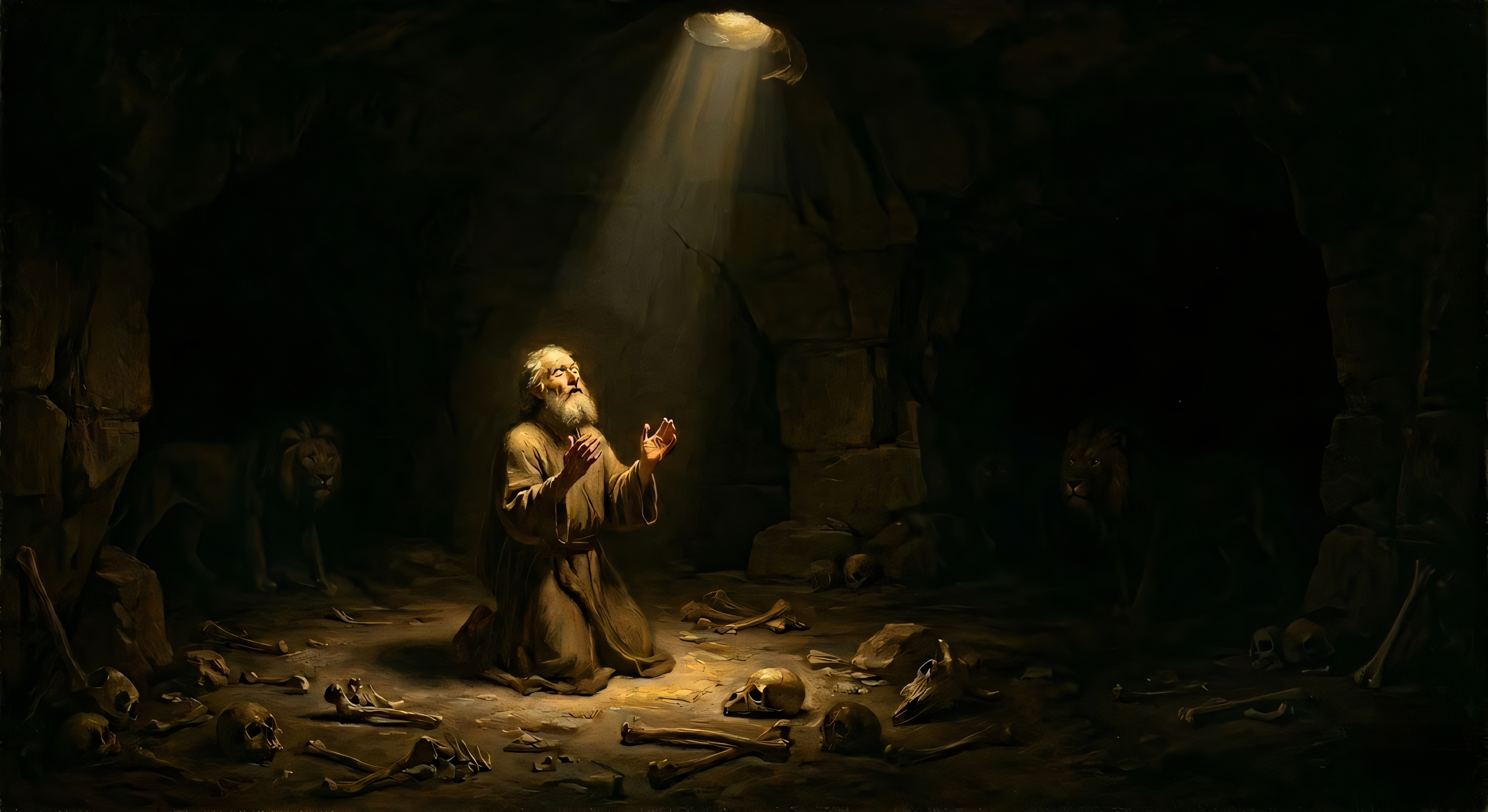
There’s an almost dreamlike quality to the OG’s narration here, as if the king is remembering fragments through a haze of confusion, piecing together seven years of insanity from broken memories. “I would walk about naked with the animals of the field.” No other text gives us the interior experience of divinely inflicted madness. We get to feel what it was like from the inside.
And notice something fascinating about the hair and nails. In the OG’s third-person description (v. 30), his hair is like a lion’s and his nails like a bird’s. Now in the first-person account (v. 30b), his hair is like an eagle’s wings and his nails like a lion’s. The images have swapped.
This might be a textual wrinkle, or it might be the OG deliberately showing us that a man remembering his own madness doesn’t recall it with clinical precision. The details blur. That’s what trauma does to memory.
There’s one more piece of first-person material, and it brings the restoration into view:
Daniel 4:30c (OG/N.E.T.S.):
“’And at the completion of seven years my time of redemption came, and my sins and my ignorances were fulfilled before the God of heaven, and I entreated the great God of gods concerning my ignorances, and lo, one angel called me from heaven: “Nabouchodonosor, be subject to the holy God of heaven, and give glory to the Most High. The dominion of your nation is being given back to you.”’”
An angel calls Nebuchadnezzar by name and announces his restoration. This specific scene, the angel’s direct address, does not exist in any other tradition. In other versions, Nebuchadnezzar simply lifts his eyes and his reason returns.
And here we see the divine council again, now on the side of mercy. Presumably, it’s one of the same angels who “pursued” him during his madness (v. 29) that now announces his restoration. One of the agents of judgment had become an agent of grace.
And here’s both what I find intriguing and why I land on this interpretation:
It’s a pattern worth noticing all through Scripture. The same God who wounds is the God who heals (Deuteronomy 32:39), the same God who tears is the God who binds up (Hosea 6:1), the same hand that strikes is the hand that restores. The heavenly host that executed the sentence is the heavenly host that lifts it.
So which restoration is true?
The Masoretic, where it begins with looking up? Or the OG, where it begins with crying out from the pit?
As I almost always conclude, I think it’s both. They’re describing the same reality from two angles. Sometimes restoration begins when we simply turn our eyes in the right direction. Sometimes it begins when we cry out from the depths, before we can even see clearly.
Both are real dimensions of how God restores broken people, and the two traditions preserve both for us.
But here’s what I think is beautiful. Even without the modern angle of looking at this story through the text, centuries later, just looking at the reality of what Nebuchadnezzar experienced, there’s no reason not to believe his restoration came in stages. That both of these renderings are literally true.
The beginnings of the restoration of his sanity could have come in that moment that he looked up to heaven, with his full restoration coming only when he cried out to the Lord, having regained just enough of his sanity to realize the depths of his plight.
That’s the both/and in action.
The Doxology — A Brief Statement vs. A Royal Manifesto
Now we reach the ending, and this is where the gap between the traditions is arguably at its widest in the entire book.
In the Masoretic and Theodotion, the restoration and doxology are powerful but concise. First the Masoretic:
Daniel 4:34-35 (NRSVUE):
“When that period was over, I, Nebuchadnezzar, lifted my eyes to heaven, and my reason returned to me. I blessed the Most High and praised and honored the one who lives forever. For his sovereignty is an everlasting sovereignty, and his kingdom endures from generation to generation. All the inhabitants of the earth are accounted as nothing, and he does what he wills with the host of heaven and the inhabitants of the earth. There is no one who can stay his hand or say to him, ‘What are you doing?’”
That phrase “the host of heaven” is worth a moment.
Even in the Masoretic’s compact doxology, Nebuchadnezzar acknowledges that God “does what he wills with the host of heaven.” The divine council again. The pagan king who once thought he answered to no one now confesses that even the armies of heaven move at God’s will. If the host of heaven cannot stay His hand, what chance did the king of Babylon ever have?
Theodotion runs very close to this:
Daniel 4:34-35 (Theodotion/Brenton):
“And at the end of the time I Nabuchodonosor lifted up mine eyes to heaven, and my reason returned to me, and I blessed the Most High, and praised him that lives for ever, and gave him glory; for his dominion is an everlasting dominion, and his kingdom lasts to all generations: and all the inhabitants of the earth are reputed as nothing: and he does according to his will in the army of heaven, and among the inhabitants of the earth: and there is none who shall withstand his power, and say to him, What hast thou done?”
Then the Masoretic and Theodotion close the king’s confession:
Daniel 4:36-37 (Theodotion/Brenton):
“At the same time my reason returned to me, and I came to the honour of my kingdom; and my natural form returned to me, and my princes, and my nobles, sought me, and I was established in my kingdom, and more abundant majesty was added to me. Now therefore I Nabuchodonosor praise and greatly exalt and glorify the King of heaven; for all his works are true, and his paths are judgment: and all that walk in pride he is able to abase.”
That’s the ending in the Masoretic and Theodotion. It’s magnificent. “All that walk in pride he is able to abase.” Full stop. Chapter over.
The Old Greek’s ending is something else entirely. It begins with a shared doxology, and the wording here is close enough to the other traditions that we can see they’re offering the same praise:
Daniel 4:31-33 (OG/N.E.T.S.):
“And after the completion of the days, I, Nabouchodonosor, lifted my eyes to heaven, and my reason was returned to me. And I blessed the Most High and praised and glorified the one who lives forever. For his authority is an everlasting authority, and his kingdom is for generation upon generation. And all the inhabitants of the earth were accounted as nothing, and he acts according to his will with the host of heaven and with the settlement of the earth. And there is no one who will stay his hand or say to him, ‘What did you do?’ On that day my kingdom was restored to me, and my glory was given back to me.”
So far the OG is in harmony with the others. But where the Masoretic and Theodotion wrap up after a few more lines, the OG opens into something vast. Watch how it expands:
Daniel 4:33-34 (OG/N.E.T.S.):
“‘On that day my kingdom was restored to me, and my glory was given back to me. I acknowledge the Most High, and I praise the one who created the heaven and the earth and the seas and the rivers and everything that is in them. I acknowledge, and I praise, because he is God of gods and Lord of lords and Lord of kings, because he does signs and wonders and changes seasons and times, removing the reign of kings and setting others in their place.’”
Now, one of the things that I find very interesting about verse 34 is how some of the phrases seem to mirror the way Daniel praised God in chapter 2 after he had been granted insight into the king’s dream. Notice the lines about changing seasons and times and setting up and removing kings (v. 2:21).
Now, also notice that the king now confesses God as Creator, “the one who created the heaven and the earth and the seas and the rivers and everything that is in them.” This is a major step.
In chapters 2 and 3, Nebuchadnezzar acknowledged God’s power and even His supremacy over other gods. But here he confesses God as the Creator of all things. That’s a category leap. A henotheist can admit one god is stronger than the others. Only someone moving toward genuine monotheism confesses that this God made everything, including the rivals.
Then the OG takes it even further:
Daniel 4:34a (OG/N.E.T.S.):
“’From now on I will serve him, and trembling has gripped me from fear of him, and I praise all his holy ones, for the gods of the nations do not have power in them to give away the kingdom of a king to another king and to kill and to make alive and to do signs and great and terrible marvels and to change very great matters as the God of heaven has done with me. And he changed great things about me. I will offer sacrifices to the Most High as an odor of fragrance to the Lord for my life every day of my reign, and I will do what is pleasing before him, I and my people, my nation and my lands that are in my authority. And as many as have spoken against the God of heaven and as many as should be caught speaking anything, I will condemn these to death.’”
There is so much here. “The gods of the nations do not have power in them.” That is an explicit denial of the reality and authority of the pagan gods. And it lands right on a Divine Council theme we’ve been developing: the gods of the nations are real spiritual beings (this is the world of Deuteronomy 32:8 and Psalm 82), but they are creatures, not the Creator, and they are powerless before the God of heaven.
Nebuchadnezzar isn’t saying the other gods don’t exist. He’s saying they have no power. They cannot give kingdoms, cannot kill or make alive, cannot do signs. Only the Most High can. That’s exactly the indictment God levels against the elohim of the council in Psalm 82: you are gods, but you will die like men, because you have failed and you were never the Most High.
And then the OG does the most remarkable thing of all. It turns Nebuchadnezzar’s private confession into a public, imperial proclamation:
Daniel 4:34b (OG/N.E.T.S.):
“Then King Nabouchodonosor wrote a circular letter to all the nations in each place and to countries and languages who live in all the countries, generations and generations. ‘Praise the Lord, God of heaven. Bring sacrifice and offering to him gloriously. I, the king of kings, acknowledge him gloriously, because he has done thus with me. In the same day he established me on my throne, and I took possession of my authority and my kingdom among my people, and my greatness was restored to me.’”
A circular letter. To every nation, every language, every generation. The most powerful man in the world uses the entire apparatus of his empire to command the worship of the God of Israel. And then the climax:
Daniel 4:34c (OG/N.E.T.S.):
“‘King Nabouchodonosor to all nations and all countries and all the inhabitants in them: May peace be multiplied to you at every time. And now, I will show to you the deeds that the great God has done with me. Moreover, it seemed good to me to show you and your savants that God is one, and his marvels are great; his rule is forever; his authority is from generation to generation.’”
God. Is. One.
There it is. The OG’s Nebuchadnezzar arrives at the Shema. “Hear, O Israel: the Lord our God, the Lord is one” (Deuteronomy 6:4). The pagan king who built a golden image of himself, who threw three Hebrews into a furnace for refusing to bow, now broadcasts to the entire world that God is one.
The Masoretic ending leaves the question of Nebuchadnezzar’s conversion deliberately ambiguous. He praises God, yes, but does he trust God? The text doesn’t say. The OG resolves the ambiguity completely. This is conversion. This is a man transformed, testifying to the nations, moving from pride to genuine faith.
And here is where I think the both/and perspective does real work. The Masoretic reminds us that we can never fully read another person’s heart. We see words and actions, not the soul behind them.
That’s a wise restraint.
But the OG reminds us that God’s work in a human life can be dramatic, public, and world-shaking. A man who ravaged God’s Temple can become a man who declares God’s oneness to every nation under heaven. Both readings are true to how God works.
Some conversions are quiet and ambiguous from the outside.
Some shake empires.
If you’ve found this work insightful or enlightening, share it with a friend who needs to see the power of a publicly converted pagan king, as found in the Old Greek.
The Prayer of Nabonidus: A Parallel Voice
Before we close this chapter, there’s one more piece worth examining, and it’s one of the most fascinating discoveries to come out of the Dead Sea Scrolls.
Among the texts found in Cave 4 at Qumran is a fragmentary Aramaic document known as the Prayer of Nabonidus (catalogued as 4Q242). It tells the story of Nabonidus, the last king of Babylon and the father of Belshazzar (whom we’ll meet in chapter 5), who was afflicted by God with a severe illness for seven years while living in Teima, in the Arabian desert. A Jewish exorcist or diviner pardoned his sins and instructed him to give glory to the Most High God.
The surviving fragment reads, in part: “I was afflicted with an evil ulcer for seven years... and an exorcist pardoned my sins. He was a Jew from among the children of the exile of Judah, and he said, ‘Recount this in writing to glorify and exalt the Name of the Most High God.’”
The parallels to Daniel 4 are impossible to miss. A Babylonian king. An affliction lasting seven years. A Jewish holy man involved in the resolution. A command to write it down and give glory to the Most High God. The structural overlap is striking.
Critical scholars have generally argued that the Prayer of Nabonidus represents an earlier form of the tradition, which was later reworked into Daniel 4, with the obscure Nabonidus replaced by the far more famous Nebuchadnezzar. In other words, they say Daniel 4 is a literary adaptation of a story that originally belonged to a different king.
I want to engage that honestly, because it’s a real argument and waving it away would be dishonest. But I don’t think it requires the conclusion the critics draw. There are at least two faithful ways to read the relationship.
First, these could be two distinct but parallel events. The Babylonian royal house in this period was, by every account, unstable. We don’t have to assume only one king was ever humbled by God. Nabonidus famously abandoned Babylon for roughly ten years to live in Teima, an absence so bizarre that it disrupted the sacred New Year festival and alienated the priesthood of Marduk (the Nabonidus Chronicle records this). Something was genuinely wrong in that royal family.
Second, and just as plausible, the Prayer of Nabonidus could be a later adaptation that borrowed from the Daniel tradition and attached it to Nabonidus, not the other way around. The direction of borrowing is an assumption, not a proven fact.
And here’s a detail the critics rarely mention: there’s independent ancient evidence that Nebuchadnezzar specifically suffered some kind of breakdown. The Babylonian historian Berossus, writing in the third century B.C., records that Nebuchadnezzar fell ill toward the end of his reign. And a cuneiform tablet now in the British Museum (catalogued BM 34113) contains fragmentary text describing Nebuchadnezzar (spelled in the cuniform as Nebuchadrezzar) behaving strangely and that he gave contradictory orders.
It’s opening line reads:
"Nebuchadrezzar pondered... his life was of no value to him... to Amel-Marduk [his son] he speaks what was not... he then gives a different order..."
Note the details there. Amel-Marduk is the king we know as Evil-merodach, who was in fact the son of Nebuchadnezzar and was king before Nabonidus.
The tablet is damaged and its interpretation is debated, but it points in exactly the direction Daniel 4 describes.
So we have multiple ancient witnesses, in different languages and from different communities, all gesturing at instability and affliction in the Babylonian royal house during precisely this window.
Daniel 4 and the Prayer of Nabonidus may simply be two windows onto the same historical reality, preserved through different streams of tradition.
The important point, however, is that none of this threatens the theological message in the slightest. Whether the affliction originally fell on Nebuchadnezzar, on Nabonidus, or (as I suspect) on both in their own ways, the point Daniel 4 makes stands unshaken:
God humbles proud kings. The Most High rules the kingdom of men and gives it to whomever He will. And those who walk in pride, He is able to abase.
Reflections: The Stump Remains
Daniel 4 is the most textually diverse chapter in the entire book. The Old Greek gives us a tree with the sun and moon dwelling in it, an angel who calls the king by name, a first-person account of madness that reads like a fever dream, and a doxology that stretches into a royal manifesto declaring the oneness of God to every nation on earth.
The Masoretic gives us a framed narrative of terrifying economy, where the most powerful man on earth is reduced to eating grass in a single verse, and where the theological thesis is stated with unforgettable simplicity: “those who walk in pride he is able to abase.”
You need both.
You need the OG’s raw, detailed, emotionally vivid portrait of what it actually looks like when God breaks a proud man down and builds him back up. And you need the Masoretic’s spare, devastating clarity that wastes not a single word.
But here’s the detail that stays with me across every version, in every tradition: the stump. When the tree was cut down, the stump was left. The roots were preserved. Bound with iron and bronze, held together through the seven years of madness, waiting for the day when the tree could grow again.
God didn’t cut Nebuchadnezzar down to destroy him. He cut him down so he could grow back in the right direction. The stump remains. The roots hold. The iron and bronze bands keep the foundation intact even when everything above ground is gone.
If you’re in a season where everything has been stripped away, where you feel like your life has been cut down to nothing but a stump, take heart from Daniel 4. The stump is not the end of the story. It’s the beginning of the restoration. The roots are still alive. The bands are still holding. And the God who cut the tree down is the same God who will make it grow again.
But it starts with looking up. Whether that means lifting your eyes to heaven (as the Masoretic says) or crying out in prayer from the depths of your madness (as the OG says), the first step is the same: turn toward God.
“And at the completion of seven years my time of redemption came.”
Redemption came. It always does. Not always when we want it, but always when the time is right.
Coming Up Next
Next time, we enter Daniel 5: the feast of Belshazzar, the writing on the wall, and the night Babylon fell. Where Nebuchadnezzar’s story was about humbling and restoration, Belshazzar’s story is about judgment without reprieve. And the Old Greek, having expanded chapter 4 beyond anything we’d expect, will take the opposite approach with chapter 5, cutting it shorter than the Masoretic, with sharp editorial decisions that create a leaner, more devastating narrative.
The LXX Scrolls is free to read and always will be. If this work has been worth something to you, there are a few ways to say so:
Buy the ebooks. Completed teaching series are available as polished ebooks under the Two Witnesses, One Truth series. Buying through Curios will support this work most directly but they’re also available on Amazon (and elsewhere) if you’re loyal to a particular ereader.
Become a supporter. A monthly or annual pledge through Substack helps me to bring the Septuagint to those who never knew they needed it.
Send a one-time tip. If this post has blessed you and you want to express that directly, you can Buy Me a Coffee.

Thank you for being part of this journey, your support makes this work possible.
© 2026 LXX Scrolls. All rights reserved.