


Hello brothers and sisters,
At last, we’ve arrived at the chapter I’ve been waiting to show you.
If you missed any of the earlier posts, you can get caught up HERE
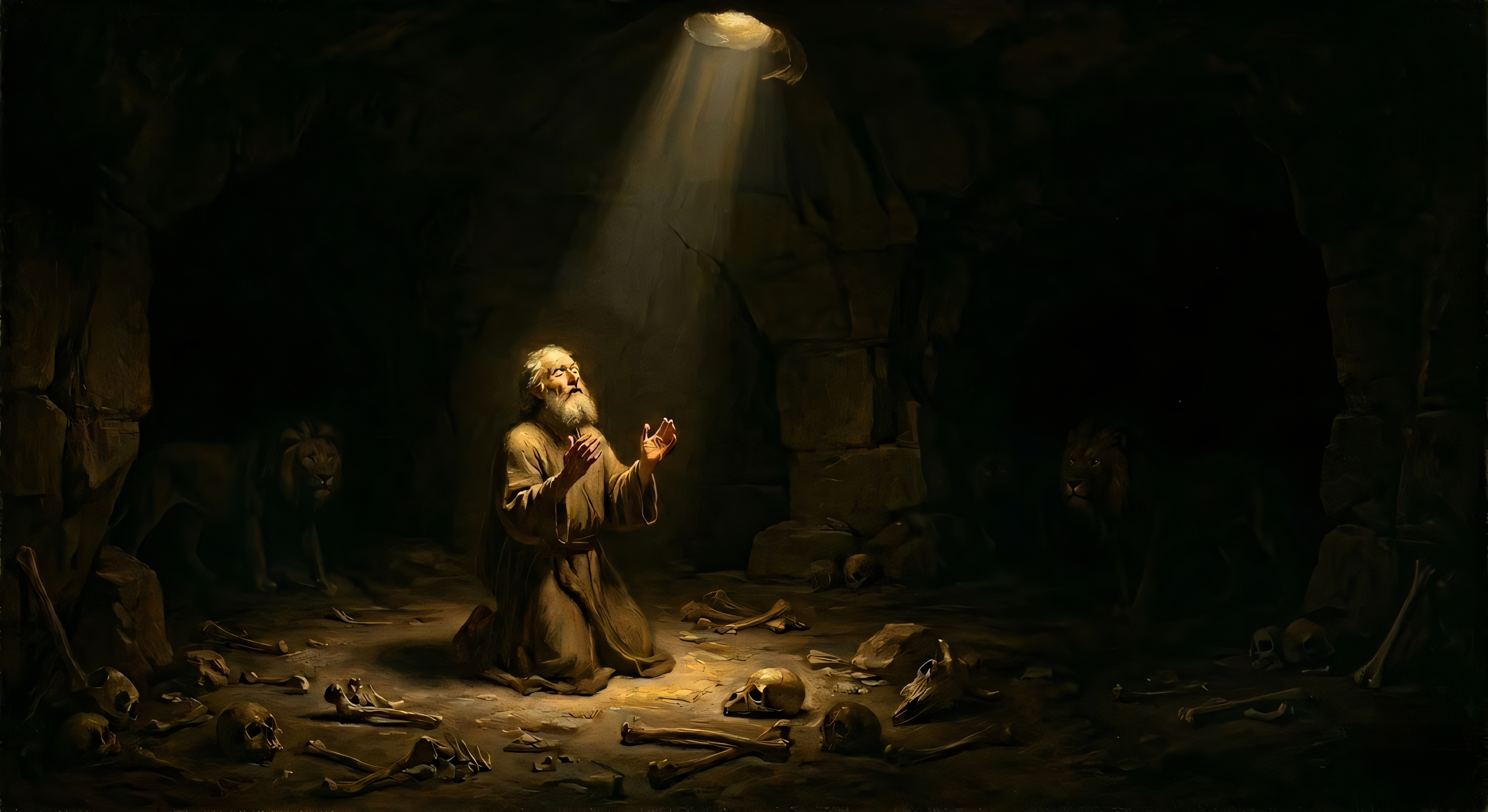
Daniel 4 is the story of Nebuchadnezzar’s madness: the most powerful man in the world is struck down by God, driven from human society to live like an animal, and eventually restored when he finally acknowledges that the Most High rules over the kingdoms of humanity.
It’s a stunning story on its own. But what makes it extraordinary for our purposes is that this is where the three textual traditions diverge most dramatically in the entire book. The Old Greek version of Daniel 4 is significantly longer than the Masoretic Text and Theodotion, with expanded narrative details, additional dialogue, a different structural arrangement, unique theological commentary, and even a specific date that doesn’t appear in the other traditions.
The differences are so extensive that we’re going to split this chapter across two posts. This first part covers the dream and its interpretation. The next post will cover the fulfillment, the madness itself, and the restoration, which is where the most dramatic divergences occur.
If the first three chapters were the warm-up, this is where the three-version comparison earns its keep. You are going to see things you have never seen in any English Bible.
If you’re reading this in email, be aware that the text is likely to cut off without warning. For a smoother reading experience and all the features Substack has to offer (including audio voiceovers of my posts), you can go HERE or download the app.
A Chapter Written by a King (In Two Different Ways)
Before we get into the verse-by-verse comparison, we need to talk about how the chapter is structured, because the Old Greek and the Masoretic Text don’t even agree on where the story begins.
In the Masoretic Text and Theodotion version, the chapter opens with Nebuchadnezzar’s doxology, his praise of God (though it should be noted that in Theodotion this actually comes at the end of chapter 3). It’s a royal proclamation addressed to “all peoples, nations, and languages”:
Daniel 4:1-3 (NRSVUE):
“King Nebuchadnezzar to all peoples, nations, and languages that live throughout the earth: May you have abundant prosperity! The signs and wonders that the Most High God has worked for me I am pleased to recount. How great are his signs, how mighty his wonders! His kingdom is an everlasting kingdom, and his sovereignty is from generation to generation.”
This is the conclusion placed at the beginning. Nebuchadnezzar has already been humbled, already been restored, and now he’s looking back and telling the story. It’s a literary framing device, like a movie that opens with the ending and then flashes back. You know from the first three verses that this story ends with the king praising God. The suspense isn’t whether he’ll be restored; it’s how he gets there.
The Old Greek does something completely different. It opens the chapter with no doxology at all. Instead, it begins with the narrative itself, and it provides a specific date:
Daniel 4:1 (OG/N.E.T.S.):
“In the eighteenth year of his reign, Nabouchodonosor said, ‘I was living at peace in my home and prospering on my throne.’”
No framing device. No preview of the ending. No royal proclamation of praise. Just a king, in his palace, having a dream that terrifies him.
The “eighteenth year” is significant. If we’re counting from the beginning of Nebuchadnezzar’s reign (around 605 B.C.), his eighteenth year would be approximately 587 B.C., the very year he destroyed Jerusalem and Solomon’s Temple. The Masoretic Text gives no date for this chapter at all. If the Old Greek’s date is historically reliable, it creates a provocative theological juxtaposition: at the very moment Nebuchadnezzar is at the height of his imperial power, having just razed the holy city, God sends him a dream about his own downfall.
The OG saves its doxology for the end of the chapter, where it appears in a massively expanded form that we’ll examine in the next post. The effect is completely different from the MT’s arrangement. In the OG, you experience the story without knowing how it ends. The tension builds throughout. When the doxology finally arrives, it hits with the full force of a surprise. In the MT, you know the ending from the start, and the question is only how.
Which arrangement is older? Scholars have debated this for generations, and there’s no consensus. Some argue the OG preserves the original linear narrative and the MT rearranged it by pulling the doxology forward as a frame. Others argue the MT is original and the OG moved the doxology to a more “logical” position at the end. The Dead Sea Scrolls fragments of Daniel 4 are too sparse (scattered words from verses 8-12, 15-19, and 32-33) to settle the question.
From a both/and perspective, both arrangements teach us something true. The MT tells you from the start that God wins, so you never doubt His sovereignty even as the story grows dark. The OG lets you feel the darkness, the uncertainty, and the drama of the king’s descent, making the restoration genuinely surprising. Both are faithful to the theological reality.
The King Calls Daniel
One interesting point is that the intervening verses between the opening (v.1 or 3:98-100) and the beginning of the dream do not exist in the Old Greek. In the OG we find this setup:
Daniel 4:2 (OG/NETS)
“‘I saw a dream, and I was alarmed, and fear fell upon me.’”
This is attached to the statement in verse 1, and nothing follows it. It goes straight into the dream from there.
As compared to these seven verses in the Masoretic that detail the calling of first the Chaldeans and then Daniel.
Daniel 4:2-9 (NRSV):
I, Nebuchadnezzar, was living at ease in my home and prospering in my palace. I saw a dream that frightened me; my fantasies in bed and the visions of my head terrified me. So I made a decree that all the wise men of Babylon should be brought before me, in order that they might tell me the interpretation of the dream. Then the magicians, the enchanters, the Chaldeans, and the diviners came in, and I told them the dream, but they could not tell me its interpretation. At last Daniel came in before me—he who was named Belteshazzar after the name of my god and who is endowed with a spirit of the holy gods—and I told him the dream: “O Belteshazzar, chief of the magicians, I know that you are endowed with a spirit of the holy gods and that no mystery is too difficult for you. Hear the dream that I saw, and tell me its interpretation.
Now, apart from a few minor word differences that do not alter the meaning, the Theodotion version is identical in these verses.
I find it interesting that there’s no framing of calling the soothsayers or even Daniel in the Old Greek. It’s almost as though the text is assuming Daniel to already be there.
The Dream of the Great Tree — Three Voices
Now we reach the dream itself, and this is where laying the texts side by side becomes essential. All three traditions describe a cosmic tree, but the Old Greek’s tree is far more vivid and extraordinary than the one in the Masoretic and Theodotion versions.
The Masoretic Text (via the NRSVUE) gives us a powerful but relatively straightforward image:
Daniel 4:10-12 (NRSVUE):
“Upon my bed this is what I saw; there was a tree at the center of the earth, and its height was great. The tree grew great and strong, its top reached to heaven, and it was visible to the ends of the whole earth. Its foliage was beautiful, its fruit abundant, and it provided food for all. The animals of the field found shade under it, the birds of the air nested in its branches, and from it all living beings were fed.”
The Theodotion version is quite close to the MT, as we’d expect.
Daniel 4:10-12 (Theodotion/Brenton):
I had a vision upon my bed; and behold a tree in the midst of the earth, and its height was great. The tree grew large and strong, and its height reached to the sky, and its extent to the extremity of the whole earth: its leaves were fair, and its fruit abundant, and in it was meat for all; and under it the wild beasts of the field took shelter, and the birds of the sky lodged in the branches of it, and all flesh was fed of it.
Now listen to the Old Greek describe the same tree:
Daniel 4:7-9 (OG/N.E.T.S.):
“I was sleeping, and lo, a tall tree was growing on the earth. Its appearance was huge, and there was no other like it. Its branches were about thirty stadia long, and all the animals of the earth found shade under it, and the birds of the air hatched their brood in it. Its fruit was abundant and good, and it sustained all living creatures. And its appearance was great. Its crown came close to heaven, and its span to the clouds, filling the area under heaven. The sun and the moon dwelled in it and illuminated the whole earth.”
Do you see what the Old Greek adds? The sun and the moon dwelled in the tree. The tree is so cosmic, so all-encompassing, that it contains the luminaries themselves. This is not just a big tree; it’s a tree that holds the celestial bodies, a tree that is the cosmos. The measurement of “thirty stadia” (roughly 3.5 miles) for the branches gives a concrete sense of supernatural scale that the MT leaves to the imagination.
This is the kind of detail you simply cannot see in any standard English Bible. The OG’s tree is wilder, more mythic, more terrifying in its grandeur. And that matters theologically, because the tree represents Nebuchadnezzar. The grander the tree, the more catastrophic its fall.
The Watcher vs. The Angel
Here’s another divergence that matters more than you might expect.
In the Masoretic Text and Theodotion, the heavenly figure who decrees the tree’s destruction is called “a watcher, a holy one” (עִיר וְקַדִּישׁ, ir veqaddish in the Aramaic):
Daniel 4:13 (NRSVUE):
“I continued watching in the visions of my head as I lay in bed, and there was a watcher, a holy one, coming down from heaven.”
Daniel 4:13 (Theodotion/Brenton):
“I beheld in the night vision upon my bed, and, behold, a watcher and an holy one came down from heaven.”
The term “watcher” (עִיר, ir) is remarkable. This is the only place in the canonical Old Testament where this word is used for an angelic being. But it’s not an unknown concept. The term appears extensively in 1 Enoch, where the “Watchers” are the angelic beings who descend to earth in the pre-flood era (the “sons of God” of Genesis 6). The Dead Sea Scrolls use it as well. Daniel’s use of this term opens a window into a wider tradition of Jewish angelology that was current during the exile and Second Temple period.
The Old Greek renders this quite differently:
Daniel 4:10 (OG/N.E.T.S.):
“I continued looking in my sleep; lo, an angel was sent in power out of heaven.”
No “watcher.” No unusual terminology. Just “an angel” (ἄγγελος, angelos). The main scholarly view is that the OG translator chose a familiar, standard term rather than preserving the striking and unusual “watcher” language.
But, as should surprise absolutely no one who’s been with me for long, I don’t think that’s what’s happening here. I strongly suspect (based on evidence from the Dead Sea Scrolls that proved the point with other texts) that the translator who rendered the Old Greek version of Daniel was working from a different text than the one that was translated into Theodotion’s version and that later became the later Masoretic tradition.
So why does this matter?
Because it shows us two different source texts ( or translation philosophies, if the scholars are right) at work. The MT/Theodotion preserves the distinctive Aramaic term, trusting the reader to encounter something unfamiliar and wrestle with it. Possibly going to extra biblical literature for corroboration. The OG, on the other hand, gives us a term that had been in use since Genesis so there’s no question that any reader would immediately understand it.
And both versions have value.
The MT/Theodotion’s “watcher” connects Daniel to the wider world of Jewish apocalyptic literature (1 Enoch, Jubilees, the Qumran texts) and reminds us that the biblical writers inhabited a richer angelological landscape than most modern Christians realize. The OG’s “angel” is theologically accurate (watchers are angels) and accessible, but it lacks the distinctive flavor and the treasure hunt that would lead a reader to the intertextual connections.
This is the kind of trade-off that happens in every translation, especially when there’s a chance they are coming from different vorlagen (source texts) and it’s why comparing traditions is so valuable. You need both: the distinctive term that connects you to the broader tradition, and the clear interpretation that tells you what the term means.
The Fate of the Tree
As has been the pattern, the Masoretic and Theodotion largely agree in the matter of the fate of the tree, as decreed by through his angel/watcher messenger.
Daniel 4:14-19 (Theodotion/Brenton):
“Cut down the tree, and pluck off its branches, and shake off its leaves, and scatter its fruit: let the wild beasts be removed from under it, and the birds from its branches. Only leave the stump of its roots in the earth, and bind it with an iron and brass band; and it shall lie in the grass that is without and in the dew of heaven, and its portion shall be with the wild beasts in the grass of the field. His heart shall be changed from that of man, and the heart of a wild beast shall be given to him; and seven times shall pass over him. The matter is by the decree of the watcher, and the demand is a word of the holy ones; that the living may know that the Lord is most high over the kingdom of men, and he will give it to whomsoever he shall please, and will set up over it that which is set at nought of men. This is the vision which I king Nabuchodonosor saw: and do thou, Baltasar, declare the interpretation, for none of the wise men of my kingdom are able to shew me the interpretation of it: but thou, Daniel, art able; for the Holy Spirit of God is in thee. Then Daniel, whose name is Baltasar, was amazed about one hour, and his thoughts troubled him. And Baltasar answered and said, My lord, let the dream be to them that hate thee, and the interpretation of it to thine enemies.”
Now, there’s a lot to unpack here. A fair bit of it is clearly symbolic, but there are a few points we can point to that make some pretty clear statements. The cutting down and plucking branches seems like a clear statement about losing authority and standing, but the explicit leaving of the stump mean that it shall not die, though it will be bound.
Now, the part that I find interesting is the detail about “lying in the grass” and the “dew of heaven.” This is a clear statement of being outside without shelter, especially in the rain. And then it gets even more pointed with the bit about it’s portion being with the beasts of in the grass of the field.
But then it gets more interesting His heart will become that of a beast. This is our first hint of what the tree symbolizes and it simultaneously tells us that he will be living among the wild animals. And that curious “seven times” makes a clear statement that might pass over the average English speaker’s head. It’s an obvious reference to seven years in Hebrew thought, though it seems like a strange turn of phrase for most of us.
Now, verse 17 is interesting. Not only is this blatantly saying (in agreement with the MT) that this is by decree of the Watchers, rather than God, but it also seems to be drawing a distinction between the Watchers and the holy ones.
The obvious answer there is one of two things, and maybe both. Given the world view in play here, I think it’s clear that this reference to the holy ones is a reference to the beings comprising the divine council. But what makes this more interesting is the possibility that behind the text we might be seeing a veiled reference to the Trinity, just as we saw in our latest Divine Council post that dealt with the creation of man.
As I usually do, I think both of those possibilities are true. I think the author knew they were referring to the divine council, but I think the Holy Spirit was also pointing to the Trinity in a way that wouldn’t be seen that way until after the unvieling of the new covenant.
And then we close with what is probably the most important statement in these verses: that this is being done so that the living will know that the Lord is the Most High over the kingdom of men.
Now, let’s take a look at how the Old Greek differs from the other traditions.
Daniel 4:11-16 (OG/NETS):
And he called and said: ‘Cut it down, and destroy it, for it has been decreed by the Most High to uproot and render it useless.’ And thus he said: ‘Spare one of its roots in the ground so that he may feed on grass like an ox with the animals of the earth in the mountains, and his body may be changed from the dew of heaven, and he may graze with them for seven years until he acknowledges that the Lord of heaven has authority over everything which is in heaven and which is on the earth and does with them whatever he wishes. It was cut down before me in one day, and its destruction was in one hour of the day. And its branches were given to every wind, and it was dragged and thrown away. He ate grass with the animals of the earth. And he was delivered into prison and was bound by them with shackles and bronze manacles. I marveled exceedingly at all these things, and my sleep escaped from my eyes. And when I arose in the morning from my bed, I called Daniel, the ruler of the savants and the leader of those who decide dreams, and I described the dream for him, and he showed me its entire interpretation. But since Daniel was greatly amazed and since foreboding pressed him and since he was afraid, as trembling seized him and his appearance changed, having shaken his head, having marveled for one hour, he answered me in a quiet voice: ‘O king, may this dream be for those who hate you, and its interpretation come upon your enemies!
Well right off we see that this one is calling for almost total destruction, saving only the root. This is significantly greater than what was commanded in the MT/Theodotion, but we find that the angel still call’s for the saving of a root, so it really amounts to about the same thing.
If anything, this one is even clearer. It speaks specifically feeding on grass like an ox, and then grazing with with the animals for seven years. And then we get the specific point that it will be until he acknowledges that the Lord of heaven has authority over everything. That’s a detail we don’t get at all in the other traditions, even though there are plenty of commentaries that specify that exact thing about this event.
Now it gets interesting though, because at this point the narrative turns into a first person account where he is narrating the events he’s witnessing. He talks about the tree being cut down in one day and being destroyed in one hour.
But then it gets even more interesting. “He ate grass with the animals,” is specific and shows fulfillment, yet we still don’t know who “he” is, though it’s obvious that the tree is a stand-in for a person at this point. But now we see a detail that is nowhere in the other traditions:
He was delivered into prison and bound with shackles and bronze manacles. This is a fascinating detail.
After that the three traditions largely agree. In the OG the king sends for Daniel now, but in the MT/Theodotion he’s already there. The king tells him all about the dream (and, interestingly, the OG now makes it explicit that Daniel is the ruler over the “savants” which is a clear reference to the group of job descriptions that include the Chaldeans, magicians, astrologers, and dream interpreters).
And on this final point all three traditions agree: Daniel is visibly disturbed by the dream. Daniel says he wishes the dream was for those who hate the king, and that its interpretation would come upon his enemies.
Oh, Daniel, if only.
I have no doubt that Nebuchadnezzar never saw the truth coming, even up to that moment. Given that, it’s perfectly understandable that Daniel would be worried about being honest about what the dream meant.
Advisors had lost their lives for less, especially in Babylon.
If you’ve found this work insightful or enlightening, share it with a friend who needs to see the extra detail found in the Old Greek.
Daniel’s Interpretation — Two Very Different Speeches
When Daniel interprets the dream, all three traditions agree on the core message: the tree is Nebuchadnezzar, and God is going to cut him down. But the Old Greek’s Daniel says things that have no parallel in the Masoretic or Theodotion traditions.
Daniel 4:20-22 (Theodotion/Brenton):
“The tree which thou sawest, that grew large and strong, whose height reached to the sky and its extent to all the earth; and whose leaves were flourishing, and its fruit abundant, (and it was meat for all; under it the wild beasts lodged, and the birds of the sky took shelter in its branches:) is thyself, O king; for thou art grown great and powerful, and thy greatness has increased and reached to heaven, and thy dominion to the ends of the earth.”
Now listen to the Old Greek’s Daniel:
Daniel 4:17-19 (OG/N.E.T.S.):
“The tree that was planted in the earth, whose appearance was great — it is you, O king, and all the birds of the air which nest in it. The strength of the earth and the nations and all the languages unto the ends of the earth and all countries are slaves to you. Furthermore, the fact that that tree was exalted and neared heaven and that its span touched the clouds is: You, O king, have been exalted above all humans who are upon the face of the whole earth. Your heart was exalted with pride and power vis-à-vis the holy one and his angels. Your works were seen, how you ravaged the house of the living God pertaining to the sins of the sanctified people.”
Did you catch that? The Old Greek’s Daniel explicitly accuses Nebuchadnezzar of ravaging “the house of the living God,” the Temple in Jerusalem. He connects the king’s pride directly to the destruction of God’s sanctuary. This makes the dream not just about abstract arrogance but about a specific historical act: the devastation of the Temple.
If the OG’s “eighteenth year” date is correct (placing this event around 587 B.C., the year Jerusalem fell), then Daniel is confronting Nebuchadnezzar about the very thing he just did. The king destroyed the Temple, and now God is about to destroy the king’s sanity. The symmetry is devastating.
None of this appears in the MT or Theodotion. Their Daniel gives a more restrained interpretation, focused on the king’s general pride rather than a specific act of sacrilege.
Both versions are theologically powerful, but they emphasize different things. The MT presents Nebuchadnezzar’s sin as generic pride, the universal human temptation to forget that everything we have comes from God. The OG presents it as specific sacrilege, a direct assault on God’s dwelling place. The MT’s reading applies to every proud person in every age. The OG’s reading ties the judgment to a particular historical moment and a particular crime, though there is still some universality here.
The Sentence — And Daniel’s Compassion
In all three traditions, Daniel counsels Nebuchadnezzar to repent, hoping that the judgment might be averted or delayed:
Daniel 4:27 (Theodotion/Brenton):
“Therefore, O king, let my counsel please thee, and atone for thy sins by alms, and thine iniquities by compassion on the poor: it may be God will be long-suffering to thy trespasses.”
Daniel 4:24 (OG/N.E.T.S.):
“Entreat him concerning sins, and atone for all your iniquities with alms so that equity might be given to you and you might be long-lived on the throne of your kingdom and not be destroyed. Gladly receive these words, for my word is accurate and your time is complete.”
Both versions show Daniel pleading with the king to change course. But the OG adds a final, almost desperate note: “Gladly receive these words, for my word is accurate and your time is complete.” There’s an urgency in the OG’s Daniel that the MT’s version leaves more understated. The OG’s Daniel is saying: “I am not making this up. Time is running out. Please listen.”
This is the same Daniel who, in verse 16 (OG), answered the king “in a quiet voice.” The OG portrays a man who is genuinely afraid for his king, who delivers the worst possible news as gently as he can, and who begs the king to act before it’s too late.
The MT is more restrained in its portrayal of Daniel’s emotions, but no less powerful. The single detail of Daniel being “appalled for one hour” (v. 19, NRSVUE) does enormous work with very few words.
This is a pattern we’ll see consistently across chapters 4, 5, and 6: the OG paints with more detail and more emotion, while the MT trusts silence and economy to carry the weight. Neither approach is superior. They’re different artistic choices applied to the same truth.
Coming Up Next
Next week, we’ll cover the fulfillment of the dream: Nebuchadnezzar’s boast on the palace roof, the voice from heaven, the seven years of madness, and the restoration. This is where the Old Greek’s most extraordinary material appears, including a first-person account of the madness itself that doesn’t exist in any other tradition, and a massively expanded doxology that transforms Nebuchadnezzar’s confession from a brief statement of praise into a full theological manifesto, complete with a circular letter to all nations declaring “God is one, and his marvels are great.”
You won’t want to miss this.
The LXX Scrolls is free to read and always will be. If this work has been worth something to you, there are a few ways to say so:
Buy the ebooks. Completed teaching series are available as polished ebooks under the Two Witnesses, One Truth series. Buying through Curios will support this work most directly but they’re also available on Amazon (and elsewhere) if you’re loyal to a particular ereader.
Become a supporter. A monthly or annual pledge through Substack helps me to bring the Septuagint to those who never knew they needed it.
Send a one-time tip. If this post has blessed you and you want to express that directly, you can Buy Me a Coffee.

Thank you for being part of this journey, your support makes this work possible.
© 2026 LXX Scrolls. All rights reserved.