


Hello brothers and sisters,
Last time we watched a young Daniel save a woman’s life in a courtroom. This time he is a demolition crew.
If you missed any of the earlier posts, you can get caught up HERE
Bel and the Dragon is the last text of the Greek Daniel, and it is unlike anything else we have read. It is three short, fast, almost comic stories strung together, and in every one of them Daniel goes to war against an idol.
He exposes a fraudulent god with a handful of ashes and a floor full of footprints. He kills a living dragon by feeding it a bomb. And then, for his trouble, he takes one more trip to a lions’ den, where a prophet gets airlifted in from Judea by an angel holding him by the hair to bring him dinner.
It is playful and pointed at the same time, and underneath the fun it is doing something serious. This is the Bible’s most devastating attack on the great god of Babylon, and it is the narrative payoff of a theme the prophets had been hammering for centuries: that the idols of the nations are dead, fraudulent, powerless things, and that there is only one living God. What Isaiah and Jeremiah declared in poetry, Daniel proves here on a stage, in front of a king.
This is also our last stop in the text itself. After this, one more post, a capstone, to gather up everything the whole journey has taught us.
But first, the idols have to fall.
A Word on the Text
Like Susanna, Bel and the Dragon exists only in Greek, in two versions, the Old Greek and Theodotion. So this is again a two-voice post. I will run Theodotion in Brenton’s rendering as our main text, quoting all of it, and bring in the Old Greek from the N.E.T.S. wherever the two diverge.
On the old question of whether this is Scripture, I laid out the full history last week, so I won’t repeat it here. But in this case, one thing runs opposite to Susanna, and it is worth your knowing.
Susanna’s Greek puns argued that it was composed in Greek. Bel and the Dragon argues the other way. The scholars who prepared the N.E.T.S. note that Theodotion here reads like a formal translation of a Hebrew or Aramaic original, full of Semitic turns of phrase, and that one odd line, the angel setting Habakkuk down “in a rush of his spirit,” is best explained as a garble from an underlying Semitic text.
So if Susanna looked born in Greek, Bel and the Dragon looks translated from a Semitic source, and the “it is only Greek” objection is actually weaker here than anywhere. So we now have two additions on opposite sides of that question.
Hold that thought for the capstone.
But for now, let’s dig in to Bel and the Dragon.
If you’re reading this in email, be aware that the text is likely to cut off without warning. For a smoother reading experience and all the features Substack has to offer (including audio voiceovers of my posts), you can go HERE or download the app.
Who Is Bel?
Before Daniel swings a hammer, you need to know what he is swinging it at, because the target is not some minor local trinket. It is the chief god of the Babylonian Empire.
Bel is Marduk. “Bel” is a title, from the same Semitic root as “Baal,” and it simply means “lord.” It’s a title that belonged to Marduk, the patron god of the city of Babylon. He was the king of the Babylonian pantheon, the deity in whose honor the great temple Esagila stood and in whose name every Babylonian king ruled.
To take on Bel was to take on the religious heart of the empire itself. This is not Daniel debunking a superstition. This is Daniel walking into the national cathedral and proving the national god is a con.
And in doing it, he is finishing an argument the prophets had been making for two hundred years. The Old Testament mocks idols relentlessly, and it mocks Bel by name. Isaiah watched a man cut down a tree, burn half of it to cook his dinner, and bow down to the other half and pray, “Deliver me, for you are my god” (Isaiah 44:17), and he could barely contain his contempt.
Isaiah saw the day coming when “Bel bows down, Nebo stoops,” the great gods of Babylon hauled off on the backs of pack animals, unable even to save themselves (Isaiah 46:1).
Jeremiah said idols are like scarecrows in a cucumber field, that “they cannot speak; they have to be carried, for they cannot walk” (Jeremiah 10:5). Jeremiah promised that God would “punish Bel in Babylon, and make him disgorge what he has swallowed” (Jeremiah 51:44), which, when you have read this chapter, is almost funny, because making Bel disgorge what he never really swallowed is the entire plot.
The Psalms said it plainest of all: idols “have mouths, but do not speak; eyes, but do not see,” and, the killer line, “those who make them become like them” (Psalm 115:5-8).
And a whole deuterocanonical letter, the Letter of Jeremiah, is nothing but a sustained mockery of exactly these Babylonian idols, dead things dressed in gold that cannot save themselves from rust or thieves.
Bel and the Dragon is where all of that stops being poetry and becomes theater. Every claim the prophets made about idols, that they cannot eat, cannot move, cannot act, cannot save, Daniel is about to demonstrate in the flesh, in public, on the biggest idol in the world.
Let’s have a look.
The Fraud of Bel
Bel and the Dragon 1-5 (Theodotion/Brenton)
And king Astyages was gathered to his fathers, and Cyrus of Persia received his kingdom. And Daniel conversed with the king, and was honoured above all his friends. Now the Babylonians had an idol, called Bel, and there were spent upon him every day twelve great measures of fine flour, and forty sheep, and six vessels of wine. And the king worshipped it and went daily to adore it: but Daniel worshipped his own God. And the king said unto him, Why dost not thou worship Bel? Who answered and said, Because I may not worship idols made with hands, but the living God, who hath created the heaven and the earth, and hath sovereignty over all flesh.
The Old Greek opens completely differently, and the difference tells you something. It has no King Astyages, no Cyrus. Instead it heads the whole thing as a prophecy of Habakkuk, and it makes Daniel a priest.
Bel and the Dragon 1-5 (OG/NETS)
From a prophecy of Hambakoum the son of Iesous of the tribe of Leui. There was a certain person, a priest, whose name was Daniel son of Habal, a companion of the king of Babylon. And there was an idol, Bel, which the Babylonians would revere. Now, every day they were squandering on it twelve bushels of choice flour and four sheep and six measures of oil. And the king would revere him, and the king would go every day and would do obeisance to him. But Daniel would pray to the Lord. And the king said to Daniel, “Why do you not do obeisance to Bel?” And Daniel said to the king, “I revere no one except the Lord God, who created heaven and earth.”
Notice the divergences, because they are the kind we have learned to read. The Old Greek attaches the story to the prophet Habakkuk, whom we will meet again in a moment, and even gives him a Levite pedigree.
It calls Daniel a priest, son of Habal, where Theodotion just calls him the king’s honored companion. And the daily menu for Bel differs: forty sheep and wine in Theodotion, four sheep and oil in the Old Greek. These are exactly the sort of small, unbothered differences that come from two traditions telling the same story from slightly different sources, and by now they should feel familiar rather than alarming.
But hear what both versions put in Daniel’s mouth, because it is the thesis of the entire chapter. He will not worship “idols made with hands.” He worships “the living God, who created heaven and earth.” That contrast, made by hands versus living, is the hinge everything turns on. An idol is a thing people make. The true God is the one who made the people. Everything Daniel is about to do is a demonstration of that one distinction.
The king pushes back with the obvious question. If Bel is not alive, why does he eat so much?
Bel and the Dragon 6-9 (Theodotion/Brenton)
Then said the king unto him, Thinkest thou not that Bel is a living God? seest thou not how much he eateth and drinketh every day? Then Daniel smiled, and said, O king, be not deceived: for this is but clay within, and brass without, and did never eat or drink any thing. So the king was wroth, and called for his priests, and said unto them, If ye tell me not who this is that devoureth these expenses, ye shall die. But if ye can certify me that Bel devoureth them, then Daniel shall die: for he hath spoken blasphemy against Bel. And Daniel said unto the king, Let it be according to thy word.
I love that Daniel smiles here. I imagine it being a kind of smirk we give when we know someone is making a wager they have no chance of winning.
In the Old Greek he goes further and puts his own life fully on the table:
Bel and the Dragon 7-9 (OG/NETS)
And Daniel said to him, “Not at all! Do not let anyone mislead you, for this one is only of clay inside and bronze outside. Moreover, I swear to you by the Lord God of the gods that this one has never eaten anything.” And angered, the king called the leaders of the temple and said to them, “Produce the one who eats the things prepared for Bel. But if not, you shall die, or Daniel, who says they are not being eaten by him.” But they said, “It is Bel himself who eats them.” Then Daniel said to the king, “Let it be so. Unless I prove that Bel is not eating them, I shall die, and all those with me.”
The stakes are set. If Bel really eats, Daniel dies for blasphemy. If Bel does not, the seventy priests do. And Daniel has a plan.
Bel and the Dragon 10-15 (Theodotion/Brenton)
Now the priests of Bel were threescore and ten, beside their wives and children. And the king went with Daniel into the temple of Bel. So Bel’s priests said, Lo, we go out: but thou, O king, set on the meat, and make ready the wine, and shut the door fast and seal it with thine own signet; And to morrow when thou comest in, if thou findest not that Bel hath eaten up all, we will suffer death: or else Daniel, that speaketh falsely against us. And they little regarded it: for under the table they had made a privy entrance, whereby they entered in continually, and consumed those things. So when they were gone forth, the king set meats before Bel. Now Daniel had commanded his servants to bring ashes, and those they strewed throughout all the temple in the presence of the king alone: then went they out, and shut the door, and sealed it with the king’s signet, and so departed. Now in the night came the priests with their wives and children, as they were wont to do, and did eat and drink up all.
There is the trap, and it is beautiful in its simplicity. The priests are so confident in their secret door that they barely bother to argue. They do not know that after they leave, Daniel has quietly had the whole floor of the temple dusted with ashes. The doors are sealed with the king’s own signet. And in the night, the priests and their families creep in through their hidden entrance and eat the god’s dinner, exactly as they have every night for years, never looking down.
Bel and the Dragon 16-22 (Theodotion/Brenton)
In the morning betime the king arose, and Daniel with him. And the king said, Daniel, are the seals whole? And he said, Yea, O king, they be whole. And as soon as he had opened the door, the king looked upon the table, and cried with a loud voice, Great art thou, O Bel, and with thee is no deceit at all. Then laughed Daniel, and held the king that he should not go in, and said, Behold now the pavement, and mark well whose footsteps are these. And the king said, I see the footsteps of men, women, and children. And then the king was angry, and took the priests with their wives and children, who shewed him the privy doors, where they came in, and consumed such things as were upon the table. Therefore the king slew them, and delivered Bel into Daniel’s power, who destroyed him and his temple.
The king walks in, sees the empty table, and cries out in triumph, “Great art thou, O Bel!” And Daniel, who by now has laughed and smiled his way through the whole affair, physically grabs the king before he can step forward and says, in effect, look down. Look at the floor. And there in the ashes is the evidence: the footprints of men, and women, and children.
A god does not leave footprints. Con artists do. The seals were unbroken, so no one came through the door. But the floor is covered in tracks, so someone came another way. The fraud is exposed with nothing more than physics and a little gray dust, and the priests who staged it are destroyed by the very evidence of their own feet.
Jeremiah said God would make Bel disgorge what he had swallowed. Daniel just proved Bel never swallowed anything at all. The god of Babylon turns out to be a feeding tube for a syndicate of crooked priests, and the moment the light comes on, he is nothing. Clay within, bronze without, and a floor full of footprints.
One down.
The Death of the Dragon
Bel and the Dragon 23-27 (Theodotion/Brenton)
And in that same place there was a great dragon, which they of Babylon worshipped. And the king said unto Daniel, Wilt thou also say that this is of brass? lo, he liveth, he eateth and drinketh; thou canst not say that he is no living god: therefore worship him. Then said Daniel unto the king, I will worship the Lord my God: for he is the living God. But give me leave, O king, and I shall slay this dragon without sword or staff. The king said, I give thee leave. Then Daniel took pitch, and fat, and hair, and did seethe them together, and made lumps thereof: this he put in the dragon’s mouth, and so the dragon burst in sunder: and Daniel said, Lo, these are the gods ye worship.
The king thinks he has found a loophole. Fine, Bel was a statue. But this dragon is alive. It moves, it eats, it drinks. Surely a living thing that the whole city worships is a god you cannot debunk. And the king has a point, of a kind, because this time the object of worship is not clay and bronze. It is a real, breathing creature.
The Old Greek tells it much the same, with Daniel specifying the recipe by weight:
Bel and the Dragon 23-27 (OG/NETS)
And there was a dragon in that same place, and the Babylonians would revere it. And the king said to Daniel, “Surely you shall not also say about this one, that he is bronze! Look, he lives and eats and drinks! Do obeisance to him.” And Daniel said, “O king, give me permission, and I will slay the dragon without iron or club.” And the king agreed with him and said, “I have given it to you.” And taking thirty minas of pitch and fat and hair, Daniel boiled them together, and having made a cake, he threw it into the mouth of the dragon. And after eating, it burst open. And he showed it to the king, saying, “Aren’t these the things you revere, O king?”
Daniel does not deny the dragon is alive. That is precisely his point. He kills it. He boils together pitch and fat and hair into cakes and feeds them to the beast, and the thing bloats and bursts. And his one-line sermon over the carcass is devastating: these are the gods you worship. Because a god that a boy can kill with a lump of tar and hair is no god at all. The dragon was alive, yes, which is exactly why it could die. And a thing that dies is a creature, not the Creator. Daniel’s whole theology is in that burst carcass: the living God is the one who cannot be killed, and everything that can be killed is, by definition, not Him.
There is a delicious historical irony buried in this, if you know Babylon’s own mythology. Babylon’s origin story, the Enuma Elish recited every New Year in Bel’s own temple, was a dragon-slaying. Marduk, Bel himself, became king of the gods by killing the great chaos-dragon Tiamat and building the world from her corpse. Babylon’s chief god was worshiped as the god who slew the dragon. And the very image of a dragon, the mushhushshu, decorated the walls of the Ishtar Gate as Marduk’s own sacred beast. So here comes Daniel, a captive foreigner, and slays a Babylonian dragon of his own, not to become a god, but to prove that Babylon’s gods are frauds. The empire told a story about a dragon-slayer who became divine. Daniel becomes the real dragon-slayer, and uses it to unmask the divinity as a lie.
Two down. But now Daniel has torn down the two great objects of Babylonian devotion in a single day, and a city does not take that quietly.
One More Den of Lions
Bel and the Dragon 28-32 (Theodotion/Brenton)
When they of Babylon heard that, they took great indignation, and conspired against the king, saying, The king is become a Jew, and he hath destroyed Bel, he hath slain the dragon, and put the priests to death. So they came to the king, and said, Deliver us Daniel, or else we will destroy thee and thine house. Now when the king saw that they pressed him sore, being constrained, he delivered Daniel unto them: Who cast him into the lions’ den: where he was six days. And in the den there were seven lions, and they had given them every day two carcases, and two sheep: which then were not given to them, to the intent they might devour Daniel.
And here we arrive at something you have every right to find strange, because it feels like a story we have already read. Daniel, condemned by a hostile crowd, handed over by a reluctant king, thrown into a den of lions, and coming out alive. That is Daniel chapter 6.
But this is not chapter 6. This is a different den, with different details. Seven lions, not an unspecified number. Six days, not a single night. Starved lions, deliberately unfed so they would be hungry for Daniel. And a rescue that comes by a means chapter 6 never dreamed of.
So what is the relationship between this lions’ den and the famous one? Here are the views, and let you sit with them, because I don’t think the honest answer is to pretend it’s obvious.
One reading is that this is simply a second, separate episode. Daniel lived a long life across the reigns of several kings, and there is no rule that a man can only be thrown to lions once. On this view, the faithful Daniel made powerful enemies more than once, and God delivered him more than once, and the two dens are two real events in one long career.
Another reading is that this is a parallel tradition of the same great deliverance, the story of Daniel and the lions as it was told and retold in the Greek-speaking Jewish world, preserved here in a fuller, more folkloric form, with Habakkuk and the seven lions and the six days. On this view we are not looking at a second event but at a second telling, a variant of the tradition that lies behind chapter 6.
I won’t tell you which is right, because the text does not, and I would rather leave the question open honestly than force it shut with a tidy answered that’s not supported by the text.
What I will say is that either way, the theological point is identical to chapter 6, and it is the point this whole chapter has been building toward: the idols cannot save anyone, but the living God saves His servant, even from starved lions, even on the sixth day, even when a whole city wants him dead.
And the way He does it is one of the most charming miracles in all of Scripture.
Bel and the Dragon 33-39 (Theodotion/Brenton)
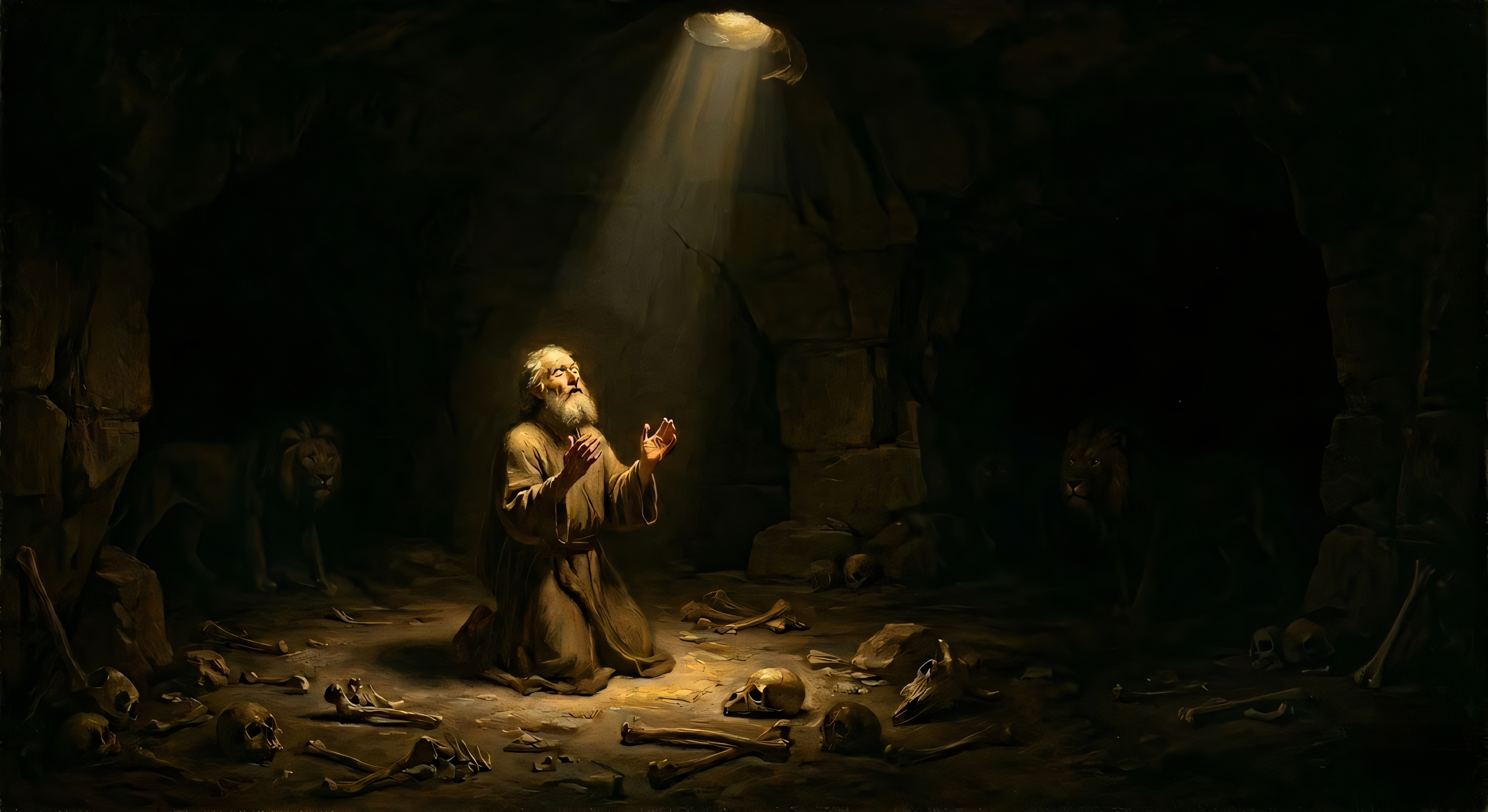
Now there was in Jewry a prophet, called Habbacuc, who had made pottage, and had broken bread in a bowl, and was going into the field, for to bring it to the reapers. But the angel of the Lord said unto Habbacuc, Go, carry the dinner that thou hast into Babylon unto Daniel, who is in the lions’ den. And Habbacuc said, Lord, I never saw Babylon; neither do I know where the den is. Then the angel of the Lord took him by the crown, and bare him by the hair of his head, and through the vehemency of his spirit set him in Babylon over the den. And Habbacuc cried, saying, O Daniel, Daniel, take the dinner which God hath sent thee. And Daniel said, Thou hast remembered me, O God: neither hast thou forsaken them that seek thee and love thee. So Daniel arose, and did eat: and the angel of the Lord set Habbacuc in his own place again immediately.
The prophet Habakkuk, the same Habakkuk whose short book sits in our Bibles, is at home in Judea, hundreds of miles away, making stew and carrying lunch out to farmhands in a field. And an angel tells him to take that lunch to Daniel in Babylon.
Habakkuk quite reasonably objects that he has never even seen Babylon and has no idea where the den is. So the angel solves the logistics by grabbing him by the hair of his head and carrying him, stew and all, across the whole distance in “the vehemency of his spirit,” setting him down over the lions’ pit.
Habakkuk shouts down into the den, Daniel eats his miraculously delivered dinner, and the angel whisks the bewildered prophet straight back to his field.
It is a wonderful, almost comic scene, and it would be easy to laugh past the point. But listen to what Daniel says when the food arrives: “Thou hast remembered me, O God, neither hast thou forsaken them that seek thee and love thee.”
That is the heart of it. Down in the dark, six days into what should have been his death, surrounded by starving lions, Daniel discovers that God has not forgotten him.
The God who created heaven and earth, the God the idols could only counterfeit, reaches across six hundred miles and reroutes a prophet’s lunch to feed one faithful man in a pit.
The idols of Babylon could not so much as eat their own dinner. The living God delivers His servant’s.
Bel and the Dragon 40-42 (Theodotion/Brenton)
Upon the seventh day the king went to bewail Daniel: and when he came to the den, he looked in, and behold, Daniel was sitting. Then cried the king with a loud voice, saying, Great art Lord God of Daniel, and there is none other beside thee. And he drew him out, and cast those that were the cause of his destruction into the den: and they were devoured in a moment before his face.
On the seventh day the king comes, expecting to mourn, and finds Daniel sitting there alive among the lions. And the cry that breaks out of him is the confession the whole book of Daniel keeps pulling out of pagan kings, from Nebuchadnezzar to Darius to this one: “Great is the Lord God of Daniel, and there is none other beside him.”
The Old Greek makes the king’s confession slightly broader, referring to Him as ‘The Lord God’ rather than ‘God of Daniel’:
“The Lord God is great, and there is no other besides him.”
In both tellings, the idols are finished. The king who began the chapter bowing to Bel ends it confessing the God of a Jewish captive. And the men who engineered Daniel’s death are thrown to the very lions that would not touch him, and devoured in a moment, because the den was never the danger.
The danger was ever and only being on the wrong side of the living God.
If you’ve found this work insightful or enlightening, share it with a friend who needs to see the power of reading this incredible story in multiple traditions.
What the Fathers Saw
The early church received Bel and the Dragon as part of Daniel and read it warmly, and it is not hard to see why.
In an age when Christians were surrounded by the idols of Rome and often dragged before magistrates for refusing to worship them, a story about a man who would not bow to the empire’s gods, who exposed them as frauds, and whom God delivered from the beasts, was not an ancient curiosity.
It was a mirror.
Hippolytus, whose commentary on Daniel is the oldest we possess, treated these stories as part of the whole. Jerome, as we saw, flagged that they were not in the Hebrew and set them apart, and the debate he represented is the one that still divides the church over whether these belong in the canon.
I pointed you to that full history last week when we talked about Susanna, so I won’t relitigate it here, except to repeat the one new wrinkle: the Semitic fingerprints in this particular text make it, if anything, a poorer candidate than Susanna for the charge of being a mere Greek invention.
Not that it being composed in Greek is the slam dunk some believe it to be.
My Take
Here is where I land on Bel and the Dragon.
I find it delightful, and I find it serious, and I do not think those are in tension. It is genuinely funny: the smiling prophet, the footprints in the ashes, the exploding dragon, and the airlifted lunch
And it is genuinely profound, because underneath the comedy it is making the single most important claim any human being can make: that there is a living God and everything else is at best a fallen spirit and at worst a man-made thing.
The prophets argued that idols are dead. Daniel proves it with ashes and tar. What Isaiah and Jeremiah and the Psalms declared, this story dramatizes: the gods of the nations cannot eat, cannot move, cannot save, and can be killed by a boy with a lump of pitch, but the Lord who made heaven and earth remembers His own and delivers them.
On the two lions’ dens, I have given you the real options and declined to force one, because I think the honest state of the evidence is genuinely open, and either way the meaning holds.
On the canon, I stand where I stood in Part 16, leaning toward receiving these as Scripture, finding nothing in them unworthy of the God they proclaim, while respecting that faithful Christians land in different places.
And on the origin question, I want you to notice the pattern one last time before we close, because it matters: Susanna looks to have been composed in Greek, and Bel and the Dragon appears to be a translation from a Semitic original.
And both were received as Scripture by the church that read the Greek Daniel. Whatever else that tells us, it tells us the “Greek versus Hebrew” question is more tangled and more interesting than either the confident Catholic (or Eastern Orthodox) or the confident Protestant usually admits.
As always, do not take my word for it. Refer to Acts 17:11 and be like the Bereans. Read the two versions alongside the whole of Scripture, watch Daniel smile, and ask yourself two questions: First is how does this match up with accepted Scripture? And the second is the question this whole chapter is asking you: which of the things you serve could survive a handful of ashes on the floor?
Why This Matters for Your Walk With God
We do not keep idols of clay and bronze anymore, so it is tempting to read this as a museum piece, a quaint story about ancient superstition. That would be a mistake, and here is why.
Every one of us is spending our twelve bushels of flour and our forty sheep and our six vessels of wine on something. We are all pouring the resources of our lives, our time, our attention, our worship, our trust, onto some altar, hoping the thing on it will feed us back, protect us, save us, make us secure.
And the question this chapter puts to you is brutally simple: can it eat? Does the thing you are feeding your life to actually live, or is it clay within and bronze without, a made thing that will one day be exposed by a handful of ashes on the floor?
Money cannot eat. Status cannot eat. The approval of the crowd that wanted Daniel dead cannot eat. They take and take and give nothing back, and in the end they leave you devoured, like the priests, by the very thing you served.
There is only one God in this story who actually acts. He creates heaven and earth. He remembers a man in a pit. He reroutes a prophet’s lunch across six hundred miles because one of His own is hungry and alone in the dark.
The idols could not feed themselves. The living God feeds His children. And the whole point of Daniel’s smiling, fearless war on the gods of Babylon is to get you to stop bowing to what cannot save and turn to the One who can.
The idols cannot eat.
The living God remembers you.
Do not fear.
Coming Up Next
Next time, I’ll show you the grand finale.
Not another chapter, but a capstone. This is where we’ll gather up the whole journey: Twelve chapters and two Greek additions across 17 parts, and ask what it has taught us about reading the Hebrew and the Greek together, where the both/and has held and where it has strained, and why any of it matters for how you read your Bible tomorrow morning.
The LXX Scrolls is free to read and always will be. If this work has been worth something to you, there are a few ways to say so:
Buy the ebooks. Completed teaching series are available as polished ebooks under the Two Witnesses, One Truth series. Buying through Curios will support this work most directly but they’re also available on Amazon (and elsewhere) if you’re loyal to a particular ereader.
Become a supporter. A monthly or annual pledge through Substack helps me to bring the Septuagint to those who never knew they needed it.
Send a one-time tip. If this post has blessed you and you want to express that directly, you can Buy Me a Coffee.

Thank you for being part of this journey, your support makes this work possible.
© 2026 LXX Scrolls. All rights reserved.