


Hello brothers and sisters,
Last time we reached the end of the Hebrew book of Daniel, and I told you Jerome had marked the seam. Up to chapter 12, he said, we read Daniel in the Hebrew. What follows comes from the Greek. Today we cross that seam.
If you missed any of the earlier posts, you can get caught up HERE
And on the other side of it is a story most of you have never read in your own Bibles, because most Protestant Bibles do not contain it. It is the story of Susanna, and it is unlike anything in the Daniel we have walked through so far. No beasts, no kings, no visions of the end. Instead, a garden, a bath, two dirty old men, a woman condemned to die for a crime she did not commit, and a teenage Daniel, decades before the lions, who stops an execution with two questions.
It is a beautiful story. It is also the storm center of one of the most important arguments in the history of the Bible, an argument about whether this story is Scripture at all, and it turns, of all things, on two little Greek puns. A first-rate Christian scholar threw those puns at one of the greatest minds of the early church as proof that Susanna was a forgery. And the argument they had about it goes to the very heart of what this whole publication is about.
So this one is different, and I want to be honest with you about how before we start.
A Word on What Makes This Different
For fifteen posts we have compared three witnesses: the Hebrew Masoretic Text, the Old Greek, and Theodotion. That is not possible here, because Susanna has no Hebrew text.
None.
It survives only in Greek, in two versions, the Old Greek and Theodotion, and those two differ from each other more than almost anything we have set side by side all series. So this is a two-voice post, Greek against Greek, and I will use Theodotion in Brenton’s rendering as our main narrative, since that is the fuller version and the one that stands behind the Catholic and Orthodox Bibles, and bring in the Old Greek from the N.E.T.S. where it diverges.
In one crucial spot I will also bring in the N.E.T.S. rendering of Theodotion, because Brenton flattens something there that matters enormously.
And there is a question hanging over the whole thing that we’ve only had to ask once before, all the way back in part 5 from inside the furnace: Is this Scripture?
I am going to lay that question out fairly, give you the history, tell you where I lean, and let you decide for yourself.
If you’re reading this in email, be aware that the text is likely to cut off without warning. For a smoother reading experience and all the features Substack has to offer (including audio voiceovers of my posts), you can go HERE or download the app.
Is Susanna Scripture? A Fair Accounting
Let me give you the lay of the land honestly, because good and serious Christians disagree about this, and you deserve the real picture rather than a tidy one.
Susanna is one of the “additions to Daniel,” a handful of passages that appear in the Greek Daniel but not in the Hebrew and Aramaic one. The early church, which read its Old Testament overwhelmingly in Greek, received these as part of Daniel. When manuscripts placed Susanna, they often set it at the very beginning, before chapter 1, precisely because it shows Daniel as a youth.
Jerome, translating the Latin Vulgate around A.D. 400, moved it to the end and attached a note that it is not found in the Hebrew, and he regarded it with suspicion.
That is the fault line that still runs through the church today. The Roman Catholic and Eastern Orthodox traditions consider Susanna fully canonical Scripture, the thirteenth chapter of Daniel, and it has been read that way in the majority of the world’s churches for most of Christian history.
That fact is something worth considering. Our canon of 66 books is not nearly as old as most of us grew up believing. For nearly fifteen centuries, the entirety of the Body of Christ considered this (and a lot else besides) to be Scripture.
The Protestant Reformers, following the shorter Hebrew canon and Jerome’s “Hebrew verity,” placed it among the Apocrypha, valuable and edifying but not finally authoritative for doctrine. So whether you consider Susanna Scripture probably depends, in large part, on which stream of Christianity you are standing in.
I think it should give us pause that a huge part of the global church has always said yes.
Here is where I come down, and I want to be careful and honest about it.
I have read this story closely in both Greek versions, and I will tell you plainly: I find nothing in its content that should keep it out. It enforces the ninth commandment. It applies the Mosaic law of false witness exactly as Deuteronomy prescribes. It vindicates the innocent, it honors the law of Moses by name, and it shows a young Daniel stirred by the Spirit of God to defend a condemned woman.
There is no strange doctrine here, nothing that contradicts the rest of Scripture, nothing unworthy of the God who inspired the prophets. It reads like what it claims to be, an episode from the life of the same Daniel we have followed all series, only younger. So I lean toward receiving it as Scripture, and I think it fits the character of a young Daniel beautifully.
The arguments against it, and they are real, are almost entirely about where it came from, not what it says. And the sharpest of them is the one this whole post is going to build toward.
So let’s hear the story first, and then we’ll engage with the fight.
The Story: A Garden and a Trap
Theodotion opens with a setup the Old Greek lacks entirely.
Susanna 1-4 (Theodotion/Brenton)
There dwelt a man in Babylon, called Joacim: and he took a wife, whose name was Susanna, the daughter of Chelcias, a very fair woman, and one that feared the Lord. Her parents also were righteous, and taught their daughter according to the law of Moses. Now Joacim was a great rich man, and had a fair garden joining unto his house: and to him resorted the Jews, because he was more honourable than all others.
There she is. Susanna, beautiful, wealthy by marriage, and, the detail that matters most, raised by righteous parents in the law of Moses. That upbringing is not decoration. It is the hinge the whole story turns on, because in a moment Susanna is going to be offered her life in exchange for her integrity, and the reason she can make the choice she makes is that she was taught, from childhood, to fear the Lord more than she fears death.
Susanna 5-9 (Theodotion/Brenton)
The same year were appointed two of the ancients of the people to be judges, such as the Lord spake of, that wickedness came from Babylon from ancient judges, who seemed to govern the people. These kept much at Joacim’s house: and all that had any suits in law came unto them. Now when the people departed away at noon, Susanna went into her husband’s garden to walk. And the two elders saw her going in every day, and walking; so that their lust was inflamed toward her. And they perverted their own mind, and turned away their eyes, that they might not look unto heaven, nor remember just judgments.
Two elders are appointed judges that year, and the text drops a chilling line about them, quoting God Himself: “wickedness came from Babylon from ancient judges, who seemed to govern the people.” These are not petty men. They hold the community’s judicial power. And they both, secretly, conceive a lust for Susanna as they watch her walk in her husband’s garden. The Old Greek is blunt about what that lust did to them:
Susanna 9 (OG/NETS)
they diverted their mind and turned away their eyes in order not to look to heaven nor to remember to make right decisions.
That is the anatomy of the whole crime in one sentence. Before they ever touched Susanna, they turned their eyes away from heaven. Sin in the heart is first a refusal to look up. And men who have stopped looking up, but who still hold the power to judge, are the most dangerous men alive.
Susanna 10-21 (Theodotion/Brenton)
albeit they both were wounded with her love, yet durst not one shew another his grief. For they were ashamed to declare their lust, that they desired to have to do with her. Yet they watched diligently from day to day to see her. And the one said to the other, Let us now go home: for it is dinner time. So when they were gone out, they parted the one from the other, and turning back again they came to the same place; and after that they had asked one another the cause, they acknowledged their lust: then appointed they a time both together, when they might find her alone. And it fell out, as they watched a fit time, she went in as before with two maids only, and she was desirous to wash herself in the garden: for it was hot. And there was no body there save the two elders, that had hid themselves, and watched her. Then she said to her maids, Bring me oil and washing balls, and shut the garden doors, that I may wash me. And they did as she bade them, and shut the garden doors, and went out themselves at privy doors to fetch the things that she had commanded them: but they saw not the elders, because they were hid. Now when the maids were gone forth, the two elders rose up, and ran unto her, saying, Behold, the garden doors are shut, that no man can see us, and we are in love with thee; therefore consent unto us, and lie with us. If thou wilt not, we will bear witness against thee, that a young man was with thee: and therefore thou didst send away thy maids from thee.
They discover each other’s lust, they conspire, and they wait. And on a hot day, when Susanna sends her maids to fetch oil so she can bathe in the sealed garden, they spring the trap. Consent, they tell her, or we will testify that we caught you here with a young man. It is the oldest and ugliest kind of coercion, backed by the unbeatable advantage that they are the judges. Their word is the law.
And here is Susanna’s answer, the moral summit of the whole book, and both versions preserve it almost identically.
Susanna 22-24 (Theodotion/Brenton)
Then Susanna sighed, and said, I am straitened on every side: for if I do this thing, it is death unto me: and if I do it not I cannot escape your hands. It is better for me to fall into your hands, and not do it, than to sin in the sight of the Lord. With that Susanna cried with a loud voice: and the two elders cried out against her.
Read that slowly, because it is one of the great statements of integrity in all of Scripture, canonical or not. Susanna does the math perfectly. She knows there is no escape. If she refuses, they will destroy her, and she has no defense against two judges.
She chooses destruction.
She would rather die innocent than live guilty. It is the same choice the three young men made at the furnace, our God is able to deliver us, but if not, we still will not bow, and it is the same choice an old man named Daniel will one day make in front of a den of lions. This is the family Susanna belongs to. She is a Daniel-shaped character, facing a Daniel-shaped test, before Daniel himself has done any of it.
Susanna 25-40 (Theodotion/Brenton)
Then ran the one, and opened the garden door. So when the servants of the house heard the cry in the garden, they rushed in at the privy door, to see what was done unto her. But when the elders had declared their matter, the servants were greatly ashamed: for there was never such a report made of Susanna. And it came to pass the next day, when the people were assembled to her husband Joacim, the two elders came also full of mischievous imagination against Susanna to put her to death; And said before the people, Send for Susanna, the daughter of Chelcias, Joacim’s wife. And so they sent. So she came with her father and mother, her children, and all her kindred. Now Susanna was a very delicate woman, and beauteous to behold. And these wicked men commanded to uncover her face, (for she was covered) that they might be filled with her beauty. Therefore her friends and all that saw her wept. Then the two elders stood up in the midst of the people, and laid their hands upon her head. And she weeping looked up toward heaven: for her heart trusted in the Lord. And the elders said, As we walked in the garden alone, this woman came in with two maids, and shut the garden doors, and sent the maids away. Then a young man, who there was hid, came unto her, and lay with her. Then we that stood in a corner of the garden, seeing this wickedness, ran unto them. And when we saw them together, the man we could not hold: for he was stronger than we, and opened the door, and leaped out. But having taken this woman, we asked who the young man was, but she would not tell us: these things do we testify.
She screams. The elders scream back, the counter-accusation already rolling.
And this is the part that’s truly chilling. By the next day they’ve hauled her before the assembled people and told their lie: a young man, they say, was with her in the garden, and he overpowered them and fled. Susanna, veiled and weeping, is stripped of her covering so the crowd can look at her, one final humiliation for the apparent titillation of the elders.
And then the assembly does the thing that should make every reader’s blood run cold.
Susanna 41 (Theodotion/Brenton)
Then the assembly believed them as those that were the elders and judges of the people: so they condemned her to death.
They believed them because they were the judges. Not because the evidence was good. Because of who was speaking. The office lent its authority to the lie, and an innocent woman was sentenced to die on the word of the very men who had assaulted her.
Whether you view this story as canonical or not, this rings true just as much today as it ever did in ancient times. It’s a terrifying reality than many people in many places have to live with.
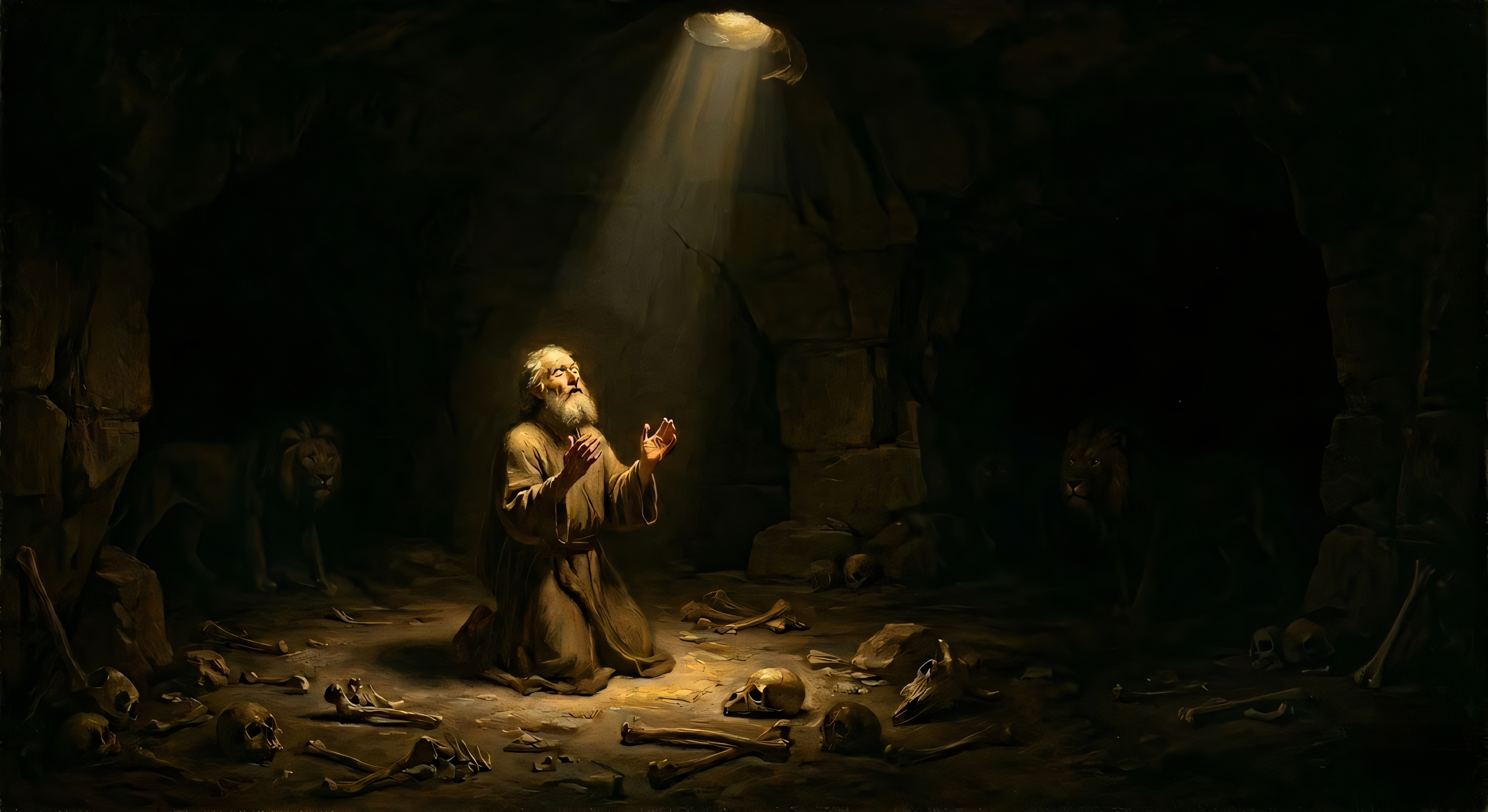
And now Susanna does the only thing she has left. She prays.
Susanna 42-43 (Theodotion/Brenton)
Then Susanna cried out with a loud voice, and said, O everlasting God, that knowest the secrets, and knowest all things before they be: Thou knowest that they have borne false witness against me, and, behold, I must die, whereas I never did such things as these men have maliciously invented against me.
And what a prayer it is. She cries out in her anguish, knowing she has no hope but trusting in the Lord that He will see her heart. That He will see the truth of these things.
And then comes the line that should make every believer sit up straight. Will probably bring us close to tears if we’ve really been invested in the story:
Susanna 44 (Theodotion/Brenton)
And the Lord heard her voice.
Isn’t that they very thing we all wish to hear when we’re facing circumstances completely out of our control that couldn’t be more unfair?
And what’s more is in Susanna’s case, God doesn’t just hear. He does something about it.
The Young Prophet and the Two Questions
Heaven’s answer is not a lightning bolt. It is a boy.
Susanna 45-46 (Theodotion/Brenton)
Therefore when she was led to be put to death, the Lord raised up the holy spirit of a young youth whose name was Daniel: who cried with a loud voice, I am clear from the blood of this woman.
The Old Greek tells it with an angel:
Susanna 44-45 (OG/NETS)
And lo, there was an angel of the Lord as she was being taken off to be executed. And the angel, just as he was ordered, gave a spirit of understanding to a youth, being Daniel.
This is our Daniel, years before Babylon’s court, before the dreams and the beasts and the lions, a boy in the crowd whom the Spirit of God seizes and stands on his feet.
And notice what he does with that Spirit. He does not perform a miracle. He does not call down fire. He demands due process.
Susanna 48-51 (OG/NETS)
Then Daniel parted the crowd, and after he stood among them, he said, “Are you such fools, O sons of Israel? Without examining or learning the plain truth, do you kill a daughter of Israel? And now, separate them far from one another for me so that I can test them.” So, when they were separated, Daniel said to the assembly, “Now, have no regard that they are elders, saying, ‘They would never lie!’ But I will examine them according to what occurs to me.”
The Spirit-filled boy’s first act is to insist that the court actually do its job, that testimony be tested before a life is taken. There is a whole theology of justice packed into that.
And then Daniel does the thing that has echoed through courtrooms for over two thousand years. He separates the witnesses. He will not let them coordinate their story. He examines them one at a time.
Susanna 52-54 (Theodotion/Brenton)
So when they were put asunder one from another, he called one of them, and said unto him, O thou that art waxen old in wickedness, now thy sins which thou hast committed aforetime are come to light. For thou hast pronounced false judgment and hast condemned the innocent and hast let the guilty go free; albeit the Lord saith, The innocent and righteous shalt thou not slay. Now then, if thou hast seen her, tell me, Under what tree sawest thou them companying together? Who answered, Under a mastick tree.
So after rebuking their wickedness, he puts a single, devastating question to each: under what tree did you see it happen?
The first elder answers. And Daniel springs the trap.
Susanna 54-55 (OG/NETS)
And the impious one said, “Under a mastich.” Then the youth said, “Truly you have lied to the detriment of your own soul, for this very day the angel of the Lord will split your soul.”
Daniel is clearly confident of his verdict here, and I lowkey kinda love it. Next he brings in the other elder.
Susanna 56-59 (OG/NETS)
And after he had this one removed, he told them to bring the other to him. Then he also said to that one, “Why is your seed twisted, like that of Sidon, and not like that of Iouda? Beauty has deceived you. And thus you used to treat the daughters of Israel, and they, being afraid, would have intercourse with you, but a daughter of Iouda did not tolerate bearing your sickness in lawlessness. Now, therefore, tell me: Under what tree and in what place of the garden did you catch them having intercourse together?” Then, he said, “Under an evergreen oak.” And Daniel said, “Sinner! Now, the angel of the Lord stands with the sword until the people destroy you so that he may saw you in pieces.”
One said mastic. The other said oak. Two men who claimed to witness the same event, in the same garden, at the same moment, cannot agree on the tree they were standing under. The lie collapses out of their own mouths, and the whole assembly sees it.
Susanna 60-62 (Theodotion/Brenton)
With that all the assembly cried out with a loud voice, and praised God, who saveth them that trust in him. And they arose against the two elders, for Daniel had convicted them of false witness by their own mouth: And according to the law of Moses they did unto them in such sort as they maliciously intended to do to their neighbour: and they put them to death. Thus the innocent blood was saved the same day.
They rise up, and by the law of Moses, the law of false witness in Deuteronomy that says you shall do to the false witness as he intended to do to his brother, they put the two elders to death. Susanna is vindicated.
I’m not sure if this is poetic justice or just justice, but either way I love the reversal that happens here.
But interestingly, the Old Greek adds a lovely closing flourish that Theodotion lacks, a little moral about why God loves to use the young:
Susanna 62a-62b (OG/NETS)
For this reason youths are beloved by Iakob, because of their simplicity. And as for us, let us watch out for young able sons. For youths will be pious, and a spirit of knowledge and understanding shall be with them forever and ever.
It is a wisdom-tale ending, and it tips the story’s hand about what it thinks it is doing: showing that God can put His Spirit of discernment on the young and the overlooked, and use a boy to shame a bench of corrupt elders.
Susanna 63-64 (Theodotion/Brenton)
Therefore Chelcias and his wife praised God for their daughter Susanna, with Joacim her husband, and all the kindred, because there was no dishonesty found in her. From that day forth was Daniel had in great reputation in the sight of the people.
And here we have the Theodotion closing that the Old Greek lacks. It makes for a nice, tidy closing to the preceding story that sets up Daniel for his future career under Nebuchadnezzar in Babylon.
But here’s the important part I promised you we’d dive into. Look again at those two trees and those two threats, because we have arrived at the fight.
The Two Words That Shook a Canon
Here is what you cannot see in English, and it is the whole thing.
In Greek, the first elder says the couple was under a mastic tree, a σχῖνος, schinos. And Daniel says the angel will σχίσει, schisei, split him. Schinos, schisei. The tree and the punishment rhyme.
The second elder says an evergreen oak, a πρῖνος, prinos. And Daniel says the angel will πρίσει, prisei, saw him. Prinos, prisei. Again, the tree and the punishment rhyme.
The whole climax is built on two puns. The name of the tree each liar invents becomes, by a hair’s breadth of sound, the manner of his execution. It is gorgeous wordplay.
Notice, by the way, that you have to read the N.E.T.S. to see the second one at all, because Brenton renders both threats as “cut thee in two” and the saw pun vanishes. The Greek keeps them distinct, split and saw, schisei and prisei, matched to schinos and prinos. The puns are the point.
And now the storm.
Around A.D. 240, a brilliant Christian scholar named Julius Africanus, one of the finest historical minds of the early church, the man who essentially invented Christian chronology and shaped Eusebius after him, wrote a letter to the great Origen. And in it he argued, with real force, that Susanna could not be genuine Scripture.
His central proof was these very puns. Here is his reasoning, and it is genuinely sharp:
Those wordplays, schinos and schisei, prinos and prisei, only work in Greek. In Hebrew, the words for those trees and those punishments sound nothing alike. But, Africanus argued, every authentic book of the Old Testament was written in Hebrew and only later translated into Greek.
A pun that exists only in Greek cannot have survived translation from a Hebrew original, because it could not have existed in the Hebrew to begin with. Therefore Susanna was never Hebrew. Therefore it was composed in Greek. Therefore it is not part of the real Daniel. It is, in his blunt word, a forgery, however elegantly written. He even sneered that not even a comic playwright would stoop to such puns in a serious story.
That is a formidable argument, and I want you to feel its weight, because I am not going to wave it away. Africanus was largely right about the linguistics. The puns really do work in Greek and really do not work in the Hebrew we know.
When Origen wrote back to defend Susanna, and he did, at length, he could not actually rebut this part. He admitted he had gone and asked Jewish scholars for the Hebrew words behind the puns and come away, in his own words, still in doubt.
His best move was to suggest that a translator might have found clever Greek words to approximate a lost Hebrew wordplay. But even he seems to have known it was thin.
On the narrow, technical question, Africanus won. The puns really do point to a Greek composition.
So does that settle it? Is Susanna disqualified?
Only if you accept the hidden premise buried in Africanus’s argument. And that premise is the exact thing this entire publication exists to question.
Look at the load-bearing step again: “every authentic book of the Old Testament was written in Hebrew.” That is not a finding. It is an assumption, the assumption that Hebrew is the only language in which God inspires Old Testament Scripture, and that Greek can only ever be a translation, a secondhand echo of a Hebrew original.
Grant that premise, and yes, a Greek composition is automatically a fake. But that premise is precisely what the early Greek-speaking church did not hold, and it is precisely what I have been pushing back on for sixteen posts (and the whole breadth of my work in general).
If God can breathe out Scripture in Greek, and not merely permit its translation into Greek, then a book composed in Greek is not thereby disqualified. It is simply Scripture that God chose to give in Greek.
And here is the delicious irony at the center of it. Africanus’s proof, the thing he offered as the nail in Susanna’s coffin, is actually one of the cleanest demonstrations in all of ancient literature that this text was born in Greek.
He proved Greek composition. He just assumed, without arguing for it, that Greek composition means lesser, means false, means not-Scripture.
Strip that assumption away, and his airtight case for forgery becomes an airtight case for something else entirely: that here, in Susanna, we may be looking at a piece of Scripture that God inspired directly in the language of the Septuagint. Africanus handed us the evidence and drew the wrong conclusion from it, because he was reading through a Hebrew-only lens.
I should be fair in every direction here, so let me add the one thing that complicates even Africanus’s linguistics.
Not every scholar is sure the puns prove Greek origin. Some have pointed out that a Hebrew or Aramaic original could have used its own similar-sounding tree-and-cutting word pairs, the way the Anchor Bible reproduces the effect in English with “yew” and “hew,” “clove” and “cleave.”
Others think a Greek translator added the puns to a story that already existed in a Semitic form. So the honest state of the question is this: the puns strongly suggest Greek composition, and they may prove it, but even that is not beyond dispute.
What is beyond dispute is that Africanus’s leap from “Greek” to “not Scripture” was a theological assumption, not a linguistic fact. And it is the assumption I would ask you to examine.
Origen, for all that he lost the technical argument, understood the deeper stakes. His real defense of Susanna was not linguistic at all. It was that the churches of God had received these Scriptures and read them and been fed by them, and that it was a fearful thing to stand over the church’s own Bible and start striking out the parts that did not appear in the synagogue’s.
The church, reading in Greek, had long since said yes to Susanna. Origen thought that mattered more than a philologist’s puzzle.
You may weigh that as your conscience and the Holy Spirit dictate.
But one thing you should see at this point is why this small exchange, over two little puns in a story about a garden, is as close as anything to a founding document for everything The LXX Scrolls is trying to say.
If you’ve found this work insightful or enlightening, share it with a friend who needs to see the power of reading this incredible story in multiple traditions.
What the Story Is For
Set the canon fight down for a moment, because whatever you conclude about Susanna’s status, the story itself is doing serious spiritual and theological work, and it would be a shame to argue about the frame and never look at the picture.
It is, first and foremost, a story about false witness, and it takes that sin with a deadly seriousness we have largely lost. The ninth commandment is not a rule against fibbing. It is a wall standing between the innocent and the grave, because a society that will believe a lie told by the powerful is a society that will kill the innocent on command.
Susanna shows you exactly how it happens, step by step: the abuse of office, the coordinated lie, the crowd that believes the accusation because of the accuser’s rank. And it shows you the only thing that stops it, which is the stubborn insistence that testimony be tested, that witnesses be separated, that the truth be examined before a life is taken. Daniel’s Spirit-given wisdom does not bypass justice. It demands justice actually be done.
Second, it is a story about integrity that costs everything. Susanna is offered a clean, secret escape, no one will ever know. And she refuses it because God will know, and God’s knowing is more real to her than her own life.
That is the fear of the Lord in its purest form, and it was planted in her by parents who taught her the law of Moses when she was small. Her whole character, in the crisis, is the harvest of an ordinary godly upbringing. Never think the quiet work of teaching a child to fear God is small. It is the thing that stands up, decades later, in front of two judges and says, “It’s better to die than to forget God.”
And third, it is a story about how God defends the defenseless. Susanna has no advocate, no evidence, no standing, nothing but her innocence and her prayer.
The Lord hears her voice, and He does not send an army. He sends a boy with the Spirit of God on him and two good questions.
God’s rescues so often look like that: not the overwhelming force we imagined, but the right person, stirred at the right moment, willing to stand up in a hostile crowd and say, “This is wrong, we need to examine it again.”
The Thread Into the Gospels
There is a connection here the early church could hardly miss, and I think it is worth naming.
An innocent person stands condemned before a hostile assembly. False witnesses have been produced. The verdict is death. And the case against them falls apart for one specific reason: the witnesses cannot get their story straight. Their testimonies do not agree.
That is Susanna.
It is also the trial of Jesus.
Mark tells us that at His trial:
“many bore false witness against him, but their testimonies did not agree”
(Mark 14:56)
And again:
“Then some rose up and bore false witness against Him, saying, “We heard Him say, ‘I will destroy this temple made with hands, and within three days I will build another made without hands.’” But not even then did their testimony agree.”
’(Mark 14:57-59).
The exact flaw that saved Susanna, contradicting false witnesses, appears at the trial of Christ. The difference, and it is the whole difference, is that Susanna had a Daniel in the crowd to expose the contradiction and stop the execution, and Jesus had no one.
The innocent woman was delivered. The innocent Son of God was not, because His death was the point. Susanna is rescued from an unjust death so that, in the fullness of time, the truly innocent One could go to the cross, willingly, for her and for us.
Read that way, Susanna is not a detour from the gospel. It is a rehearsal for it, and a foil to it. The pattern of the innocent condemned by lying witnesses runs straight from this Babylonian garden to a Roman cross.
My Take
Here is where I land on Susanna.
On the story, I love it without reservation. It is morally serious, spiritually rich, and it deepens rather than contradicts everything we know about Daniel. The young man who will not defile himself with the king’s food, who will not stop praying though it costs him the lions, is entirely recognizable in the boy who stands up in a murderous crowd and demands that the witnesses be examined.
It fits.
On the canon, I have shown you the real history and the real arguments, and I have told you where I lean, toward receiving it, because I find nothing in its content unworthy of Scripture and much in it that bears the marks of the God of justice.
But I have also tried to be honest that faithful Christians land differently, and that a very large portion of the global church has always read this as the thirteenth chapter of Daniel while much of the Protestant world has not.
I would rather you weigh it than take my verdict. As always, refer to Acts 17:11. Be Berean. Test everything I say against the whole weight of Scripture.
On the great debate, this is the one I care about most, because it is the hinge of everything I write. Africanus proved (with some modern scholarly debate) that Susanna was composed in Greek, and then assumed that this made it a forgery.
I would ask you to see clearly what he could not: that the second half of that sentence does not follow from the first unless you have already decided that God does not inspire in Greek.
Take away that assumption, the very assumption this publication was created to challenge, and the puns stop being an accusation and become a window. They may be showing us Scripture that was born in Greek.
And if that unsettles you, I would encourage you to question the reason for that. Don’t just explain it away. Sit with it. Really consider it.
If I were a betting man, I would wager that it probably unsettles you for exactly the reason it unsettled Africanus, because somewhere deep down we have all been taught to hear “Greek” and think, at best, “Translation. Secondary. Not authoritative.”
Susanna asks us to unlearn that.
As always, do not take my word for any of this. Read the two versions for yourself. Find the puns. And then ask yourself Africanus’s question honestly, and then ask whether his answer was really the only one available.
Why This Matters for Your Walk With God
Two things to carry out of the garden.
The first is Susanna’s arithmetic, because you will face a version of it. Somewhere, sometime, you will be offered a secret, a compromise no one would ever know about, with real consequences for refusing.
And in that moment the only thing that will hold is the thing that held Susanna: the conviction that God’s knowing is more real than the cost. She would rather fall into the hands of wicked men, innocent, than stand free before God, guilty.
If you build that conviction now, in the small choices, it will be there for the large one. And if you are raising children, understand what the story is telling you: the law of God taught to a little girl became the courage of a grown woman at the edge of death. That work is never wasted.
The second is the part where I’m going to get really real and vulnerable with you. Because this story is for anyone who has been lied about, falsely accused, condemned by people who would not examine the truth.
Susanna is our story, and its center is four words: the Lord heard her voice. She had no advocate and no evidence and no way out, and heaven was not deaf. God sees the false witness. God knows the secret you are accused of and did not do. And God has a long history of raising up, at the last possible moment, the one person willing to stand in the crowd and say, examine this again.
He may be slower than you want. He was not slow for Susanna. But the God who defended a powerless woman in a Babylonian garden is the same yesterday, today, and forever, and He has never once been fooled by a lie, however many judges swore to it.
Now, here’s the thing. Maybe you were lied about. Condemned. Punished. For something that never happened. If that’s you, my heart goes out to you. I’ve been there. I lived through it. The only people who stood up and told the truth were not listened to. And the whole situation could have ruined my entire life.
If you’ve been through something similar, just know that God has not forgotten us. He didn’t fail to save us. He allowed us to go through it because it was what we needed.
Now, I know exactly how hard that is to hear. And if you’re still in the thick of it, I’m truly sorry and I pray the Lord rescues you from the clutches of whatever malice has brought you to where you’re at.
And please know that if you need someone to talk to about whatever it is you’re going through, my DMs are always open. I would love to sit with you, talk with you, and pray with you.
God bless.
The Lord heard her voice.
And He hears yours. Just as He hears mine.
Do not fear.
Coming Up Next
Next time we’ll be in the Greek Daniel again for the finale of the text, and it could not be more different from this quiet courtroom drama.
It is a story of Daniel against the idols, a rigged temple, a pile of secret footprints in the ashes, a dragon that bursts, and one more trip to the lions’ den.
Bel and the Dragon is next.
The LXX Scrolls is free to read and always will be. If this work has been worth something to you, there are a few ways to say so:
Buy the ebooks. Completed teaching series are available as polished ebooks under the Two Witnesses, One Truth series. Buying through Curios will support this work most directly but they’re also available on Amazon (and elsewhere) if you’re loyal to a particular ereader.
Become a supporter. A monthly or annual pledge through Substack helps me to bring the Septuagint to those who never knew they needed it.
Send a one-time tip. If this post has blessed you and you want to express that directly, you can Buy Me a Coffee.

Thank you for being part of this journey, your support makes this work possible.
© 2026 LXX Scrolls. All rights reserved.
Awesome! As I was reading this, I thought of the woman who was dragged before Jesus, accused of adultery, and the fact that her lover was not brought too. Although she may have been guilty, Jesus showed mercy, humiliated her accusers, and set her onto the correct path.
But I was also thinking, ancient Greek language was very similar to the Phoenecian language that predated the Hebrew Herodian script that came much later. Is it possible that the Septuagint is the evolution of that much older textual form, and is therefore the inspired Word of God?