


Hello brothers and sisters,
We have come to the end.
Not the end of our series, because there is one more stop to make, and I will tell you about it before we finish. But the end of the great vision that began by the Tigris in chapter 10, and the end of the Hebrew and Aramaic book of Daniel itself. After this chapter, in the Bibles of the Jewish people and in the Hebrew text behind most of our English ones, Daniel simply stops.
If you missed any of the earlier posts, you can get caught up HERE
And look at how it stops. Not with a whimper. Not trailing off. It stops with the single loudest note the Old Testament ever sounds about what lies on the far side of the grave.
“Many of those who sleep in the dust of the earth shall awake.”
Resurrection. The book that opened with four young men who would rather starve than defile themselves, who walked into a furnace rather than bow, who faced a den of lions rather than stop praying, closes by telling those same faithful ones the secret that made all of it worth it.
Death is not the end. The dust is not the end. There is an awakening coming, and a book with your name in it, and a reward waiting at the end of the days. Daniel gets told, in the last verse of his book, that he himself will rise.
There is grief in this chapter, and terror, and a good deal of arithmetic that has kept people arguing for two thousand years. But underneath all of it runs the deepest comfort in the Hebrew Scriptures.
A Word on Our Three Voices
Like in chapter 11, here I’ll quote the Old Greek in full, in order, with the Masoretic Text and Theodotion brought in where they diverge, and the smaller differences noted in my commentary.
This short chapter is unusually full of divergence, and the differences are not decorative. The Old Greek has Michael doing something different at the start, splits the fate of the dead three ways instead of two, and reads the end of days as a flood of evil where the Hebrew reads a flood of knowledge. Watch the Greek closely. It is arguing theology on nearly every line.
Let’s dig in.
If you’re reading this in email, be aware that the text is likely to cut off without warning. For a smoother reading experience and all the features Substack has to offer (including audio voiceovers of my posts), you can go HERE or download the app.
Michael Stands (verse 1)
Daniel 12:1 (OG/NETS)
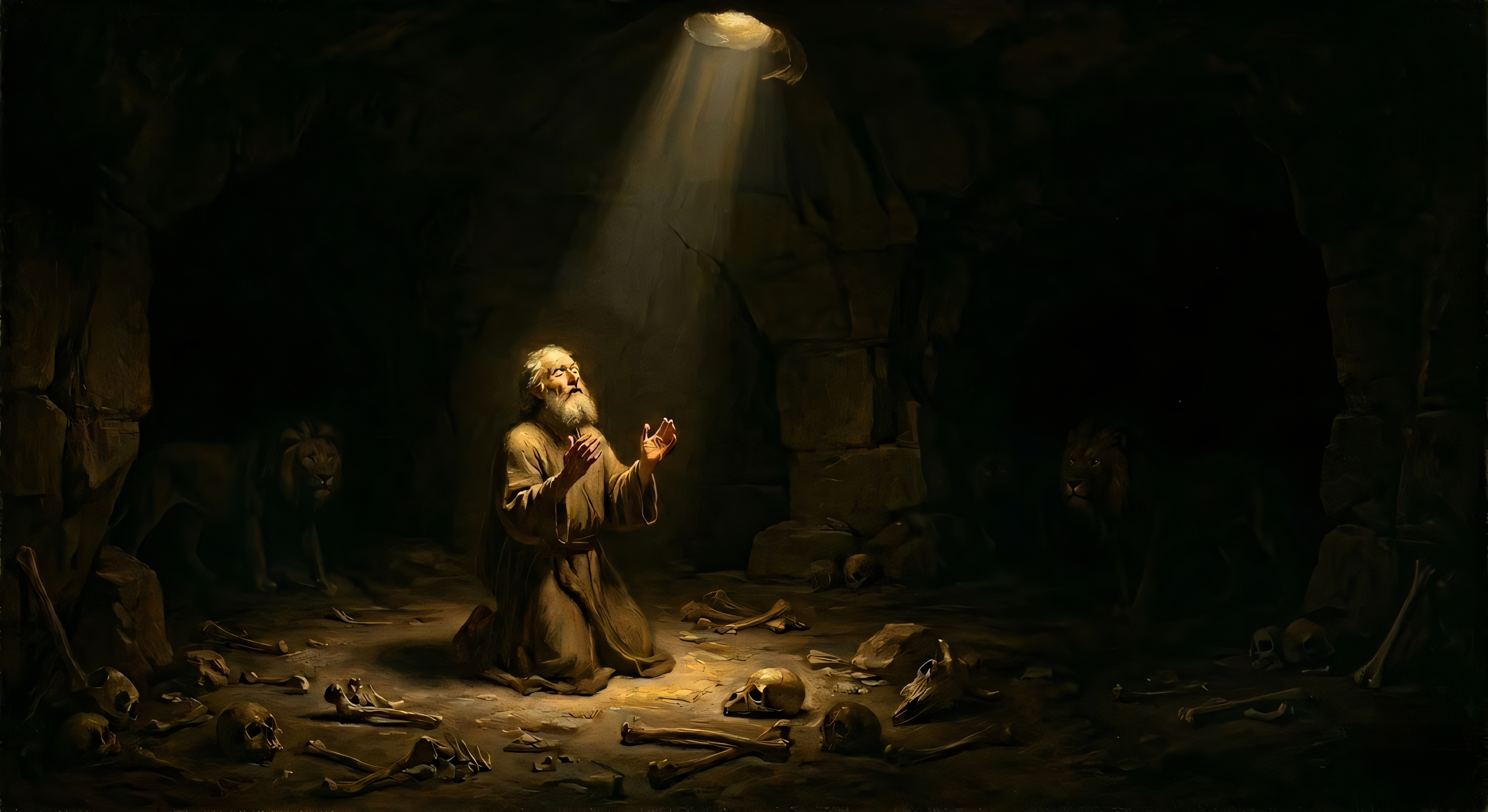
And at that hour Michael, the great angel who stands over the sons of your people, will pass by. That is a day of affliction, which will be such as has not occurred since they were born until that day. And on that day the whole people will be exalted, whoever is found inscribed in the book.
Daniel 12:1 (NRSVUE)
At that time Michael, the great prince, the protector of your people, shall arise. There shall be a time of anguish such as has never occurred since nations first came into existence. But at that time your people shall be delivered, everyone who is found written in the book.
The vision closes the way the great crisis passages of Scripture always seem to, with Michael on his feet. In chapter 10 he came to help the messenger against the prince of Persia. Here, at the time of the end, he “arises,” or in the Old Greek he “passes by,” standing over the sons of Daniel’s people as their appointed guardian. This is the same Michael, Israel’s prince, whom we met in the war behind the throne, and whom John will see leading the armies of heaven against the dragon in Revelation 12. When the last and worst tribulation breaks, the archangel is not absent.
He rises.
And it will be the worst. “A time of anguish such as has never occurred since nations first came into existence.” Jesus takes this exact phrase and carries it forward to the great tribulation still ahead of His hearers, “great suffering, such as has not been from the beginning of the world until now” (Matthew 24:21). This is the Old Testament seed of what the New Testament calls the tribulation, the concentrated distress at the end of the age.
But notice where the sentence lands. Not on the anguish. On the deliverance. “At that time your people shall be delivered, everyone who is found written in the book.” There is a book, and the ones written in it come through. The Old Greek says they will be “exalted.” The Hebrew says “delivered.” Both are true, and both point at the same registry of grace that Revelation calls the book of life, the one Moses once begged to be removed from to save his people, the one whose names were written before the foundation of the world.
The tribulation is real. The book even more so.
The Awakening (verse 2)
Now the summit of the whole book, and I am going to slow down, because there is nothing else quite like this verse anywhere in the Old Testament.
Daniel 12:2 (OG/NETS)
And many of those who sleep in the flat of the earth will arise, some to everlasting life but others to shame and others to dispersion and contempt everlasting.
Daniel 12:2 (NRSVUE)
Many of those who sleep in the dust of the earth shall awake, some to everlasting life and some to shame and everlasting contempt.
Daniel 12:2 (Theodotion/Brenton)
And many of them that sleep in the dust of the earth shall awake, some to everlasting life, and some to reproach and everlasting shame.
This is perhaps the clearest statement of bodily resurrection in the entire Old Testament, though the resurrection promise in the LXX of Job 42 might match it (“And it is written that he will rise again with those the Lord raises up.” (Job 42:17aα NETS)).
This is not a hint, not a poetic maybe, not the national metaphor of Ezekiel’s dry bones, but the flat declaration that individual human beings who have died and returned to dust will one day wake up. The Hebrew Old Testament reaches for resurrection here and there, Isaiah’s “your dead shall live,” Job’s “in my flesh I shall see God,” but nowhere else does it say it this plainly, this personally, with this much on the line.
Look first at the image. They “sleep in the dust,” and they “awake.” Scripture’s gentlest word for death, sleep, and its most defiant word for what follows, waking. The grave is not a destination in this verse. It is a bed. And the God who put His people to sleep in the dust intends to wake them up.
Then look at the two destinies, because the verse refuses to let resurrection be uniformly comforting. Some awake “to everlasting life.” And some awake “to shame and everlasting contempt.”
Everyone rises.
Not everyone rises to the same thing.
This is the Old Testament root of what Jesus makes explicit in John 5, in words that are almost a direct quotation of this verse: “all who are in the tombs will hear his voice and come out, those who have done good to the resurrection of life, and those who have done evil to the resurrection of judgment” (John 5:28-29).
Paul says the same in a single breath before Felix, that there will be “a resurrection of both the righteous and the unrighteous” (Acts 24:15). The two-fold resurrection of Daniel 12 becomes the settled teaching of the New Testament.
There is a small mystery in that word “many.” Daniel says many awake, not all. Some read it as pointing to a limited or staged resurrection. But the ancient interpreters, Jerome and Theodoret among them, took “many” here to mean the great multitude, effectively all, the many as opposed to the mere handful still alive at the end. John seems to read it that way too, since he changes Daniel’s “many” to “all.” I lean with the fathers here. “Many” is the vast number of the dead, not a restriction on who rises.
Now that word “contempt,” because it is doing more than you would guess. The Hebrew is deraon, and it is one of the rarest words in the entire Hebrew Bible. It appears in exactly one other place, and the place is unforgettable: the very last verse of Isaiah, where the redeemed go out and look on the corpses of the rebels, “and they shall be an abhorrence to all flesh” (Isaiah 66:24).
Same word.
And that verse is the one Jesus reaches for when He describes Gehenna (often flattened to “Hell” in English, which is rather misleading as this is neither Hades/Sheol, nor the Lake of Fire of Revelation), the place where “their worm never dies, and the fire is never quenched” (Mark 9:48).
So a thread runs straight from Daniel’s “everlasting contempt” through the last line of Isaiah into the lips of Jesus describing final judgment. Three passages, one rare and terrible word, binding the resurrection of the wicked in Daniel to the ruin of the rebels in Isaiah to the warnings of Christ Himself.
And here I have to be careful and honest, because that same rare word opens a genuine question the church has never fully closed.
In Isaiah, the deraon, the contempt or abhorrence, is not something the dead are consciously feeling. It is how the living look upon the dead. The redeemed regard the corpses of the rebels with revulsion. If Daniel is using the word the same way, and the parallel is hard to ignore, then “everlasting contempt” may describe the everlasting shame and abhorrence that clings to the lost rather than an ongoing conscious experience of torment.
That reading sits at the heart of the long debate between the traditional view of eternal conscious punishment and the conditionalist view that the lost finally perish. Scripture doesn’t give us an easy answer, so I’m not going to settle that debate here.
It deserves its own careful treatment, and it will get one in an upcoming series, where the destination of the human dead is the whole subject.
But for today I only want you to see that the word itself is richer and more sobering than the English lets on, and that faithful believers who love this text have read its final clause in more than one way.
One more thing, and it is the Old Greek quietly complicating the picture. Where the Hebrew and Theodotion give two destinies, life and shame, the Old Greek gives three: “some to everlasting life, but others to shame, and others to dispersion and contempt everlasting.” Dispersion. A scattering, set as its own category between glory and disgrace. I will not pretend to know exactly what the Old Greek translator intended by it, and I will not build a doctrine on a single divergent word. But it is the kind of detail that rewards a slow reader, a hint that the ancient tradition felt the fate of the dead was not quite as simple as a clean fork in the road, and it is one more thread that future series will have to pick up.
The Wise Shall Shine (verse 3)
Daniel 12:3 (OG/NETS)
And those who are intelligent will light up like the luminaries of heaven, and those who strengthen my words will be as the stars of heaven forever and ever.
Daniel 12:3 (NRSVUE)
Those who are wise shall shine like the brightness of the sky, and those who lead the many to righteousness, like the stars forever and ever.
After the terror of the two destinies comes one of the loveliest promises in the book. The wise, the maskilim, the ones who kept understanding and kept teaching through the fire of chapter 11, “shall shine like the brightness of the sky.” And those who turned many toward righteousness will shine “like the stars forever and ever.” The faithful who looked so small and so defeated during the persecution, cut down by the sword, worn out by captivity, will blaze in the resurrection like the lights of heaven. Jesus makes the same promise: “the righteous will shine like the sun in the kingdom of their Father” (Matthew 13:43).
Notice the beautiful shift in the Old Greek. Where the Hebrew honors “those who lead the many to righteousness,” the Old Greek honors “those who strengthen my words.” The teachers and the witnesses, the ones who held the line on the truth and helped others hold it, become stars. If you have ever quietly kept the faith when it cost you, or steadied someone else who was wavering, this is your verse, and this is your future. Small and unnoticed now. Blazing in eternity.
Seal the Book (verse 4)
Daniel 12:4 (OG/NETS)
And you, Daniel, hide the ordinances, and seal the book until the time of consummation, until the many rage violently and the earth is filled with injustice.
Daniel 12:4 (NRSVUE)
But you, Daniel, keep the words secret and the book sealed until the time of the end. Many shall be running back and forth, and evil shall increase.
Daniel 12:4 (NKJV)
“But you, Daniel, shut up the words, and seal the book until the time of the end; many shall run to and fro, and knowledge shall increase.”
Daniel is told to seal the book until the time of the end, and here we hit one of the most interesting textual forks in the whole chapter, and it is a place where our usual Masoretic voice does something surprising.
The Hebrew says that at the end “knowledge shall increase.” Theodotion keeps that reading faithfully: “many are taught, and knowledge is increased.” But the Old Greek reads something quite different, that “the earth is filled with injustice.” Evil, not knowledge.
And here is the surprise: the NRSVUE, which we have leaned on all series as our window into the Hebrew, actually sided with the Greek here. Its main text reads “evil shall increase,” and it drops the Hebrew “knowledge” down into a footnote.
Our usually faithful translation from the Masoretic tradition quietly crossed the aisle and printed the Old Greek’s reading.
So which is it? At the time of the end, does knowledge increase, or does evil?
And the answer, I think, is that this is one of those places where the both/and is not a strain at all but simply the truth about the last days seen from two angles. The Hebrew looks at the end and sees knowledge multiplying, understanding of these very prophecies unsealing as the time approaches, the wise growing wiser.
The Greek looks at the same end and sees wickedness multiplying, the earth filling up with injustice as the crisis peaks. Both happen at once. That is exactly the shape the New Testament gives the end, a time when knowledge and lawlessness both run ahead together, when the gospel goes to all nations and the love of many grows cold in the same generation. You do not have to choose. Both traditions are telling the truth, and between them they describe the age we seem to be living in.
I will add only a caution, because this verse has been badly abused. “Many shall run back and forth, and knowledge shall increase” has been paraded for a century as a coded prediction of cars and airplanes and the internet.
It is not.
The running to and fro is the searching of the book, people moving through the sealed words seeking understanding, and the knowledge that increases is knowledge of God’s revelation as the end draws near.
Read it that way and it is rich.
Read it as a prophecy of modern travel and it is embarrassingly narrow.
The Man in Linen, and “How Long?” (verses 5-7)
Daniel 12:5-7 (OG/NETS)
And I, Daniel, saw, and lo, two others stood, one on this side of the stream and one on the other. And they said to the one wearing linen, “O, O Sir, when then will you do the consummation of the wonders and the purification of these things which you have told?” And I heard the one wearing linen, who was above the water of the stream: “Until the time of the consummation.” And he raised the right hand and left hand toward heaven, and he swore by God, who lives forever, “The consummation of the power for the release of the holy people will be at a time and times and half a time, and all these things will be accomplished.”
Daniel 12:7 (NRSVUE)
The man clothed in linen, who was upstream, raised his right hand and his left hand toward heaven. And I heard him swear by the one who lives forever that it would be for a time, two times, and half a time and that when the shattering of the power of the holy people comes to an end all these things would be accomplished.
Here the man clothed in linen returns, the glorious figure from chapter 10, and I want you to notice how the scene positions him, because it bears on a question we deliberately left open back in Part 13.
There are now three figures at the river: two others on the banks, and the man in linen standing above the waters. And the two on the banks put their question to him. He is plainly the exalted one here, set apart, elevated over the stream, the one who holds the answer and swears the oath.
That is exactly the picture that supports reading the man in linen as a figure distinct from and greater than the interpreting angels, the reading I found most compelling in chapter 10 without settling it. I still will not settle it. But chapter 12 tips the scene further in that direction, and it is worth seeing.
Then the oath, and it is stunning in its solemnity. He lifts not one hand but both toward heaven, a doubled oath, and swears “by the one who lives forever.” When a man swears, he swears by something greater than himself. The living God has nothing greater to swear by, so the figure swears by the Eternal One, staking the very life of God on the promise.
And the promise is that the crisis will last “a time, times, and half a time,” the broken seven, three and a half, the same measure that will echo through Revelation. Whatever the number means, the point of the oath is that it has a limit, sworn to on the life of God Himself. The suffering is bounded. Heaven has put a term on it.
And look at how the traditions describe what happens when that term runs out. The Hebrew says it ends when “the shattering of the power of the holy people comes to an end.” The Old Greek says it comes “for the release of the holy people.” Theodotion says “when the dispersion is ended.”
Three angles on one moment: the shattering, the release, the end of the scattering. The Hebrew feels the breaking. The Greek sees the liberation on the far side of it.
Held together, they tell the whole story of the end of the tribulation: the power of God’s people is broken all the way down, and precisely there, at the bottom, comes their release.
Sealed Until the End (verses 8-10)
Daniel 12:8-10 (OG/NETS)
And I heard and did not comprehend regarding the time itself, and I said, “Sir, what is the interpretation of this word and what are these illustrations?” And he said to me, “Run along, Daniel, for the ordinances have been hidden and sealed until many are tested and sanctified, and the sinners sin. And no sinners will ever comprehend, and those who understand will pay heed.”
Daniel 12:10 (NRSVUE)
Many shall be purified, cleansed, and refined, but the wicked shall continue to act wickedly. None of the wicked shall understand, but those who are wise shall understand.
Daniel does what we all do at the end of this book. He says, in effect, I heard it and I still do not understand it. There is something deeply reassuring about that. The prophet himself, the man who received the vision, does not fully grasp the timeline. If Daniel did not understand the numbers, we can hold our own interpretations with a little humility.
And the answer he gets is not a decoding. It is a sealing. The words stay closed “until the time of the end.” But then comes a line that quietly reframes the whole question. “Many shall be purified, cleansed, and refined, but the wicked shall continue to act wickedly. None of the wicked shall understand, but those who are wise shall understand.” Theodotion’s version is even sharper, the faithful “tested, and thoroughly whitened, and tried with fire.”
Do you see what that does? It tells you that understanding this book was never mainly a matter of intelligence. It is a matter of the heart. The wicked will not understand, not because the code is too hard, but because understanding is reserved for the refined, the purified, the ones being tried in the fire and coming out white. The book yields itself to the faithful, not the clever. Which means the way to understand Daniel is not finally to be smarter. It is to be sanctified.
The Numbers (verses 11-12)
Daniel 12:11-12 (OG/NETS)
From the time that the perpetual sacrifice was taken away and the abomination of desolation was prepared to be given, there are one thousand two hundred ninety days. Happy is the one who continues, because he will gather one thousand three hundred thirty-five days.
Daniel 12:11-12 (NRSVUE)
From the time that the regular burnt offering is taken away and the desolating sacrilege is set up, there shall be one thousand two hundred ninety days. Happy are those who persevere and attain the thousand three hundred thirty-five days.
Let’s start with the math, because it’s genuinely interesting.
The oath in verse 7 gave us “a time, times, and half a time,” which is three and a half (the “times” is a dual, something that doesn’t really exist in English except in specific usages, such as “both.” So the “times” is two, plus a time makes three, and the half a time, bringing to total to three and a half).
On the ancient reckoning of a three-hundred-and-sixty-day year, three and a half years is twelve hundred and sixty days, the same figure that appears over and over in Revelation as 1,260 days and 42 months. Then verse 11 gives us 1,290 days, which is 1,260 plus thirty. And verse 12 gives us 1,335 days, which is 1,290 plus another forty-five, or seventy-five days beyond the 1,260. So there is a deliberate ladder here: 1,260, then thirty more, then forty-five more. Something is being added at each step, and the one who waits all the way to the top of the ladder, to day 1,335, is called blessed.
What do the added days mean? There are three main ways serious readers have answered, and I will give you each fairly.
The first is the historical reading, which ties the numbers to Antiochus. The desecration of the temple lasted roughly three years, and these figures are read as measuring that period, or the interval from the desecration to the cleansing and beyond, with the extra days marking the time until things were fully set right.
The honest difficulty is that the numbers do not map cleanly onto the known dates of Antiochus, which is part of why even the strongest defenders of an Antiochus reading, like Keil and E. J. Young, treat the figures as broadly symbolic of a suffering that was long, seemed finished, was extended, and was then cut short.
And I will be candid with you: excellent, believing commentators have simply confessed they do not know exactly what the added days count. Stuart Olyott says so plainly. That kind of honesty is worth more than a confident chart.
The second is the futurist reading, which takes the numbers as literal days in the tribulation still to come. On this view the 1,260 days are the second half of the final seven-year period, the great tribulation itself, and the extra thirty and forty-five days measure events that happen after the tribulation ends but before the millennial kingdom fully begins, the judgment of the nations, the setting up of the kingdom, the things that must happen in the interval between Christ’s return and the start of His reign. This is the reading most at home in the premillennial and pretribulational framework, and it is where I am most comfortable, though I hold it with the humility this chapter demands.
The third is the symbolic reading, which says the precise arithmetic is not the point at all. “A time, times, and half a time” is the broken seven, the perfect number of completion snapped in half, the sign of a judgment that is severe but deliberately incomplete, limited, cut short for the sake of the elect. On this view the 1,290 and 1,335 exist to make one overwhelming point: the suffering is measured. Not vague, not open-ended, but counted out by God to the very day, with a blessing pronounced on the one who endures to the end of the count.
Here is where I land, and it will not surprise you if you have followed the series. I read the numbers, like the willful king of chapter 11, as having a real near fulfillment in the days of Antiochus and an ultimate fulfillment in the tribulation still ahead, with Antiochus as the type and the final crisis as the reality. For the fuller eschatological framework, the seven-year structure and how it all fits, I will point you as always to the my Seventy Weeks post rather than rebuild it here.
But do not miss the thing the numbers are actually for, because it is not a chart. It is a beatitude. “Happy is the one who waits and reaches the 1,335 days.”
The whole point of measuring the suffering is to promise its end and to bless the one who holds on all the way to that end. God did not give Daniel these numbers so that we could calculate a date. He gave them so that the person in the middle of the worst of it would know, to the day, that it is counted, it is limited, it is almost over, and that there is a blessing waiting for the one who does not quit before the last morning. The numbers are a hand on the shoulder of the sufferer, saying: hold on. It is measured. You are almost there.
Rest, and Rise (verse 13)
And now the last verse of the Hebrew book of Daniel, and it is unbearably tender.
Daniel 12:13 (OG/NETS)
And you, go! Be off! For there are yet days and hours until the fulfillment of the consummation. And you will rest and will rise upon your glory at the consummation of days.
Daniel 12:13 (NRSVUE)
But you, go your way, and rest; you shall rise for your reward at the end of the days.
Daniel 12:13 (Theodotion/Brenton)
But go thou, and rest; for there are yet days and seasons to the fulfillment of the end; and thou shalt stand in thy lot at the end of the days.
The book does not end with the numbers. It ends with a word to one old man.
Daniel has spent his whole life in exile, in the courts of kings who came and went, faithful through furnace and lions and vision after vision that broke his body and left him sick for days. He is past eighty now. And the last thing God says to him is not another prophecy. It is a blessing, and a promise, and a goodbye.
“Go your way, and rest.” Rest. After a lifetime of standing before kings and wrestling with angels, Daniel is told he may lay it down. The Hebrew word is death, but the tone is not grim. It is the tone you use with a faithful servant at the end of a long day. Go on now. Rest.
“And you shall rise for your reward at the end of the days.” There it is, the promise of the whole chapter, brought down from the many and given to the one. The resurrection Daniel announced in verse 2 is now spoken directly to him. You, Daniel, personally, will rise. You will sleep in the dust like everyone else, and you will wake like the wise who shine, and you will stand in your allotted place at the end of the days to receive what has been kept for you.
Notice that the Old Greek carries this promise too, and the Hebrew and Theodotion state it plainly. The book of Daniel closes with a man being told he will die, and in nearly the same breath being told that death is not the end of him. Rest, and rise. That is the last word of the Hebrew Daniel, and it is the gospel five centuries early: for those written in the book, the grave is a bed, and morning is coming.
If you’ve found this work insightful or enlightening, share it with a friend who needs to see the power of reading this incredible story in multiple traditions.
What the Fathers Saw
The early church read this chapter’s resurrection exactly as it stands. Jerome, in the great commentary that shaped how the church read Daniel for over a thousand years, took the “many” who awake in verse 2 to mean the whole number of the dead, “all shall rise again.” The bodily resurrection of the just and the unjust was not a doctrine the fathers had to argue their way toward from this verse. They simply found it here, plainly stated, and built on it.
Hippolytus, whose commentary is the oldest we have, read the chapter’s tribulation and its numbers within a premillennial frame, the Antichrist prefigured by Antiochus, the suffering bounded and then broken by the return of Christ. The instinct to read Antiochus as a type of a final enemy, and the numbers as measuring a real but limited crisis, is very old.
And Jerome noticed something else at the end of this chapter that matters for us more than he could have known. Right here, at the close of Daniel 12, he drew a line. Up to this point, he observed, we have been reading Daniel in the Hebrew. What follows comes from Theodotion’s Greek. Jerome was marking the exact seam we are standing on. The Hebrew book of Daniel ends at chapter 12. But the Greek book of Daniel, the Daniel the early church actually read, does not end here at all. It keeps going.
My Take
Chapter 12 is where the whole book has been heading, and I do not think that is an accident of arrangement. Everything before it, the furnace, the wall, the lions, the beasts, the kings of north and south, has been building toward this one promise: that the God who rules the rise and fall of every empire also rules the grave, and that the faithful who lose everything, even their lives, lose nothing that matters, because they will rise.
On the resurrection, I hold what the church has always held, that verse 2 means what it says, a real, bodily, universal resurrection to two eternal destinies.
On the precise nature of the second destiny, the everlasting contempt, I have shown you honestly that the key word points in a direction the traditional view and the conditionalist view read differently, and I have left that door open on purpose, because it deserves the full treatment the afterlife series will give it.
On the numbers, I hold the dual fulfillment, Antiochus and then the final tribulation, and I hold it with the same humility Daniel himself models when he admits he did not understand.
And on the both/and divergences all through this chapter, the knowledge and the injustice, the two destinies and the three, the shattering and the release, I find them not as contradictions to resolve but as a fuller picture than either tradition could give alone, which is the whole reason we’ve been reading them side by side.
And as always, do not take my word for any of this. Read the chapter yourself from all three traditions. Sit with verse 2 until it stops being a doctrine and starts being a promise with your name in it. And then read the last verse slowly, and hear it spoken to you: go your way, and rest, and you shall rise.
Why This Matters for Your Walk With God
Here is what I want you to carry out of the end of this book.
You are going to sleep in the dust. So am I. Every person you love will. That is the one appointment none of us (save those who remain when Christ returns) will miss, and Daniel does not pretend otherwise. He calls it what it is:
Sleep, in the dust of the earth.
Note that word: sleep. Because you don’t use that word for something final. You use it for something you wake up from.
For everyone written in the book, the grave is not a full stop. It is a comma. It is a bed at the end of a long day, and there is a morning coming when the wise will shine like the brightness of the sky and the ones who held the line will blaze like stars forever.
The tribulation is measured to the day. The suffering is bounded by an oath sworn on the life of God. And on the far side of all of it stands the same promise God gave to a tired old man in exile who had given his whole life to faithfulness: rest now, and rise later, and stand in your place to receive your reward at the end of the days.
That is the last word of the Hebrew Daniel. Rest, and rise.
But it is not the last word of the Septuagint’s Daniel, and it is not the last of our journey. Because the Greek Bible the early church carried did not close the book here. After chapter 12 it keeps going, into stories the Hebrew text does not contain: a falsely accused woman named Susanna and the young Daniel who saves her, and a contest between Daniel and the priests of a Babylonian idol called Bel, and a dragon. Jerome himself marked the seam. Next time, we cross it.
Rest, and rise.
And do not fear.
The LXX Scrolls is free to read and always will be. If this work has been worth something to you, there are a few ways to say so:
Buy the ebooks. Completed teaching series are available as polished ebooks under the Two Witnesses, One Truth series. Buying through Curios will support this work most directly but they’re also available on Amazon (and elsewhere) if you’re loyal to a particular ereader.
Become a supporter. A monthly or annual pledge through Substack helps me to bring the Septuagint to those who never knew they needed it.
Send a one-time tip. If this post has blessed you and you want to express that directly, you can Buy Me a Coffee.

Thank you for being part of this journey, your support makes this work possible.
© 2026 LXX Scrolls. All rights reserved.