


Hello brothers and sisters,
Every chapter of Daniel has pulled back a curtain. We’ve encountered a lot of surprises from these texts.
If you missed any of the earlier posts, you can get caught up HERE
Chapter 10 pulls back the last one, and it is the biggest of them all.
Before we start, you need to know that chapter 10 does not stand alone. Chapters 10, 11, and 12 are a single unbroken vision, the last and longest in the book. Chapter 10 is the doorway, the terrifying encounter that sets it up. Chapter 11 is the astonishingly detailed prophecy that follows. Chapter 12 is the epilogue. So what we are walking into today is the front porch of Daniel’s final revelation, and the porch alone is enough to knock a grown prophet flat on his face.
And here is why this chapter matters more than almost any other in the Old Testament. Every other passage that hints at the unseen realm gives you a glimpse, a flash, a single frame. Daniel 10 sits you down and shows you the machinery. A glorious man by a river. A messenger delayed three weeks. A “prince” of Persia strong enough to hold up an angel. Michael the archangel arriving as reinforcement. A war being fought in the heavens over the fate of nations, right behind the politics you can see with your eyes.
And a prayer. A prayer that was answered on the very first day Daniel prayed it, and did not arrive for twenty-one days, because there was a battle in the way.
If you have ever prayed and heard nothing and wondered whether heaven was listening, this is your chapter.
A Word on Our Three Voices
The Old Greek is especially lively here, and it does three things worth watching for. It disagrees about what year this happened. It reads Daniel’s collapse in a stranger and darker way than the Hebrew. And at one key moment it preserves a reading that the Dead Sea Scrolls back up against the Masoretic Text. So keep an eye on the Greek. It is not just translating this chapter. In places it is arguing with it.
Let’s dig in.
If you’re reading this in email, be aware that the text is likely to cut off without warning. For a smoother reading experience and all the features Substack has to offer (including audio voiceovers of my posts), you can go HERE or download the app.
Three Weeks of Mourning (the setting)
Daniel 10:1-4 (NRSVUE):
In the third year of King Cyrus of Persia a word was revealed to Daniel, who was named Belteshazzar. The word was true, and it concerned a great conflict. He understood the word, having received understanding in the vision. At that time I, Daniel, had been mourning for three weeks. I had eaten no rich food, no meat or wine had entered my mouth, and I had not anointed myself at all, for the full three weeks. On the twenty-fourth day of the first month, as I was standing on the bank of the great river (that is, the Tigris),
Daniel 10:1-4 (OG/NETS):
In the first year of King Cyrus of the Persians a decree was shown to Daniel, whose name was called Baltasar. And the decree was true. And the forceful multitude will understand the decree, and I understood it by means of a vision. In those days I, Daniel, was in mourning. I had not eaten food of desire, and no meat or wine had entered my mouth. I had not anointed myself with oil until I completed three weeks of days. And it happened on the twenty-fourth day of the first month, and as I was on the bank of the great river, which is the Tigris,
Daniel 10:1-4 (Theodotion/Brenton):
In the third year of Cyrus king of the Persians a thing was revealed to Daniel, whose name was called Baltasar; and the thing was true, and great power and understanding in the vision was given to him. In those days I Daniel was mourning three full weeks. I ate no pleasant bread, and no flesh or wine entered into my mouth, neither did I anoint myself with oil, until three whole weeks were accomplished. On the twenty-fourth day of the first month, I was near the great river, which is Tigris Eddekel.
Right away the Greek and the Hebrew part ways on the calendar. The Masoretic and Theodotion set this in the third year of Cyrus, around 536 B.C. The Old Greek says the first year. I am not going to build a doctrine on it, but I will note the small echo, because the very last verse of Daniel chapter 1 told us Daniel lasted “until the first year of King Cyrus.” The Old Greek’s “first year” quietly rhymes with the bookend of the whole story.
Make of it what you will.
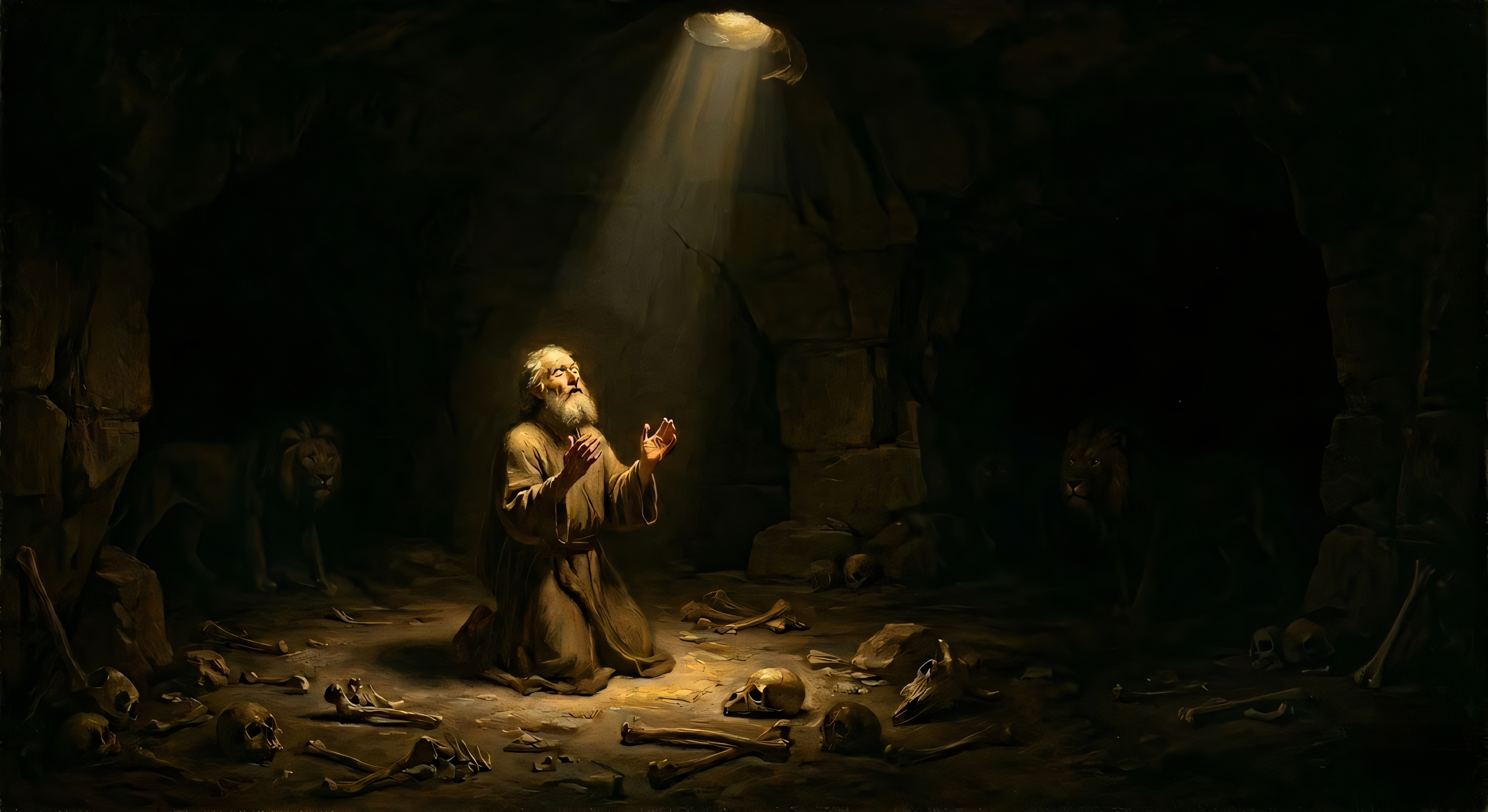
What matters more is what Daniel is doing. He is grieving. Three full weeks, no rich food, no meat, no wine, no oil on his skin, which was the ancient world’s way of saying he had stopped taking any comfort at all. And the timing is poignant. The twenty-fourth day of the first month means this fast ran straight through Passover and the Feast of Unleavened Bread. While his people, at least the ones who had gone home, were meant to be feasting, Daniel was in Babylon in sackcloth, unable to celebrate a deliverance that still felt unfinished.
Why the grief? The text does not say outright, but the timing tells the story. The first wave of exiles had gone back under Cyrus, and the return was going badly. The work was small, the opposition was fierce, and the glorious restoration the prophets had promised looked, on the ground, like a disappointment. Daniel, now well past eighty, had lived long enough to see the promise begin and to watch it struggle. So he mourns, and he fasts, and he prays. And heaven, as we are about to learn, had already answered him on day one.
The Man by the River
Daniel 10:5-6 (NRSVUE):
I looked up and saw a man clothed in linen, with a belt of gold from Uphaz around his waist. His body was like beryl, his face like lightning, his eyes like flaming torches, his arms and legs like the gleam of burnished bronze, and the sound of his words like the roar of a multitude.
Daniel 10:5-6 (OG/NETS):
and I raised my eyes and saw, and lo, there was one person clothed in linen and girded with gold around the waist and a phasa from his middle. And his body was like tharsis, and his face like an appearance of lightning, and his eyes like torches of fire, and his arms and feet like dazzling bronze, and the sound of his talking like the sound of a throng.
Daniel 10:5-6 (Theodotion/Brenton):
And I lifted up mine eyes, and looked, and behold a man clothed in linen, and his loins were girt with gold of Ophaz: and his body was as Tharsis, and his face was as the appearance of lightning, and his eyes as lamps of fire, and his arms and his legs as the appearance of shining brass, and the voice of his words as the voice of a multitude.
Now stop, because we have arrived at one of the genuine puzzles of the book, and I am not going to pretend it has a settled answer.
Who is this?
Read the description slowly. Clothed in linen. A belt of gold. A body gleaming like precious stone. A face like lightning. Eyes like flaming torches. Arms and legs like burnished bronze. A voice like the roar of a multitude. If that description rings a bell, it should, because it is almost word for word the way the apostle John describes the glorified Christ in Revelation 1: eyes “like a flame of fire,” feet “like burnished bronze,” a voice “like the sound of many waters,” a face “like the sun shining in full strength.” And it echoes the glory of God that Ezekiel saw by another river, the Chebar, in Ezekiel 1.
So there is a serious and old reading that says this figure is no ordinary angel. It is a theophany, an appearance of God, and specifically the preincarnate Christ, the Angel of the Lord, the second Yahweh figure who shows up all through the Old Testament. The white linen is the dress of the high priest on the Day of Atonement, and who is our great High Priest?
Careful interpreters like E. J. Young and Keil held exactly this, and Matthew Henry called it a settled matter, “one Man Christ Jesus.”
But there is a real problem with that reading, and honest interpreters have always felt it. Because in a few verses, this figure, or the one speaking right after him, is going to say he was delayed for three weeks by the prince of Persia and needed Michael the archangel to come help him. And that is a very strange thing to say about God. God does not get delayed. God does not need reinforcements.
So a second reading says the man is simply a high-ranking angel, glorious but created, and points out that Ezekiel saw angelic figures dressed in linen too (Ezekiel 9). The dazzling description, on this view, is just what a powerful angel looks like when a human being sees one and nearly dies of it.
And there is a third reading, which I find genuinely compelling, that says we have been assuming something the text never says. It says there are actually two figures here. The glorious man in linen of these verses is the exalted one, possibly the divine figure, but the one who reaches down and touches Daniel and starts speaking in the next paragraph is a different, lesser messenger, the angel who was actually delayed. Look closely and the text cooperates. It does not say “his hand touched me.” It says “a hand touched me.” And when we get to chapter 12, we will find the man in linen standing above the waters of the river while other figures ask him questions, plainly in charge, plainly distinct from the angel doing the talking.
I’m not going to settle this for you, because I don’t think I can do so honestly. But I will tell you where my instinct leans.
I don’t read the “delay” as the messenger being too weak or “needing” help, as though heaven were losing. I interpret this passage as the messenger waiting, holding back, letting Michael handle the prince of Persia rather than overwhelming him directly.
This interpretation keeps the glory of the figure intact without pretending the difficulty away, and it fits the two-figure view comfortably. But I want to be honest that I am reading a motive into a text that does not state one. So it’s important to note that I hold this loosely. In fact, I hold the whole question loosely. Some things in Daniel are meant to be stood in front of with your face on the ground, not filed neatly into a category.
One small textual delight before we move on. Where the Masoretic says the man’s body was like “beryl,” both Greek traditions do not translate the word at all. They just carry the Hebrew over: his body was like tharsis. That is the gem the Hebrew calls tarshish, and the Greek translators, unsure exactly which stone it was, simply kept the original word rather than guess.
We have watched them do this before, with Phelmouni back in chapter 8. When the ancient translators hit a word they could not pin down, they often preserved the mystery instead of flattening it, and I love them for that.
The Prophet on the Ground
Daniel 10:7-9 (NRSVUE):
I, Daniel, alone saw the vision; the people who were with me did not see the vision, though a great trembling fell upon them, and they fled and hid themselves. So I was left alone to see this great vision. My strength left me, and my complexion grew deathly pale, and I retained no strength. When I heard the sound of his words, I fell into a trance, face to the ground.
Daniel 10:7-9 (OG/NETS):
And I, Daniel, saw this great vision, and the persons who were with me saw this vision, and a mighty fear fell on them, and they ran away in haste. And I remained alone, and I saw this great vision. And no strength remained in me, and I saw a spirit turned toward me in order to corrupt, and I did not prevail. And as I heard the sound of his talking, I fell on my face to the ground.
Daniel 10:7-9 (Theodotion/Brenton):
And I Daniel only saw the vision: and the men that were with me saw not the vision; but a great amazement fell upon them, and they fled in fear. So I was left alone, and saw this great vision, and there was no strength left in me, and my glory was turned into corruption, and I retained no strength. Yet I heard the voice of his words: and when I heard him I was pricked in the heart, and I fell with my face to the earth.
Here is a scene the New Testament will echo centuries later. Daniel alone sees the vision. The men with him see nothing, but they feel something, a terror they cannot name, and they run and hide. That is almost exactly what happens on the Damascus road in Acts 9, where Paul alone sees the risen Christ and the men with him stand speechless, sensing a presence they cannot see. The unseen realm has a way of leaking into the visible one. The companions could not see the man in linen, but they felt the change in the atmosphere and it sent them running.
Our traditions diverge here in ways worth naming, however. First, a small one: the Old Greek clearly says the men with Daniel did see the vision, where the Masoretic and Theodotion say they did not. That may be a slip in the Old Greek’s transmission, or it could be an older reading.
I’m not going to lean on it either way, but it is there.
Second, and more interesting, is what happened to Daniel’s own body. You can see that all three traditions describe it differently, and those differences are a beautiful window into how translation works.
The Hebrew says his “splendor,” his hod, was turned to mashchit. Now that Hebrew word mashchit is a chameleon. It can mean “corruption” or “ruin,” an abstract state, and it can mean “a destroyer,” an actual agent, the very same word used for “the destroyer” who passed over Egypt at Passover.
And watch the three traditions split right along that fault line. The NRSVUE reads it as a state affecting his appearance: his “complexion grew deathly pale.”
Theodotion reads it as his glory decaying: “my glory was turned into corruption.”
And the Old Greek reads mashchit as an agent, a corrupting spirit: “I saw a spirit turned toward me in order to corrupt, and I did not prevail.”
One word, three faithful readings, because the word itself holds all three. The NRSV hears ruin. Theodotion hears decay. The Old Greek hears a destroyer in the room. None of them is wrong. They are standing at different angles to the same terrifying Hebrew noun.
But whatever angle you view it from, the point is the same. A glimpse of the unseen realm does not energize Daniel. It empties him. He loses his color, his strength, his composure, and finally consciousness, and he ends the way every human being ends in the presence of real glory.
Face down.
The Hand That Raised Him
Daniel 10:10-11 (NRSVUE)
But then a hand touched me and roused me to my hands and knees. He said to me, “Daniel, greatly beloved, pay attention to the words that I am going to speak to you. Stand on your feet, for I have now been sent to you.” So while he was speaking this word to me, I stood up trembling.
Daniel 10:10-11 (OG/NETS):
And lo, he reached out a hand to me and roused me on my knees to the soles of my feet. And he said to me, “Daniel, you are a person shown mercy. Ponder the ordinances that I am going to speak to you. And stand in your place, for I have just been sent to you.” And while he spoke this decree to me, I stood trembling.
Daniel 10:10-11 (Theodotion/Brenton):
And, behold, a hand touched me, and it raised me on my knees. And he said to me, O Daniel, man greatly beloved, understand the words which I speak to thee, and stand upright: for I am now sent to thee. And when he had spoken to me this word, I stood trembling.
“A hand touched me.” Not, notice again, “his hand.” Just a hand, reaching into Daniel’s collapse and lifting him up by stages, first to his hands and knees, then to his feet. Whoever this messenger is, the first thing he does is not speak. It is touch. He gets down to where the broken prophet is lying and physically raises him before he says a word.
However, I’m sure you noticed the slight wrinkle there. The Old Greek says, “he reached out a hand.” Now, it’s important to note that it still isn’t described as his hand, but rather that he reached out a hand. So let’s explore what the Greek actually says for a minute. Because there are structural indicators regarding whether this hand is distinct from the primary heavenly figure:
The Verb of Extension (προσήγαγε): Unlike the Theodotion text which uses a passive/intransitive construction (χεὶρ ἁπτομένη μου / “a hand touching me”), the Old Greek uses an active, transitive, third-person singular verb: προσήγαγε (”he brought near” / “he extended”). This means the grammar explicitly ties the action to a singular “he”—the overarching celestial figure Daniel has been looking at. Syntactically, the hand is the direct object being manipulated by that subject.
The Accusative Form (χεῖρα): Because the word for hand is in the accusative case (χεῖρα) rather than the nominative (χεὶρ), it functions strictly as the instrument or object. The grammar forcefully states that “He [the figure] brought a hand to me,” signaling he was in direct control without explicitly stating that it was part of his own physical anatomy.
Lack of Possessive Pronoun: The text still lacks a possessive pronoun (it does not say “his” hand). However, because it is grammatically governed by the active verb of the primary figure, the omission is standard Greek economy of language, implying it is the subject’s own hand being extended.
Of course, this is still not a rock-solid argument against the two figure interpretation. While the features of the text and grammar do tend to imply a single figure, it is still slightly open since, if we interpret this figure as being the pre-incarnate Messiah, there’s no reason he couldn’t be the active force drivin the action of the angelic hand.
And then the word, and it is the same word Daniel has heard before: “greatly beloved.” The Masoretic and Theodotion both use it. The Old Greek, as it did back in chapter 9, says something slightly different and just as sweet: “a person shown mercy.” Put the two together and you have the whole truth about Daniel, and about you. Why is he beloved? Because he was shown mercy. The love came first as mercy, and the mercy made him beloved.
Heaven’s own vocabulary for this trembling old man is the vocabulary of grace.
The War Behind the Throne
Now we reach the heart of it, and this is the passage that has no real parallel anywhere else in Scripture.
Daniel 10:12-14 (NRSVUE):
He said to me, “Do not fear, Daniel, for from the first day that you set your mind to gain understanding and to humble yourself before your God, your words have been heard, and I have come because of your words. But the prince of the kingdom of Persia opposed me twenty-one days. So Michael, one of the chief princes, came to help me, and I left him there with the prince of the kingdom of Persia and have come to help you understand what is to happen to your people at the end of days. For there is a further vision for those days.”
Daniel 10:12-14 (OG/NETS):
And he said to me, “Do not fear, Daniel, for from the first day that you gave your mind to gain knowledge and to be humble before your Lord, your word has been heeded, and I have come because of your word. And the general of the king of the Persians opposed me twenty and one day. Lo, one of the holy angels approached to help me, and I left him there with the general of the king of the Persians.” And he said to me, “I have come to explain to you that it will come upon your people at the end of days, for a vision is yet for days.”
Daniel 10:12-14 (Theodotion/Brenton):
And he said to me, Fear not, Daniel: for from the first day that thou didst set thine heart to understand, and to afflict thyself before the Lord thy God, thy words were heard, and I am come because of thy words. But the prince of the kingdom of the Persians withstood me twenty-one days: and behold, Michael, one of the princes, came to help me; and I left him there with the chief of the kingdom of the Persians: and I have come to inform thee of all that shall befall thy people in the last days: for the vision is yet for many days. (Brenton)
Read the first sentence again and let it land. “From the first day that you set your mind to understand and to humble yourself, your words have been heard.”
The first day. Not the twenty-first. Daniel had been fasting and praying for three weeks, twenty-one days of sackcloth and hunger, almost certainly wondering somewhere in his heart whether any of it was reaching the ceiling. And the answer is that the response left heaven the moment he began.
Day one.
His prayer was heard, answered, and dispatched before he had missed his second meal.
So why did the answer take three weeks to arrive?
Here is the sentence that changes how you read your own prayer life: “But the prince of the kingdom of Persia opposed me twenty-one days.”
There was a war in the way.
Let me lay out plainly what this chapter is telling us, because it is the fullest picture Scripture gives of the unseen government of the world. Behind the earthly kingdom of Persia stands a spiritual “prince,” and he is no human being. No human king could physically block an angel of God for three weeks. This is a spiritual power, a hostile one, exercising real authority over a nation. And he is not alone. In a moment the messenger will mention the “prince of Greece” too, the spiritual power behind the next empire on the horizon. And standing against them, on behalf of God’s people, is Michael, called here “one of the chief princes,” and later, in chapter 12, “the great prince who protects your people.” Three princes, three peoples: the prince of Persia, the prince of Greece, and Michael, the prince of Israel.
This is what I have been calling the Divine Council all throughout this series, and Daniel 10 is its clearest single window.
In case you missed any of my recently completed “The Divine Council” series on this topic, the basic framework is this:
Back in Deuteronomy 32, at the dividing of the nations, God “fixed the borders of the peoples” according to a number. The Masoretic Text says “according to the number of the sons of Israel.” But the Dead Sea Scrolls and the Septuagint read “according to the number of the sons of God,” the angels of God. And here, as so often, I don’t think we have to choose.
The Hebrew gives us the covenant architecture, God arranging the world around His people. The Greek and the DSS give us the cosmic architecture, God assigning heavenly beings over the nations. Both are true, and Daniel 10 is where the cosmic architecture becomes visible. The nations were placed under spiritual princes. Many of those princes went bad, corrupting the very peoples they were meant to govern. And the result is exactly what Daniel is being shown: a world where the politics you can see are the shadow cast by a war you cannot.
Paul knew this framework cold. When he told the Ephesians that “our struggle is not against blood and flesh, but against the rulers, against the authorities, against the cosmic powers of this present darkness, against the spiritual forces of evil in the heavenly places” (Ephesians 6:12), he was not inventing a metaphor. He was describing the world of Daniel 10. And when John saw “Michael and his angels” waging war against the dragon in Revelation 12, he was watching the same conflict reach its climax.
Now, in fairness, not everyone reads it this way. A minority of interpreters take the “prince of Persia” to be a stubborn human official, and I understand the caution behind that. But the reading collapses under the weight of the text.
No human obstructs an angel for three weeks. No human is opposed by Michael the archangel. And no human stands in the same category as the “prince/commander of Greece” who has not even risen to power yet. Not to mention that Greece was not unified to have such an individual until Alexander. The princes here operate in the same sphere as Michael, and Michael is not a man.
Not to mention that for those who interpret this figure as being the Son of God, while I can stretch my mind enough to accept that an angelic figure could perhaps get in the way (and keep Him from progressing if He was holding back, not wanting to destroy the angel), the same cannot be said of a mere human. He could simply bypass such a human without the man so much as noticing Him.
Watch the Old Greek do its quiet, familiar thing in this passage. Where the Hebrew and Theodotion name Michael outright at his first appearance, the Old Greek holds the name back and calls him only “one of the holy angels.” It is the very same veiling we watched it perform with Gabriel back in chapter 8, sharpening the sense of awe by refusing to hand you the name too soon. And notice the Old Greek calls the spiritual powers “generals” and “commanders” where the Hebrew calls them “princes.” The Hebrew hears the unseen realm as a government. The Greek hears it as an army at war.
Given what is actually happening in this chapter, both are exactly right.
Strengthened, Again and Again
Daniel 10:15-19 (NRSVUE):
While he was speaking these words to me, I turned my face toward the ground and was speechless. Then one in human form touched my lips, and I opened my mouth to speak and said to the one who stood before me, “My lord, because of the vision such pains have come upon me that I retain no strength. How can my lord’s servant talk with my lord? For I am exhausted; no strength remains in me, and no breath is left in me.” Again one in human form touched me and strengthened me. He said, “Do not fear, greatly beloved; you are safe. Be strong and courageous!” When he spoke to me, I was strengthened and said, “Let my lord speak, for you have strengthened me.”
Daniel 10:15-19 (OG/NETS):
And as he spoke with me these decrees, I gave my face toward the ground and was silent. And lo, as it were a likeness of a human hand touched my lips, and I opened my mouth, and I spoke and said to the one who stood in front of me, “Sir, as the vision turned to me, to my flank, there was not even strength in me. And how will the servant be able to talk with his lord?” And as for me, I became weak, and no strength stayed in me, and no breath remained in me. And a specter of a human continued and touched me and gave me strength. And he said to me, “You are a person shown mercy. Do not fear; be well. Be courageous and strong!” And when he spoke with me, I was strengthened and said, “Let my lord speak, for he has strengthened me.”
Daniel 10:15-19 (Theodotion/Brenton):
And when he had spoken with me according to these words, I turned my face to the ground, and was pricked in the heart. And, behold, as it were the likeness of a son of man touched my lips; and I opened my mouth, and spoke, and said to him that stood before me, O my lord, at the sight of thee my bowels were turned within me, and I had no strength. And how shall thy servant be able, O my lord, to speak with this my lord? and as for me, from henceforth strength will not remain in me, and there is no breath left in me. And there touched me again as it were the appearance of a man, and he strengthened me, and said to me, Fear not, man greatly beloved: peace be to thee, quit thyself like a man, and be strong. And when he had spoken with me, I received strength, and said, Let my lord speak; for thou hast strengthened me.
Daniel cannot even hold himself up under the weight of this encounter. He is touched, he stands, he crumples, he is touched again, he is strengthened again. Three times something reaches down and props this old man back up so he can bear to hear the rest. There is real tenderness in it. Heaven is not annoyed with his weakness. It keeps stooping to strengthen him, the way you would keep steadying someone who is about to faint.
And given the agreement of the verbiage here, the way all three traditions align on Daniel referring to this figure as “my lord” with fear and trembling that mirrors the ways that Isaiah, John, and others show when coming into the divine presence, I don’t think we can have any doubt of whose presence Daniel is in right now.
And also, right here, in the middle of that tenderness, sits one of the most interesting textual moments in the whole chapter. What touched Daniel’s lips?
The Masoretic Text says “one in human form.” Theodotion says “the likeness of a son of man.” But the Old Greek says something more specific: “a likeness of a human hand touched my lips.”
A hand. And here is why that matters. That Old Greek “hand” reading is not a loose paraphrase or a random variant. It has support from the Dead Sea Scrolls, the Hebrew manuscripts from Qumran, and it fits the flow of the scene better than the Masoretic does.
Because look at what surrounds it.
A few verses earlier, “a hand touched me and roused me.” A few verses later, “one in human form touched me and strengthened me.” The whole passage is a sequence of a hand reaching out to a fallen man. So when the Old Greek and the Scrolls agree that it was a “hand” that touched his lips too, they are almost certainly preserving the original picture, and the Masoretic “human form” is the reading that drifted.
This is the same kind of moment we hit back in chapter 8 with the four directions, and it is worth saying clearly, because it is the whole reason this series exists. Sometimes the Greek is not the corrupted text. Sometimes the Greek, standing alongside the oldest Hebrew scrolls we possess, is the one that kept the earlier reading, and the Masoretic is the one that moved. Neither tradition owns the truth by itself. You need them both on the table, and Qumran keeps proving it.
But I also want to be just as clear about the other side to that. The both/and is real. “one in human form,” “the likeness of a son of man,” and “the likeness of a human hand” are each saying fundamentally different things, but think about what happens when you hold them together. One in the likeness of a son of man (aka the pre-incarnate Son), who is in human form, reaches out an appendage that looks like a human hand. Not only does this imply that Daniel is aware that what touches him is so much more than human, adding Theodotion and the Masoretic gives us a deeper understanding not only of what’s really in view here, but also of what Daniel understood himself to be witnessing.
The Book of Truth and the Wars to Come
Daniel 10:20-21 (NRSVUE):
Then he said, “Do you know why I have come to you? Now I must return to fight against the prince of Persia, and when I am through with him, the prince of Greece will come. But I am to tell you what is inscribed in the book of truth. There is no one with me who contends against these princes except Michael, your prince.”
Daniel 10:20-21 (OG/NETS):
And he said to me, “Do you understand why I have come to you? And now I will return to contend with the general of the king of the Persians. And I was leaving, and lo, the commander of the Greeks was entering. And the more I will explain to you the chief things that are in the register of truth. And there was no one with me who helped concerning these things except Michael, the mighty angel.”
Daniel 10:20-21 (Theodotion/Brenton):
And he said, Knowest thou, wherefore I am come to thee? and now I will return to fight with the prince of the Persians: and I was going in, and the prince of the Greeks came. But I will tell thee that which is ordained in the scripture of truth: and there is no one that holds with me in these matters but Michael your prince.
The messenger has come down to deliver a word, and he is going right back into the fight. He has not won yet. He is going to return to the conflict with the prince of Persia, and behind that door another is already opening: “the prince of Greece will come.” The Old Greek makes it feel even more immediate, “the commander of the Greeks was entering,” as if the next war were already walking into the room while this one still rages.
And there it is again, the pattern the whole book has been drawing for us. Persia gives way to Greece. We have watched this succession twice now, in the ram overrun by the goat in chapter 8, in the silver giving way to the bronze back in chapter 2. But here we are shown the same succession from the other side, from behind the curtain, where it is not empires trading places but spiritual princes contending, one power behind Persia yielding to another power behind Greece, while heaven’s own prince holds the line for Israel.
Notice the last, almost lonely line. “There is no one with me who contends against these princes except Michael, your prince.”
One ally. In the whole struggle against the massed spiritual powers behind the world’s empires, the messenger names exactly one who stands with him: Michael. The Old Greek calls him “the mighty angel.” It is not that heaven is undermanned. It is that this is the specific assignment of the one being God has set over His people. When the princes of the nations move against Israel, Michael is the one who answers.
And what is the messenger carrying out of all this? Not a weapon. A book. “What is inscribed in the book of truth.” The Old Greek calls it “the register of truth.” Behind the war behind the throne, there is a book, already written, already true, recording what will surely come to pass. The powers rage, the princes contend, and the outcome is already inscribed. That is what chapter 11 is about to read to us, straight off the page of that book.
If you’ve found this work insightful or enlightening, share it with a friend who needs to see the power of reading this incredible story in multiple traditions.
What the Fathers Saw
I always want to know how the earliest readers of a passage understood it, and here the church’s memory speaks to both of the hard questions this chapter raises.
On the man in linen, the reading that connects him to Christ is not a modern hunch. It is as old as Christian commentary gets. Hippolytus of Rome, writing around A.D. 236 in the earliest surviving commentary on any book of Scripture, took the man clothed in linen of Daniel 10 to be Christ Himself. So the instinct that ties this glorious figure to the Jesus of Revelation 1 was already alive in the third-century church, centuries before anyone opened a study Bible. It does not settle the question, and Hippolytus pressed his allegories a good deal further than the text can bear. But when you feel the pull toward Christ in these verses, you are feeling something the early church felt first.
On the prince of Persia, the fathers hand us something even more useful, because the whole framework we have been building today turns out to be ancient. The idea that nations stand under angelic “princes” was, in the words of one old summary, the common view of the fathers. And it found its most developed voice in Origen, who in the early third century worked out a genuine doctrine of the angels of the nations. He read Daniel 10 exactly this way, with the prince of Persia as the spiritual power set over that kingdom. He grounded it precisely where we grounded it, in the Septuagint of Deuteronomy 32, which divides the nations “according to the number of the angels of God.”
Sit with that, because it changes how you should receive everything I have said. The Divine Council framework, the angels over the nations, the spiritual princes behind earthly empires, is sometimes waved off as a recent novelty, a modern fascination dressed up as exegesis. It is nothing of the kind. It is one of the oldest readings the church has, and it rests on the very same verse of the Greek Old Testament this series keeps returning to. The early church did not need the Dead Sea Scrolls to read Deuteronomy 32 this way. They had the Septuagint, and the Septuagint told them plainly.
There is one honest tension the fathers wrestled with, and it is worth naming. If every nation has an angel, and the prince of Persia is Persia’s angel, is he a good angel doing his appointed work, or a fallen one gone to war against heaven?
They did not all answer alike.
But Daniel 10 itself presses toward an answer, because whatever this prince is, he stands against the messenger of God and has to be held off by Michael. An angel who opposes God’s own errand is an angel who has gone wrong. Which is exactly the picture Scripture gives of these princes everywhere else: appointed over the nations, and then corrupting the very peoples they were set to govern.
The fathers handed us the framework.
The text hands us the tragedy inside it.
The Line You Must Not Cross
Before we close, I have to stop and say the hard, necessary thing. A chapter like this one is dangerous in the wrong hands, as I have written about at length in the Divine Council series.
Daniel 10 shows you that territorial spirits are real. That earthly powers have spiritual powers behind them. That there is a genuine war in the heavenly places. And the moment people grasp that, some of them go straight to a fatal conclusion: that we, believers, are supposed to jump into that war and start fighting those princes ourselves. To “bind the corrupted prince” over our family. Or our city. Or our nation. To rebuke and command territorial spirits or even Satan himself by name. Doing it in our own authority, not calling on the holy name of Jesus.
Read this chapter again and notice who fights the prince of Persia. It is not Daniel. Daniel prays. Daniel fasts. Daniel mourns for three weeks with his face toward the ground. And while Daniel prays, the archangel Michael fights. The human intercedes; the mighty angel wages the war. Daniel never once addresses the prince of Persia, never commands him, never rebukes him. He would not have dared, and he was the most righteous man of his generation. Arguably one of the most righteous in the entire Bible.
If a prophet like Daniel keeps his face on the ground and leaves the fighting to Michael, we have no business swaggering into the heavenly places to trade blows with principalities in our own name.
Even Michael, when he contended with the devil over the body of Moses, “did not presume to pronounce a blasphemous judgment, but said, ‘The Lord rebuke you’” (Jude 9).
If the archangel would not rebuke a fallen power in his own authority, but appealed to the Lord to do it, then neither can we. Our posture toward the unseen war is Daniel’s posture: prayer, humility, dependence, and trust that the Lord commands His own armies.
We pray.
Michael fights.
The Lord rebukes.
Stay in your lane, and it is a good lane, because the One who assigns Michael his orders is your Father.
What This Means for Your Walk With God
I want to leave you with the thing that has kept me up at night in the best way while working on this chapter.
Your prayers are heard on the first day.
Daniel’s were. From the first day he set his heart to seek God, the answer was already moving. And it still took twenty-one days to reach him, not because God was slow, not because God was weighing whether Daniel deserved it, not because heaven was silent, but because there was a war in the way that Daniel could not see.
Sit with what that does to the way you have understood your own unanswered prayers.
That prayer you have prayed for weeks, for months, and heard nothing back from. It may not be that God has not heard. It may be that God heard on the first day, and the answer is even now making its way to you through a conflict you will never see this side of the New Creation.
Delay is not denial. Silence is not absence. The stillness you feel may be the stillness of a battlefield you are not equipped to see, where your prayers have set something in motion in the heavenly places that has nothing to do with whether God loves you and everything to do with a war that is already, in the book of truth, decided.
So do what Daniel did. Keep praying through the twenty-one days. Do not stop on day three because nothing has come. Do not conclude on day twelve that heaven is not listening. Keep your face toward the ground and keep asking, because the answer left the throne room the moment you began, and it is coming, and there is a prince named Michael who fights for the people of God, and behind him stands the Lord of hosts Himself, whose book is already written and already true.
The answer is already on its way.
Do not fear.
The LXX Scrolls is free to read and always will be. If this work has been worth something to you, there are a few ways to say so:
Buy the ebooks. Completed teaching series are available as polished ebooks under the Two Witnesses, One Truth series. Buying through Curios will support this work most directly but they’re also available on Amazon (and elsewhere) if you’re loyal to a particular ereader.
Become a supporter. A monthly or annual pledge through Substack helps me to bring the Septuagint to those who never knew they needed it.
Send a one-time tip. If this post has blessed you and you want to express that directly, you can Buy Me a Coffee.

Thank you for being part of this journey, your support makes this work possible.
© 2026 LXX Scrolls. All rights reserved.