


Hello brothers and sisters,
For two chapters now, Daniel has been a man who sees. Beasts out of the sea, a ram, a goat, a little horn, an Ancient of Days. He watches, and he trembles, and he writes it down. But he does not, in chapters 7 and 8, do the one thing you would most expect a godly man to do when heaven tears open in front of him.
He does not pray.
But that’s about to change.
If you missed any of the earlier posts, you can get caught up HERE
Chapter 9 is where he prays. And it did not start with a vision at all. It started with a man reading his Bible.
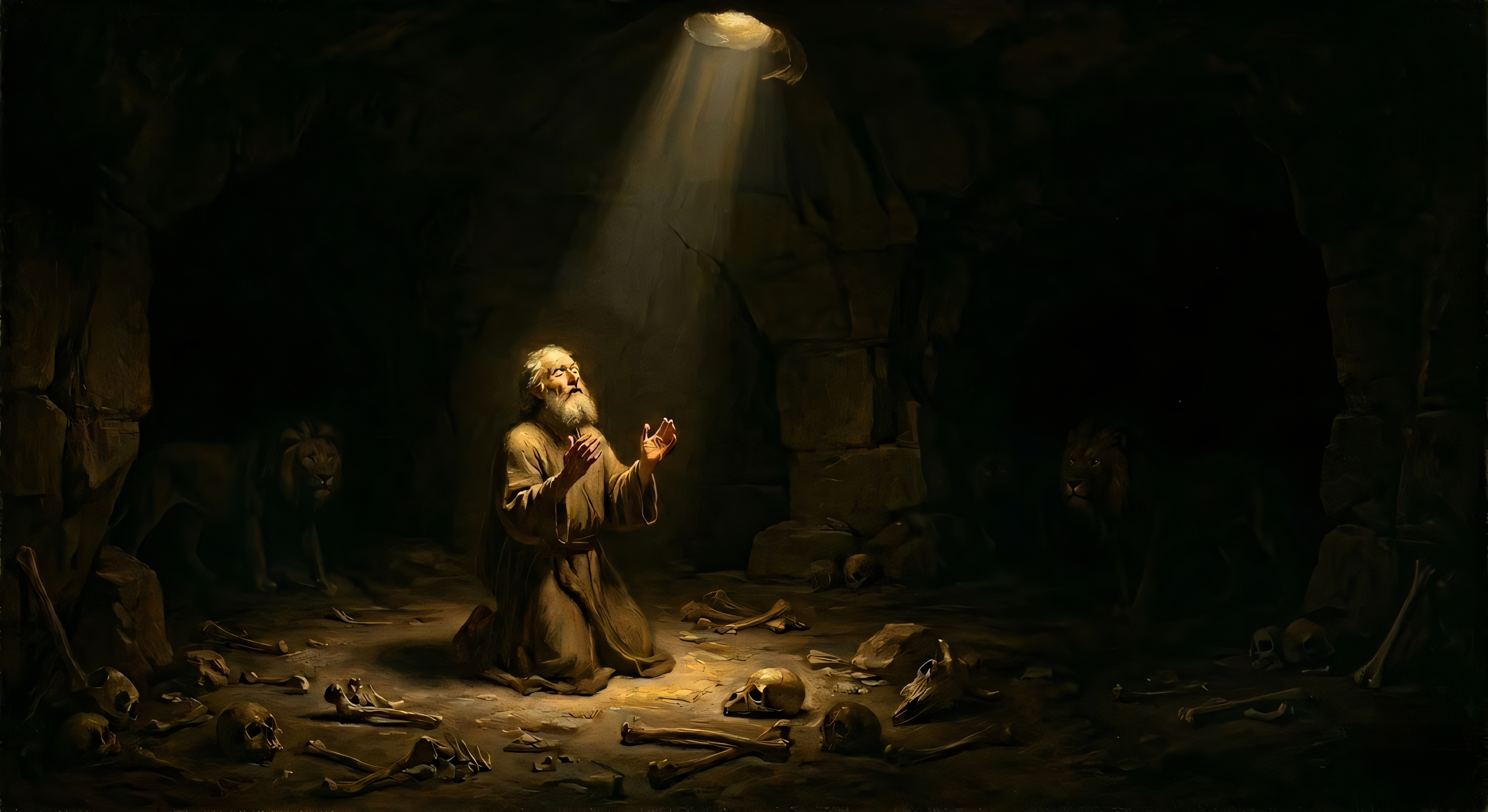
Daniel, an old man now, past eighty, is reading the scroll of Jeremiah. He counts the years. Seventy, Jeremiah said, seventy years of desolation for Jerusalem, and Daniel does the math and realizes the seventy are almost up. And that reading drives him to his knees in one of the great prayers of Scripture, a prayer of confession so complete that the man widely called blameless includes himself in every sin he names.
And while he is still praying, heaven interrupts him. Gabriel comes, and he brings the single most debated prophecy in the entire Bible: the Seventy Weeks. Seventy sevens, decreed to finish transgression, to atone for iniquity, to bring in everlasting righteousness. The gospel, compressed into one sentence, handed to a praying old man in exile.
There are two things about this chapter you need to know before we start:
The first is that I am not going to try to settle the Seventy Weeks for you here. I have already done that work at some length in one of my earliest deep dive posts, “The Seventy Weeks: How One Prophecy Became Three Interpretations.” One prophecy, three very different readings, and I am not going to relitigate all of that here. What we’re going to do here is what this series has been doing from the start: put the three texts side by side and watch what happens.
The second is a warning. The Old Greek of the prophecy itself, verses 24 through 27, is the single most damaged stretch of text in the whole book of Daniel. Maybe in the whole Greek tradition. It’s not merely different, the way chapter 8 was different. It’s damaged. The numbers are scrambled. Doublets are stacked on top of doublets. And yet, and this is the thing I cannot get over, even in the wreckage, the heart of it survives.
Hold that thought. We’ll earn it.
A Word on Our Three Voices
Same method as always. NRSVUE for the Masoretic Text. N.E.T.S. for the Old Greek. Brenton for Theodotion.
One note for this chapter. The two Greek traditions diverge so sharply here that keeping them straight matters more than usual. When you see the Greek do something strange in verses 24 through 27, I will always tell you which Greek is doing it.
Let’s dig in!
If you’re reading this in email, be aware that the text is likely to cut off without warning. For a smoother reading experience and all the features Substack has to offer (including audio voiceovers of my posts), you can go HERE or download the app.
A Man Reading His Bible
Daniel 9:1-2 (NRSVUE):
In the first year of Darius son of Ahasuerus, by birth a Mede, who became king over the realm of the Chaldeans, I, Daniel, perceived in the books the number of years that, according to the word of the Lord to the prophet Jeremiah, must be fulfilled for the devastation of Jerusalem, namely, seventy years.
Daniel 9:1-2 (OG/NETS):
During the first year of Darius son of Xerxes, of Median lineage, who were reigning over the kingdom of the Chaldeans, in the first year of his reign, I, Daniel, pondered in the books the number of the days when the ordinance of the Lord came to the prophet Ieremias to arise for the fulfillment of the reproach of Ierousalem, seventy years.
Daniel 9:1-2 (Theodotion/Brenton):
In the first year of Darius the son of Assuerus, of the seed of the Medes, who reigned over the kingdom of the Chaldeans, I Daniel understood by books the number of the years which was the word of the Lord to the prophet Jeremias, even seventy years for the accomplishment of the desolation of Jerusalem.
We are back in the days of Darius the Mede, right at the hinge between the fall of Babylon and the rise of Persia, around 538 B.C. This is the same Darius we wrestled with back in chapters 5 and 6, and I will not reopen that puzzle here.
What I want you to see is the thing that starts the whole chapter. Daniel is reading. “I perceived in the books.” He has the scroll of Jeremiah in front of him, and he finds the promise: seventy years, and then the desolation of Jerusalem ends (Jeremiah 25:11-12, 29:10).
This is a prophet reading a prophet.
And notice what reading Scripture does to him. It does not make him passive. It does not make him sit back and wait for God to keep His own promise on His own schedule. It drives him to pray as though the promise depended on it.
There is a small divergence worth catching even here, in the very first sentence. The Masoretic Text and Theodotion both say Daniel was counting toward the end of the “desolation” of Jerusalem. The Old Greek says he was counting toward the end of her “reproach,” her shame. That is a different wound.
Desolation is what the city looks like from the outside, rubble and emptiness. Reproach is what it feels like from the inside, the disgrace of a people whose God appears to have abandoned them. Both are true, and Daniel’s prayer, as we will see, is soaked in exactly that second word.
He feels the shame.
The Great Confession
Daniel 9:3-6 (NRSVUE):
Then I turned to the Lord God to seek an answer by prayer and supplication with fasting and sackcloth and ashes. I prayed to the Lord my God and made confession, saying, “Ah, Lord, great and awesome God, keeping covenant and steadfast love with those who love you and keep your commandments, we have sinned and done wrong, acted wickedly and rebelled, turning aside from your commandments and ordinances. We have not listened to your servants the prophets, who spoke in your name to our kings, our princes, and our ancestors, and to all the people of the land.”
Daniel 9:3-6 (OG/NETS):
And I gave my face to the Lord God, to find prayer and compassion with fasting and with ashes and sackcloth. And I prayed to the Lord God and acknowledged him and said, “O Lord, lo, you are the great and powerful God and the fear-inspiring one in maintaining the covenant and mercy with those who love you and keep your ordinance, we have sinned, acted wickedly, done wrong and rebelled and passed over your commandments and your ordinances. And we have not obeyed your servants the prophets, what they spoke in your name to our kings and sovereigns and our ancestors and to every nation on the earth.”
Daniel 9:3-6 (Theodotion/Brenton):
And I set my face toward the Lord God, to seek him diligently by prayer and supplications, with fastings and sackcloth. And I prayed to the Lord my God, and confessed, and said, O Lord, the great and wonderful God, keeping thy covenant and thy mercy to them that love thee, and to them that keep thy commandments; we have sinned, we have done iniquity, we have transgressed, and we have departed and turned aside from thy commandments and from thy judgments: and we have not hearkened to thy servants the prophets, who spoke in thy name to our kings, and our princes, and our fathers, and to all the people of the land.
Stop on the pronoun. We.
This is Daniel. The man who would not defile himself with the king’s food in chapter 1. The man thrown to the lions in chapter 6 precisely because his enemies could find no fault in him. The man an angel will call “greatly beloved” before this chapter is out. And what does he say?
“We have sinned.”
Not “they.” Not “my fathers, back then.” We. He wraps himself inside the guilt of his whole people and does not exempt himself for a second. This is what real intercession looks like. It does not stand over the sinner and pray down at them. It kneels beside the sinner and confesses as one of them.
If you have ever wondered how to pray for a church, a family, or a nation that has gone wrong, here is your model, and it is not comfortable. You do not get to pray “fix them.” You have to pray “forgive us.”
And look at how the confession is grounded. Before Daniel names a single sin, he names God’s character: great, awesome, covenant-keeping, merciful. He confesses to a God he already knows to be faithful. That is the only soil confession can grow in. You cannot truly repent before a God you suspect is looking for a reason to destroy you. You can only repent before a God you trust to keep covenant.
The three voices track closely through the confession. But the Old Greek slips in one phrase worth noticing. Where the Masoretic and Theodotion say the prophets spoke “to all the people of the land,” the Old Greek widens it to “every nation on the earth.” A small thing. But the Old Greek keeps doing this in Daniel, quietly pushing the frame outward from Israel toward the nations, and it is worth filing away.
Righteousness Is Yours, Shame Is Ours
Daniel 9:7-14 (NRSVUE):
“Righteousness is on your side, O Lord, but open shame, as at this day, falls on us, the people of Judah, the inhabitants of Jerusalem, and all Israel, those who are near and those who are far away, in all the lands to which you have driven them because of the treachery that they have committed against you. Open shame, O Lord, falls on us, our kings, our princes, and our ancestors because we have sinned against you. To the Lord our God belong mercy and forgiveness, but we have rebelled against him and have not obeyed the voice of the Lord our God by following his laws, which he set before us by his servants the prophets. All Israel has transgressed your law and turned aside, refusing to obey your voice. So the curse and the oath written in the law of Moses, the servant of God, have been poured out upon us because we have sinned against you. He has confirmed his words that he spoke against us and against our rulers by bringing upon us a calamity so great that what has been done against Jerusalem has never before been done under the whole heaven. Just as it is written in the law of Moses, all this calamity has come upon us. We did not entreat the favor of the Lord our God, turning from our iniquities and reflecting on his fidelity. So the Lord kept watch over this calamity until he brought it upon us. Indeed, the Lord our God is right in all that he has done, for we have disobeyed his voice.”
Daniel 9:7-14 (OG/NETS):
“Righteousness belongs to you, O Lord, and the shame of our face belongs to us, on this day, to the people of Iouda and the settlers in Ierousalem and to all the people of Israel, those who are near and those who are farther off, in all the regions into which you have dispersed them there, because of the trespasses that they have perpetrated before you. O Master, the shame of our face belongs to us and to our kings and sovereigns and to our ancestors, because we have sinned against you. To the Lord belongs justice and mercy, for we have rebelled against you and have not obeyed the voice of the Lord our God by following your law, which you gave before Moyses and us through your servants the prophets. And all Israel has forsaken your law and turned away in order not to hear your voice. And the curse and the oath written in the law of Moyses, the servant of God, have come upon us, because we have sinned against him. And he has established his ordinances for us, what he spoke against us and against our judges who judged, by bringing great evils upon us such as have not happened under heaven as they have happened in Ierousalem. According to what is written in the covenant of Moyses, all the evils have come upon us. And we did not seek the face of the Lord our God, to turn away from our sins and to consider your righteousness, O Lord. And the Lord God kept watch over the evils and brought them upon us, for the Lord God is right in everything that he does, and we have not obeyed his voice.”
Daniel 9:7-14 (Theodotion/Brenton):
To thee, O Lord, belongs righteousness, and to us confusion of face, as at this day; to the men of Juda, and to the dwellers in Jerusalem, and to all Israel, to them that are near, and to them that are far off in all the earth, wherever thou hast scattered them, for the sin which they committed. In thee, O Lord, is our righteousness, and to us belongs confusion of face, and to our kings, and to our princes, and to our fathers, forasmuch as we have sinned. To thee, the Lord our God, belong compassions and forgivenesses, whereas we have departed from thee; neither have we hearkened to the voice of the Lord our God, to walk in his laws, which he set before us by the hands of his servants the prophets. Moreover all Israel have transgressed thy law, and have refused to hearken to thy voice; so the curse has come upon us, and the oath that is written in the law of Moses the servant of God, because we have sinned against him. And he has confirmed his words, which he spoke against us, and against our judges who judged us, by bringing upon us great evils, such as have not happened under the whole heaven, according to what has happened in Jerusalem. As it is written in the law of Moses, all these evils have come upon us: yet we have not besought the Lord our God, that we might turn away from our iniquities, and have understanding in all thy truth. The Lord also has watched, and brought the evils upon us: for the Lord our God is righteous in all his work which he has executed, but we have not hearkened to his voice.
Here is the theological spine of the whole prayer, and it fits in a single sentence: “Righteousness is on your side, O Lord, but open shame falls on us.”
That is the posture. Daniel does not argue that God has been unfair. He does the opposite. He agrees with the verdict. He says, in effect, You were right, and we were wrong, and everything that has fallen on us is just. The exile is not evidence that God broke His promises. It is evidence that God kept them, because the covenant itself, back in the law of Moses, promised these very curses for exactly this disobedience. Daniel is not accusing God of abandoning the covenant. He is confessing that the covenant worked precisely as written.
That is a hard word for a suffering person to pray, but it’s a healthy one. There is a kind of grief that heals and a kind that curdles into blame. Daniel’s grief does not curdle. It confesses.
Two small textual notes. The Old Greek, in that line about the law being given “through your servants the prophets,” adds a phrase the others lack: the law was given “before Moyses and us.” It reaches back and names Moses explicitly, as if to underline that this is not new information, that Israel was warned from the very beginning. And where the Masoretic and Theodotion address God as “Lord” throughout, the Old Greek keeps reaching for a different word, “Master,” despotēs, the word for an owner, the one who holds absolute authority over a household. It is the language of a servant who knows exactly where he stands. Daniel is not negotiating. He is a slave appealing to a Master who owes him nothing and to whom he owes everything.
On the Ground of Your Mercy (the prayer, part three)
Daniel 9:15-19 (NRSVUE):
“And now, O Lord our God, who brought your people out of the land of Egypt with a mighty hand and made your name renowned even to this day, we have sinned, we have done wickedly. O Lord, in view of all your righteous acts, let your anger and wrath, we pray, turn away from your city Jerusalem, your holy mountain; because of our sins and the iniquities of our ancestors, Jerusalem and your people have become a disgrace among all our neighbors. Now therefore, O our God, listen to the prayer of your servant and to his supplication, and for your own sake, Lord, let your face shine upon your desolated sanctuary. Incline your ear, O my God, and hear. Open your eyes and look at our desolation and the city that bears your name. We do not present our supplication before you on the ground of our righteousness but on the ground of your great mercies. O Lord, hear; O Lord, forgive; O Lord, listen and act and do not delay! For your own sake, O my God, because your city and your people bear your name!”
Daniel 9:15-19 (OG/NETS):
“And now, O Master, our God, that brought your people out of Egypt by your uplifted arm and you made a name for yourself at this day, we have sinned; we have failed to understand. O Master, according to your righteousness, let your anger turn away from us, and your wrath from your city Ierousalem, the holy mountain. Because by our sins and by the ignorance of our ancestors, Ierousalem and your common people, O Lord, became a disgrace among all our neighbors. And now, O Master, heed the prayer of your servant even for my supplications; for the sake of your slaves, O Master, let your face look upon your desolated holy mountain. Give your ear attention, O Lord, and heed me. Open your eyes, and see the desolation of us and of your city where your name has been called upon it, for we do not make requests in our prayers before you on the ground of our righteous acts, but because of your mercy, O Lord. O Master, heed your people; O Lord, do be gracious. O Lord, do heed, and act, and do not delay for your own sake, O Master, because your name is called upon your city, Sion, and upon your people, Israel!”
Daniel 9:15-19 (Theodotion/Brenton):
And now, O Lord our God, who broughtest thy people out of the land of Egypt with a mighty hand, and madest to thyself a name, as at this day; we have sinned, we have transgressed. O Lord, thy mercy is over all: let, I pray thee, thy wrath turn away, and thine anger from thy city Jerusalem, even thy holy mountain: for we have sinned, and because of our iniquities, and those of our fathers, Jerusalem and thy people are become a reproach among all that are round about us. And now, O Lord our God, hearken to the prayer of thy servant, and his supplications, and cause thy face to shine on thy desolate sanctuary, for thine own sake, O Lord. Incline thine ear, O my God, and hear; open thine eyes and behold our desolation, and that of thy city on which thy name is called: for we do not bring our pitiful case before thee on the ground of our righteousness, but on the ground of thy manifold compassions, O Lord. Hearken, O Lord; be propitious, O Lord; attend, O Lord; delay not, O my God, for thine own sake: for thy name is called upon thy city and upon thy people.
And now the prayer reaches for the only ground it has left.
“We do not present our supplication before you on the ground of our righteousness but on the ground of your great mercies.”
Read that again, because it’s the whole gospel more than five hundred years early. Daniel has spent this entire prayer establishing that they have no righteousness to stand on. None. So when he finally asks, he asks on the only ground that will hold: God’s mercy, and God’s name. Not “answer us because we deserve it.” But, “Answer us for your own sake, because your name is on this city, because your reputation is bound up with this people.”
That is the boldest and humblest thing a person can pray at the same time. It throws away every claim of merit and clings entirely to the character of God. And notice how it ends, in the Masoretic, in a burst of five short imperatives with the pretense stripped off: hear, forgive, listen, act, do not delay. No more careful theology. Just a broken man hammering on the door of heaven with the last strength he has.
He will not have to knock long. In fact, he does not even finish.
Gabriel, Before the Prayer Is Done
Daniel 9:20-23 (NRSVUE):
While I was speaking and was praying and confessing my sin and the sin of my people Israel and presenting my supplication before the Lord my God on behalf of the holy mountain of my God, while I was speaking in prayer, the man Gabriel, whom I had seen before in a vision, came to me in swift flight at the time of the evening sacrifice. He came and said to me, “Daniel, I have now come out to give you wisdom and understanding. At the beginning of your supplications a word went out, and I have come to declare it, for you are greatly beloved. So consider the word and understand the vision.”
Daniel 9:20-23 (OG/NETS):
And as I kept speaking, praying and acknowledging my sins and the sins of my people Israel and entreating with prayers before the Lord, my God, and on behalf of the holy mountain of our God and while I was still speaking in my prayer, and lo, the man whom I had seen at first in my sleep, Gabriel, being carried swiftly approached me at the time of the evening sacrifice. And he came and spoke with me and said, “Daniel, I have just come out to show you intelligence. At the beginning of your supplication an ordinance went out from the Lord, and I have come to explain to you, for you are shown mercy. And think about the ordinance.”
Daniel 9:20-23 (Theodotion/Brenton):
And while I was yet speaking, and praying, and confessing my sins and the sins of my people Israel, and bringing my pitiful case before the Lord my God concerning the holy mountain; yea, while I was yet speaking in prayer, behold the man Gabriel, whom I had seen in the vision at the beginning, came flying, and he touched me about the hour of the evening sacrifice. And he instructed me, and spoke with me, and said, O Daniel, I am now come forth to impart to thee understanding. At the beginning of thy supplication the word came forth, and I am come to tell thee; for thou art a man much beloved: therefore consider the matter, understand the vision.
He is still praying. The words are still in his mouth. And Gabriel is already there.
Look at the timing that all three traditions carefully preserve: “at the beginning of your supplication a word went out.” Before Daniel finished. Before he even got to the hammering imperatives at the end. The answer was dispatched the moment he started. Heaven was not waiting to see if he would pray well enough or long enough. The word left the throne room at the first syllable.
This is the same Gabriel we met in chapter 8, the first angel ever named in Scripture, and it is worth remembering where we will meet him next. Centuries from now, this same Gabriel will stand in a room in Nazareth and tell a young woman she is going to bear the very One this whole prophecy is about (Luke 1:26). The angel who explains the seventy weeks is the angel who announces their fulfillment.
And notice the hour. “The time of the evening sacrifice.” Around three in the afternoon, when the lamb was offered in the temple. Except there was no temple. It lay in rubble, which is the whole reason Daniel is on his knees. So he is keeping the rhythm of a sacrifice that cannot be offered, praying at the hour of an altar that has been thrown down. Hold that image too. It is going to matter enormously in a moment, because the prophecy Gabriel is about to give ends with a sacrifice that ceases, and points, if you have eyes to see it, to the one sacrifice that would make all the others unnecessary forevermore.
There is a lovely divergence in how the three name Daniel here. The Masoretic and Theodotion call him “greatly beloved,” a “man much beloved.” The Old Greek says he is one who is “shown mercy.” Both are true, and together they are the whole story of every believer. Why is Daniel beloved? Not because he earned it. Because he was shown mercy. The prayer said it: not our righteousness, but your mercy. And heaven’s own description of him agrees.
The Seventy Weeks
Now we come to it. The most analyzed, most disputed, most chart-covered passage in the Old Testament. I am going to show you all three texts in full, and then I am going to do three things: point you to the deep interpretive work rather than repeat it, show you the one place where the Greek Bible says something in plain sight that will stop your heart, and then be honest with you about the state of the Old Greek text, which is a wreck, and about the astonishing thing that survives inside the wreck anyway.
Daniel 9:24-27 (NRSVUE):
“Seventy weeks are decreed for your people and your holy city: to finish the transgression, to put an end to sin, and to atone for iniquity, to bring in everlasting righteousness, to seal both vision and prophet, and to anoint a most holy place. Know therefore and understand: from the time that the word went out to restore and rebuild Jerusalem until the time of an anointed prince, there shall be seven weeks, and for sixty-two weeks it shall be built again with streets and moat, but in a troubled time. After the sixty-two weeks, an anointed one shall be cut off and shall have nothing, and the troops of the prince who is to come shall destroy the city and the sanctuary. Its end shall come with a flood, and to the end there shall be war. Desolations are decreed. He shall make a strong covenant with many for one week, and for half of the week he shall make sacrifice and offering cease, and in their place shall be a desolating sacrilege until the decreed end is poured out upon the desolator.”
Daniel 9:24-27 (Theodotion/Brenton):
Seventy weeks have been determined upon thy people, and upon the holy city, for sin to be ended, and to seal up transgressions, and to blot out the iniquities, and to make atonement for iniquities, and to bring in everlasting righteousness, and to seal the vision and the prophet, and to anoint the Most Holy. And thou shalt know and understand, that from the going forth of the command for the answer and for the building of Jerusalem until Christ the prince there shall be seven weeks, and sixty-two weeks; and then the time shall return, and the street shall be built, and the wall, and the times shall be exhausted. And after the sixty-two weeks, the anointed one shall be destroyed, and there is no judgment in him: and he shall destroy the city and the sanctuary with the prince that is coming: they shall be cut off with a flood, and to the end of the war which is rapidly completed he shall appoint the city to desolations. And one week shall establish the covenant with many: and in the midst of the week my sacrifice and drink-offering shall be taken away: and on the temple shall be the abomination of desolations; and at the end of time an end shall be put to the desolation. (Brenton)
Daniel 9:24-27 (OG/NETS):
Seventy weeks have been decided for your people and for the city, Sion: for sin to be consummated and to make iniquities scarce and to blot out iniquities and to comprehend the vision and for everlasting righteousness to be given and for the vision to be consummated and to gladden a holy of holies. And you shall understand and will rejoice and will discover ordinances to respond, and you will build Ierousalem as a city for the Lord. And after seven and seventy and sixty-two weeks, an anointing will be removed and will not be. And a king of nations will demolish the city and the sanctuary along with the anointed one, and his consummation will come with wrath even until the time of consummation. He will be attacked through war. And the covenant will prevail for many, and it will return again and be rebuilt broad and long. And at the consummation of times [even after seven years and seventy times and sixty-two times] [until the time of the consummation of the war even desolation will be removed] [when the covenant prevails for many weeks]. And in half of the week the sacrifice and the libation will cease, and in the temple there will be an abomination of desolations until the consummation of a season, and a consummation will be given for the desolation.
First, what I am not going to do
I am not going to calculate the seventy weeks here. I am not going to discuss which decree starts the clock, whether the sevens are years, where the seventieth week lands, or whether there is a gap between the sixty-ninth and the seventieth. Those are exactly the questions that split this prophecy into three distinct interpretations, and I have walked through all of them, carefully and at length, in my deep dive into the Seventy Weeks. If this section leaves you wanting the arithmetic and the argument, that’s where you’ll find it.
This post is about the text, not the timeline or interpretation.
Now, the thing that might stop your heart
Read the Masoretic and Theodotion versions of that second sentence again, side by side.
The Masoretic says the clock runs “until the time of an anointed prince.”
Theodotion says it runs “until Christ the prince.”
Christ.
Now, before anyone gets carried away, let me tell you exactly what happened, because the truth is better than the hype. Theodotion did not sneak Jesus into the Old Testament. The Hebrew behind “an anointed prince” is מָשִׁיחַ נָגִיד (mashiach nagid), “anointed one, ruler.” And the ordinary, dictionary Greek word for “anointed one” is Χριστός (Christos). Theodotion rendered mashiach nagid as Χριστοῦ ἡγουμένου, (Christou hēgoumenou), which is simply the exact Greek equivalent of the Hebrew. “Christ” is not an addition, it’s just a translation.
But sit with what that means. The Greek Old Testament that the early church carried, read, and preached from said the word “Christ” right there in Daniel 9, in a prophecy about someone coming after a fixed number of weeks and then being cut off. The connection the church would later make between this passage and Jesus was not something they had to argue their way into against the text. It was sitting on the surface of the page they were already holding.
The NRSVUE, reaching honestly for the Hebrew sense, gives you “an anointed prince,” and that is a fair translation. But it quietly buries what the ancient Greek reader saw the instant he looked down: Christ, the prince.
This is the same thing that happened back in chapter 7, where the NRSVUE gave us “a human being” and the tradition heard “the Son of Man.” The Hebrew and Greek are not in conflict. They are two windows onto the same figure, and sometimes the Greek window is the one that gives us a clearer view.
You will notice a second difference in that same sentence: the way the weeks are divided. The Masoretic separates them, seven weeks, then sixty-two. Theodotion runs them together, seven and sixty-two. That difference is not decoration. It changes where the “anointed prince” lands in the timeline, and it is one of the hinges the three interpretations turn on. Which is exactly why you should read my original post on the Seventy Weeks for it. It’s a genuinely thorny issue that deserves to be wrestled with rather than pretending to settle it in a paragraph.
Now the hard part, honestly
Look at the Old Greek again, and this time do not look for theology. Just look at the numbers.
“After seven and seventy and sixty-two weeks.”
Seven, and seventy, and sixty-two. Add them. You get one hundred and thirty-nine. In a prophecy about seventy weeks. The number does not work. It cannot work. Somewhere in the transmission of this text, a scribe or a series of scribes let the “seventy” from the opening sentence collide with the “seven and sixty-two” from the timeline, and the two fused into an impossible total that no one ever went back and fixed.
And it gets worse. Look at verse 27 in the Old Greek, at those three clauses I have left in their brackets:
[even after seven years and seventy times and sixty-two times] [until the time of the consummation of the war even desolation will be removed] [when the covenant prevails for many weeks].
Those brackets are not mine. That is how the N.E.T.S. prints it, and the brackets are the editors telling you something specific. These are doublets. Competing versions of the same clause, variant attempts at the chronology, that got copied into the manuscript one after another and stacked up like sediment, never sorted out, never chosen between. You are not reading a translation there. You are reading a pile of a translator’s and several scribes’ competing guesses, preserved side by side because no one dared throw any of them away.
I am not going to pretend this is a beautiful complementary witness the way the “commander in chief delivers the captives” was back in chapter 8. It is not. This is a damaged text. Honesty is part of the both/and, or the both/and is worthless. And the honest thing to say is that when you want the shape of this prophecy in clear focus, you go to the Masoretic and to Theodotion. Because the Old Greek of verses 25 through 27 is too mangled to carry the weight.
And now the thing I cannot get over
But do not close the Old Greek yet. Because look at where the damage falls, and look at where it does not.
The damage falls on the timeline. The numbers, the weeks, the arithmetic, the chronology. That is what got scrambled and doubled and lost.
Now read the Old Greek of the very first sentence, verse 24, the purpose of the whole thing, and compare it word for word with the Masoretic:
Seventy weeks decided. Sin consummated. Iniquities blotted out. The vision comprehended. Everlasting righteousness given. A holy of holies gladdened.
It is intact. Every single one of the six great purposes survives in the Old Greek, right alongside the Masoretic and Theodotion, unscrambled and whole. And even down in the wreckage of verses 26 and 27, the beats are still there if you look: an anointing removed, the city and sanctuary demolished, a covenant that prevails for many, the sacrifice ceasing in the half of the week, the abomination of desolations, a decreed consummation poured out at the end.
Do you see what that means?
The corruption hit the arithmetic. It did not hit the atonement.
Scribes lost the numbers. They could not lose the gospel. You can scramble the weeks of Daniel 9 into an impossible sum, you can stack three broken clauses on top of each other and never sort them out, and the thing still stands there and says: sin will be finished, iniquity will be atoned, everlasting righteousness will be brought in. The message God put in this chapter turns out to be more durable than the manuscript that carried it. The damage went as deep as it could go, and it could not reach the center.
That is not me rescuing the Old Greek with a pious spin. That is just what the page says when you read it carefully. The heart of the prophecy is the one part the corruption could not touch.
The Threads That Run to the Gospels
Three lines run straight from this chapter into the New Testament, and I want to name them without pretending to resolve the timeline questions that belong in a post on interpretation.
The first is that phrase all three traditions preserve at the very end: the abomination of desolations. Years later, standing in the temple courts, Jesus would point His disciples back to this exact chapter, telling them that when they saw “the abomination of desolation spoken of by the prophet Daniel” (Matthew 24:15), they would know the hour had come. Whatever you make of the timeline, Jesus Himself read Daniel 9 as pointing forward, past its nearest fulfillment, to something still ahead of Him.
The second is the anointed one who is “cut off and shall have nothing.” Set that beside Isaiah 53, the servant “cut off from the land of the living,” who “had done no violence.” The Masoretic says the anointed one is cut off and has nothing, stripped, destitute, left with empty hands. Theodotion, at the very same spot, says of him “there is no judgment in him,” which has been read as a declaration of his innocence, no fault, no guilt to be found. An innocent one, cut off, left with nothing. The church did not have to strain to hear the cross in that.
The third is quieter and it is aimed right at the heart of what I have argued elsewhere. Theodotion’s verse 27 says that in the midst of the week “my sacrifice and drink-offering shall be taken away.” My sacrifice. And all three traditions agree that the sacrifice ceases. Now hold that against the book of Hebrews, which is my other great love, the argument that Christ, by the one offering of Himself, brought the entire sacrificial system to its intended end, so that “there is no longer any offering for sin” (Hebrews 10:18). Daniel prayed at the hour of a sacrifice that had no altar. The prophecy he received ends with a sacrifice that ceases. And the New Testament tells us why it would cease: because the real one had finally been made.
If you’ve found this work insightful or enlightening, share it with a friend who needs to see the power of reading this incredible story in multiple traditions.
What the Fathers Saw
The early church went to work on this chapter early and never really stopped.
The first to attempt a full chronological calculation was Julius Africanus, writing after A.D. 232. He counted from a decree of Artaxerxes down to Christ, and though his arithmetic was rough and he had to bend the calendar to make it land, he reached the conclusion that mattered: the seventy weeks pointed to Jesus. Origen, in the same era, said flatly that Daniel’s weeks had been “fulfilled” in the coming of Christ.
But my favorite patristic witness here is Jerome, because of what he refused to do. When Jerome wrote his commentary on Daniel around A.D. 407 and reached the seventy weeks, he laid out the competing interpretations of the great teachers before him, Africanus, Eusebius, Hippolytus, Apollinaris, and more, and then he declined to choose. It was not safe, he said, to set one great teacher of the church above another, so he would simply report each view and leave the judgment to the reader.
I find that deeply reassuring, and a little bit funny. Sixteen hundred years before I sat down to write a post called “How One Prophecy Became Three Interpretations,” Jerome looked at the very same passage, counted up the views of the fathers, threw up his hands, and told his readers to weigh it for themselves.
Some things about this chapter have never changed. The prophecy has always been clear about what it accomplishes and famously difficult about when.
Jerome knew it. So do we.
My Take
Here is where I land on chapter 9.
The prayer is the part I do not want you to rush past on your way to the prophecy, because the prayer is where you actually live. Most of us will never have to work out the terminus of the sixty-ninth week.
All of us have to learn how to confess. And Daniel shows you: you confess as “we,” not “they.” You ground it in the character of a covenant-keeping God, not in the hope that He might be in a good mood. You throw away every claim of your own righteousness and stand entirely on His mercy. And you can start praying like that today, in a language you already speak, without resolving a single textual question.
On the prophecy, I hold what I have argued at length in the Seventy Weeks post, which I won’t compress here into something that would only mislead you by its brevity.
What I will say plainly is that the Greek Bible said “Christ” in this chapter in plain sight, that the “anointed one cut off and having nothing” is the kind of sentence that only ever found its true weight at a Roman cross, and that the sacrifice which the prophecy says would cease is the sacrifice the book of Hebrews says has now been made once for all.
And on the text, I have said the hard thing on purpose. The Old Greek of the Seventy Weeks is damaged. I am not going to dress that up. But I hope you will carry out of this post the thing that stunned me while I was writing it: the damage could not reach the center. The numbers scrambled. The purposes held. Sin finished, iniquity atoned, everlasting righteousness brought in, and a holy of holies gladdened, standing there intact in the very manuscript that lost the ability to count. If you have ever worried that the Bible is too fragile a thing to have survived all these hands, let this chapter be your answer. The scribes did their worst right here, and the gospel walked out of it without a scratch.
As always, do not take my word for any of this. Read the three side by side. Find the word “Christ” sitting in Theodotion where your English says “anointed.” Add up the Old Greek’s weeks yourself and watch them fail to reach seventy. And then read verse 24 in all three and notice the one thing none of the damage could touch.
Why This Matters for Your Walk With God
Daniel opened a scroll, found a promise, and it broke his heart open into prayer. That is where this chapter starts, and it is worth asking whether your Bible reading has ever once done that to you. Not informed you. Not impressed you. Broken you open. Daniel read that the seventy years were almost done, and instead of celebrating, he went and put on sackcloth and confessed the sin that had cost his people those years in the first place. He let the promise drive him to his knees.
And heaven answered before he was finished.
That is the pattern I want you to take with you. Not a timeline. A pattern. You pray on the ground of God’s mercy and not your record, and the word goes out at the first syllable, before you have prayed well enough, because it was never about praying well enough. It was always about the mercy.
The seventy weeks were decreed to finish transgression and to atone for iniquity and to bring in an everlasting righteousness that no confession of ours could ever manufacture. Daniel prayed “not on the ground of our righteousness.” The prophecy answered him with a righteousness that would be brought in from the outside, everlasting, given, gladdening the holy of holies. He asked for mercy. He was handed the gospel.
The anointed one was cut off and had nothing, so that you, who also had nothing to stand on, might be given everything. The sacrifice ceased because the true one had come. And not even a wrecked manuscript full of scrambled numbers could keep that news from reaching you.
Everlasting righteousness has been brought in.
Do not fear.
The LXX Scrolls is free to read and always will be. If this work has been worth something to you, there are a few ways to say so:
Buy the ebooks. Completed teaching series are available as polished ebooks under the Two Witnesses, One Truth series. Buying through Curios will support this work most directly but they’re also available on Amazon (and elsewhere) if you’re loyal to a particular ereader.
Become a supporter. A monthly or annual pledge through Substack helps me to bring the Septuagint to those who never knew they needed it.
Send a one-time tip. If this post has blessed you and you want to express that directly, you can Buy Me a Coffee.

Thank you for being part of this journey, your support makes this work possible.
© 2026 LXX Scrolls. All rights reserved.
So much in this chapter, and the OG is especially interesting. I love how it brings out that the Lord gave His Torah before Moses. This same idea is found in the Book of Jubilees, which traces a lot of Torah back before Mt. Sinai.