


Hello brothers and sisters,
Last time, we stood at the summit of the book. The Son of Man came on the clouds, the Ancient of Days took His throne, and the whole vision shimmered with mystery. Four beasts, but which kingdoms? A little horn, but which king? Chapter 7 gives you the cosmic picture and lets you wonder.
Chapter 8 refuses to let you wonder.
If you missed any of the earlier posts, you can get caught up HERE
Where chapter 7 showed us beasts rising from a chaotic sea, chapter 8 shows us a ram and a goat, and then the interpreting angel leans in and says, in effect, “Let me remove all doubt.” The ram is the kings of Media and Persia. The goat is the king of Greece. The great horn is the first king. This is the most historically specific vision in the entire book. So specific that skeptics have insisted for centuries it could only have been written after the events it describes. We’ll come back to that.
There is also a quieter shift here, one your English Bible cannot show you. Chapter 8 returns to Hebrew. From chapter 2, verse 4 through the end of chapter 7, Daniel was written in Aramaic, the international language of empire. Now, as the focus narrows from world kingdoms down to the fate of the Jewish people and their sanctuary, the book slips back into the sacred tongue of Israel. The language itself follows the camera as it zooms in.
And zoom in it does. All the way down to one man. A “little horn” who grows great, tramples the host of heaven, stops the daily sacrifice, and desecrates the temple. The text never speaks his name, but history does: Antiochus IV Epiphanes. And he is the clearest preview the Old Testament ever gives us of the Antichrist.
A Word on Our Three Voices
Same method as always. For the Masoretic Text (MT), the Hebrew behind most English Bibles, I quote the NRSVUE. For the Old Greek (OG), the earliest Greek translation, I quote the New English Translation of the Septuagint (N.E.T.S.). For Theodotion, the later Greek revision the church adopted for Daniel, I quote Brenton.
One flag before we start, because chapter 8 is where it matters most. The Old Greek of Daniel 8 is one of the most divergent chapters in the entire Greek Old Testament. It does not merely translate the Hebrew differently. In places it tells a noticeably different story. And that difference turns out to be one of the most beautiful both/and moments we have encountered in this whole series. So read the Greek closely here. It is doing more than you think.
Let’s dig in.
If you’re reading this in email, be aware that the text is likely to cut off without warning. For a smoother reading experience and all the features Substack has to offer (including audio voiceovers of my posts), you can go HERE or download the app.
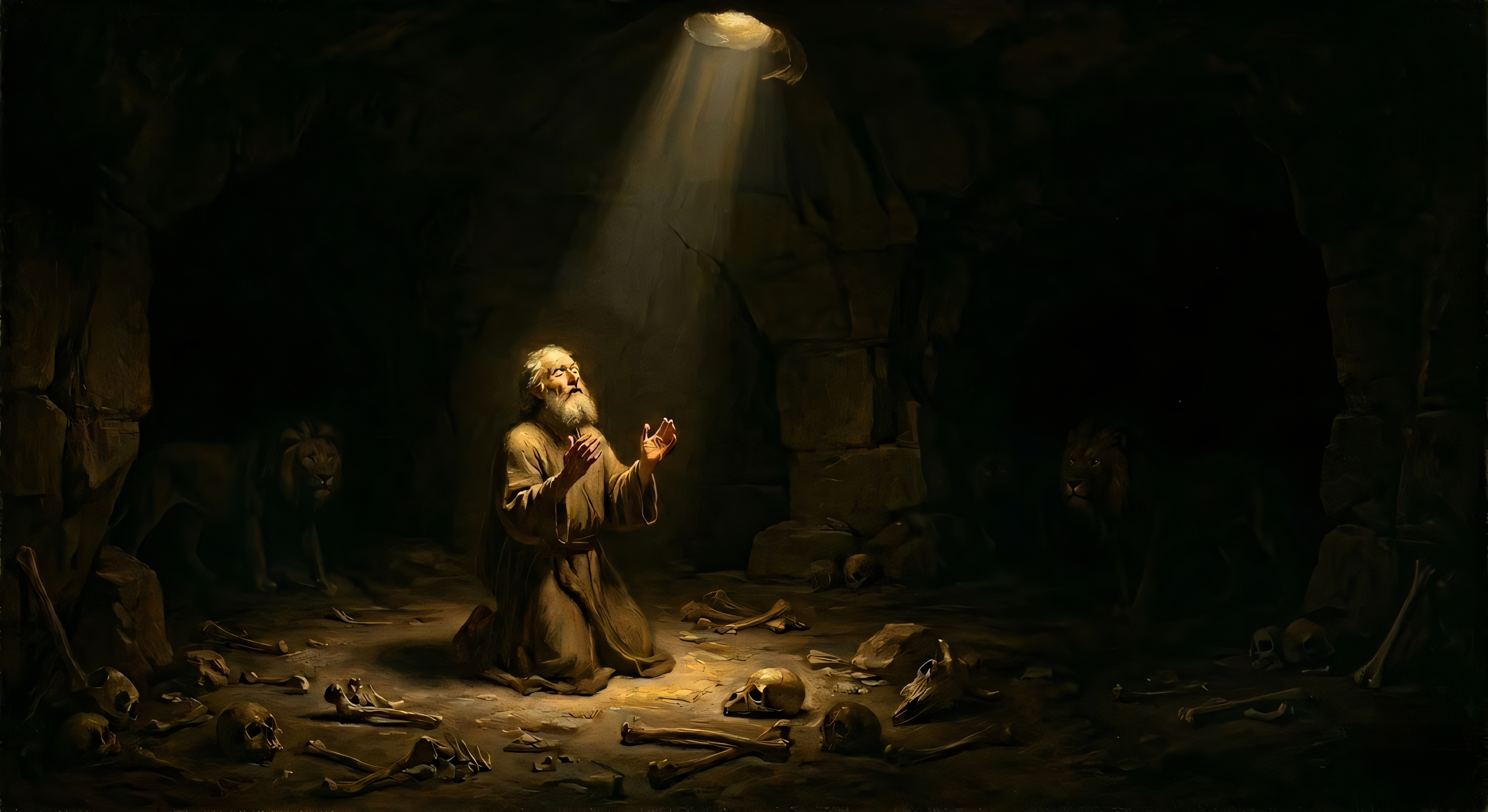
The Setting: A Vision in Susa (verses 1–2)
Daniel 8:1-2 (NRSVUE):
In the third year of the reign of King Belshazzar a vision appeared to me, Daniel, after the one that had appeared to me at first. In the vision I saw myself in Susa the capital, in the province of Elam, and I was by the Ulai Gate.
Daniel 8:1-2 (OG/NETS):
During the third year, when Baltasar was king, there was a vision, which I, Daniel, saw after I saw the first one. And I saw in the vision of my dream. When I was in Sousa the city, which is in the region of Elymais, while I was still by the gate of Olam.
Daniel 8:1-2 (Theodotion/Brenton):
In the third year of the reign of king Baltasar a vision appeared to me, even to me Daniel, after that which appeared to me at the first. And I was in Susa the palace, which is in the land of Ælam, and I was on the bank of Ubal.
Two years have passed since the vision of chapter 7 (that one came in Belshazzar’s first year; this one in his third). Babylon is still standing, but its days are numbered. And notice where Daniel finds himself in this vision: Susa, in the province of Elam, by the waters of the Ulai.
Susa was not a Babylonian city. It would become one of the great capitals of the Persian Empire, the very empire about to swallow Babylon whole. Daniel, sitting in a doomed kingdom, is carried in vision to the seat of the kingdom that will replace it. The geography is prophecy. Before a single horn appears, the setting itself is whispering that power is about to change hands.
The Ram and the Goat (verses 3–8)
Daniel 8:3-8 (NRSVUE):
I looked up and saw a ram standing beside the gate. It had two horns. Both horns were long, but one was longer than the other, and the longer one came up second. I saw the ram charging westward and northward and southward. All beasts were powerless to withstand it, and no one could rescue from its power; it did as it pleased and became strong. As I was watching, a male goat appeared from the west, coming across the face of the whole earth without touching the ground. The goat had a horn between its eyes. It came toward the ram with the two horns that I had seen standing beside the gate, and it ran at it with savage force. I saw it approaching the ram. It was enraged against it and struck the ram, breaking its two horns. The ram did not have power to withstand it; it threw the ram down to the ground and trampled upon it, and there was no one who could rescue the ram from its power. Then the male goat grew exceedingly great, but at the height of its power the great horn was broken, and in its place there came up four prominent horns toward the four winds of heaven.
Daniel 8:3-8 (OG/NETS):
when I looked up, I saw one large ram standing in front of the gate, and it had stately horns. And the one was more stately, and the stately one came up. But after this I saw the ram charging to the east and to the north and to the west and to the south. And no beasts stood before it, and no one could rescue from its hands. And it was doing as it wanted and became exalted. And I was pondering, and lo, a male goat of goats was coming from the west, over the face of the earth, and it did not touch the ground. And one horn of the male goat was between its eyes. And it came at the ram, which had the horns, which I had seen standing by the gate, and it ran against it in a furious rage. And I saw it approaching toward the ram. And it was inflamed against it, and it struck and crushed its two horns. And there was no longer power in the ram to stand against the male goat, and it rent it asunder on the ground and crushed it, and there was no one who could rescue the ram from the male goat. And the male goat of the goats prevailed exceedingly, and when it prevailed, its great horn was crushed, and another four horns came up behind it toward the four winds of heaven.
Daniel 8:3-8 (Theodotion/Brenton):
And I lifted up mine eyes, and saw, and, behold, a ram standing in front of the Ubal; and he had high horns; and one was higher than the other, and the high one came up last. And I saw the ram butting westward, and northward, and southward; and no beast could stand before him, and there was none that could deliver out of his hand; and he did according to his will, and became great. And I was considering, and, behold, a he-goat came from the south-west on the face of the whole earth, and touched not the earth: and the goat had a horn between his eyes. And he came to the ram that had the horns, which I had seen standing in front of the Ubal, and he ran at him with the violence of his strength. And I saw him coming up close to the ram, and he was furiously enraged against him, and he smote the ram, and broke both his horns: and there was no strength in the ram to stand before him, but he cast him on the ground, and trampled on him; and there was none that could deliver the ram out of his hand. And the he-goat grew exceedingly great: and when he was strong, his great horn was broken; and four other horns rose up in its place toward the four winds of heaven.
We do not have to guess at the meaning here, because later in the chapter the angel spells it out. But let us read it the way Daniel first saw it.
A ram with two horns, one longer than the other, and the longer one coming up second. The ram charges, unstoppable. Then from the west comes a goat, moving so fast it does not touch the ground, with a single conspicuous horn between its eyes. The goat smashes the ram, breaks both its horns, and tramples it. But at the height of its power, the goat’s great horn snaps, and four horns rise in its place.
If you know your ancient history, the picture is unmistakable. The ram is the Medo-Persian empire, its two horns the Medes and the Persians, with the Persians (the later, longer horn) rising to dominate.
The goat is Greece, and its speed is the speed of Alexander the Great, who conquered the known world in a handful of years, moving so fast he seemed never to touch the ground. The single great horn is Alexander himself. And its breaking “at the height of its power” is Alexander’s sudden death in Babylon in 323 B.C., at just thirty-two, with no heir to hold the empire together.
The four horns that rise in its place are the four generals who carved up his kingdom among themselves.
Which Way Does the Ram Charge?
Now look at verse 4 again, closely, because the traditions do not agree on something you probably read straight past.
The Hebrew sends the ram in three directions: west, north, south.
Theodotion agrees. Three.
The Old Greek gives four: east, north, west, south.
Three directions, or four. And the difference is the east.
Here is why the Hebrew’s three are worth stopping over. Remember where Daniel is standing. He is in Susa, in the province of Elam, and Elam is east. The ram is not standing in the middle of a blank map. It is standing in the Persian homeland, and it charges away from home in every direction that matters: west toward Babylon and Asia Minor and eventually Greece, north toward the peoples of the mountains, south toward Egypt. It does not charge east, because east is where it came from.
That is not a gap in the Hebrew. That is a vantage point. It is the same kind of quiet, incidental precision we ran into back in chapter 5, where Belshazzar could only offer Daniel the third place in the kingdom because the second was already his own. Somebody knew exactly where he was standing.
And the Old Greek gives you the whole compass. Not a vantage point. A verdict. This ram went everywhere and nothing stood in front of it.
Now, I want to show you something about how the Septuagint reaches you in English, because this one word is a perfect window into it, and most Christians have no idea it is happening.
If you read this verse in the Lexham English Septuagint, you get all four directions, printed plainly, no footnote, nothing unusual. If you read it in the New English Translation of the Septuagint, “[to the east and]”. Notice the brackets, which flag it as a probable scribal doubling.
Why the difference? Because they are translating two different kinds of Greek text. The LES translates Swete’s edition, which is a diplomatic text: it prints what an actual manuscript actually says. The N.E.T.S. translates the Göttingen critical edition, which is a scholarly reconstruction of what the original translator is thought to have written. One shows you the Bible the church actually held in its hands. The other shows you a hypothesis about an original that no ancient Christian ever read.
Both are legitimate projects. They are not the same project. And when they diverge, you are not looking at a manuscript problem. You are looking at an editorial judgment.
So what do the manuscripts say?
They say east. All of them, as far as we know. It is in Papyrus 967, the second-century papyrus that is the oldest witness we have to the Old Greek of Daniel and the only one that predates Origen. It is in the Syro-Hexaplar. It is in Codex Chisianus, the manuscript that carries the Old Greek of Daniel and stands behind Swete and therefore behind the LES. There is not a Greek witness anywhere that lacks it.
Which means the bracket in your N.E.T.S. is not reporting an absence. It is a modern editor’s opinion, rendered against the unanimous evidence, that the ancient translator could not have written what every surviving copy of his work says he wrote.
I want to be fair here. That judgment is not arbitrary; critical editors bracket doublets because the Old Greek of Daniel demonstrably accumulated them over centuries, and they are trying to answer a real question. But it is not my question. I am not trying to excavate a lost original. I am trying to read what God preserved. And on that question the manuscripts are not divided at all.
So take both. The Hebrew shows you where the ram was standing. The Greek shows you that nothing on the map was safe. Neither is wrong, and the ram is just as unstoppable either way.
A Small Horn, or a Strong One? (8:9)
Now the vision narrows to its true target, and immediately the three traditions part company over a single adjective that is carrying far more freight than you would ever guess.
The Masoretic Text says the horn is little:
Out of one of them came another horn, a little one, which grew exceedingly great toward the south, toward the east, and toward the beautiful land. (NRSVUE)
The Old Greek says the horn is strong:
And out of one of them sprang one strong horn, and it prevailed, and it struck against the south and against the east and against the north. (N.E.T.S.)
And Theodotion agrees with the Old Greek:
And out of one of them came forth one strong horn, and it grew very great toward the south, and toward the host. (Brenton)
The Hebrew word is מִצְּעִירָה (mitse’irah), “small.” The Greek word in both versions is ἰσχυρόν (ischyron), “strong.”
That is not a shade of meaning. That is the opposite end of the scale.
Now, I’m sure you’ll also notice the three traditions list the horn’s directions differently, and that the Hebrew alone names “the beautiful land,” which is to say Israel, as its target. That is a separate tangle, and an honest one. But I’m going to leave this one alone rather than pretend to more certainty than I have. This one is a genuinely thorny issue.
Why One Adjective Matters This Much
Think back to Daniel 7. A horn came up among the ten, and the Aramaic called it זְעֵירָה (ze’erah), “little.” Both Greek versions rendered it μικρόν (mikron), “little.” No disagreement anywhere.
Now the Hebrew of chapter 8 calls its horn “small” too. Different language, same idea. And that shared description is the single most quoted piece of evidence that these two visions are talking about the same figure. It is the weld. Say “the little horn” to almost any Christian who has read Daniel and they will assume, without thinking about it, that chapter 7 and chapter 8 are describing one man.
But in the Greek, that weld does not exist. Chapter 7 has a little horn. Chapter 8 has a strong horn. The two visions are not verbally the same figure at all.
The Argument That Surprised Me
The scholar Michael Segal has made a case here that I find genuinely difficult to shake, and I want to walk you through it, because it is a beautiful piece of reasoning and you can judge it for yourself.
The obvious move is to say the Greek translator took liberties. He wanted a mightier villain, so he wrote “strong.” Case closed, the Hebrew is original.
Except look at what that translator is doing everywhere else in these two verses.
He is a harmonizer. Compulsively. In 8:9 the Hebrew verb is יָצָא (yatsa), “emerged,” and the Old Greek renders it ἀνεφύη (anephyē), “sprang up,” which is the exact verb it had already used back in 7:8. He is reaching across the chapters to make them match. And he does it in the other direction too. Over in 7:8 the Old Greek adds the word “one,” which we can presume was borrowed forward from 8:9. He is stitching these two visions together with both hands.
Now put the question to him.
If this translator had a Hebrew text in front of him that said “small,” he had every motive in the world to keep it. It would have completed the harmony he was building. The words would have matched. Instead he writes “strong,” and in doing so he wrecks the very connection he is knitting together everywhere else in the verse.
A harmonizer does not manufacture a discord.
Which makes it far more likely that his Hebrew text simply did not say “small.” And if harmonizing is the live instinct in this pair of verses, then the Masoretic “small,” sitting there matching chapter 7 so tidily, starts to look like exactly what harmonizing produces.
There is more. The divergence is old, and it runs deeper than Greek. Before Jerome, there was an Old Latin Bible translated from the Greek, and at this verse it reads cornum in virtute, a horn in strength. Then Jerome came along and translated from the Hebrew, and his Vulgate reads cornu unum modicum, a little horn. The Latin tradition splits precisely along its source. Translate from the Greek, you get strong. Translate from the Hebrew, you get little. Three languages, one fault line, running all the way down.
I want to be straight with you about the state of this. Segal’s piece is an unpublished lecture and he hedges it himself; he says this is where he landed only while writing it. But he is not alone. Ian Young, working from the manuscripts rather than the translation technique, arrives at the same place from a different direction and says outright, in a published study, that the Masoretic “little horn” at Daniel 8:9 is a secondary reading. Two scholars, two routes, one destination. It also runs against most critical commentators, who assume the Hebrew is original here.
Weigh it accordingly, and go look for yourself.
What This Does Not Touch
Take a breath, because less is at stake than it first appears.
The horn is still Antiochus. That identification never rested on the adjective. It rests on this verse placing him among the four horns of the Greek goat, and on verses 20 through 25 naming Greece outright and then describing the man to the life. Segal himself says the horn “almost certainly” represents Antiochus IV. Nobody is arguing about that.
And the substantive links between the two visions are all still standing. A horn rising up among others. War against the holy ones. A mouth, or a mind, set against the Most High. An end that comes by no human hand. Those are not one word. Those are the architecture.
What does shift is a small piece of scaffolding on the other side of the argument. One common route to reading Daniel’s fourth kingdom as Greece runs through this word: chapter 8’s horn is certainly Antiochus, chapter 7’s horn shares the description, so chapter 7’s horn is Antiochus, so the fourth beast must be Greece.
If that shared description is a later harmonization, the middle step gets thinner. I will not oversell it, because Segal reads both horns as Antiochus anyway on other grounds. But a plank the other side leans on turns out to be less solid than it looks.
Both, and It Is Better This Way
Now here is why I think we have been given both.
Look at the Hebrew again, the whole clause and not just the adjective. A little horn, which grew exceedingly great. The Hebrew is not saying the horn stayed small. It is telling you where the thing started.
And the Greek tells you where it ended. Strong. It prevailed.
The Hebrew watches the horn come up out of nothing. The Greek watches what it became.
And that is Antiochus, exactly. He was not the heir to the Seleucid throne. He was a usurper, a younger son with no real claim, a man who came from nowhere. Small. And he ended as the most feared name in a century of Jewish history, the man who put a pagan altar on the altar of God.
Strong.
Neither witness is wrong. They are two photographs of the same thing, taken at different moments, and if you only had one of them you would only have half the truth.
Because this is how evil works, and I think the Lord made certain we would have both frames so we could not miss it.
It starts small.
It always starts small. A little horn among the others, hardly worth noticing, easy to explain away. Nobody sounds an alarm over a little horn. And then it grows exceedingly great, and by the time it is a strong horn trampling the sanctuary, the moment to see it clearly is long gone.
The Hebrew shows you the seed. The Greek shows you the tree. Watch the seed.
The Horn Against Heaven (verses 10–12)
Now the horn reaches up, and here the Old Greek does not merely differ from the Hebrew. It turns the whole scene inside out.
Daniel 8:10-12 (NRSVUE):
It grew as high as the host of heaven. It threw down to earth some of the host and some of the stars and trampled on them. Even against the prince of the host it acted arrogantly; it took the regular burnt offering away from him and overthrew the place of his sanctuary. Because of wickedness, the host was given over to it together with the regular burnt offering; it cast truth to the ground and kept prospering in what it did.
Daniel 8:10-12 (OG/NETS):
And it was raised unto the stars of the sky. And it was thrown down upon the earth from the stars and was trodden upon by them until the commander in chief delivers the captives. And the mountains, which were from eternity, were overthrown on account of it, and their place and sacrifice were taken away. And he put it to the ground, and it prospered, and it emerged, and the sanctuary will be desolated. And sins were on the offering, and justice was thrown to the ground, and it acted, and it prospered.
Daniel 8:10-12 (Theodotion/Brenton):
And it magnified itself to the host of heaven; and there fell to the earth some of the host of heaven and of the stars, and they trampled on them. And this shall be until the chief captain shall have delivered the captivity: and by reason of him the sacrifice was disturbed, and he prospered; and the holy place shall be made desolate. And a sin-offering was given for the sacrifice, and righteousness was cast down to the ground; and it practised, and prospered.
Read verse 10 in the Hebrew, then read it in the Old Greek, and watch who ends up on the ground.
In the Hebrew, the horn wins. It grows up to the host of heaven, it throws stars down, and it tramples them. It reaches שַׂר־הַצָּבָא (sar ha-tsava), the prince of the host, the commander of the armies of heaven, and it acts arrogantly against Him. It strips away the תָּמִיד (tamid), the perpetual daily offering. It overthrows the sanctuary. And then the most chilling line in the chapter: it cast truth to the ground, and it kept prospering.
That is a picture of evil that succeeds. Truth in the dust. The altar silent. Heaven, apparently, doing nothing.
Now the Old Greek. The horn is raised toward the stars, and then it is thrown down to the earth, and it is trampled by them. The roles are exactly reversed. The horn never lays a finger on heaven. Heaven throws it down and walks on it.
And the prince of the host is not a victim in the Greek at all. He is the rescuer.
Michael Segal argues, and I think he is right, that this is not a case of the translator working from a different Hebrew text. That is usually where I land when the Old Greek diverges, and you have watched me argue it through this whole series. But the evidence here does not support it, and I would rather follow evidence than a habit. You could just about repoint the first two Hebrew verbs to read passively. You cannot do it to the last one, “and it trampled them.” The Greek is not reading different letters. The Greek is making a decision.
And I think I know what decision. Segal suggests, and this is where it becomes electric for anyone following the Divine Council series, that the Old Greek is reading this horn through Isaiah 14, the taunt against הֵילֵל בֶּן שָׁחַר, Helel ben Shachar, the shining one, son of the dawn, who said in his heart I will ascend into heaven, I will exalt my throne above the stars of God, and who was brought down to Sheol for it.
Look at the Old Greek again with that in your ear. Raised toward the stars. Thrown down to the earth. That is Isaiah 14’s arc, laid over Daniel 8’s horn, deliberately.
So the Old Greek translator is not being sloppy. He is being a theologian. He is telling you that whatever this horn appears to accomplish against heaven, the thing has already lost, because he has seen this story before and he knows how it ends.
Is that a corruption of the text? I do not believe it for a second. I believe it is a faithful reader of Scripture reading Scripture by Scripture, and I believe the Spirit who preserved his work for us knew exactly what He was doing.
But do not let go of the Hebrew, because the Hebrew is telling a truth that the Greek is not telling.
The Hebrew is honest about how it feels while it is happening. Sometimes the horn does win. Sometimes it does throw down the stars and trample them, and it does cast truth to the ground, and it does keep prospering, and heaven is silent for years while it happens. The Jewish people who lived through Antiochus did not experience a horn being trampled by the stars. They experienced a horn on the altar of God, and it lasted three years.
You need both. You need the Hebrew’s honesty about the darkness and the Greek’s certainty about the outcome. Read only the Hebrew and you may despair. Read only the Greek and you may not recognize your own suffering when it comes.
Three Times “No One Could Rescue”
And now let me show you the most beautiful thing in this chapter, and it took me reading through a scholar’s eye to see it.
Go back through the Old Greek of these verses and count a single word.
Verse 4, the ram: “no one could rescue from its hands.”
Verse 7, the goat and the ram: “there was no one who could rescue the ram from the male goat.”
Verse 11: “until the commander in chief delivers the captives.”
It is the same Greek verb all three times: ῥύομαι (rhyomai), to rescue, to deliver, to snatch out of danger.
Do you see what has been built?
Twice the vision tells you that when the empires come, there is no deliverer. Not for the nations under Persia. Not for Persia under Greece. The world watches the beasts trade the map back and forth and nobody can rescue anybody. That is the ache the vision opens with.
And the third time, at the moment when the horn is at the very height of its blasphemy, somebody rescues.
The word is ἀρχιστράτηγος (archistratēgos), commander in chief, commander of the army. It is the same title the Septuagint uses at Joshua 5:14 for the commander of the army of the Lord, the figure Joshua fell on his face and worshiped. Both Greek witnesses carry it.
No deliverer. No deliverer. Then the Deliverer.
And here is the thing that stopped me. The Hebrew starts this pattern. It has the very same “there was none to rescue” in verse 4 and verse 7, using מַצִּיל (matsil), one who delivers. But the Hebrew never closes it. The Hebrew leaves the ache open. It asks the question twice and does not answer it.
The Greek answers it.
That is the both/and at its most beautiful, and I do not think it is an accident. One tradition opens a wound and leaves it open, so you feel it. The other tradition names the One who closes it. Together they preach the whole gospel of this chapter, and neither of them could do it alone.
“How Long?” The 2,300 Evenings and Mornings (verses 13–14)
Daniel 8:13-14 (NRSVUE):
Then I heard a holy one speaking, and another holy one said to the one who spoke, “For how long is this vision concerning the regular burnt offering, the transgression that makes desolate, and the giving over of the sanctuary and host to be trampled?” And he answered him, “For two thousand three hundred evenings and mornings; then the sanctuary shall be restored to its rightful state.”
Daniel 8:13-14 (OG/NETS):
And I kept hearing another holy one speaking, and the other one said to the Phelmouni who was speaking, “How long will this vision continue: even the sacrifice, which has been taken away, and the sin of desolation that has been given and the sanctuaries will be desolated unto trampling?” And he said to him, “Two thousand three hundred days, evenings and mornings, and the sanctuary will be purified.”
Daniel 8:13-14 (Theodotion/Brenton):
And I heard one saint speaking, and a saint said to a certain one speaking, How long shall the vision continue, even the removal of the sacrifice, and the bringing in of the sin of desolation; and how long shall the sanctuary and host be trampled? And he said to him, Evening and morning there shall be two thousand and four hundred days; and then the sanctuary shall be cleansed.
Two of the holy ones, the angels of the heavenly court, speak to each other, and one asks the question every suffering believer eventually asks: how long? How long will the sacrifice be gone, the desolation stand, the sanctuary be trampled?
There is a lovely small detail buried in the Old Greek here. Where the Masoretic Text simply calls the speaker “the one who spoke,” the Hebrew actually uses a strange, enigmatic word, פַּלְמוֹנִי (palmoni), something like “a certain unnamed one,” a placeholder for a name too holy or too mysterious to give. The Old Greek does not even try to translate it. It just carries the Hebrew sound straight across into Greek as “the Phelmouni.” It is a tiny window into how the ancient translators worked: when they hit a word they could not unlock, sometimes they simply preserved the mystery rather than flattening it.
Then comes the answer, and with it a number that has launched a thousand prophecy charts: two thousand three hundred evenings and mornings.
You will notice Brenton reads “two thousand and four hundred” here. I checked this carefully, and it is worth telling you what I found, because it is a good lesson in how texts travel. That “2,400” is not a genuine ancient variant. It crept into some of the older printed editions of the Septuagint, the tradition that Brenton’s underlying text followed, which carried 2,400 in the body and 2,300 in the margin. The actual manuscripts, and every modern critical edition, read 2,300 in both the Old Greek and Theodotion, in full agreement with the Hebrew. So all three of our traditions actually say the same thing here. The “2,400” is a printer’s ghost, not a witness. I mention it only so that when you see it in Brenton, you know what you are looking at.
What does “two thousand three hundred evenings and mornings” mean? There are two honest ways to count it. If you take each “evening and morning” as a full day, you get 2,300 days, roughly six years and four months. If you take it the way the daily offering worked, one sacrifice in the evening and one in the morning, then 2,300 of them is 1,150 days, roughly three years and two months.
And here is the striking thing: that second figure lands almost exactly on the span of time the temple actually lay desecrated under Antiochus, from the setting up of the pagan altar to its cleansing. Either way you count, the vision is measuring the same thing, a fixed and limited span of horror with a guaranteed end. “Then the sanctuary shall be restored.” The Old Greek says “purified”; Theodotion says “cleansed.” The desolation is real, but it is on a timer, and God set the timer.
Which brings us to the man himself.
The Man Behind the Horn: Antiochus IV Epiphanes
You have waited patiently, so let me now give you the history in full, because this is the chapter where it belongs.
After Alexander died in 323 B.C. and his empire fractured into the four horns, two of those horns mattered most for the Jewish people: the Ptolemies who ruled Egypt to the south, and the Seleucids who ruled Syria and the East to the north. Little Judea sat right between them, and for over a century it was passed back and forth like a coin between these two Greek dynasties. By the early second century B.C., the Seleucids had won control.
Out of that Seleucid line rose our horn. His name was Antiochus, and he took for himself the title Epiphanes, “God Manifest,” as though divinity had appeared on earth in his person. His enemies, with a bitter pun, called him Epimanes instead, “the madman.” He reigned from 175 to 164 B.C.
He did not begin as a monster to the Jews. But the high priesthood in Jerusalem had already rotted into a political prize. The legitimate high priest, Onias III, was pushed aside. His own brother, taking the Greek name Jason, bought the office from Antiochus with a bribe. Then a man named Menelaus outbid Jason and seized it for himself. Onias III, the last legitimate high priest, was murdered around 171 B.C. The sacred office had become a thing for sale, and the sanctuary was already being hollowed out from within before Antiochus ever raised a hand against it.
The explosion came in 168 and 167 B.C. Antiochus had marched on Egypt and very nearly conquered it, only to be turned back by a single Roman ambassador who drew a circle in the sand around him and told him to decide before he stepped out of it. Humiliated, he vented his rage on Jerusalem.
He stormed the city, plundered the temple treasury, and slaughtered its people. Then, on the twenty-fifth of the month of Kislev in 167 B.C., he committed the act that Daniel had foreseen: he had an altar to Zeus Olympios erected on top of the altar of burnt offering in the temple of God, and swine flesh sacrificed upon it. He outlawed the Sabbath, circumcision, and the dietary laws on pain of death. He ordered the scrolls of Scripture burned and executed anyone found possessing them.
This is the event that First Maccabees calls “the abomination of desolation” (1 Maccabees 1:54), and it is the precise event Daniel 8 describes: the daily sacrifice taken away, the sanctuary trampled, truth cast to the ground.
But the horn was on a timer.
A priestly family from the village of Modein refused to comply, and under Judas Maccabeus (”the Hammer”) they launched a guerrilla war against the might of the Seleucid empire.
Against every expectation, they won. In December of 164 B.C., on the twenty-fifth of Kislev, exactly three years to the day after the desecration, Judas and his men recaptured the temple mount, tore down the altar of Zeus, and rededicated the sanctuary with songs and harps and cymbals. That rededication is the festival the Jewish people still keep every winter as Hanukkah, the Feast of Dedication, the Festival of Lights.
It is the very feast John tells us Jesus Himself walked through in Solomon’s portico (John 10:22). And Antiochus, the man who thought himself “God Manifest,” died that same year, 164 B.C., far from Jerusalem, of disease, not by any human hand raised against him in battle. Hold that detail. Daniel foretold it: “he shall be broken, and not by human hands.”
The precision of all this is so exact that many critical scholars conclude the book of Daniel simply must have been written after these events, around 165 B.C., dressed up as prophecy.
I understand the instinct, but I do not share the conclusion, and I have said why in earlier posts and in my post (and book) on the Seventy Weeks prophecy.
If you grant that God knows the future and can reveal it, then precise prophecy is exactly what you would expect to find. The skeptic’s certainty here rests entirely on a prior assumption that such prophecy is impossible.
That is a philosophical commitment, not a textual discovery.
Gabriel Interprets the Vision (verses 15–27)
Daniel, shaken, tries to understand. And then Scripture does something it has never done before.
Daniel 8:15-17 (NRSVUE):
When I, Daniel, had seen the vision, I tried to understand it. Then someone appeared standing before me, having the appearance of a man, and I heard a human voice by the Ulai, calling, “Gabriel, help this man understand the vision.” So he came near where I stood, and when he came, I became frightened and fell prostrate. But he said to me, “Understand, O mortal, that the vision is for the time of the end.”
Daniel 8:15-17 (OG/NETS):
And it happened that when I, Daniel, was seeing, I was seeking to comprehend the vision. And lo, one having the appearance of a human stood in front of me, and I heard a human voice in the midst of the Olam, and after the human cried out he said, “The vision is for this ordinance.” And he came and stood near where I stood, and when he came, I became bewildered and fell on my face. And he said to me, “Consider, O son of man, for this vision is yet for an appropriate time.”
Daniel 8:15-17 (Theodotion/Brenton):
And it came to pass, as I, even I Daniel, saw the vision, and sought to understand it, that, behold, there stood before me as the appearance of a man. And I heard the voice of a man between the banks of the Ubal; and he called, and said, Gabriel, cause that man to understand the vision. And he came and stood near where I stood: and when he came, I was struck with awe, and fell upon my face: but he said to me, Understand, son of man: for yet the vision is for an appointed time.
Here is the first thing to notice, and it is another of those quiet Old Greek divergences. In the Hebrew and in Theodotion, the interpreting voice calls out a name: Gabriel. This is the first time in all of Scripture that an angel is given a personal name. Up to this point, angels come and go anonymously, “the angel of the Lord,” “a man,” “one of the holy ones.”
Now, suddenly, one of them has a name, and it means “God is my strength” or “mighty one of God.” Michael will be named a couple of chapters later, but Gabriel is first. And it is fitting that the angel who unveils the future here is the same Gabriel who, centuries later, will stand before a young woman in Nazareth and announce the birth of the One all these visions were pointing toward (Luke 1:26).
But look at the Old Greek. As we have it, the Old Greek does not name Gabriel here at all. The messenger simply speaks and remains unnamed. It is the same pattern we saw with the horn and the commander of the host: right where the Hebrew sharpens the focus and hands us a name, the Old Greek keeps the figure veiled.
I do not think one is right and the other wrong. I think we are being given two different gifts. The Hebrew gives us intimacy, a named heavenly servant we will meet again. The Greek preserves the awe of an unnamed voice from the midst of the light.
And notice how the angel addresses Daniel: “O son of man.” We just spent all of chapter 7 on that phrase, the glorious Son of Man coming on the clouds. But here the words are different underneath. Chapter 7 was Aramaic, and its Son of Man was בַּר אֱנָשׁ (bar enash), an exalted heavenly figure.
Chapter 8 is Hebrew, and here the phrase is בֶּן־אָדָם (ben adam), which simply means “mortal,” “son of dust.” The same two English words carry opposite weight. In chapter 7, the Son of Man receives an everlasting kingdom. In chapter 8, the son of man is a trembling old prophet flat on his face in the dirt.
And there is something beautiful in that pairing, because the One who is the exalted Son of Man of chapter 7 would one day become the lowly son of man of chapter 8, taking on our dust so that He might lift us to His throne.
The angel goes on to interpret:
Daniel 8:18-22 (NRSVUE):
As he was speaking to me, I fell into a trance, face to the ground; then he touched me and set me on my feet. He said, “Listen, and I will tell you what will take place later in the period of wrath, for it refers to the appointed time of the end. As for the ram that you saw with the two horns, these are the kings of Media and Persia. The male goat is the king of Greece, and the great horn between its eyes is the first king. As for the horn that was broken, in place of which four others arose, four kingdoms shall arise from his nation but not with his power.”
Daniel 8:18-22 (OG/NETS):
And while he spoke with me, I slept facedown on the ground, and as he touched me, he roused me on the spot. And he said to me, “Lo, I am telling you what will take place at the end of the wrath against the sons of the people, for yet will remain the appropriate time of consummation. The ram that you saw, which had the horns, is the king of the Medes and Persians. And the male goat of the goats is the king of the Greeks, and the great horn that is between its eyes, this one is the first king. And as for the four horns that were crushed and came up after it: four kings will arise from his nation, not in accordance with their power.”
Daniel 8:18-22 (Theodotion/Brenton):
And while he spoke with me, I fell upon my face to the earth: and he touched me, and set me on my feet. And he said, Behold, I make thee know the things that shall come to pass at the end of the wrath: for the vision is yet for an appointed time. The ram which thou sawest that had the horns is the king of the Medes and Persians. The he-goat is the King of the Greeks: and the great horn which was between his eyes, he is the first king. And as for the one that was broken, in whose place there stood up four horns, four kings shall arise out of his nation, but not in their own strength.
There it is in black and white. Media and Persia. Greece. The first king. The four kingdoms that lack his unified power. And notice that all three traditions agree completely here. Whatever they do with adjectives and directions, when the angel names the empires, the witnesses speak with one voice.
This is why chapter 8 is the interpreter’s gift to the whole book. Whatever you decide the beasts of chapter 7 mean, chapter 8 hands you a fixed reference point: the second and third kingdoms of Daniel’s visions are named outright as Media-Persia and Greece. And that, incidentally, is a strong anchor for reading the fourth kingdom of chapter 7 as Rome rather than as a divided Greece, but I will not relitigate that here, since we walked through it last time.
Then the angel turns to the horn itself:
Daniel 8:23-26 (NRSVUE):
At the end of their rule, when the transgressions have reached their full measure, a king of bold countenance shall arise, skilled in intrigue. He shall grow strong in power, shall cause fearful destruction, and shall succeed in what he does. He shall destroy the powerful and the people of the holy ones. By his cunning he shall make deceit prosper under his hand, and in his own mind he shall be great. Without warning he shall destroy many and shall even rise up against the Prince of princes. But he shall be broken, and not by human hands. “The vision of the evenings and the mornings that has been told is true. As for you, seal up the vision, for it refers to many days from now.”
Daniel 8:23-26 (OG/NETS):
And at the last of their reign, when their sins are full, a king shameless of countenance will arise who understands obscure sayings. And his power will be established, and he will destroy terribly. And he will prosper and will accomplish, and he will destroy the powerful and the common people of the holy ones. And his thought will be against the holy ones. And the lie will prosper by his hands, and his heart will be exalted. And by deceit he will annihilate many, and he will rise by the destruction of men. And he will make a gathering by hand and will repay. The evening and morning vision was told truthfully. And now, the vision is closed, for it is yet for many days.
Daniel 8:23-26 (Theodotion/Brenton):
And at the latter time of their kingdom, when their sins are coming to the full, there shall arise a king bold in countenance, and understanding riddles. And his power shall be great, and he shall destroy wonderfully, and prosper, and practise, and shall destroy mighty men, and the holy people. And the yoke of his chain shall prosper: there is craft in his hand; and he shall magnify himself in his heart, and by craft shall destroy many, and he shall stand up for the destruction of many, and shall crush them as eggs in his hand. And the vision of the evening and morning that was mentioned is true: and do thou seal the vision; for it is for many days.
This is Antiochus to the life. “A king of bold countenance, skilled in intrigue.” He destroys the mighty and “the people of the holy ones,” God’s own people. He exalts himself in his own heart. He prospers by deceit. Every phrase matches the historical tyrant we just met.
And here in verse 25 we reach a divergence that runs the opposite way from everything else in this chapter, which is exactly why I want you to see it.
The Masoretic Text alone gives us this: “he shall even rise up against the Prince of princes. But he shall be broken, and not by human hands.” The Hebrew names the ultimate victim of the horn’s arrogance, שַׂר־שָׂרִים (sar sarim), the Prince of princes, and it names the manner of the horn’s downfall, an end that comes not from any human army but from God Himself. Antiochus did not fall in battle. He died of disease in the East, exactly as this said he would.
Now look at the two Greek witnesses. Neither of them carries “the Prince of princes.” Theodotion turns the phrase toward the horn crushing men “as eggs in his hand.” The Old Greek turns it toward the horn’s “thought against the holy ones.” That explicit, breathtaking collision, a mere king daring to rise against the Prince of princes, is unique to the Hebrew.
Sit with how strange that is. All through this chapter it has been the Greek that heightened the theology, that threw the horn down from the stars, that named a Commander who rescues the captives. And now, at the climax, it is the Hebrew that is bold enough to say out loud that this tyrant set himself against the Prince of princes and was shattered by a hand not his own.
The traditions trade places.
And who is the Prince of princes? I’m going to leave that where the text leaves it. But read verse 11 and verse 25 together, the commander of the host whose sanctuary is attacked, and the Prince of princes whom the horn dares to challenge and by whom the horn is broken, and ask yourself who in all of Scripture is both the wronged Prince and the unstoppable Judge.
I think you already know.
And finally, we get to Daniel’s reaction:
Daniel 8:27 (NRSVUE):
So I, Daniel, was overcome and lay sick for some days; then I arose and went about the king’s business. But I was dismayed by the vision and did not understand it.
Daniel 8:27 (OG/NETS):
I, Daniel, having been weak many days and having risen, again was conducting the royal affairs. And I was continually upset by the vision, and there was no one who comprehended it.
Daniel 8:27 (Theodotion/Brenton):
And I Daniel fell asleep, and was sick: then I arose, and did the king’s business; and I wondered at the vision, and there was none that understood it.
The vision breaks him. He is physically sick for days. And then, and I love this, he gets up and goes back to work, back to “the king’s business,” carrying a mystery he cannot solve. Sometimes faithfulness is not resolving the vision. Sometimes it is doing your job with a troubled heart while you wait for God to make it plain in His time.
A Type of the One Still to Come
I have leaned hard into Antiochus as the fulfillment of this chapter, because he genuinely is. But if you have followed this series or the Seventy Weeks material, you know I do not think the story stops there. Hebrew prophecy tends to work in patterns that recur, and Antiochus is the great pattern of the enemy of God’s people: the ruler who exalts himself, desecrates the holy, forbids true worship, and persecutes the faithful, only to be broken by a hand not his own.
That pattern did not exhaust itself in 164 B.C. Jesus, standing in the temple courts long after Antiochus was dust, took Daniel’s “abomination of desolation” and spoke of it as still future (Matthew 24:15).
Paul described a coming “man of lawlessness” who “takes his seat in the temple of God, proclaiming himself to be God” (2 Thessalonians 2:4), which is Antiochus’s self-deifying arrogance stretched to its final form.
And John saw a beast granted authority to make war on the saints (Revelation 13:7), in language that reaches straight back through Daniel. Antiochus is the near fulfillment and the template. The Antichrist is the ultimate expression. I hold this as a genuine dual fulfillment, and for the fuller eschatological case I will point you, as before, to the Seventy Weeks post rather than rebuilding it here.
If you’ve found this work insightful or enlightening, share it with a friend who needs to see the power of reading this incredible story in multiple traditions.
What the Fathers Saw
The early church read this chapter much as we have. Jerome, in his great commentary on Daniel written around A.D. 407, identified the horn of chapter 8 squarely with Antiochus, and he did so in direct combat with the pagan philosopher Porphyry, who had used the very precision of Daniel to argue the book was a forgery written after the fact. Jerome’s answer was essentially the one I gave above: precise prophecy is only a problem if you have already decided prophecy is impossible. Jerome also, along with Hippolytus before him, saw in Antiochus a foreshadowing of the Antichrist still to come, the near tyrant as a portrait of the final one. So the dual reading, Antiochus now and Antichrist later, is not a modern novelty. It is very old.
My Take
Here is where I land on chapter 8.
The vision is about Antiochus. I do not think that is seriously in doubt, and the fit is so exact that it ought to strengthen your confidence in Scripture rather than shake it. God told Daniel, two and a half centuries in advance, the shape of a crisis down to the desecration of the altar and the death of the tyrant by no human hand, and history obliged in precise detail. And the vision is also, in the Hebrew way, about more than Antiochus, reaching forward to the final enemy and, underneath it all, to the Prince of princes who cannot ultimately be overthrown.
On the small horn and the strong horn, I hold both, and I am not troubled by the possibility that the Greek is the older reading. The Hebrew shows me where the thing began and the Greek shows me what it became, and I need both to recognize the pattern when it comes around again.
On verse 10, I have done something in this post that I have not often done in this series: I have declined to argue for a different Hebrew source text. You know that is my usual instinct, and I still think it is right far more often than not. But a default is not a doctrine. When the evidence points somewhere else, I would rather follow it than defend a habit, and here I think the Old Greek translator was reading Daniel through Isaiah 14 on purpose. That is not corruption. That is a man who knew his Bible.
And the thing I cannot stop thinking about is that verb. Three times, ῥύομαι. No one could rescue. No one could rescue. Until the Commander delivers the captives.
The Hebrew asked that question twice and let it hang in the air. The Greek answered it. And I do not believe for one moment that we ended up with both by accident.
As always, do not take my word for any of this. Sit with these three texts yourself. Read verse 11 in your Hebrew-based Bible and then read it in an English Septuagint and feel the floor move. And let the Spirit show you the Prince of the host who is standing behind both of them.
Why This Matters for Your Walk With God
Daniel 8 is a chapter for anyone who has ever watched evil prosper and wondered where God was.
Because the honest truth, the Masoretic truth, is that sometimes the horn wins. Sometimes it grows great, tramples the holy, silences true worship, and casts truth to the ground, and it keeps right on prospering while heaven looks silent. Daniel saw it. It made him physically sick. If you have felt that way watching the world, you are in good and prophetic company.
But that is not the whole vision, and it was never meant to be.
There is a number stamped on the desolation. Two thousand three hundred evenings and mornings, and then the sanctuary shall be restored. Evil is on a timer, and God set it.
There is a Prince of princes against whom every arrogant horn finally shatters, broken not by human hands but by the hand of God.
And there is that verb, running underneath the whole chapter like a river under stone. No one could rescue. No one could rescue. Until the Commander delivers the captives.
Twice this vision tells you that when the powers of the world come for you, there is no deliverer. And it is telling the truth. There is not one. Not in the empires, not in the armies, not in the horns, not in yourself.
And then there is One.
Antiochus called himself God Manifest. He lasted eleven years and died of a disease in a foreign land. The sanctuary he defiled was cleansed, and the Jewish people still light candles about it every winter. That is what happens to every horn that lifts itself against the Prince of princes.
So when you look at the world and the horn seems to be winning, remember the timer. Remember the empty span between the desecration and the cleansing. And remember that the vision that says twice there is no deliverer says a third time that there is.
The sanctuary shall be restored. Do not fear.
The LXX Scrolls is free to read and always will be. If this work has been worth something to you, there are a few ways to say so:
Buy the ebooks. Completed teaching series are available as polished ebooks under the Two Witnesses, One Truth series. Buying through Curios will support this work most directly but they’re also available on Amazon (and elsewhere) if you’re loyal to a particular ereader.
Become a supporter. A monthly or annual pledge through Substack helps me to bring the Septuagint to those who never knew they needed it.
Send a one-time tip. If this post has blessed you and you want to express that directly, you can Buy Me a Coffee.

Thank you for being part of this journey, your support makes this work possible.
© 2026 LXX Scrolls. All rights reserved.
Tv i Evil Co C k Co and the eu cc CC Co I CB CC I CC