


Hello brothers and sisters,
We have reached the hinge of the whole book.
For six chapters we have followed Daniel through the courts of Babylon and Persia: the fiery furnace, the writing on the wall, the lions’ den. Those were stories, narratives of faithful men in a pagan empire. But now the book turns. From here to the end, Daniel is no longer mainly a character in the story. He is a seer, and what he sees will shake him to his core.
If you missed any of the earlier posts, you can get caught up HERE
Chapter 7 is also a boundary in a way your English Bible cannot show you. Daniel is a bilingual book. From chapter 2, verse 4 all the way through chapter 7, the text is written not in Hebrew but in Aramaic, the common language of the ancient Near East. Chapter 7 is the last Aramaic chapter. After this, Daniel returns to Hebrew. So this vision sits right on the seam of the book, looking backward to the four kingdoms of chapter 2 and forward to the visions still to come.
And it contains the single most important image in the entire book. A figure comes on (or with) the clouds of heaven, receives an everlasting kingdom, and is worshiped by all peoples. Centuries later, standing on trial for His life, Jesus of Nazareth would quote this exact passage to tell the high priest who He was.
The high priest tore his robes and called it blasphemy.
This is the summit. And this is where our three voices, diverge in ways that do not flatten the picture but deepen it.
A Word on Our Three Voices
As always in this series, we are reading three witnesses side by side. For the Masoretic Text (MT), the Hebrew and Aramaic tradition behind most English Bibles, I will quote the NRSVUE. For the Old Greek (OG), the earliest Greek translation, I will quote the New English Translation of the Septuagint (N.E.T.S., published in 2007). For Theodotion, the later Greek revision that the early church adopted for Daniel, I will quote the Brenton translation of the Septuagint.
One thing to notice before we even begin. Because chapter 7 is in Aramaic, the famous titles in this chapter come to us first in Aramaic, not Hebrew. “Son of man” is the Aramaic בַּר אֱנָשׁ (bar enash), and in verse 13 it appears as כְּבַר אֱנָשׁ (kevar enash), “like a son of man.” “Ancient of Days” is the Aramaic עַתִּיק יוֹמִין (Attiq Yomin).
Keep those phrases in mind. Everything in this chapter builds toward the moment they meet.
Now, with that established, let’s dig in!
If you’re reading this in email, be aware that the text is likely to cut off without warning. For a smoother reading experience and all the features Substack has to offer (including audio voiceovers of my posts), you can go HERE or download the app.
The Four Winds and the Four Beasts (verses 1–8)
Here is the vision as it opens.
Daniel 7:1-8 (NRSVUE):
In the first year of King Belshazzar of Babylon, Daniel had a dream and visions of his head as he lay in bed. Then he wrote down the dream: I, Daniel, saw in my vision by night the four winds of heaven stirring up the great sea, and four great beasts came up out of the sea, different from one another. The first was like a lion and had eagles’ wings. Then, as I watched, its wings were plucked off, and it was lifted up from the ground and made to stand on two feet like a human being, and a human mind was given to it. Another beast appeared, a second one, that looked like a bear. It was raised up on one side, had three tusks in its mouth among its teeth, and was told, “Arise, devour many bodies!” After this, as I watched, another appeared, like a leopard. The beast had four wings of a bird on its back and four heads, and dominion was given to it. After this I saw in the visions by night a fourth beast, terrifying and dreadful and exceedingly strong. It had great iron teeth and was devouring, breaking in pieces, and stamping what was left with its feet. It was different from all the beasts that preceded it, and it had ten horns. I was considering the horns when another horn appeared, a little one that came up among them. Three of the original horns were plucked up from before it. There were eyes like human eyes in this horn and a mouth speaking arrogantly.
Daniel 7:1-8 (Old Greek/NETS):
During the first year of Baltasar’s reign over the land of Babylonia, Daniel saw a vision from his head upon his bed. Then Daniel wrote down the vision that he saw. He wrote as a summary of the account: On my bed I was watching in my sleep during the night, and lo, the four winds of heaven fell upon a great sea, and four beasts were coming up out of the sea, each one differing from the other. The first was like a lioness, having as though wings of an eagle. I kept watching until its wings were plucked out, and it was lifted from the ground and was set upon human feet, and a human heart was given to it. And lo, another beast was after it, having the likeness of a bear. And it was placed on one side, and three ribs were in its mouth. And thus it said, “Rise, devour much flesh!” And after this, I was watching another beast like a leopard. And four wings of a bird were on it, and the beast had four heads, and language was given to it. But after this, I was watching in a vision by night a terrifying fourth beast, and the fear of it was surpassing in strength. It had great iron teeth, devouring and pounding; it was trampling with its feet round about, and it behaved differently from all the beasts before it, and it had ten horns. And many designs were in its horns, and lo, one horn grew up among them, a little one among its horns, and three of the earlier horns were removed by it. And lo, eyes like human eyes were in this horn, and a mouth speaking great things. And it made war against the holy ones.
Daniel 7:1-8 (Theodotion/Brenton):
In the first year of Baltasar, king of the Chaldeans, Daniel had a dream, and visions of his head upon his bed: and he wrote his dream. I Daniel beheld, and, lo, the four winds of heaven blew violently upon the great sea. And there came up four great beasts out of the sea, differing from one another. The first was as a lioness, and her wings as an eagle’s; I beheld until her wings were plucked, and she was lifted off from the earth, and she stood on human feet, and a man’s heart was given to her. And, behold, a second beast like a bear, and it supported itself on one side, and there were three ribs in its mouth, between its teeth: and thus they said to it, Arise, devour much flesh. After this one I looked, and behold another wild beast as a leopard, and it had four wings of a bird upon it: and the wild beast had four heads, and power was given to it. After this one I looked, and behold a fourth beast, dreadful and terrible, and exceedingly strong, and its teeth were of iron; devouring and crushing to atoms, and it trampled the remainder with its feet: and it was altogether different from the beasts that were before it; and it had ten horns. I noticed his horns, and behold, another little horn came up in the midst of them, and before it three of the former horns were rooted out: and, behold, there were eyes as the eyes of a man in this horn, and a mouth speaking great things.
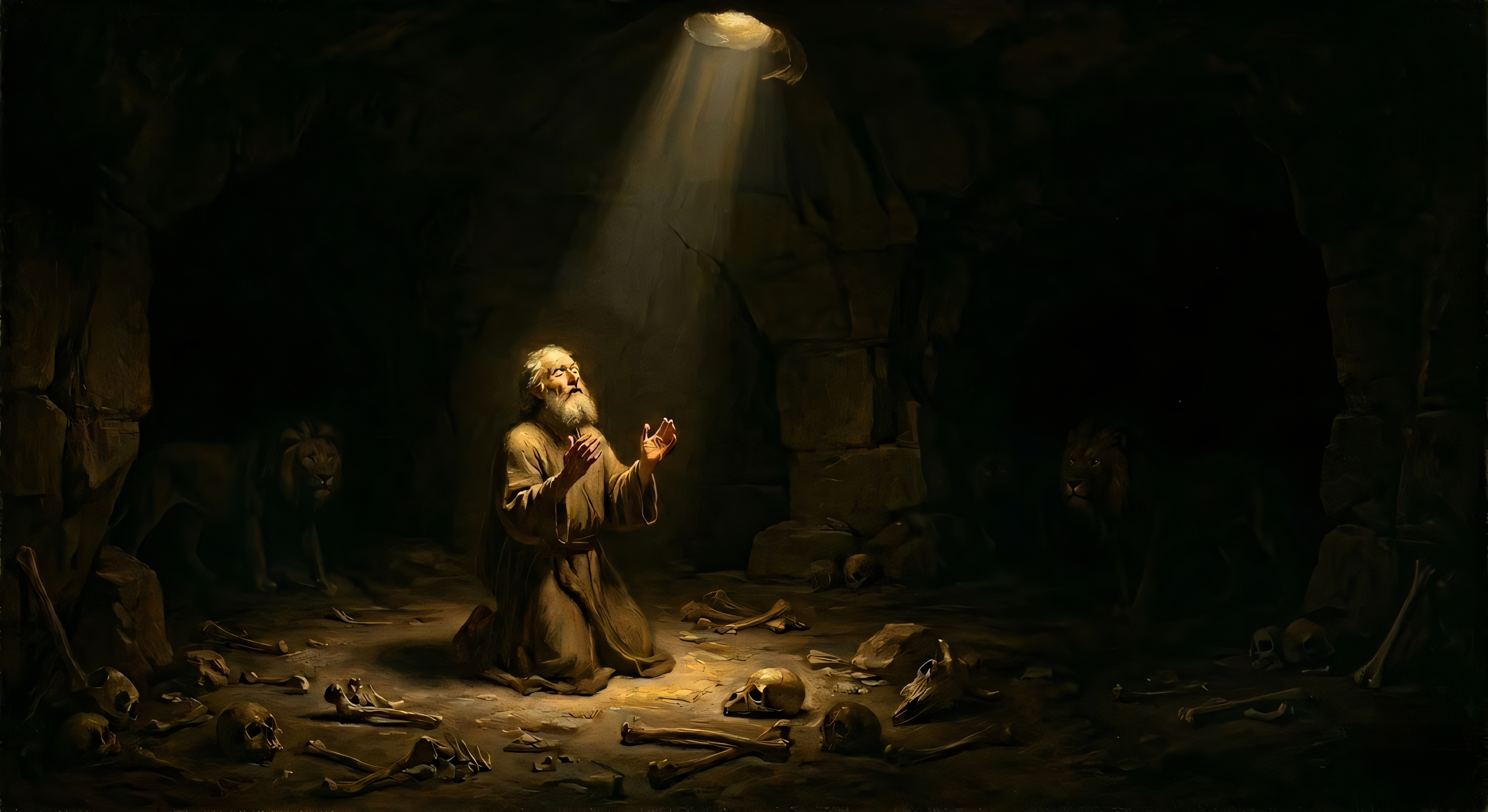
The imagery is ancient, and it is meant to frighten you. The "great sea" is not a body of water. In the Bible's symbolic grammar it is chaos itself, the roiling mass of the nations, the deep that never stops churning. And out of that sea, four monsters climb.
The traditional reading, held by Jewish and Christian interpreters alike for over two thousand years, sees four successive empires rising from the waves. The lion (or lioness) is Babylon. The bear, raised up on one side because Persia came to dominate the Medes, is Medo-Persia. The leopard is Greece, its four heads the four generals who carved up Alexander's empire after his death. And the fourth beast, the one the text refuses to compare to any animal at all, is Rome. We will come back to that fourth beast and its little horn. Daniel himself demands a fuller explanation later in the chapter, and we will stand beside him when he gets it.
But before we go anywhere, look closely. Because even here, in the opening description, our three voices are not singing in unison.
The Old Greek begins with a small editorial note the others lack: Daniel “wrote as a summary of the account.” A glimpse of the prophet at his desk, deciding what to record. Then at verse 6, where the MT and Theodotion say “dominion” or “power” was given to the leopard, the Old Greek says “language was given to it.” Sit with that for a moment. Not power. Language. That is not a rounding error in translation.
And then the Old Greek does something remarkable. At the end of verse 8 it adds an entire clause that appears nowhere in the Masoretic Text or Theodotion: “And it made war against the holy ones.”
The other two traditions introduce the little horn, let it speak its arrogant words, and hold its violence back until later in the chapter. The Old Greek refuses to wait. The moment the horn appears, the Old Greek tells you exactly what it is: a power at war with the people of God.
No suspense. No slow reveal. The verdict is stamped right on the introduction.
Now, this is one of those places where I want to exercise some care and give you the intellectual honesty you deserve.
When the Old Greek diverges like this, scholars generally offer one of two broad explanations for it. One says the translator worked loosely, adding interpretive touches and softening things he was uncomfortable with as he went.
The other, which I find more persuasive as a general rule, says the Old Greek often preserves a genuinely different underlying Semitic text than the one that became the Masoretic Text.
The Dead Sea Scrolls taught us that much of the Hebrew Old Testament was more fluid in antiquity than we once assumed. And the Old Greek of Daniel in particular frequently reads like a witness to a different edition rather than an interpretive paraphrase (or correction) of ours.
I lean that way here.
But I will say plainly that scholars genuinely disagree, and some, like Emanuel Tov, describe the Old Greek of Daniel as more interpretive in character.
Here is the good news though: you do not have to settle that debate to feel the effect. These traditions were preserved. They were intended. And each one shows you a slightly different angle on the same vision.
The Ancient of Days and the Heavenly Court (verses 9–10)
Then the scene changes, and it changes hard. The beasts are still raging below, still tearing at the nations, and without warning we are lifted out of the churning sea and set down in a throne room. This is one of the grandest scenes in all of Scripture.
Daniel 7:9-10 (NRSVUE):
As I watched, thrones were set in place, and an Ancient One took his throne; his clothing was white as snow, and the hair of his head like pure wool; his throne was fiery flames, and its wheels were burning fire. A stream of fire issued and flowed out from his presence. A thousand thousands served him, and ten thousand times ten thousand stood attending him. The court sat in judgment, and the books were opened.
Daniel 7:9-10 (OG/NETS):
I kept watching until thrones were set, and an ancient of days sat, having a cloak like snow, and the tuft of hair on his head was like pure wool. The throne was like a flame of fire shooting out, and a stream of fire went out from before him. A thousand thousands were waiting on him, and ten thousand times ten thousand stood attending him. And books were opened, and a court sat in judgment.
Daniel 7:9-10 (Theodotion/Brenton):
I beheld until the thrones were set, and the Ancient of days sat; and his raiment was white as snow, and the hair of his head, as pure wool: his throne was a flame of fire, and his wheels burning fire. A stream of fire rushed forth before him: thousand thousands ministered to him, and ten thousands of myriads, attended upon him: the judgment sat, and the books were opened.
Read that slowly. Then read it again. This is a courtroom, and it’s a cosmic one.
Now I want to draw out something we have been tracing through this whole series, the reality known as the Divine Council Worldview or DCW. Look at the very first line: "thrones were set in place." Thrones. Plural.
The Ancient of Days takes His throne, but the text will not let you imagine His seat is the only one in the room. Around Him stand "a thousand thousands" and "ten thousand times ten thousand," a host beyond counting, and a court that sits in judgment.
We have met this assembly before. Micaiah saw the LORD enthroned with all the host of heaven standing beside Him (1 Kings 22:19). Asaph saw God take His place in the divine assembly (Psalm 82). The sons of God presented themselves before the Lord in Job 1 and 2.
Daniel is being shown the throne room of God. And it is not empty. It’s populated.
Notice, too, that the NRSVUE renders the divine title as “an Ancient One” where the older tradition reads “the (or an) Ancient of Days.” That is a translation choice, and I understand the reasoning behind it, but something is lost. The Aramaic Attiq Yomin (”Ancient of Days”) carries a weight the flatter phrase cannot hold. This is the Eternal One. The One whose existence stretches back before there were days to be ancient of.
The three voices agree on the essentials, but each adds its own brushstroke. The Old Greek gives us a “cloak like snow” and a “tuft of hair,” language almost tender in its concreteness. And watch the order of the final two lines. The MT and Theodotion say the judgement sat and the books were opened; the Old Greek reverses it: “books were opened, and a court sat in judgment.” Small differences. But together they paint a deliberate, unhurried, heavenly tribunal.
No rushing. No mob justice. The books are opened, and every deed of every beast is on record. If you’ve read Revelation, you should recognize this scene. John saw it too: “books were opened... and the dead were judged... according to their works” (Revelation 20:12).
The empires think they are writing history. Daniel is shown who keeps the records.
The Beast Slain, the Others Spared (verses 11–12)
The judgment falls. And here the traditions preserve a small divergence with large implications.
Daniel 7:11-12 (NRSVUE):
I watched then because of the noise of the arrogant words that the horn was speaking. And as I watched, the beast was put to death and its body destroyed and given over to be burned with fire. As for the rest of the beasts, their dominion was taken away, but their lives were prolonged for a season and a time.
Daniel 7:11-12 (OG/NETS):
I was then watching the noise of the great words, which the horn kept speaking, and the beast was beaten to death, and its body perished and was given over to burning with fire. And he removed those around him from their authority, and time of life was granted to them for a season and a time.
Daniel 7:11-12 (Theodotion/Brenton):
I beheld then because of the voice of the great words which that horn spoke, until the wild beast was slain and destroyed, and his body given to be burnt with fire. And the dominion of the rest of the wild beasts was taken away; but a prolonging of life was given them for certain times.
Here is the difference. The MT and Theodotion describe verse 12 in the passive voice: the dominion of the remaining beasts “was taken away.” The action simply happens to them. No agent is named, and that silence is its own kind of statement; the unnamed hand points quietly back to the heavenly court.
The Old Greek will have none of that quiet. It is active and personal: “he removed those around him from their authority.” Someone acts. Someone reaches down and strips the defeated powers of their offices, one by one, like a king dismissing faithless governors. It reads less like a description and more like a royal decree.
This is the same pattern we have watched again and again in the Old Greek of Daniel: a preference for concrete, active verbs where the MT keeps things veiled in the passive.
Whether that reflects a different source text or the translator’s instinct, the effect is unmistakable. In the Old Greek, the judgment is not merely an event. It is a governing act. A change of administration in the heavenly realm.
But here’s the important part: both are true. The MT gives you the mystery, dominion dissolving before the throne with no hand visible. The Old Greek gives you the King, actively unseating every rival power. The dominion is stripped away, and there is One who strips it.
But I need you to notice something here, and it’s something we’ve been tracing for months now. There are two very different ways of reading verse 12, and both are consistent across traditions. We can read this as being a statement about the fate of the nations represented by the beasts (the fourth nation, Rome, is killed and destroyed by fire, but the others continue to exist), though this presents some interpretive challenges regarding Babylon. Or, we can read this from the viewpoint of the DCW and see it as taking away the dominion of the spiritual powers behind Persia and Greece (while preserving their existence) after destroying and burning the power behind Rome.
But here’s what makes this genuinely intriguing. The only tradition that explicitly connects this action to God (“And he removed…”) is the Old Greek, which also explicitly states that He’s removing “those around Him,” which strongly suggests that what’s really in view here is the dominion of the spiritual powers behind the nations rather than the nations themselves.
And this brings us, of course, to the figure who receives that stripped dominion.
One Like a Son of Man (verses 13–14)
This is the passage. If you remember nothing else from this chapter, remember these two verses. Read all three voices slowly, because the entire difference between them hangs on one small preposition. One word. And that one word changes everything and nothing at the same time.
Daniel 7:13-14 (NRSVUE):
As I watched in the night visions, I saw one like a human being coming with the clouds of heaven. And he came to the Ancient One and was presented before him. To him was given dominion and glory and kingship, that all peoples, nations, and languages should serve him. His dominion is an everlasting dominion that shall not pass away, and his kingship is one that shall never be destroyed.
Daniel 7:13-14 (OG/NETS):
I was watching in the night visions, and lo, as it were a son of man was coming upon the clouds of heaven. And he came as far as the ancient of days, and the attendants were present with him. And royal authority was given to him, and all the nations of the earth according to posterity, and all honor was serving him. And his authority is an everlasting authority, which shall never be removed—and his kingship, which will never perish.
Daniel 7:13-14 (Theodotion):
I beheld in the night vision, and, lo, one coming with the clouds of heaven as the Son of man, and he came on to the Ancient of days, and was brought near to him. And to him was given the dominion, and the honour, and the kingdom; and all nations, tribes, and languages, shall serve him: his dominion is an everlasting dominion, which shall not pass away, and his kingdom shall not be destroyed. (Brenton)
Before anything else, a note on the English. The NRSVUE renders the Aramaic kevar enash as “one like a human being.” That is defensible. It is also a flattening. Behind “human being” stands בַּר אֱנָשׁ (bar enash), Son of Man, the title the tradition and the New Testament heard here, the title the NKJV preserves as “One like the Son of Man” and Brenton as “as the Son of man.” Note that Theodotion is the only tradition using the definite article the for “The Son of Man.” And again, that behind “Ancient One” stands Attiq Yomin, the Ancient of Days.
That’s two different titles that point to one throne room. And you need to hold onto both.
Now the preposition.
The Masoretic Text and Theodotion both say the Son of Man comes with the clouds of heaven. The Aramaic is עִם (im), “with,” and Theodotion’s Greek matches it exactly: μετά (meta), “with.” The Old Greek stands apart. It says He comes upon the clouds, ἐπί (epi), “upon.”
With the clouds, or upon the clouds. It looks like a trivial shift, but it’s not.
Coming with the clouds is accompaniment. The clouds are His entourage, the theophany, the same glory-cloud that filled the tabernacle and led Israel through the wilderness. To come with the clouds is to arrive wrapped in the visible glory of God, attended by the hosts of heaven, the divine warrior descending to judge.
Coming upon the clouds is something else entirely. In the Hebrew Bible, riding upon the clouds is not something a man does. It is not something an angel does. It is a divine prerogative, reserved for God alone. The LORD “makes the clouds his chariot” and “rides on the wings of the wind” (Psalm 104:3). “The LORD is riding on a swift cloud and comes to Egypt” (Isaiah 19:1). He is the one “who rides through the heavens” to help His people (Deuteronomy 33:26), the one whose “way is in whirlwind and storm, and the clouds are the dust of his feet” (Nahum 1:3).
Everywhere else in the Old Testament, the cloud-rider is God. No exceptions. Not one.
So when the Old Greek says this Son of Man comes riding upon the clouds, it is not smoothing out a phrase. It is making the boldest possible claim about His identity that the language allows. It is seating Him where only God sits.
And here is where my both/and framework becomes almost unbearably beautiful. These two traditions are not fighting over this verse; they are harmonizing from different vocal ranges.
The MT and Theodotion show you a figure who arrives with the glory-cloud, attended by heaven’s host, presented before the Ancient of Days like a royal son brought into his father’s throne room.
The Old Greek shows you a figure who does what only God does, riding the clouds as their master. Set them side by side and you get a portrait neither could paint alone: a Son of Man who is brought before God and who wields the prerogative of God. Distinct from the Ancient of Days. Approaching Him, receiving from Him. And sharing His glory all the while.
Now, unlike some of the divergences we saw earlier in this chapter, I do not think the Old Greek’s “upon” is best explained by a different source text. The Aramaic “with” is secure. What I hear instead is a translator who understood the scene, felt where it was pointing, and drew out its deepest implication: this cloud-coming figure belongs on the divine side of the ledger. That is not a translator corrupting the text. That is a translator, and I would say the Spirit who preserved his work, showing us what was there all along.
And what is given to Him? Dominion, glory, and kingship. An everlasting dominion that shall never pass away. The worship of all peoples, nations, and languages. Look hard at that last phrase, because in this book it is the vocabulary of worship.
All through Daniel, “all peoples, nations, and languages” describes the whole world bowing before a king; think of Nebuchadnezzar’s decrees. Here the whole world serves the Son of Man forever. That is not a promotion. That is an enthronement, and the One enthroned is receiving the devotion that belongs only to God.
The Son of Man in Three Voices Beyond Daniel
Now I want to widen the lens, because the figure we just watched ride the clouds does not stay in Daniel 7. He echoes. I hear Him in three distinct places, and hearing all three together is one of the most thrilling exercises in all of biblical study. There is the Son of Man of Daniel 7. There is the Son of Man of the Parables of Enoch section of 1 Enoch. And there is the Son of Man on the lips of Jesus.
Daniel 7 we have just read. A heavenly figure, coming with the clouds, receiving an everlasting kingdom and the service of every people, nation, and language.
The second voice demands some care. So let’s give it some.
The Son of Man in the Parables of Enoch
The Parables of Enoch (also called the Similitudes) are chapters 37 through 71 of 1 Enoch. And I want to be careful and measured here, because this is exactly the sort of extrabiblical territory where confident claims get made that the evidence cannot support. So let me tell you what scholars can and cannot say.
Here is the puzzle. Every major section of 1 Enoch turned up among the Dead Sea Scrolls. Every section except this one. The Parables alone are missing from Qumran, and that silence led J.T. Milik to argue they were a late composition, possibly even a Christian one.
But the scholarly consensus, associated with names like Charlesworth, Nickelsburg, and VanderKam, has since moved decisively the other way: the Parables are a Jewish work, not a Christian one, most likely composed shortly before the birth of Christ (roughly 40-4 B.C. by most estimates). I will note honestly, however, that the dating is still debated, and the Qumran absence keeps a minority cautious.
I think that caution is healthy. But the consensus has shifted dramatically.
Why does the date matter so much? Because of what the Parables contain.
Listen to what Enoch sees:
“And there I saw One who had a head of days, and His head was white like wool, and with Him was another being whose countenance had the appearance of a man, and his face was full of graciousness, like one of the holy angels. And I asked the angel who went with me and showed me all the hidden things, concerning that Son of Man, who he was, and whence he was, and why he went with the Head of Days. And he answered and said unto me: ‘This is the Son of Man who hath righteousness. With whom dwelleth righteousness, and who reveals all the treasures of that which is hidden. Because the Lord of Spirits hath chosen him, and whose lot hath preeminence before the Lord of Spirits in uprightness for ever.’” (1 Enoch 46:1-3)
The Head of Days. His head white like wool. This is not a subtle allusion. I see only two possibilities.
Either 1 Enoch really does come from an older text and the minority view that it is authentically copied/translated from a text predating the Flood, and this is literally what Enoch himself saw.
Or the person who composed the Parables had Daniel 7 open in front of him, took the Ancient of Days, and gave Him a new name built from the same image. And standing beside the white-haired Enthroned One is a second figure, “one like a son of man,” just as in Daniel’s night vision.
The very next verse tells us this Son of Man “shall raise up the kings and the mighty from their seats and shall loosen the reins of the strong” (1 Enoch 46:4). If your ear catches a faint pre-echo of Mary’s song, “he has brought down the powerful from their thrones” (Luke 1:52), you are not alone. I won’t press that connection as proof of anything. I simply note that the music was already playing.
Then the Parables say something Daniel never says out loud. They tell us where this Son of Man came from:
“And at that hour that Son of Man was named in the presence of the Lord of Spirits, and His name before the Head of Days. Yea, before the sun and the signs were created, before the stars of the heaven were made, His name was named before the Lord of Spirits.” (1 Enoch 48:2-3)
Named before the sun. Named before the stars. And a few verses later: “For this reason hath He been chosen and hidden before Him, before the creation of the world and for evermore” (1 Enoch 48:6). This is a pre-existent, heavenly figure, hidden with God from before creation and revealed to the elect at the end. The same chapter says of Him: “He shall be a staff to the righteous whereon to stay themselves and not fall and he shall be the light of the Gentiles” (1 Enoch 48:4). And then, “All who dwell on earth shall fall down and worship before Him” (1 Enoch 48:5).
Worship. Directed at the Son of Man. In a thoroughly Jewish, fiercely monotheistic text.
And the throne language goes further than you might expect. In 1 Enoch 51:3, the Lord of Spirits declares:
“And the Elect One shall in those days sit on My throne and His mouth shall pour forth all the secrets of wisdom and counsel.”
Not a throne beside God’s throne. Not a lesser seat in the divine court. My throne. The Son of Man sits where only God sits.
The judgment scene of chapter 62 gathers all of it into one terrifying tableau. The kings and the mighty of the earth stand before the enthroned figure, and “pain shall seize them when they see that Son of Man sitting on the throne of his glory” (1 Enoch 62:5).
Then the secret is announced: “For from the beginning the Son of Man was hidden and the Most High preserved Him in the presence of His might, and revealed Him to the elect” (1 Enoch 62:7). The kings “shall fall down before Him on their faces and worship and set their hope upon that Son of Man, and petition him and supplicate for mercy at his hands” (1 Enoch 62:9). And for the righteous, the scene ends not in terror but at a table: “with that Son of Man shall they eat and lie down and rise up for ever and ever” (1 Enoch 62:14).
A shared meal with the Messiah as the reward of the redeemed. If that makes you think of a certain supper, and of a certain promise about eating and drinking at His table in His kingdom (Luke 22:29-30), I understand completely.
He carries other titles throughout the Parables, too. He is “the Righteous One” (1 Enoch 38:2). He is “the Elect One,” again and again. And twice he is called by the title that matters most: those who fall under judgment “have denied the Lord of Spirits and His Anointed One” (1 Enoch 48:10; see also 52:4). His Anointed. His Mashiach. His Christos.
The Messiah.
Now, honesty requires me to show you the wrinkle, because there is one. And it’s not small.
At the very end of the Parables, the Head of Days Himself comes out to greet Enoch, and the greeting is startling: “This is the Son of Man who is born unto righteousness, and righteousness abides over Him, and the righteousness of the Head of Days forsakes Him not” (1 Enoch 71:14).
In several translations that sentence reads as though it is addressed to Enoch, about Enoch. As though the seer is being identified with the very figure he has spent thirty chapters watching. Scholars handle this a few different ways: some see chapters 70-71 as a later appendix, some read it as an exaltation scene, some as a deliberate paradox the author never resolved.
I refuse to flatten this with a tidy answer. I don’t explain the difficulty away. And if you dig into the Parables you will run into it yourself.
But notice what this wrinkle does not do. It does not erase chapters 46 through 62. However you resolve the ending, the portrait stands: a Son of Man who is heavenly, pre-existent, enthroned on God’s own throne, worshiped by the nations, and named the Anointed One.
So here is where the second voice leaves us. If the consensus dating is right, then a Jewish text from a little before the time of Jesus had already concluded and/or corroborated that Daniel 7’s Son of Man was a heavenly, pre-existent, messianic being.
And notice one more thing before we move on, because it matters enormously for the third voice. “Elect One” is not a title the Parables invented. It comes from Isaiah: “my chosen, in whom my soul delights” (Isaiah 42:1). “Light of the Gentiles” is Isaiah too (Isaiah 42:6; 49:6). Which means either the Parables are ancient and had a profound influence on Scripture, or they had already begun braiding Daniel’s cloud figure together with Isaiah’s Servant.
But they only took the Servant’s glory. His election, his light, his vindication. Never his wounds.
The Enochic Son of Man judges. He does not bleed.
The Son of Man on the Lips of Jesus
And then there is Jesus. “Son of Man” was His favorite way of referring to Himself, appearing on His lips dozens of times in the Gospels. And He did something the Parables never dared.
Where they braided Daniel 7 with Isaiah’s Servant and stopped at the Servant’s glory, Jesus pulled the braid all the way through Isaiah 53. He was the Son of Man who “has nowhere to lay his head” (Matthew 8:20), and also the Son of Man who would come “on the clouds of heaven with power and great glory” (Matthew 24:30). Homeless and enthroned. Pierced and worshiped. The category existed. The crucified version of it did not, until He filled it.
There may even be a fingerprint of this whole expectation at the Transfiguration. In the earliest manuscripts of Luke 9:35, the voice from the cloud does not say “beloved” as in Matthew and Mark. It says ὁ ἐκλελεγμένος (ho eklelegmenos, “the Chosen One”):
“This is my Son, my Chosen; listen to him!” (NRSVUE)
Later manuscripts harmonized Luke to the other evangelists, which is why the KJV and NKJV read “beloved” here; that is a manuscript variant, not a translator’s whim. Now, I am not claiming the Father was quoting Enoch. The title is Isaiah’s before it is anyone else’s. But the Parables show us that “Chosen One” was live messianic currency in first-century Judaism, the standing title of the heavenly Son of Man. And out of a cloud, of all places, the Father applied it to His Son.
The moment all three voices converge is the trial. Standing before the high priest, under oath, asked directly whether He is the Messiah, Jesus answers by quoting Daniel 7 and Psalm 110 in a single breath:
“you will see the Son of Man seated at the right hand of the Power”
and
“coming on the clouds of heaven” (Mark 14:62)
Now, it’s worth noting here (and I don’t believe it’s at all trivial) that when Jesus quotes this verse, both in Matthew 24:30 & in Mark 14:62, He’s quoting the Old Greek phrasing. He uses the Greek word epi (ἐπὶ), which translates to on or upon, to describe His return.
The high priest does not need a theology lecture to understand what has just happened. He tears his robes and cries blasphemy.
Why?
Because he heard exactly what the Old Greek translator heard. He heard a man claiming to be the cloud-rider, claiming the seat and the prerogative of God. That is the whole case against Jesus in a single sentence, and it rests on Daniel 7:13.
Whether or not the men in that room had read the Parables of Enoch, the expectation of a heavenly Son of Man was in the air of first-century Judaism. Jesus did not invent the category. He stepped into it, claimed it, and carried it somewhere no one expected it to go: a cross.
And the apostle John, writing Revelation, completes the circle. He sees “one like the Son of Man,” and then describes Him with the very features Daniel and Enoch reserved for the Enthroned One: “His head and his hair were white as white wool, white as snow” (Revelation 1:13-14).
Follow the progression. In Daniel, the Son of Man approaches the Ancient of Days. In the Parables, the Son of Man stands beside the Head of Days and sits on His throne. In Revelation, the Son of Man wears the Ancient of Days’ own appearance.
The distinction between the figures remains, and yet the identity is shared. I believe that is as close as Scripture comes to drawing the doctrine of the Trinity out of Daniel 7. Not imposed on the text from outside, but embedded there by the divine Author from the beginning, and made visible, voice by voice, through progressive revelation.
The Interpretation: Four Kingdoms and the Holy Ones (verses 15–18)
Daniel, understandably, is undone. He asks one of the heavenly attendants what it all means.
Daniel 7:15-18 (NRSVUE):
As for me, Daniel, my spirit was troubled within me, and the visions of my head terrified me. I approached one of the attendants to ask him the truth concerning all this. So he said that he would disclose to me the interpretation of the matter: “As for these four great beasts, four kings shall arise out of the earth. But the holy ones of the Most High shall receive the kingdom and possess the kingdom forever—forever and ever.”
Daniel 7:15-18 (OG/NETS):
And as for me, Daniel, since I was exhausted by these things, by the night vision, I approached one of those standing and was seeking the truth from him about all these things. So answering, he spoke to me and disclosed to me the meaning of the words: “These great beasts are four kingdoms, which shall perish from the earth. And holy ones of the Most High will receive the kingdom and possess the kingdom forever—forever and ever.”
Daniel 7:15-18 (Theodotion/Brenton):
As for me Daniel, my spirit in my body trembled, and the visions of my head troubled me. And I drew near to one of them that stood by, and I sought to learn of him the truth of all these things: and he told me the truth, and made known to me the interpretation of the things. These four beasts are four kingdoms that shall rise up on the earth: which shall be taken away; and the saints of the Most High shall take the kingdom, and possess it for ever and ever.
The interpretation is compressed and stunning. Four beasts. Four kingdoms. And then the kingdom is handed not to a fifth empire but to “the holy ones of the Most High.” Watch what just happened there: the Son of Man’s kingdom and the holy ones’ kingdom are the same kingdom. What is given to Him in verse 14 is given to them in verse 18. The King and His people share the reign.
Who are these “holy ones,” the Aramaic קַדִּישִׁין (qaddishin)? This is a genuine and old debate. Across much of the Old Testament, “holy ones” means the angelic host, the members of the heavenly court we just watched assemble around the throne.
But it can also mean the faithful people of God. In Daniel 7, I believe the both/and serves us well once more: the earthly saints and their heavenly counterparts receive the kingdom together, the whole company of the redeemed and the holy angels sharing in the Son of Man’s everlasting reign.
That reading fits the divine council picture this chapter has been painting since verse 9. The kingdom the beasts fought over is given, in the end, to the assembly of heaven and the people of God.
Together.
A small grammatical curiosity worth a footnote: in verses 18, 22, 25, and 27, the Aramaic word behind “Most High” (עֶלְיוֹנִין, elyonin) is plural in form. Most scholars take it as an intensive or majestic plural, “the Most High” as the highest of all.
I wouldn’t build doctrine on it, but it is the kind of texture that rewards slow reading.
The Fourth Beast and the Little Horn (verses 19–25)
Daniel is still fixated on the fourth beast, the terrible one, and its arrogant little horn. He asks again. This time he gets a fuller answer.
Daniel 7:19-22 (NRSVUE)
Then I desired to know the truth concerning the fourth beast, which was different from all the rest, exceedingly terrifying, with its teeth of iron and claws of bronze, and which devoured and broke in pieces and stamped what was left with its feet; and concerning the ten horns that were on its head, and concerning the other horn that came up and before which three others had fallen—the horn that had eyes and a mouth that spoke arrogantly and that seemed greater than the others. As I looked, that horn made war with the holy ones and was prevailing over them, until the Ancient One came; then judgment was given for the holy ones of the Most High, and the time arrived when the holy ones gained possession of the kingdom.
Daniel 7:19-22 (OG/NETS):
Then I wanted to learn accurately concerning the fourth beast, which was different from all others and extremely terrible. And lo, its teeth were iron, and its claws were bronze, consuming all round about and trampling with the feet. And concerning its ten horns that were upon its head, and the one, which was growing, and three fell out because of it—and that horn had eyes and a mouth speaking great things, and its looks surpassed the others, And I was observing that horn preparing for war against the holy ones and routing them until the ancient of days came, and he gave the verdict for the holy ones of the Most High, and the time was given, and the holy ones gained possession of the seat of empire.
Daniel 7:19-22 (Theodotion/Brenton):
Then I enquired carefully concerning the fourth beast; for it differed from every other beast, exceeding dreadful: its teeth were of iron, and its claws of brass, devouring, and utterly breaking to pieces, and it trampled the remainder with its feet: and concerning it ten horns that were in its head, and the other that came up, and rooted up some of the former, which had eyes, and a mouth speaking great things, and his look was bolder than the rest. I beheld, and that horn made war with the saints, and prevailed against them; until the Ancient of days came, and he gave judgment to the saints of the Most High; and the time came on, and the saints possessed the kingdom.
And then the interpretation of the fourth kingdom itself:
Daniel 7:23-25 (NRSVUE):
This is what he said: “As for the fourth beast, there shall be a fourth kingdom on earth that shall be different from all the other kingdoms; it shall devour the whole earth and trample it down and break it to pieces. As for the ten horns, out of this kingdom ten kings shall arise, and another shall arise after them. This one shall be different from the former ones and shall put down three kings. He shall speak words against the Most High, shall wear out the holy ones of the Most High, and shall attempt to change the ritual calendar and the law, and they shall be given into his power for a time, two times, and half a time.
Daniel 7:23-25 (OG/NETS):
And it was said to me concerning the fourth beast: “There shall be a fourth kingdom upon the earth, which shall excel over the whole earth and disturb it and grind it down. And as for the ten horns of the kingdom, ten kings shall rise, and another king shall rise after these. And he shall excel more than the former ones in evil, and he shall humble three kings. And he shall speak words against the Most High and shall wear down the holy ones of the Most High and shall expect to change seasons and law, and everything shall be delivered into his hands for a time and times and until half a time.
Daniel 7:23-25 (Theodotion/Brenton):
And he said, The fourth beast shall be the fourth kingdom on the earth, which shall excel all other kingdoms, and shall devour the whole earth, and trample and destroy it. And his ten horns are ten kings that shall arise: and after them shall arise another, who shall exceed all the former ones in wickedness, and he shall subdue three kings. And he shall speak words against the Most High, and shall wear out the saints of the Most High, and shall think to change times and law: and power shall be given into his hand for a time and times and half a time.
We have to talk about this fourth kingdom and this little horn, because they sit at the center of one of the most contested questions in the entire book.
I am going to keep this comparatively brief, and here is why. The little horn of Daniel 7 is the same figure I have already treated at length in my deep dive post on the Seventy Weeks of Daniel 9, where I laid out the three great interpretive frameworks (the Antiochene, the messianic, and the futurist) and landed on a dual, even multiple, fulfillment with Rome as the fourth kingdom.
I am not going to rebuild that whole argument here. If this section leaves you hungry for the full case, that post is where it lives.
But here is the anchor, and I want it driven deep. I hold, with the mainstream of Christian interpretation going back to the earliest commentators, that the fourth kingdom is Rome. Everything hinges on that identification; it is the pivot on which both the messianic and futurist readings turn.
The main scholarly alternative, popular among critical scholars, splits the Medo-Persian empire into two, Media and then Persia, so that the four kingdoms become Babylon, Media, Persia, and Greece.
Do that, and the little horn shrinks to Antiochus IV Epiphanes and the whole prophecy gets locked inside the second century B.C. I do not find it persuasive. Daniel consistently treats the Medes and Persians as a single entity (the famous “law of the Medes and Persians”), and Jesus Himself, as we saw, spoke of Daniel’s climactic desolation as still future in His own day. Rome as the fourth kingdom keeps the prophecy open. Open toward Christ, and open beyond Him.
However, if you’re interested in reading a fantastic historical analysis that gives, times, dates, and all the reasons to take seriously an at least partial fulfillment of Daniel 7 in the Selucid empire, I recommend the book Daniel: Prophet to the Nations by John Oakes
The little horn, then. He speaks against the Most High. He wears out (or down) the holy ones. He “shall attempt to change the ritual calendar and the law,” which is nothing less than an assault on the very rhythms of God’s covenant. And he is given power “for a time, two times, and half a time,” the famous three-and-a-half, the Aramaic עִדָּן (iddan) counted out one, two, half.
Three and a half is the broken seven. The number of covenant and completion, snapped in the middle. And that same three-and-a-half surfaces again in Revelation as forty-two months and 1,260 days (Revelation 11–13), where the beast makes war on the saints in language lifted straight from Daniel 7:21.
Consistent with the dual-fulfillment reading, I take Antiochus as a real, historical foreshadowing of this horn, a type. With a still-future world leader (I hesitate to use the culturally common “antichrist” title these days, as the deeper I dig into Scripture the less convincing I find that title) as its ultimate expression, with Rome as the imperial frame that binds them together.
A Note on the Manuscripts: The Vanishing Little Horn
Here is a textual detail made for this series, and I want to hand it to you carefully, because it is exactly the kind of manuscript-specific claim that is easy to state with more confidence than the evidence will bear.
In the Masoretic Text, the little horn appears twice in Daniel: once here in chapter 7, and again in chapter 8. The Old Greek manuscripts do not agree with that count, or with each other. In the Old Greek manuscript known as 88 (the Codex Chisianus, or Chigi codex), the little horn appears only once. And in the earliest and most important Old Greek witness of all, Papyrus 967, the little horn is absent from Daniel 7 altogether.
Twice in the Hebrew. Once in manuscript 88. Not at all in Papyrus 967’s chapter 7. That pattern is documented in a 2023 study by the scholar Ian Young titled “The Joy of Secondary Texts: The ‘Little Horn’ in Masoretic Text and Old Greek Daniel 7–8.”
And I want to give you two cautions on how we hold it.
First, the scholarship treats the absence in Papyrus 967 as a secondary reading, not as proof that the little horn was a late addition. So this is a fascinating window into how fluid the text once was, not a smoking gun about what Daniel “originally” wrote.
Second, it connects to things we noticed in earlier posts: Papyrus 967 also arranges the chapters in a different order (chapters 7 and 8 before 5 and 6) and changes the dimensions of Nebuchadnezzar’s statue in chapter 3.
The same manuscript that reshuffles the book is the one missing the little horn here. Which shows that the witnesses to Daniel were doing more editorial work than most modern readers ever imagine.
The Everlasting Kingdom (verses 26–27)
The vision does not end with the horn. It ends with the court.
Daniel 7:26-27 (NRSVUE):
Then the court shall sit in judgment, and his dominion shall be taken away, to be consumed and totally destroyed. The kingship and dominion and the greatness of the kingdoms under the whole heaven shall be given to the people of the holy ones of the Most High; their kingdom shall be an everlasting kingdom, and all dominions shall serve and obey them.
Daniel 7:26-27 (OG/NETS):
And the trial shall sit, and they shall destroy authority, and they shall resolve to defile and destroy completely. And he shall give the authority and the kingdom and the magnitude of all the kingdoms, which are under heaven, to the holy people of the Most High, to reign over an everlasting kingdom, and all authorities will be subjected to him and obey him until the conclusion of the word.
Daniel 7:26-27 (Theodotion/Brenton):
And the judgment has sat, and they shall remove his dominion to abolish it, and to destroy it utterly. And the kingdom and the power and the greatness of the kings that are under the whole heaven were given to the saints of the Most High; and his kingdom is an everlasting kingdom, and all powers shall serve and obey him.
The court sits a second time. The same tribunal that opened the books in verse 10 now hands down its verdict, and the horn’s dominion is stripped away and destroyed. And everything the beasts spent the whole vision clawing at, all the kingship and dominion and greatness under the whole heaven, is given to the people of the holy ones.
Notice the lovely ambiguity the two Greek traditions preserve in verse 27, an ambiguity the MT resolves. The MT says the dominion is given to the people, and “all dominions shall serve and obey them,” the people. The Old Greek and Theodotion shift to the singular: “all authorities will be subjected to him and obey him.”
So which is it? Is the object the people, or the Son of Man who reigns over them? Hold both traditions together and the question dissolves, because the King and His people share one kingdom. To serve Him is to be joined to them. To belong to them is to serve Him. The everlasting kingdom is His, and by grace it is theirs, and there is no seam between the two.
That is the answer to the whole vision. Empires climb out of the churning sea, each more terrible than the last. They rage, they blaspheme, they make war on the holy ones. And then the court sits, and it is over. “His kingdom is an everlasting kingdom, and all powers shall serve and obey him.”
Daniel’s Reaction (verse 28)
Daniel does not respond with a theology of triumph. He responds like a man who has seen too much.
Daniel 7:28 (NRSVUE):
Here the account ends. As for me, Daniel, my thoughts greatly terrified me, and my face turned pale, but I kept the matter in my mind.
Daniel 7:28 (OG/NETS):
As for me, Daniel, I was seized with great dismay, and my condition spread within me, and I fixed the matter in my heart.
Daniel 7:28 (Theodotion/Brenton):
Hitherto is the end of the matter. As for me Daniel, my thoughts greatly troubled me, and my countenance was changed: but I kept the matter in my heart.
His face turns pale. He is dismayed. And yet he "kept the matter in his heart." That phrase should sound familiar. It is the same posture Mary takes when she treasures up the mysteries of her Son (Luke 2:19). Daniel does not understand everything he has seen. Neither will we. But he holds it. He ponders it. He keeps it. Sometimes faithfulness looks like sitting with a vision you cannot fully explain.
If you’ve found this work insightful or enlightening, share it with a friend who needs to see the power of reading this incredible story in multiple traditions.
What the Fathers Saw
I always want to know what the earliest readers heard in a passage, and Daniel 7 has a rich early history.
The oldest surviving Christian commentary on any book of the Bible is Hippolytus of Rome’s commentary on Daniel, written around A.D. 204. Hippolytus read the fourth beast as Rome and the little horn as a coming Antichrist, and he expected Christ to return from heaven in the future.
Irenaeus, writing even earlier in the second century, likewise identified the fourth kingdom as Rome, breaking apart into ten kingdoms.
And Jerome, in his great commentary on Daniel around A.D. 407, defended the Roman identification against the pagan critic Porphyry, who insisted the whole prophecy had already been spent on Antiochus. In other words, Rome as the fourth kingdom and the little horn as Antichrist are not modern inventions. They are not dispensational novelties. They are as old as Christian commentary on Daniel gets.
I do not say that to end the debate by appeal to authority. I say it because you should know that when you read this chapter the way we have read it here, you are standing in very old company.
My Take
You know by now that I am not going to hand you a tidy, dogmatic system. I do not think the text gives us one. But let me tell you where I land.
On the clouds, I hold both readings, and I hold them gladly. I believe the Masoretic and Theodotion “with the clouds” and the Old Greek “upon the clouds” are both true and both inspired, and that together they say more than either could say alone.
The Son of Man comes wrapped in the glory-cloud, presented before the Ancient of Days as a distinct person. And He comes riding the clouds as their sovereign master, wielding a prerogative that belongs to God alone. That is not a contradiction to be solved. That is a mystery to be worshiped. And it is, I think, the closest the Old Testament ever comes to showing us the Son and the Father in a single frame.
On the four kingdoms, I believe the fourth is Rome, and I believe the little horn carries the same layered fulfillment I argued for in the Seventy Weeks post: a real historical foreshadowing in Antiochus, and an ultimate expression still ahead of us, held together by the imperial thread that runs from Daniel’s day into ours.
And on the Son of Man, it genuinely moves me that the writer of a Jewish text from shortly before the time of Jesus (if not older), the Parables of Enoch, had read Daniel 7 and concluded that its Son of Man was heavenly, pre-existent, and messianic.
If the consensus is right (or if the book is a lot older than we think), then the expectation Jesus stepped into was not something He conjured. It was already there. In the air. Waiting. And He walked into the high priest’s courtroom and claimed it under oath.
As always, I would rather you study this for yourself than take my word for anything. Read the three versions side by side. Sit with the preposition. Ask the Holy Spirit to show you the One these texts are pointing to.
I’m certain He will.
Why This Matters for Your Walk With God
Here is the thing about Daniel 7. It was given to a man in exile, living under the boot of an empire, watching beasts rise and rage and blaspheme. And it is being read by you, in a world that still feels, most days, like a churning sea throwing up one terrible power after another.
The vision does not pretend the beasts are unreal. They are real. They have iron teeth. They make war on the holy ones, and sometimes, for a time and times and half a time, they appear to be winning.
But the vision shows you what the beasts cannot see. It shows you the throne room behind the headlines. It shows you the court in session, the books lying open, the record kept by One whose hair is white as wool and whose throne is a river of fire.
And it shows you that when the gavel falls, the everlasting kingdom is not handed to the strongest beast. It is handed to a Son of Man who comes on the clouds, and to the holy ones who belong to Him.
Whatever beast is roaring in your life or your headlines this week, that is the ending. The dominion is His. The kingdom is His. And because you belong to Him, it is, astonishingly, yours.
Do not fear. The court has already sat.
Do not fear. God is in control.
The LXX Scrolls is free to read and always will be. If this work has been worth something to you, there are a few ways to say so:
Buy the ebooks. Completed teaching series are available as polished ebooks under the Two Witnesses, One Truth series. Buying through Curios will support this work most directly but they’re also available on Amazon (and elsewhere) if you’re loyal to a particular ereader.
Become a supporter. A monthly or annual pledge through Substack helps me to bring the Septuagint to those who never knew they needed it.
Send a one-time tip. If this post has blessed you and you want to express that directly, you can Buy Me a Coffee.

Thank you for being part of this journey, your support makes this work possible.
© 2026 LXX Scrolls. All rights reserved.
Very enlightening! Thank you!