


Hello brothers and sisters.
This is one of the most common questions Christians ask. Walk into any church small group, post it on any Christian forum, or ask any pastor after service, and you’ll get the same question in a dozen variations:
“Which Bible translation is the most reliable?”
“What’s the best Bible for serious study?”
“Should I read the ESV or the NIV?”
“Is the KJV still the best?”
I saw a version of this question just the other day here on Substack, and it stopped me in my tracks. Not because it’s a bad question. It’s a perfectly natural one. But because lurking beneath it is an assumption that most Christians never think to examine.
The assumption is this: somewhere behind all these English translations, there is one single, authoritative original text, and the “best” translation is the one that gets closest to it.
It sounds reasonable. It feels obvious. And it’s not entirely wrong.
But it’s not entirely right, either.
If you’re reading this in email, be aware that the text is likely to cut off without warning. For a smoother reading experience and all the features Substack has to offer (including audio voiceovers of my posts), you can go HERE or download the app.
The Question Behind the Question
Here’s what most believers don’t realize. When you pick up an English Bible, your Old Testament is almost certainly translated from a Hebrew text called the Masoretic Text. This is a carefully preserved manuscript tradition that was standardized by Jewish scholars (the Masoretes) between the 6th and 10th centuries A.D. It’s an extraordinary work of preservation, and it deserves the reverence it receives.
But it’s not the only ancient text of the Old Testament that exists.
More than two centuries before Christ, Jewish scholars in Alexandria translated the Hebrew Scriptures into Greek. That translation is called the Septuagint, and it was the Bible of the early church. It’s the text the apostles quoted. It’s the Scripture Paul preached from. When the New Testament writers cite the Old Testament (which they do over 300 times), they are almost (but not quite) always quoting the Septuagint rather than the Hebrew text that your English Bible is based on.
And here’s the thing that changed everything we thought we knew about “the original text.”
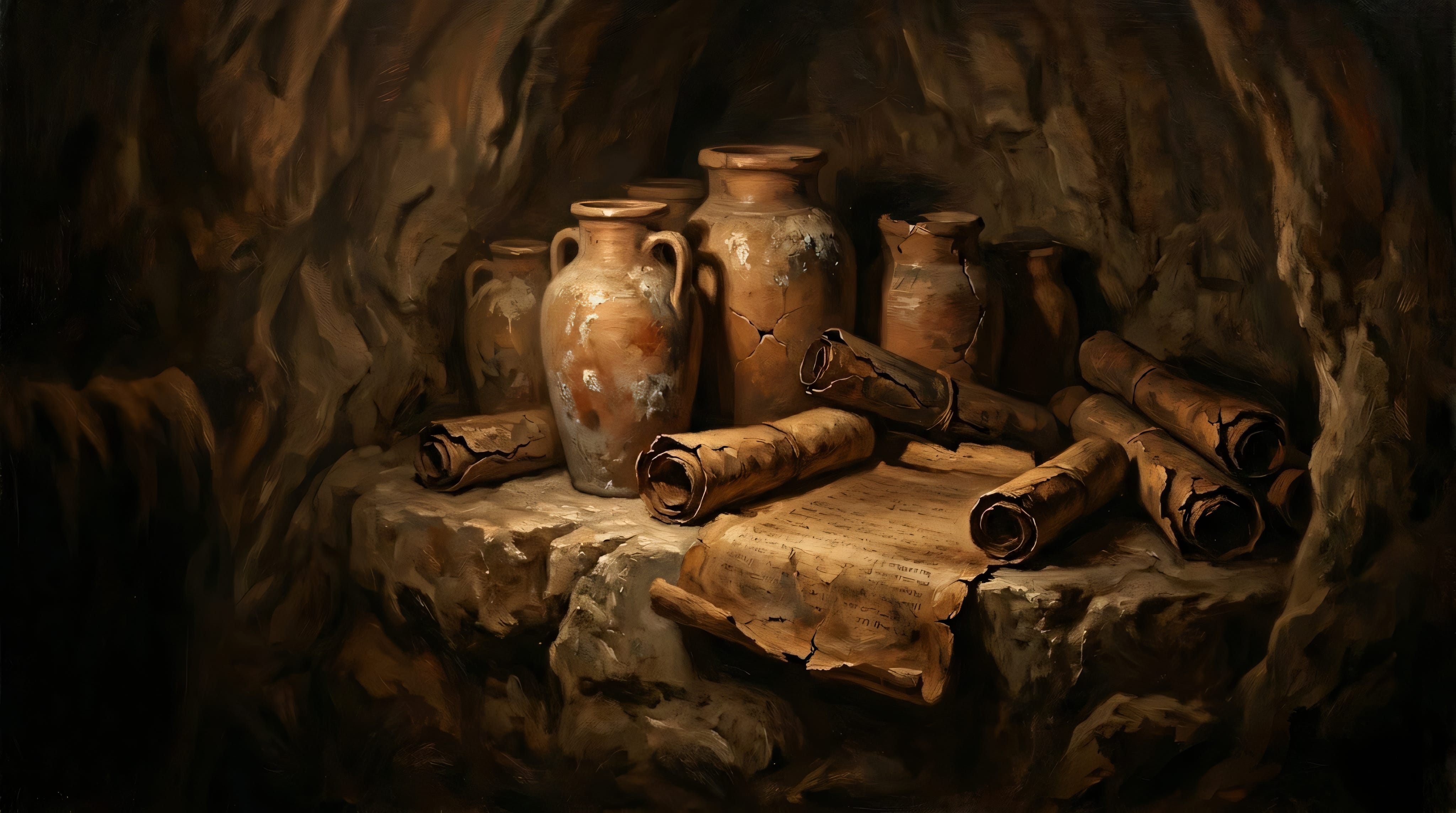
In 1947, a Bedouin shepherd stumbled into a cave near the Dead Sea and found a collection of ancient scrolls that would reshape biblical scholarship forever. The Dead Sea Scrolls contained Hebrew manuscripts a thousand years older than the oldest Masoretic Text we had. And when scholars began comparing them, they discovered something remarkable: some of these ancient Hebrew manuscripts agreed with the Masoretic Text. Some agreed with the Septuagint. And some agreed with neither.
There is no single, monolithic “original” Hebrew text sitting behind all our translations. There never was. There were multiple textual traditions, preserved by different communities, each faithfully transmitting what they had received.
The book of Jeremiah makes this point more dramatically than any other book of the Bible. The Septuagint version of Jeremiah is roughly one-seventh shorter than the Masoretic Text. It’s not just missing a few words here and there. It has approximately 2,700 fewer words, and the material is arranged in a different order. The Oracles Against the Foreign Nations, for example, appear in the middle of the book in the Septuagint but at the end in the Masoretic Text. This isn’t a minor shift, this is a dramatic difference that makes reading the two versions side-by-side quite complicated!
For centuries, scholars debated why. Did the Greek translators cut the text? Did later Hebrew scribes expand it? Was one version a corruption of the other?
Then the Dead Sea Scrolls provided the answer. In Cave 4 at Qumran, archaeologists found multiple Hebrew scroll fragments of Jeremiah. Two of them (4QJer-a and 4QJer-c) follow the longer Masoretic tradition. But a third (4QJer-b) follows the shorter text and different arrangement of the Septuagint.
Both versions. In Hebrew. In the same cave.
The Qumran community possessed both the longer and shorter versions of Jeremiah, and the scrolls show no signs of marginal corrections, no notes flagging one as more authoritative than the other, no evidence that anyone at Qumran considered one version to be “the real one” and the other defective. Both were preserved, copied, and treated as Scripture.
The lesson here is that this is not a problem to be solved. This is evidence that God preserved His Word through multiple faithful traditions, and that the early Jewish community was comfortable holding both versions as authoritative.
It’s not a crisis. It’s not a reason to question the Bible or your faith. It isn’t even a problem. What it is, friends, is a gift.
Because when you read the Masoretic Text and the Septuagint side by side, they don’t contradict each other (except in a couple of very rare instances). What they do is complement each other. They’re two angles of vision on the same divine revelation, like two witnesses testifying to the same truth from different vantage points.
I believe both the Masoretic Text and the Septuagint are authoritative. I believe God intentionally preserved both traditions to tell a fuller story than either is capable of telling alone. I believe that neither is more authoritative than the other.
Point blank: in almost every case, both readings are correct. What might at first look like a contradiction dissolves when you read them side by side and consider the fuller picture of putting all the details together.
This is the heart of the “both/and” perspective that drives everything I write at The LXX Scrolls. And it’s the lens through which I want to examine this question about Bible translations.
Because the real question isn’t “which translation is most reliable?” The real question is: which translations, used together, give me the fullest picture of what God has revealed?
That one small shift changes everything about how you evaluate your options.
A Brief Word on Translation Philosophy
Before we walk through specific translations, you need to understand the spectrum that all Bible translations fall on. This isn’t complicated, but it matters.
On one end, you have formal equivalence, sometimes called “word-for-word” translation. These translations prioritize matching the structure and vocabulary of the original Hebrew and Greek as closely as possible. The English follows the original language’s word order, grammar, and idiom wherever it can. The result is highly literal and excellent for detailed study, but it can sometimes read stiffly because Hebrew and Greek don’t structure sentences the way English does.
On the other end, you have dynamic equivalence, sometimes called “thought-for-thought” translation. These translations prioritize conveying the meaning of the original text in natural, readable modern English. The translator asks, “If the biblical author were writing in English today, how would he say this?” The result is clear and accessible, but it requires the translator to make more interpretive decisions about what the text means before rendering it.
Beyond both of these, you have paraphrase. A paraphrase isn’t really a translation at all. It’s one person’s interpretation of what the text means, rewritten in their own words. Paraphrases can be devotionally powerful, but they blur the line between what the text says and what the paraphraser thinks it means.
No translation is purely one thing. Every translation sits somewhere on this spectrum. Even the most literal translation has to make interpretive choices, and even the most dynamic translation is constrained by what the original actually says.
Here’s the key principle I want you to hold onto as we go through these translations: a single Hebrew or Greek word can often be validly translated by multiple different English words. This is true of any language. The Hebrew word חֶסֶד (chesed), for example, can be translated as “lovingkindness,” “steadfast love,” “mercy,” “covenant loyalty,” or “faithfulness,” and every one of those is a legitimate rendering depending on context. The Greek word λόγος (logos) can mean “word,” “reason,” “speech,” “message,” or “account.”
Let me show you how this plays out in practice. Take Isaiah 7:14, one of the most famous messianic prophecies in the Old Testament. The Hebrew word עַלְמָה (almah) is translated “virgin” in the KJV and NKJV, but “young woman” in the NRSV.
Which is right?
They both are.
The Hebrew word refers to a young woman of marriageable age, and in the cultural context, the assumption of virginity was embedded in that. The Septuagint translators, working more than a century before Christ, chose the Greek word παρθένος (parthenos), which specifically and unambiguously means “virgin.” Matthew, writing under the inspiration of the Holy Spirit, quotes the Septuagint’s word when he applies this prophecy to Mary (Matthew 1:23).
Is “young woman” wrong? No. Is “virgin” wrong? No. Each captures a real dimension of what the text communicates. And reading both together, alongside the Septuagint’s explicit παρθένος, gives you the fullest picture. That’s the both/and approach in microcosm.
Different translations bring out different facets of these rich, multivalent words. That’s not a weakness. It’s a feature. A “both/and” approach to translations mirrors my both/and approach to textual traditions. Think of it like watching a filmed event. You’ll get a certain amount of truth from a single angle, but you’ll see so much more of the truth when you can see it from multiple angles.
With that in mind, let’s dig in.
The Translations
King James Version (KJV) — 1611
The King James Bible is the most influential English book ever published. Commissioned by King James I and translated by 47 scholars working from the Textus Receptus (for the New Testament) and the Masoretic Text (for the Old Testament), the KJV has shaped English literature, worship, and culture for over 400 years.
Its language is majestic. There’s a reason people still memorize the 23rd Psalm in the KJV. Phrases like “the valley of the shadow of death” and “though I speak with the tongues of men and of angels” have become part of the English language itself. For sheer beauty and literary power, nothing else even comes close.
But the KJV has a strength that often goes unrecognized, and it’s one I think is genuinely important. The KJV preserves a linguistic distinction that modern English has lost: the difference between singular and plural “you.” In the KJV, “thee” and “thou” are singular (addressing one person), while “ye” and “you” are plural (addressing a group). This matters because both Hebrew and Greek make this distinction, and knowing whether a passage is addressed to an individual or a community can change how you understand it. Modern translations flatten this distinction because modern English doesn’t have it anymore.
The KJV’s preservation of this nuance has tremendous value.
That said, the KJV has real limitations. It was based on the best manuscript evidence available in the early 17th century, but we now have access to far more manuscripts, including some that are significantly older. The archaic language also creates genuine comprehension barriers. Words have changed meaning over 400 years: “prevent” used to mean “precede,” “conversation” meant “conduct” or “behavior,” “expedient” meant fitting, profitable, or advantageous, and “let” meant “hinder.” A modern reader encountering these words will simply misunderstand what the text is saying.
The KJV remains a treasure. But for study purposes, I would pair it with a modern translation that can illuminate what the 17th-century English is actually saying.
New King James Version (NKJV) — 1982
The NKJV is what happens when you take the KJV’s translation philosophy and put it in modern English. Produced by 130 scholars, it updates the language while preserving the formal equivalence approach. It’s still based on the Textus Receptus for the New Testament and the Masoretic Text for the Old Testament, but it includes footnotes showing readings from the Nestle-Aland/UBS critical texts and the Majority Text. This gives you a window into how different manuscript traditions read at key points.
The NKJV retains the dignity and rhythm of the KJV without requiring you to parse Elizabethan English. It capitalizes divine pronouns (He, Him, His when referring to God), which many readers appreciate as a mark of reverence. And its footnote apparatus is quietly one of the best features of any English Bible: those little markers showing variant readings from different manuscript traditions are gold for anyone who wants to study the text seriously.
It does lose the singular/plural “you” distinction that the KJV preserves. That’s a real loss. But the trade-off in readability is worth it for most readers.
The NKJV is my anchor translation for The LXX Scrolls. It’s where I start before comparing with anything else.
New Revised Standard Version Updated Edition (NRSVue) — 2021
The NRSVue is the latest in a lineage that stretches back through the NRSV (1989), the RSV (1952), and ultimately to the English Revised Version of 1885. It was produced by an ecumenical committee of scholars and is based on the Biblia Hebraica Stuttgartensia for the Old Testament and the Nestle-Aland 28th edition / UBS 5th edition for the New Testament. These are the most current critical texts available.
In academic and ecumenical circles, the NRSV tradition is the gold standard. Seminaries use it. Scholarly publications quote it. The NRSVue incorporates the latest Dead Sea Scrolls scholarship and textual discoveries, making it one of the most up-to-date translations on the market.
It strikes an excellent balance between accuracy and readability, leaning toward the formal end of the spectrum without becoming wooden. Where it differs from the NKJV, you often discover something important about the underlying text or the latest scholarship.
Its most debated feature is its use of gender-inclusive language where the original is ambiguous. For example, the Greek word ἀδελφοί (adelphoi), which literally means “brothers,” is sometimes rendered “brothers and sisters” when the context suggests the author was addressing a mixed audience. Some readers appreciate this as a more accurate rendering of the original intent. Others see it as an interpretive step that goes beyond what the text says. You’ll need to decide for yourself where you land on that question.
The NRSVue is my scholarly companion. When the NKJV raises a question, the NRSVue often answers it, or at least shows me where the scholarly conversation is happening.
New American Standard Bible (NASB) — 1971 / 1995 / 2020
The NASB has long been regarded as one of the most literal major English translations. Produced by the Lockman Foundation, it uses the Biblia Hebraica for the Old Testament and the Nestle-Aland Greek text for the New Testament.
Its greatest strength is its commitment to formal equivalence. The 1995 edition, in particular, is widely considered the “most literal readable” English translation. It also has a helpful transparency feature: words added for English clarity that aren’t in the original languages are printed in italics, so you always know what the translators supplied.
A brief note on the editions: the 2020 update introduced gender-inclusive language (such as adelphoi as “brothers and sisters”), modernized some vocabulary, and made other changes that have divided the NASB’s user base. Some long-time readers feel the 2020 moved away from the strict formal equivalence that defined the translation. Others appreciate the improved readability. Both the 1995 and 2020 remain excellent translations. Which you prefer depends on whether you prioritize strict literalness or contemporary accessibility. To their credit, the Lockman Foundation continues publishing the 1995 alongside the 2020, so you can choose.
I have nothing against the NASB. It’s a fine translation. My preference for the NRSVue in the “rigorous study” slot comes down to the NRSVue being based on more current critical texts and incorporating the latest manuscript scholarship, but the NASB would serve you well in that role too.
English Standard Version (ESV) — 2001
The ESV is a revision of the RSV produced by a team of over 100 evangelical scholars and published by Crossway. It describes itself as “essentially literal” and has become the default translation for many Reformed and evangelical churches.
It produces clean, readable prose while maintaining strong literalness. The study Bible editions are excellent. And it retains traditional gender language, which appeals to readers who prefer that approach.
Where I occasionally find the ESV less satisfying is in certain renderings that feel like they’re shaped by a particular theological tradition rather than emerging naturally from the text. Some of its choices in passages related to gender roles, for example, have been criticized by scholars as reflecting complementarian theology rather than neutral translation. I want to be gentle about this because the ESV is a serious, scholarly translation and these are debatable points. But I do think readers should be aware that every translation carries its translators’ theological fingerprints to some degree, and the ESV is no exception.
If your church uses the ESV, you’re in good hands. It’s a reliable, well-executed translation. I simply find that the NRSVue and NKJV together cover the same ground with fewer theological presuppositions baked into the English.
New International Version (NIV) — 1978 / 2011
The NIV is the world’s most popular modern English Bible translation. Produced by an international team of over 100 scholars under the Committee on Bible Translation, it uses the Biblia Hebraica Stuttgartensia for the Old Testament and the Nestle-Aland / UBS texts for the New Testament.
Its strength is readability. The NIV reads like natural, modern English while maintaining genuine scholarly rigor behind the scenes. For devotional reading, public worship, and accessibility, it’s hard to beat. The sheer size of its ecosystem (study Bibles, devotionals, apps, commentaries) means you’ll never lack for supporting resources.
Its weakness is the flip side of its strength. As a dynamic equivalence translation, the NIV sometimes interprets rather than translates. It smooths over textual difficulties rather than preserving them for the reader. This makes for a better reading experience, but it means you’re sometimes getting the translation committee’s interpretation of an ambiguous passage rather than the ambiguity itself.
Here’s a concrete example of why this matters for the both/and approach. When a Hebrew or Greek word has multiple valid meanings, a formal equivalence translation will often preserve that ambiguity, letting you see the range of possibilities. A dynamic equivalence translation like the NIV picks the meaning the translators think best fits the context and renders only that meaning. You get clarity, but you lose the texture. And sometimes, that texture is exactly where the richness lies.
The 2011 update, like the NRSVue and NASB 2020, introduced gender-inclusive language that was controversial among its user base. The underlying translation, however, remains solid.
For detailed word studies, you’ll want to pair the NIV with something more literal. But for the sheer experience of reading Scripture in clear, natural English, the NIV is excellent.
New Living Translation (NLT) — 1996 / 2015
The NLT began as a revision of Kenneth Taylor’s Living Bible paraphrase, but the team of 90+ scholars who worked on it essentially produced a new translation. Despite its origins, the NLT is a genuine committee translation with serious scholarly oversight, not a paraphrase.
It sits further toward the dynamic end of the spectrum than the NIV, and it excels at one thing above all others: clarity. When the NKJV and NRSVue are both saying something you can’t quite parse, the NLT will make it plain. It also captures the emotional and narrative flow of Scripture beautifully, making it ideal for reading large sections at a time. If you’ve never read an entire epistle in one sitting, try it in the NLT. You’ll see the argument’s flow in a way that verse-by-verse study in a formal translation can sometimes obscure.
Its trade-off is the same as any dynamic translation, but more so. It paraphrases away ambiguities that are present in the original, and its casual tone can feel too informal for prophetic and poetic literature. You wouldn’t want to do a detailed word study in the NLT. But that’s not what it’s for.
The NLT is my “accessibility bridge.” When the formal translations are opaque, the NLT illuminates. And when I’m recommending a first Bible for someone who’s never read Scripture before, the NLT is almost always what I reach for.
New English Translation (NET) — 2005
The NET Bible is a sleeper pick that deserves far more attention than it gets. Produced by a team of more than 25 scholars, it was designed from the ground up as a digital-first Bible.
Its signature feature is staggering: over 60,000 translator’s notes. No other English Bible comes close. These notes explain why the translators chose a particular rendering, discuss variant readings in the manuscripts, present alternative translations, and engage with scholarly debates. If you’ve ever wondered why two translations render the same verse differently, the NET’s notes will show you.
The translation itself is solid, sitting in a moderate position on the spectrum between formal and dynamic. But the notes are what make it irreplaceable. And it’s freely available online at netbible.org.
If you’re the kind of reader who wants to understand the translation process itself, the NET Bible is an essential tool.
World English Bible (WEB/WEBUS) — 2000 (ongoing)
The World English Bible is an updated revision of the American Standard Version (1901), produced by Michael Paul Johnson and volunteers. It uses the Biblia Hebraica Stuttgartensia for the Old Testament and the Majority Text for the New Testament.
Its greatest strength is that it’s completely public domain. You can quote it, reproduce it, distribute it, and publish it without any copyright restrictions. For mission work, digital publishing, and free distribution, this is invaluable.
The WEB is readable, modern, and competent. It’s not as polished as translations backed by major publishers and large academic teams, but it’s a solid, honest translation.
One note: the WEB renders the tetragrammaton (the four-letter name of God, יהוה) as “Yahweh.”
I’m not sure I’ve ever come out and said this, so allow me to be transparent about it. I’m not convinced that scholars are correct about the pronunciation of the divine name, and I hold (somewhat loosely, as I do most of my theological positions) to the old Hebrew view that the name of God is too holy to be spoken casually. So in my own writing (and speaking) I refer to God as “God,” “Father,” “Adonai,” or “Lord.” I use “YHWH” only when directly quoting Scripture that includes it.
The WEB’s choice is a legitimate scholarly decision, but it’s one I personally don’t choose to follow.
GOD’S WORD Translation (GW) — 1995
The GW was produced by the God’s Word to the Nations Mission Society, originally rooted in Lutheran scholarship. It employs what it calls “Closest Natural Equivalence,” a middle ground between formal and dynamic equivalence.
What makes the GW unusual is its production process. Unlike most Bible translations, which use part-time scholars, the GW employed full-time biblical scholars and full-time English editorial reviewers who worked together at every stage. The result is exceptionally clear, natural English.
It’s excellent for new believers and readers who find more formal translations intimidating. But some of its vocabulary choices concern me. Rendering δικαιόω (dikaioō, “to justify”) as “God’s approval” weakens a theologically vital concept. Justification is more than God’s positive reaction to us; it’s our acquittal from sin. Similarly, rendering χάρις (charis, “grace”) as “kindness” loses the dimension of undeserved favor that makes grace what it is.
These are the kinds of trade-offs that happen when readability is weighted heavily against precision. The GW makes those trade-offs honestly and openly, and the translation itself is competent. Just be aware that some key theological terms have been softened.
Literal Standard Version (LSV) — 2020
The LSV is a modern revision of Robert Young’s Literal Translation (1862), produced by the Covenant Christian Coalition. It is, by its own description, the most literal English translation currently available.
It’s based on the Masoretic Text for the Old Testament and the Textus Receptus / Majority Text for the New Testament, but it consults the Septuagint and Dead Sea Scrolls where the evidence warrants. One of its distinctive features is that it includes the Septuagint’s Genesis chronology alongside the Masoretic chronology in bracketed text, so you can see both traditions side by side. For anyone interested in textual comparison, that’s a remarkable feature.
The LSV transliterates the tetragrammaton as “YHWH” rather than substituting “LORD,” preserves verb tenses more consistently than any other English translation, and capitalizes divine pronouns. It’s also released under a Creative Commons license, making it freely available.
The trade-off is readability. The LSV is so literal that it can be difficult for devotional reading. Hebrew and Greek sentence structures don’t always work in English, and the LSV preserves those structures even when they sound awkward. But for deep word studies and understanding the grain of the original languages, it’s an excellent resource.
The Message (MSG) — 2002
The Message is a paraphrase by Eugene Peterson, a pastor and scholar who worked from the original Hebrew and Greek languages. Peterson’s goal was to capture the tone, rhythm, and emotional force of Scripture in contemporary American English.
Peterson was a genuine scholar, and his pastoral heart shows through on many pages. When it works, The Message can make a familiar passage come alive in ways that send you running back to the original text with fresh eyes. There’s value in that.
But I have to be direct about my concerns.
The Message is one man’s interpretation. And because it’s a paraphrase rather than a translation, Peterson’s theological perspectives shape every page. The reader has no way to distinguish between what the text actually says and what Peterson thought it meant. In places, his renderings depart significantly from the wording of the original.
Let me give you a few examples. In Romans 12:1, where the NKJV reads “present your bodies a living sacrifice,” Peterson renders it “Take your everyday, ordinary life—your sleeping, eating, going-to-work, and walking-around life—and place it before God as an offering.” The spirit isn’t entirely wrong, but the specificity of Paul’s language about bodies, sacrifice, and worship has been dissolved into a general sentiment about everyday life.
The theological precision is gone.
Or consider Ephesians 6:12. Where the NKJV reads “we do not wrestle against flesh and blood, but against principalities, against powers, against the rulers of the darkness of this age, against spiritual hosts of wickedness in the heavenly places,” Peterson gives us “This is no afternoon athletic contest that we’ll walk away from and forget about in a couple of hours. This is for keeps, a life-or-death fight to the finish against the Devil and all his angels.” The atmospheric energy is there, but the specific theological vocabulary of principalities, powers, and rulers of darkness (which maps onto a detailed biblical theology of spiritual authority) has been replaced with something much vaguer.
These aren’t trivial differences. When you flatten Paul’s precise theological vocabulary into general impressions, you lose the ability to trace those concepts through Scripture and build a coherent understanding of what the text is teaching.
When you read a formal translation like the NKJV or NRSVue, you’re reading what the text says. You’re free to interpret it. When you read The Message, you’re reading Peterson’s interpretation of what the text means. You’ve lost the ability to do your own work because the interpretive decisions have already been made for you.
The Message should never be used as a primary study Bible. It should never be the text you base doctrine on. If you enjoy it devotionally or occasionally consult it to clarify an opaque passage, that’s fine. Keep it on your shelf. But always, always, always read it alongside a real translation.
The Passion Translation (TPT) — 2011-present
I want to be careful here. Brian Simmons, the creator of The Passion Translation, appears to be a sincere believer with a genuine desire to make Scripture accessible and emotionally resonant. I don’t question his faith, and nothing I’m about to say should be taken as a personal attack.
But I have a responsibility to be honest about this work, because the integrity of Scripture is at stake.
The Passion Translation is produced almost entirely by one person. Every major Bible translation in history has used committees of scholars specifically to prevent individual theological biases from shaping the text. The Passion Translation has no meaningful committee oversight. Simmons has identified himself as the “lead translator,” but there is little evidence of a scholarly team providing the kind of rigorous academic oversight that translations require.
More concerning: The Passion frequently inserts words, phrases, and entire concepts that do not appear in any Hebrew, Aramaic, or Greek manuscript. Andrew Shead, head of Old Testament and Hebrew at Moore Theological College and a member of the NIV Committee on Bible Translation, has documented that the Psalms in The Passion are at least 50% longer than the original text due to inserted material.
That’s not translation. It’s addition.
Simmons also claims to translate from “the original Aramaic,” by which he means the Syriac Peshitta. But the scholarly consensus is overwhelming: the New Testament was written in Greek. The Peshitta is a translation from the Greek dating to at least the 2nd century A.D. It is not a source text. Treating it as if it were “the original” is a fundamental methodological error.
The Passion Translation’s renderings consistently align with New Apostolic Reformation theological positions, inserting concepts like “experiencing the kingdom in fullness” where the Greek text of Mark 1:15 simply says “the kingdom of God has come near.” Bible Gateway removed The Passion in January 2022 due to scholarly concerns about its accuracy.
I would recommend against using The Passion Translation. If you enjoy it devotionally, please cross-reference every passage with a reputable translation. It should never be used for study, doctrine, or preaching.
Tree of Life Version (TLV) — 2014
The Tree of Life Version is a Messianic Jewish translation produced by the Tree of Life Bible Society. It was created by a team of over 70 translators, scholars, and contributors, including both Jewish believers in Yeshua/Jesus (Messianic Jews) and Christian scholars. It uses the Masoretic Text for the Old Testament and the Nestle-Aland 27th edition for the New Testament.
The TLV does something no other major English translation attempts: it restores the Jewish context that most English translations flatten. It uses “Yeshua” instead of “Jesus,” “Miriam” instead of “Mary,” and follows the traditional Jewish order of Old Testament books (Torah, Prophets, Writings) rather than the Christian rearrangement. It includes Hebrew transliterated terms with a glossary, messianic prophecy footnotes throughout the Old Testament, and a wealth of resources connecting readers to the Jewish roots of the Christian faith.
What caught my attention is how the TLV handles the divine name. It renders the tetragrammaton as “Adonai,” reflecting traditional Jewish reverence for the unspoken name of God. This aligns with my own practice. I’m drawn to that approach because it honors the weight and holiness of the name without presuming to know its correct pronunciation.
My friend Diane Ferreira of “She’s So Scripture” primarily uses the TLV, and her Messianic Jewish perspective has enriched my own understanding of how Jewish believers in Jesus engage with the same texts through a complementary lens.
The TLV is a committee translation with recognized scholarly credentials. It’s not a paraphrase or a one-man project. The Hebrew transliterations can be jarring for readers unfamiliar with them, and the Messianic Jewish perspective is a specific lens that not every reader will share. But as a window into the Jewish roots of the faith and a complement to standard English translations, the TLV is a fascinating and valuable resource.
Septuagint Translations: Brenton, N.E.T.S., and the Lexham English Septuagint
Now we arrive at the translations closest to my heart. And I need to share an observation that surprised me when I first realized it.
Until very recently, every major English translation of the Septuagint was built on top of an existing translation of the Masoretic Text.
Let me explain what that means. Sir Lancelot Brenton’s 1851 translation of the Septuagint used KJV-era English conventions as its starting point, departing from KJV phrasing only where the Greek text demanded it. The New English Translation of the Septuagint (N.E.T.S., 2007) explicitly uses the NRSV as its “base of referral,” defaulting to NRSV wording wherever the Septuagint and the Masoretic Text agree. The Orthodox Study Bible uses the NKJV as its base, correcting wherever the Septuagint differs.
In each case, the English you’re reading in passages where the two traditions agree is shaped by translation from Hebrew, not from Greek. Even though you’re holding a “Septuagint translation,” the English phrasing in those shared passages reflects the Masoretic tradition’s influence.
This isn’t necessarily a problem. For comparative study, it’s actually a feature. When the English matches the underlying MT-based translation, you know the two traditions agree. When it differs, you’re seeing the Septuagint’s distinctive voice. But it means that in a very real sense, no major English Septuagint has been a fully independent translation of the Greek text.
Until the Lexham English Septuagint.
But I’ll come back to that in a moment. Let’s walk through these translations one by one.
Sir Lancelot Brenton’s Septuagint — 1851
Brenton’s translation was the first widely available English rendering of the Septuagint, based primarily on the Codex Vaticanus. For over 160 years, it was essentially the only English Septuagint most readers could access. It remains widely available and freely accessible, and it serves as the Old Testament base (with modifications) for the Orthodox Study Bible.
Its weaknesses are a product of its age. The Victorian-era English can be wooden and difficult. It’s built on KJV-era conventions, so the English often reads like the KJV even where the underlying text is Greek. And it’s not based on the most current critical editions of the Septuagint text.
But for a free, accessible starting point for reading the Septuagint in English, Brenton remains a solid choice.
New English Translation of the Septuagint (N.E.T.S.) — 2007
The N.E.T.S. was produced by an international team of over 30 scholars under the International Organization for Septuagint and Cognate Studies (IOSCS). It’s based on the critical edition of the Göttingen Septuagint (where available) and Rahlfs’ edition for the rest.
As I mentioned, the N.E.T.S. deliberately uses the NRSV as its “base of referral.” Where the Septuagint and the Masoretic Text agree, the English defaults to NRSV phrasing. Where they differ, the translators rendered the Greek independently. This approach is actually a powerful feature for comparative study: when the English matches the NRSV, you know the LXX and MT agree at that point. When it differs, you’re looking at the Septuagint’s distinctive reading.
The N.E.T.S. is the most scholarly and academically respected English translation of the Septuagint. If you’re doing serious comparative work on the textual traditions, this is an essential resource. Its weakness is that it’s designed primarily as a scholarly tool, not for devotional reading, and it does not include a New Testament (it covers only the Old Testament and Apocrypha).
Lexham English Septuagint (LES) — 2019 (2nd edition)
Here’s where things get exciting.
I only recently realized that the Lexham English Septuagint is a genuinely fresh, independent translation of the Septuagint. It is not built on the KJV, NRSV, NKJV, or any other MT-based English translation. Ken Penner, a professor of religious studies at St. Francis Xavier University and a member of the IOSCS, translated directly from Swete’s edition of the Greek Septuagint into modern English.
That makes the LES the only major English Septuagint that lets you read the Greek Old Testament in English without it being filtered through a translation of the Hebrew. The English reflects the natural flow and vocabulary of the Greek text itself, not a Hebrew-to-English translation that’s been corrected where the Greek differs.
Scholars have praised the LES for its reliable textual basis and faithful, consistent translation. Michael Haykin of the Southern Baptist Theological Seminary has called it “by far the best on the market.” It’s available in print in a beautifully typeset single-column format, and on the Logos Bible Software platform.
It’s based on Swete’s edition rather than the more current Göttingen critical text, and it’s still relatively new with a growing user base. But for readers who want to encounter the Septuagint as its own text rather than as a correction layer on top of a Masoretic translation, the LES is the only choice.
I’m planning to begin a readthrough of it soon, and I expect it will open up dimensions of the text I haven’t seen before. That’s the kind of discovery that keeps this work alive.
The Orthodox Study Bible (OSB) — 2008
The Orthodox Study Bible deserves its own mention, though it’s a study Bible rather than a standalone translation.
Published by Thomas Nelson, the OSB uses the NKJV for the New Testament. For the Old Testament, it presents a fresh translation from the Septuagint by St. Athanasius Academy of Orthodox Theology, using the NKJV as its base text and correcting wherever the Septuagint differs from the Masoretic Text. It includes the Deuterocanonical books and was overseen by 14+ Orthodox bishops and numerous scholars.
The OSB’s significance goes beyond its text. It demonstrates that an entire major branch of Christianity, Eastern Orthodoxy, the second largest Christian communion in the world, has always treated the Septuagint as its authoritative Old Testament. This isn’t a fringe position. It’s the tradition of hundreds of millions of Christians who trace their lineage to the apostolic church.
The commentary is drawn from the first ten centuries of Christian interpretation, giving you access to how the Church Fathers read these texts. That patristic perspective is invaluable. The OSB also includes icons, liturgical resources, and daily prayer guides.
Like Brenton and the N.E.T.S., the OSB uses an existing English translation (the NKJV) as its base, correcting wherever the Septuagint differs. The result is functionally a Septuagint-based Old Testament, though the English phrasing in passages where the MT and LXX agree reflects the NKJV’s translation from Hebrew.
The commentary reflects Eastern Orthodox theology specifically, which may not align with every reader’s perspective. But even if you’re not Orthodox, the OSB offers something you can’t get from any other study Bible: a window into how the Septuagint tradition has been read and understood by one of the oldest continuous Christian communities in the world.
Why the Septuagint Translations Matter
If you’ve been with me for any length of time, you’ve probably heard this refrain before. But just in case, allow me to clarify the point.
The Septuagint is the entire reason I do what I do. I was first exposed to the Brenton translation of the LXX quite early in my walk with Jesus and I was immediately fascinated with it. The ways it differs from the Hebrew text grabbed my attention and has yet to let go.
So please understand that these are not just “alternative” versions of Scripture for academic curiosity. The Septuagint was the Bible of the early church. It was the text the apostles quoted. It was the Scripture that shaped Christian theology for its first three centuries.
Having a Septuagint translation alongside your MT-based English Bible allows you to see where the two traditions agree, where they diverge, and how those differences enrich your understanding of God’s Word.
The fact that until the LES, every major English Septuagint was built on an MT-based translation tells you something about how deeply embedded the Masoretic tradition is in English-speaking Christianity. That’s not a bad thing. The Masoretic Text is a treasure. But it’s worth being aware of, and it’s worth having access to the Septuagint on its own terms.
This is the heart of the both/and approach.
My Recommendation: A Study Stack
So after all of that, which Bible should you read?
All of them.
Okay, I’m kidding. Partially. In fact, I do think that being exposed to numerous translations can only benefit the believer. I myself just recently completed a parallel read of the NKJV, The Message, and the Septuagint, which makes a total of ten different translations that I’ve read.
And in case I haven’t made this point clearly enough, having read the Bible cover to cover more than a dozen times in ten translations I still consider myself an amateur. My understanding of Scripture is far from masterful. So if I had to make a realistic suggestion, it would be this:
At least read more than one translation. Two or three in parallel will provide the greatest benefit.
I realize this might sound like like a cop-out. Especially considering the title of this post.
But I promise, it’s not. The real point of this post from the very start has been that no single translation captures everything the original texts contain. That’s not a failure of translation. It’s the nature of language itself. And the solution isn’t to keep trying to find that one perfect translation that doesn’t really exist. It’s to read multiple translations and let them illuminate each other.
Here’s the stack I recommend for serious study:
1. NKJV — Your Anchor
Strong formal equivalence, readable modern English, dignified language, and an excellent footnote apparatus that shows variant readings from different manuscript traditions. This is your foundation. Start here.
2. NRSVue — Your Scholarly Companion
Based on the best available critical texts, informed by the latest Dead Sea Scrolls scholarship, with ecumenical credibility. Where it differs from the NKJV, pay attention. You’ve probably found something important about the underlying text.
3. NLT — Your Accessibility Bridge
When the NKJV and NRSVue are both saying something you can’t quite parse, the NLT will make it clear. It excels at capturing the emotional and narrative flow of Scripture. It’s also the one I’d hand to a new believer who’s never read the Bible before.
4. A Septuagint Translation — Your Window into the Early Church’s Bible
This is where the both/and method comes alive. Read the passage in your MT-based translations first, then check the Septuagint. Where they differ, dig in. That’s where the richest discoveries happen.
Which Septuagint translation? If you want the most independent rendering of the Greek, not filtered through an MT-based English translation, the Lexham English Septuagint is the one to get. If you want the best critical text with a scholarly comparative approach, go with N.E.T.S. alongside the NRSV. If you want free and widely available, Brenton is your starting point.
A few notes on what’s not in this stack:
I didn’t include the KJV, not because it’s a bad translation, but because the NKJV does everything (sans the plural “you” that we’ve sadly lost in modern English) the KJV does in modern English. If you love the KJV’s language, keep reading it. But for study, the NKJV gives you the same textual tradition with better readability.
I didn’t include the NASB or ESV, not because they’re bad (they’re excellent), but because the NRSVue fills the “rigorous scholarly literal” slot in this stack, and it’s based on more current critical texts.
And I didn’t include the NET, but I very nearly did. Those 60,000+ translator’s notes make it an invaluable study tool. If you want to understand why translations differ, add it to your shelf.
You don’t need all four open at once for every reading session. Here’s how I actually use them in practice.
For devotional reading, I pick one. Usually the NKJV, sometimes the NLT if I want to read a larger section.
For study, I open two or three. I read the passage in the NKJV first, then check the NRSVue. If they differ, I dig into why. If the passage is especially complex, I open the NLT to make sure I’m understanding the overall meaning.
For deep textual work, especially when I’m writing for The LXX Scrolls, I open all four and add the NET for its translator’s notes. This is where the real magic happens. You begin to see the contours of the original languages through the different choices each translation makes. And when you add the Septuagint, the picture gets richer still.
The point is to let Scripture speak in all its richness. When you read the same passage in multiple translations and notice differences, those differences aren’t problems to solve. They’re invitations to dig deeper.
If you’ve found this topic insightful, helpful, or even challenging, please share it with a friend who loves Scripture as much as you do.
What About Other Translations?
I know some of you are looking at this list and thinking, “What about the CSB?” Or the Legacy Standard Bible, the Amplified Bible, the Common English Bible, the Good News Translation, or any of the other English translations I haven’t covered here.
There are a lot of English Bibles. More than most people realize. And I couldn’t cover all of them without this post becoming a book (or three!).
Here’s the honest truth: most major English translations produced by committee are competent, faithful, and useful. The Christian Standard Bible (CSB), for example, uses what it calls “Optimal Equivalence,” sitting in a mediating position between formal and dynamic. It’s a solid, well-executed translation produced by a team of over 100 scholars, and it’s gaining significant traction in evangelical churches. If your church uses it, you’re in good hands.
The same is true of translations like the Legacy Standard Bible (a revision of the NASB 1995 spearheaded by John MacArthur’s team), the Amplified Bible (which expands key words with multiple English equivalents in brackets), and the Common English Bible (which prioritizes accessibility at a lower reading level).
Each of these has its place. Each serves a particular audience well. I chose to focus on the translations I did because they represent the major points on the spectrum, because many of them are the ones my readers are most likely to encounter and ask about, and because they are the ones I have personal experience with.
The principle remains the same regardless of which translation you use: read more than one. Let them illuminate each other. And when they differ, don’t panic. Dig in. That’s where the richest discoveries are waiting.
The Beauty of Multiple Witnesses
The diversity of English translations isn’t a sign of confusion or unreliability. It’s a reflection of the depth and richness of God’s Word.
Think about what it means that a single Hebrew word like חֶסֶד (chesed) can be validly translated as “lovingkindness,” “steadfast love,” “mercy,” “loyalty,” or “covenant faithfulness.” Each of those English words captures a real dimension of the Hebrew. None of them captures all of it. When the NKJV renders it one way and the NRSVue renders it another, they aren’t disagreeing. They’re showing you different facets of a word so rich that no single English term can contain it.
This is the same principle that drives the both/and approach to textual traditions. The Masoretic Text shows you one angle of God’s revelation. The Septuagint shows you another. And when you hold them together, you get a fuller, deeper, more textured understanding of Scripture than either tradition gives you alone.
Reading multiple translations is like looking at a diamond from different angles. You see different facets of the same jewel. Every facet is true. And the diamond is more beautiful for having all of them.
Whether you’re reading the KJV your grandmother gave you, the NRSVue you picked up in seminary, or the NLT that first made Scripture come alive for you, God’s Word is living and active. It accomplishes what He sends it out to do, regardless of which English translation carries it to your heart.
The goal isn’t to find the “perfect” translation. There is no perfect translation. There are only faithful translations that capture different dimensions of a text so vast and so deep that it overflows every language it’s poured into.
The goal is to encounter the God who speaks through all of them.
So open your Bible. Better yet, open two of them. Compare. Question. Dig deeper. Let the text surprise you.
Because when you read the Masoretic Text and the Septuagint together, when you let formal and dynamic translations speak in harmony rather than forcing them into competition, when you hold the tension between precision and clarity and let both teach you, you will see things in Scripture you never saw before.
That’s where the real discoveries happen.
And that’s what The LXX Scrolls is all about.
Coming up next
Get ready, friends. Next week we’re going to be taking a deep dive into one of my favorite passages in all of Scripture:
The Armor of God. What is it, where did it come from, what these verses really mean, and how it applies to your walk with Jesus today!
If you haven’t’ subscribed yet, now’s the time. You’re not going to want to miss this.
The LXX Scrolls is free to read and always will be. If this work has been worth something to you, there are a few ways to say so:
Buy the ebooks. Completed teaching series are available as polished ebooks under the Two Witnesses, One Truth series. Buying through Curios will support this work most directly but they’re also available on Amazon (and elsewhere) if you’re loyal to a particular ereader.
Become a supporter. A monthly or annual pledge through Substack helps me to bring the Septuagint to those who never knew they needed it.
Send a one-time tip. If this post has blessed you and you want to express that directly, you can Buy Me a Coffee.

Thank you for being part of this journey, your support makes this work possible.
© 2026 LXX Scrolls. All rights reserved.
Thank you brother. That took some significant time. The both/and approach resonates; as well as "read all of them".🙏
Read the one you’re most likely to read and understand. Then read some more.