


Hello brothers and sisters,
The door is sealed. The three men are inside.
In our last post, we walked through the narrative of Daniel 3: the golden image, the accusation, the “but if not” declaration, and the three young men falling bound into the furnace of blazing fire. We ended at the furnace door, at the moment where your English Bible jumps straight to Nebuchadnezzar’s astonishment.
Now we go inside.
But first, if you missed any of the earlier posts, you can get caught up HERE
Now, both Greek traditions of Daniel (the Old Greek and Theodotion) insert nearly seventy verses of material between the three men falling into the fire (v. 23) and the king discovering them alive (v. 24 in the MT, v. 91 in the Greek numbering). This material breaks into three parts: the Prayer of Azariah (a penitential confession from inside the flames), a prose interlude (the angel of the Lord entering the furnace), and the Song of the Three Young Men (a cosmic hymn calling all creation to worship).
This material doesn’t appear in the Masoretic Text. It isn’t attested in any Hebrew or Aramaic manuscript, including the Dead Sea Scrolls, which has led most scholars to conclude it was composed in Greek or translated from a now-lost Semitic original. Catholics and Orthodox Christians regard it as inspired Scripture, part of the canonical book of Daniel. Protestants do not include it in their canon.
But regardless of where you land on canonicity, this material is extraordinary. The Prayer of Azariah rivals Daniel 9 for theological depth. The Song of the Three Young Men is one of the most magnificent hymns in ancient literature, used in Christian worship for nearly two thousand years. And together, they fundamentally reshape how you experience the furnace story.
Without the additions, the furnace is a gap between crisis and miracle. With them, the furnace is a cathedral.
Let’s step inside.
If you’re reading this in email, be aware that the text is likely to cut off without warning. For a smoother reading experience and all the features Substack has to offer (including audio voiceovers of my posts), you can go HERE or download the app.
The Prayer of Azariah (vv. 26-45)
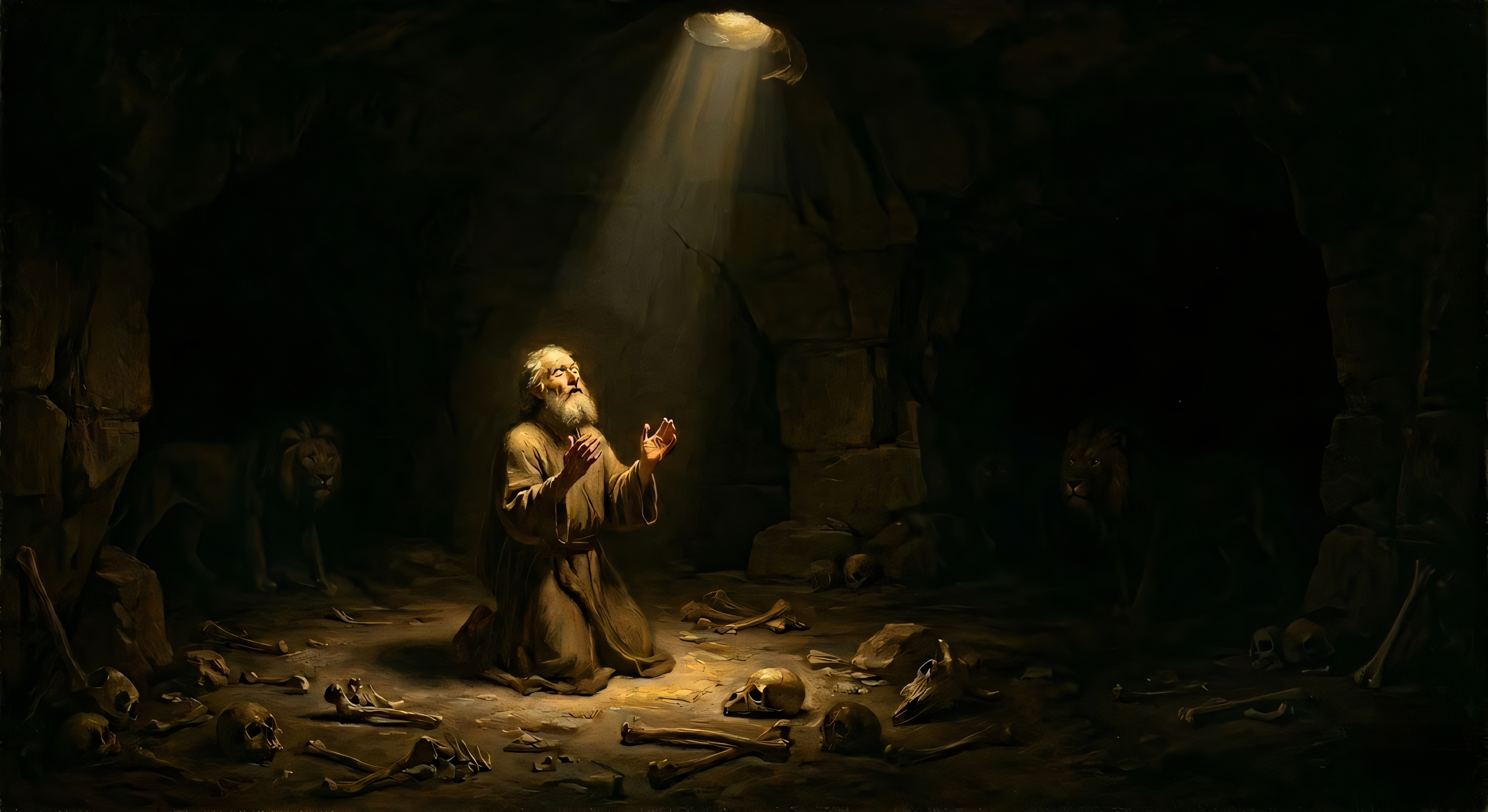
Azariah is the Hebrew name of Abednego, one of the three young men. From inside the furnace, surrounded by flames that are killing the soldiers outside (v. 22-23), Azariah opens his mouth and prays.
This is not a prayer for deliverance. Not at first. It’s a prayer of confession. And its theology is stunning.
The Opening: Praise in the Fire (vv. 26-27)
The prayer opens not with a cry for help but with worship:
“Blessed are you, O Lord, God of our ancestors, and praiseworthy and glorified is your name forever! For you are just in all you have done for us, and all your works are genuine and your ways right, and all your judgments are genuine” (vv. 26-27, OG).
Theodotion is nearly identical:
“Blessed are you, O Lord, God of our ancestors, and praiseworthy and glorified is your name forever! For you are just in all you have done, and all your works are genuine, and right are your ways, and all your judgments are truth.”
The first words out of Azariah’s mouth, in a furnace, surrounded by fire, are: You are just. Not “Save us.” Not “Why is this happening?” But “You are right in everything You have done.”
This is the theology of the furnace. Before asking for rescue, Azariah acknowledges that God’s judgments are right. Even the exile. Even the suffering. Even the furnace itself, in some sense, is within the scope of God’s just dealings with His people.
The Confession: We Deserved This (vv. 28-33)
From praise, Azariah moves to confession, and it is unflinching:
“And you have executed true judgments in all you have brought upon us and upon Ierousalem, your holy city of our ancestors, because in truth and judgment you have done all these things because of our sins. For we have sinned in everything and broken your law in turning away from you, and in all matters we have sinned grievously” (vv. 28-29, OG).
Notice the scope: “all you have brought upon us.” That includes the destruction of Jerusalem. That includes the exile. That includes the fact that three young men who faithfully refused to bow to an idol are now standing in a furnace because of a chain of events that began with Israel’s national sin.
Azariah isn’t blaming Nebuchadnezzar. He’s acknowledging that God’s people brought the exile upon themselves through disobedience, and everything that has followed, including this furnace, is downstream of that original unfaithfulness.
Then comes a verse that takes your breath away:
“And you have handed us over into the power of our enemies, lawless and hateful rebels, and to an unjust king, the most wicked in the world” (v. 32, OG).
Theodotion is essentially the same:
“And you have handed us over into the power of enemies, lawless hateful rebels, and to an unjust king and the most wicked in the world.”
Think about where Azariah is standing when he says this. He’s in Nebuchadnezzar’s furnace. The king who is “the most wicked in the world” is right outside, watching. And Azariah simultaneously acknowledges two truths: Nebuchadnezzar is wicked, and God is just in handing Israel over to him. Both things are true at once. The king is a monster, and God is sovereign. The punishment is unjust from the human perspective, and just from the divine one.
This is the kind of theological tension that most people can’t hold. We want either to blame God or to excuse the oppressor. Azariah does neither. He calls Nebuchadnezzar the worst king in the world and calls God righteous for allowing his rule. That’s the complexity of biblical faith: God can use wicked instruments to accomplish just purposes.
The Crisis: No Temple, No Sacrifice (vv. 37-38)
The prayer now reaches its most theologically significant moment. Azariah acknowledges the devastating reality of exile: there is no temple, no priesthood, no sacrificial system available to them.
“For we, O Master, have become fewer than any other nation and are brought low this day in all the earth because of our sins. And in this time there is no ruler and prophet and leader, no whole burnt offering or sacrifice or oblation or incense, no place to make an offering before you and to find mercy” (vv. 37-38, OG).
Both traditions agree almost word for word on this passage.
This is the crisis of exile distilled into two verses. Everything that connected Israel to God through the Mosaic system is gone. No temple. No altar. No sacrifice. No priest. No prophet. No leader. They have nothing to bring before God. By every measure of the old covenant system, they have no access to mercy.
And into that void, Azariah makes one of the most profound theological moves in the Old Testament:
The Breakthrough: A Broken Heart as Sacrifice (vv. 39-40)
“But rather with a broken life and a humbled spirit may we be accepted, as though it were with whole burnt offering of rams and bulls and with tens of thousands of fat lambs; thus let our sacrifice come before you today” (vv. 39-40, OG).
Theodotion is again virtually identical:
“But rather with a broken life and a spirit of humiliation may we be accepted, as though it were with whole burnt offering of rams and bulls and as though with tens of thousands of fat lambs; thus let our sacrifice come before you today.”
Let’s call this what it is: revolutionary.
In the absence of the temple system, a broken and contrite heart becomes the sacrifice. Azariah isn’t just making a philosophical statement. He’s making an offering. Standing in a furnace, stripped of every external religious resource, he offers the only thing he has left: himself. His broken life. His humbled spirit. And he asks God to accept it as though it were the most lavish sacrifice the temple ever saw.
This is the theology of Psalm 51:17 enacted in narrative form: “The sacrifices of God are a broken spirit; a broken and contrite heart, O God, you will not despise.” It’s the theology of Hosea 6:6: “For I desire mercy and not sacrifice.” And it anticipates Paul’s appeal in Romans 12:1: “Present your bodies as a living sacrifice, holy and acceptable to God, which is your spiritual worship.”
The three young men aren’t just surviving the fire. They’re offering themselves in the fire. The furnace, designed to destroy them, becomes the altar on which they lay their lives before God. Nebuchadnezzar built the furnace to demonstrate his power. Azariah transforms it into a place of worship.
That’s what faith does. It takes the instruments of destruction and turns them into altars.
The Closing Appeal (vv. 41-45)
The prayer closes with a series of petitions:
“Do not put us to shame, but deal with us in your fairness and in your abundant mercy. And deliver us in accordance with your marvelous works, and bring glory to your name, O Lord. And may all who display evil to your slaves also be put to shame, and may they be disgraced by all dominance and their strength be broken.” (vv. 42-44, OG).
And one final line that sets up everything that follows:
“Let them know that you alone are the Lord and glorious over the whole world” (v. 45, OG).
Theodotion adds “God” to the title: “Let them know that you alone are the Lord God.” But both versions express the same prayer: let them (the Babylonians, the pagans, the powers of the world) know that there is no God beside You.
The prayer isn’t just for Israel’s deliverance. It’s for God’s glory among the nations. And that glory is about to be demonstrated in spectacular fashion.
The Prose Interlude (vv. 46-51)
Between the prayer and the song, a brief narrative section describes what happens next:
“And when they cast the three in all at once into the furnace, the furnace was red hot, sevenfold in its heat. And when they threw them in, those who threw them in were over them, and those below them kept on stoking from underneath with naphtha and pitch and tow and brushwood. And the flame poured out above the furnace forty-nine cubits and flared out and burned those of the Chaldeans who were caught near the furnace” (vv. 46-48, OG).
The fire is so intense it kills the Babylonian soldiers even outside the furnace. Forty-nine cubits (roughly 73-85 feet, depending on the exact cubit measurement) of flame pour out above the structure. The detail about naphtha, pitch, tow, and brushwood tells us this isn’t just a wood fire; it’s been accelerated with every flammable substance available.
And then:
“But an angel of the Lord came down into the furnace to be with Azarias and his companions and shook the flame of the fire out of the furnace and made the inside of the furnace as if a moist breeze were whistling through. And the fire did not touch them at all and caused them no pain or distress” (vv. 49-50, OG).
Theodotion is once again nearly identical:
“But the angel of the Lord came down into the furnace to be with Azarias and his companions and shook the flame of the fire out of the furnace and made the inside of the furnace as though a moist breeze were whistling through.”
The angel doesn’t extinguish the fire. He redirects it. The flames still rage outside, still killing Babylonian soldiers. But inside the furnace, it’s like a cool breeze on a summer day. The same fire that destroys the executioners refreshes the faithful.
That’s a metaphor worth sitting with. The same circumstance that destroys one person can sustain another. The difference isn’t the circumstance. It’s the presence of the angel. It’s the presence of God.
The Song of the Three Young Men (vv. 52-90)
Once the young men are refreshed by the angel, they sing. And what pours out of them is one of the most magnificent hymns in all of ancient literature.
“Now, the three resuming, as though from one mouth, were singing hymns and glorifying and blessing and exalting God in the furnace” (v. 51, OG).
“As though from one mouth.” Three voices, one song. Three men in a furnace, singing in unison. The image is of complete harmony, complete unity in worship, even in the most extreme circumstances imaginable.
The Opening: Direct Praise (vv. 52-56)
The Song opens with direct praise of God, moving from His name to His temple to His throne to the heavens:
“Blessed are you, O Lord, God of our ancestors, and to be praised and highly exalted forever. And blessed is your glorious holy name, and to be highly praised and highly exalted forever and ever” (v. 52, OG).
Then, interestingly, a verse that only exists in Theodotion:
“Blessed art thou in the temple of thy holy glory: and to be praised and glorified above all for ever.” (v. 53).
Next is:
“Blessed are you upon the throne of your kingdom, and to be greatly hymned and highly glorified forever. Blessed are you who view the depths sitting upon cheroubin, and to be praised and glorified forever.” (v. 54-55, OG).
But Theodotion reverses the order of vv. 54-55, placing the “depths and cherubim” blessing before the throne blessing. This is one of several places where the internal arrangement of the Song differs between the two Greek traditions, a reminder that this hymn was transmitted with some fluidity.
“Blessed are you in the firmament, and to be hymned and glorified forever” (v. 56, OG).
The movement is upward: from God’s name, to His temple, to His throne, to the firmament itself. The praise ascends, as well it should, from man upward.
The Creation Litany (vv. 57-81)
Then the Song turns outward and calls on all of creation to join:
“Bless the Lord, all you works of the Lord; sing hymns, and highly exalt him forever” (v. 57, OG).
What follows is a sweeping litany that moves through the entire created order. Angels (v. 58). Heavens (v. 59). Waters above the heavens (v. 60). Powers (v. 61). Sun and moon (v.62). All the stars of heaven (v. 63). Rain and dew (v. 64). Winds (v. 65). Fire and heat (v. 66). Chill and winter cold (v. 67). Dews and falling snow (v. 68). Ice and cold (v. 69). Snows and hoarfrost (v. 70). Nights and days (v. 71). Darkness and light (v. 72). Lightnings and clouds (v. 73). The earth (v. 74). Mountains and hills (v. 75). All that grows in the ground (v. 76). Rain storms and springs (v. 77). Seas and rivers (v. 78). Sea-monsters and all that move in the waters (v. 79). The birds of the air (v. 80). Four-footed and wild animals of the land (v. 81).
Whew. That’s a lot.
And through it all, this one refrain rings out again and again: “Bless the Lord; sing hymns, and highly exalt him forever.”
The structure echoes Psalm 148 and anticipates the Benedicite, a canticle that has been used in Christian morning prayer for nearly two thousand years. The Eastern Orthodox, Catholic, and Anglican traditions all draw on this hymn in their liturgies. If you’ve ever attended a liturgical morning prayer service, you’ve heard the Song of the Three Young Men, even if you didn’t know where it came from.
The theological vision is breathtaking: from inside a furnace, three men call on the entire cosmos to worship. They don’t just praise God themselves; they summon every element of creation to join them. The fire that surrounds them is itself called to bless the Lord (v. 66): “Bless the Lord, fire and heat; sing hymns, and highly exalt him forever.” Even the flames of the furnace are part of God’s creation and owe Him praise.
There’s something almost defiant about calling on fire to bless God while standing inside a furnace. The fire that was meant to destroy them is, in their hymn, one more voice in the cosmic chorus. Nebuchadnezzar intended the fire as a demonstration of his power. The three young men conscript it as a participant in worship. The king’s instrument of death becomes another creature singing hymns to the Creator.
The litany also includes several verses where the OG and Theodotion arrange the elements in a different order. Verses 69-72 in the OG list ice and cold, then snows and hoarfrosts, then nights and days, then darkness and light. Theodotion lists nights and days, then light and darkness, then ice and cold, then hoarfrosts and snows. The rearrangement doesn’t change the content, but it reminds us that even within the Greek tradition, the Song was transmitted as a living hymn, with performers and communities adapting the sequence to their liturgical practice.
The Climax: Israel, Priests, and the Holy (vv. 82-88)
The Song narrows from creation to humanity, then to Israel, then to the priesthood, and finally to the three young men themselves:
“Bless the Lord, all humans on earth; sing hymns, and highly exalt him forever. Bless the Lord, O Israel; sing hymns, and highly exalt him forever. Bless the Lord, you priests, slaves of the Lord; sing hymns, and highly exalt him forever” (vv. 82-84, OG).
Theodotion inserts an additional verse between priests and the righteous: “Bless the Lord, you slaves; sing hymns, and highly exalt him forever” (v. 85, Theodotion), separating the priestly office from the general category of God’s servants.
From the wording, there’s certainly an argument to be made for the two traditions approaching “slaves” from very different perspectives though. While Theodotion merely says “slaves,” the OG specifically says “slaves of the Lord.” And if that phrase doesn’t sound familiar, it should. That’s a phrase used frequently in the New Testament by Paul and others. It denotes one who serves the Lord as though a slave.
Theodotion, in contrast, omits “of the Lord,” which does change the connotation just a bit, suggesting this could be referring to slaves or servants of any stripe.
However, making this contrast much more interesting is the Greek words being used. In the Old Greek, we have the Greek word douloi, from doulos, which is explicitly a term of absolute ownership that denotes one’s will being entirely subsumed to a master. This denotes God’s absolute ownership and authority.
While Thodotion chose a much softer word. Paides has a deep semantic range, covering a simple meaning of children or youths, but can also mean servant or attendant and carries the sense of a close familial bond or household closeness. This tends to suggest a note of vulnerability and an intimate relationship.
After this we come to:
“Bless the Lord, spirits and righteous souls” (v. 86).
And:
“Bless the Lord, you who are holy and humble in heart” (v. 87).
And finally, they name themselves:
“Bless the Lord, Hananias, Azarias, Misael; sing hymns, and highly exalt him forever” (v. 88).
They use their Hebrew names, their real names, not the Babylonian names Nebuchadnezzar gave them. In the furnace, the Babylonian identities melt away. They are who they have always been: Hananiah, Azariah, Mishael. Children of the covenant. Sons of Israel. And they call on themselves, by name, to bless the Lord.
The Conclusion of the Song (vv. 88b-90)
“For he has rescued us from Hades and saved us from the hand of death and delivered us from the midst of the burning flame and released us from the fire” (v. 88b, OG).
The power in this single line cannot be overstated. Every Christian child knows about the King’s response when he sees the men unharmed. But this view of the words spoken by the three young men after being delivered from this fiery death is so much more personal.
“Acknowledge the Lord, for he is kind, for his mercy is forever. All who worship the Lord, bless the God of gods; sing hymns, and acknowledge him, for his mercy is forever and ever and ever” (vv. 89-90, OG).
The Theodotion’s ending is slightly different: “for his mercy is forever” (not “forever and ever and ever”). The OG piles on the eternities, stretching the praise into infinity.
So powerful.
And that is the God we serve, friends. He is kind, and His mercy is forever.
Back to the Narrative: What the King Heard
Now the Song ends, and the narrative resumes. And here’s the detail that shows how perfectly the additions are integrated into the Greek text:
Daniel 3:91 (OG/N.E.T.S.):
“And it happened that when the king heard them singing hymns and when he stood, he saw them alive. Then Nabouchodonosor the king was astonished.”
Daniel 3:91 (Theodotion/Brenton):
“And Nabuchodonosor heard them singing praises; and he wondered, and rose up in haste.”
The king hears them singing before he sees them alive. The Song of the Three Young Men isn’t just a liturgical insertion. It’s the narrative mechanism that alerts the king to the miracle. He hears worship coming from inside a furnace that should contain nothing but ash and silence. And that’s what makes him look.
The miracle of worship leads to the discovery of the miracle of preservation.
Daniel 3:91-92 (vv. 24-25 MT) — The Fourth Figure
Daniel 3:24-25 (NKJV):
“Then King Nebuchadnezzar was astonished; and he rose in haste and spoke, saying to his counselors, ‘Did we not cast three men bound into the midst of the fire?’ They answered and said to the king, ‘True, O king.’ ‘Look!’ he answered, ‘I see four men loose, walking in the midst of the fire; and they are not hurt, and the form of the fourth is like the Son of God.’”
This is one of the most beloved verses in the book. The key phrase is the Aramaic בַּר־אֱלָהִין (bar elahin). Let’s look at how our three traditions handle it.
The Masoretic Text reads “a son of the gods” or “a son of God.” The Aramaic אֱלָהִין (elahin) is grammatically plural and could mean either “gods” (polytheistic) or “God” (as a plural of majesty, like the Hebrew Elohim). In the mouth of a pagan king, “a son of the gods” is the more natural reading.
Theodotion (as rendered by Brenton) translates this as “the form of the fourth is like the Son of God,” which has led centuries of Christians to read this as a Christophany, a pre-incarnate appearance of Christ. The capitalization is a translator’s interpretive choice, but the tradition of reading Christ into this passage goes back to the earliest church fathers.
The Old Greek, on the other hand, takes a different approach entirely:
Daniel 3:92 (OG/N.E.T.S.):
“Lo, I see four men unbound and walking in the fire, and no ruin has come to them, and the appearance of the fourth is the likeness of a divine angel.“
The OG doesn’t use “son of the gods” or “Son of God” at all. Instead, it renders the phrase as “the likeness of a divine angel.” This is consistent with the OG’s pattern throughout Daniel of replacing polytheistic language with monotheistic alternatives, the same instinct that turned “the gods” into “some angel” in chapter 2:11.
Here’s what makes this a genuine both/and moment. Nebuchadnezzar speaks from his pagan worldview: “a son of the gods.” The OG translator interprets through Jewish monotheistic eyes: “a divine angel.” Christian readers, from the earliest centuries, have seen Christ Himself walking in the fire with His people.
And notice that Nebuchadnezzar himself revises his description just a few verses later. In verse 28 (Masoretic)/95 (Greek), he says God “sent his angel.” Even the pagan king adjusts his interpretation. All three readings are instructive: the raw pagan reaction, the Jewish theological interpretation, and the Christian Christological reading.
Daniel 3:95-97 (vv. 28-30 MT) — Coming Out of the Fire
The three men emerge without a trace of what they’ve been through.
“The fire had not had any power over the bodies of those men; the hair of their heads was not singed, their tunics were not harmed, and not even the smell of fire came on them” (v. 27, NRSVUE).
Not even the smell of fire. The only thing the fire burned was their bonds. They went in bound; they came out free. The fire destroyed what held them captive and touched nothing else.
Now look at Nebuchadnezzar’s confession:
Daniel 3:95 (Theodotion/Brenton):
“Blessed be the God of Sedrach, Misach, and Abdenago, who has sent his angel, and delivered his servants, because they trusted in him; and they have changed the king’s word, and delivered their bodies to be burnt, that they might not serve nor worship any god, except their own God.”
Daniel 3:95 (OG/N.E.T.S.):
“Blessed be the Lord, the God of Sedrach, Misach, Abdenago, who has sent his angel and saved his servants who hope in him; for they disregarded the king’s order and yielded up their body for burning in order that they might not serve or do obeisance to another god except to their God.“
The OG adds “the Lord” before “the God,” maintaining its consistent covenantal language. Both versions agree on the key point: the king acknowledges that these men would rather die than worship any god other than their own.
Nebuchadnezzar then issues a protective decree. The OG says
“whoever blasphemes the Lord, God of Sedrach, Misach, Abdenago will be dismembered... because there is no other god who is able to deliver in this way“ (v. 96).
This is a significant step beyond chapter 2’s confession (”your God is God of gods”). Now:
“there is no other god who can deliver like this.”
The trajectory toward full monotheistic confession, which the OG’s chapter 4 will complete with “God is one,” is building.
The OG also says the king “gave authority to Sedrach, Misach, Abdenago over his whole region” and “appointed them rulers” (v. 97). Theodotion says the king “promoted” them and “gave them authority to rule over all the Jews who were in his kingdom.” The OG gives them authority over everyone; the Theodotion limits their authority to the Jewish community.
If you’ve found this work insightful or enlightening, share it with a friend who needs to hear the liturgical power of these additional verses.
Reflections: Worship in the Fire
I keep coming back to the Song. Even though almost no one in Western Christianity has even heard of it, I can’t get past the picture it paints.
The furnace becomes a place of worship. Not a place of merely surviving. Not a place of gritting your teeth and waiting for deliverance. A place of praise.
The three young men don’t just endure the fire. They sing in it. They call on every element of creation, from the highest heavens to the deepest seas, to join them in praising God. They worship in the very instrument designed to destroy them. They call the fire itself to bless the Lord.
And here’s the detail that makes the Greek traditions so powerful: the king hears them singing. The worship is what alerts him to the miracle. If the three men had sat in silence, enduring stoically, Nebuchadnezzar might not have looked when he did. But they sang. And the singing drew his attention. And when he looked, he saw four figures where he expected three.
Worship in the furnace isn’t just an act of personal faith. It’s a witness. It’s the sound that makes the world look up and see God.
I think there’s a reason ancient communities felt this story needed the Song. The Masoretic Text gives us the miracle from the outside: the king sees four figures, the men emerge unharmed. But the Song gives us the miracle from the inside: what does it look like when people of faith are in the fire and choose to worship anyway?
The answer the Song gives is breathtaking. It looks like all of creation joining in. When God’s people worship in the fire, they aren’t alone. Heaven and earth respond. The cosmos sings with them.
That’s the image I want to leave you with. Not just the miracle of deliverance (though that’s glorious), but the miracle of worship in the furnace. The “but if not” faith that says: even if God doesn’t deliver me, I will still praise Him. Even in the fire. Especially in the fire.
Because someone else is always walking in the furnace with you. Whether you call Him an angel, a son of the gods, or the Son of God, He is there. And His presence transforms the furnace from a place of death into a cathedral of praise.
One final thing I want to mention. If this brief discussion of the identity of the fourth man in the fire just whetted your appetite for that discussion, then I have a treat for you. A few months back I wrote a whole discussion of that very topic. You can check that out HERE if it interests you.
Coming Up Next
Next week, we enter Daniel 4, and the textual fireworks truly begin. This is where the Old Greek diverges dramatically from the Masoretic Text and Theodotion, giving us what is essentially a different telling of Nebuchadnezzar’s madness and restoration. You will not want to miss it.
The LXX Scrolls is free to read and always will be. If this work has been worth something to you, there are a few ways to say so:
Buy the ebooks. Completed teaching series are available as polished ebooks under the Two Witnesses, One Truth series. Buying through Curios will support this work most directly but they’re also available on Amazon (and elsewhere) if you’re loyal to a particular ereader.
Become a supporter. A monthly or annual pledge through Substack helps me to bring the Septuagint to those who never knew they needed it.
Send a one-time tip. If this post has blessed you and you want to express that directly, you can Buy Me a Coffee.

Thank you for being part of this journey, your support makes this work possible.
© 2026 LXX Scrolls. All rights reserved.
These are magnificent. When I first read them years ago, I read them as prayers separate from the context in the Apocrypha included in the Oxford NRSV. They are even more beautiful and meaningful when inserted into Daniel. I will definitely keep an eye out for the book!
This is awesome, is there a way to get all the parts so I can print them out please🙏🏻